Kanenaga
-
Posts
299 -
Joined
-
Last visited
Content Type
Profiles
Forums
Events
Store
Downloads
Gallery
Everything posted by Kanenaga
-
Many thanks.
-
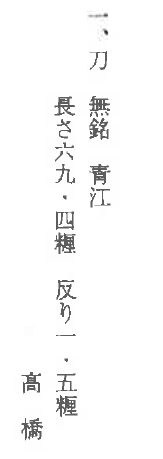
Colleagues, Attached is a listing from the NBTHK Juyo shinsa results. I can read one katana, mumei, Aoe. Can someone translate the rest? Thanks. Always grateful for this Board. Les
-
Many thanks, Wim. My rough count is more than 150 blades, more than 50 kodogu. Seems like quite a lot!
-
Does someone have the list of blades?
-
What a wonderful insight! There is nothing to compare. Thank you all!
-
So, as I feared, the feedback has gone from being a useful metric for both buyers and sellers, it has now been watered down to a useless indicator of nothing. Pity.
-
I haven't looked at eBay for a while, and I'm surprised to find that most sellers today seem to have 100% positive feedback. In the old days (3-4 years ago) feedback seemed real -- you had gripes and complaints right out there on the table, and 100% positive was a rare find. I can't quite believe that sellers have become more honorable. Have eBay feedback policies changed? What has happened?
-
The Japanese Sword Is Art? The Japanese Sword Is Art.
Kanenaga replied to a topic in General Nihonto Related Discussion
I have been waiting for this discussion to make the distinction between "fine art," which usually relates in some way to the human condition; and "applied art" aka "industrial art," which IMHO is what nihonto are. Art pottery is another example. Here's the Wikipedia definition: The applied arts are the application of design and decoration to everyday objects to make them aesthetically pleasing. Couldn't have said it better myself. -
We've all seen inazuma and kinsuji, they don't generally look like this. I prefer Andi and Ray's interpretation, that these are patches of shingane, but I'm surprised that a smith -- especially a notable one like Sokan -- would release/sell a blade with such flaws. Perhaps it had a very thin kawagane that came away with the first polish?
-
I'm having trouble copying the image from the website and putting red circles around the areas of concern. But if you look at the magnified image of the blade I don't see how you can miss these irregular oval bright whirlpools. There are two right at the machi, different sizes, one on each side.
-
Can someone tell me what these whirlpool-y structures are? Look like mokume, but ... https://www.aoijapan.com/katana-tairyusai-sokankeiou-2-nen-3-gatsu-kichijistumarch-1866
-
No smith signature will be done like that on the blade. http://www.nihonto.com/3-9-18/
-
I'm moving my question to a new topic in order not to hijack the previous thread about this blade: http://www.nihonto.com/05-07-18/ This is a Juyo sword with hi that must be ato-bori (i.e., added later), but the Juyo paper does not mention this. I guess it's a matter of personal preference, but I prefer blades, even old ones, that are as close as possible to how they were originally made. We speak about the "health" of a blade, meaning how little aging change it shows, as a positive attribute. Deliberate changes such as suriage diminish the merits of the sword, and for me decorations added later do the same, even if tastefully done. At least it should be mentioned, although in this case perhaps it was considered "obvious." I wonder how others feel? Les
-
Lottery Ticket Time - Ichimonji
Kanenaga replied to Vermithrax16's topic in Auctions and Online Sales or Sellers
Question to the group: It seems to me that the hi on this o-suriage blade must be ato-bori, but the Juyo paper doesn't comment. Am I misreading something, or is this something that's ok to overlook? Les -
I was taught that "fatal" means it cannot pass NBTHK shinsa, and the value is reduced to 10% of the original price.
-
Rai/ Niji Kunitoshi Question
Kanenaga replied to Ilovekatana's topic in General Nihonto Related Discussion
The trend today is to consider these to be the same person. https://yuhindo.com/ha/topics/traditions/ https://yuhindo.com/rai-kunitoshi-4/ -
I tend to agree with Peter. Ray's illustrations are clearly chikei, but these Hosho lines seem different -- broader and more "organized." Layering of different steels seems a good possibility. When Norishige did this sort of thing it's called matsukawa. I thought perhaps these Hosho things might also have a name.
-
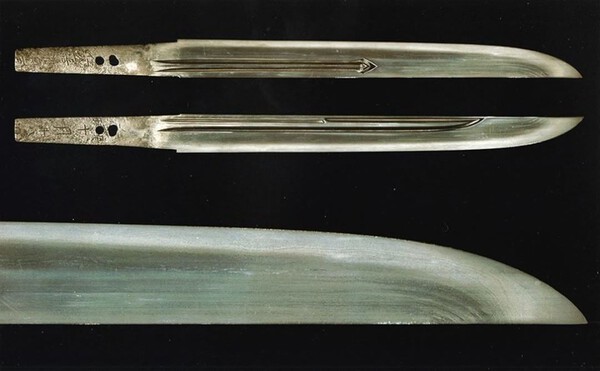
Older Yamato Hosho blades from the Kamakura period often show prominent longitudinal bands of light and dark steel which more-or-less follow the masame grain. There seems to be not much written about these. Does anyone know what these are called? Shown is the Kurayama Hosho, a national treasure tanto.
-
Someone told me that Yoshikawa Koen sensei, the respected former head of the NTHK, was quoted as saying, in effect "If you want to collect sue-koto swords, you must be willing to accept some ware." So d___ the naysayers! This is an ubu, one-hole, signed and dated, tokubetsu hozon, koto katana from a respected group of makers. So it has a (definitely non-fatal) flaw -- big deal. A single forging flaw does not make it low quality. Enjoy it, study it, and don't mess with it. The last polisher already did what could be done.
-
In the heat of the moment, a word of caution may be in order. Not sure how it works in the EU or in SA, but over here I believe that someone who organizes an economic boycott of a business may be liable for restraint of trade, which is grounds for legal penalties. Les
-
So where's the paper for the tsuba? Les
-
Only one face on the reverse.. That's a brow ridge.
-
The most notable aspect of Yoshiaki's work that I've seen has been the utsuri. Smiths have been trying to recreate utsuri for centuries, and a few have had some modest success, notably Naotane and Sokan, but Yoshiaki was able to make dramatic utsuri which rivals the natural utsuri of early Bizen and Bitchu blades. Another swordsmithing secret lost.
-
Wonderful article! Required reading for collectors' wives??
-
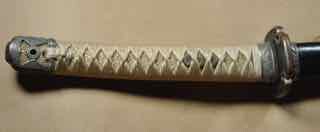
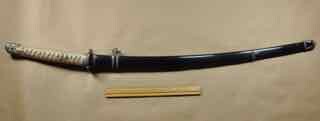
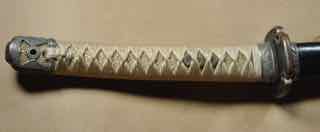
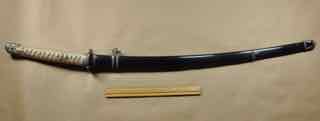
Not sure if this belongs here since I'm not a gunto collector, but here's something that snuck in many years ago among the koto stuff. It's been "tarted up" a bit, either during the war or after, I suppose. The ito has been re-wrapped, the fittings all silver-plated, the saya repainted or re-laquered, and the tsuba replaced with a civilian one. I was told it once held a Yasukuni-to, long gone.