Kanenaga
-
Posts
314 -
Joined
-
Last visited
Content Type
Profiles
Forums
Events
Store
Downloads
Gallery
Everything posted by Kanenaga
-
The tagane-mei suggests perhaps Kamiyoshi work, but I've forgotten whose combination this is (2/3).
-
Are we to think this is the original shape?
-
This discussion is about art. Can we prevent it from degenerating into yet another pointless argument about AI? It's true that swords are no longer useful (except in martial arts training) but that does not, IMHO, make them any less utilitarian. They can certainly be beautiful, but beauty is not a synonym for art. A lot of art is not beautiful, but is meaningful -- which swords are not. I guess for some this is not an easy distinction.
-
Perhaps others have seen it before, but I just came across this YouTube video of an interview with Iida Yoshio san, current owner of the Iida Koendo sword shop in Tokyo. The shop deals mainly in high-level items, has been a family enterprise for several generations. The video is in Japanese with good subtitles, and gives some dealer perspective on the sword business, including a discussion on what defines a masterpiece -- linking to a thread on this forum last year: I have spoken with Iida san on several occasions at DTI. He is a thoughtful person who understands and speaks good English, and who has been open to interacting with foreigners who demonstrate some knowledge of swords and sword etiquette. I found his views worth listening to.
-
IMO nihonto are not fine art, which concerns itself mainly with the human condition. Nihonto are examples of applied art, aka industrial art. Here's how AI makes the distinction: Feature Fine Art Applied Art Primary Purpose To be observed, stimulate the intellect, and evoke emotion. To serve a practical function or commercial need. Use Exclusively for visual enjoyment; non-functional. Has a specific use Common Mediums Painting, sculpture, drawing, printmaking, and fine art photography. Graphic design, fashion design, industrial design, interior design, and ceramics. Creation Process Typically self-directed; dictated entirely by the artist's own vision. Often client-driven; heavily constrained by budget, and mass production.
-
samurai shokai (サムライ商会)
Kanenaga replied to swordnoob's topic in Auctions and Online Sales or Sellers
Erik, it would be very helpful if you could share some details of your very negative experience. I am/was on the verge of making an offer to this seller (surname Masuda) but the mixed reviews on this old thread are making me xtra cautious. If anyone else can share recent interactions that would be much appreciated. -
Thanks, Dale. Nice examples.
-
Dreaming of Japan...
Kanenaga replied to MassiveMoonHeh's topic in General Nihonto Related Discussion
Atsu Toshiro, I think. Named for the celebrated maker, Toshiro Yoshimitsu. -
Here's a Kaneie style tsuba with an unusual religious theme. It appears to show a saint or bodhisattva, perhaps kannon, duking it out with a pair of oni. Is there a recognizable story here? For all kannon's popularity as a religious icon, it's rare to encounter her/him on fittings. Are there other examples out there?
-
Nihonto Displays in Japan
Kanenaga replied to Kanenaga's topic in General Nihonto Related Discussion
Hi Jussi, That will depend on what's to see, like special exhibitions. Nagoya is high on the list, then maybe a bit northward. -
Hi all, I'm thinking about visiting Japan later this year, not connected to DTI. Can anyone tell me if there are any scheduled displays of swords and/or fittings that would be worth seeing? In addition, that is, to things that are always on display, like the items at the TNM. All recommendations will be appreciated.
-
https://www.bonhams.com/auction/32178/arts-of-the-samurai/?page=2 This is taking place this month, 51 swords, some tsuba. Does anyone know whose collection this is/was?

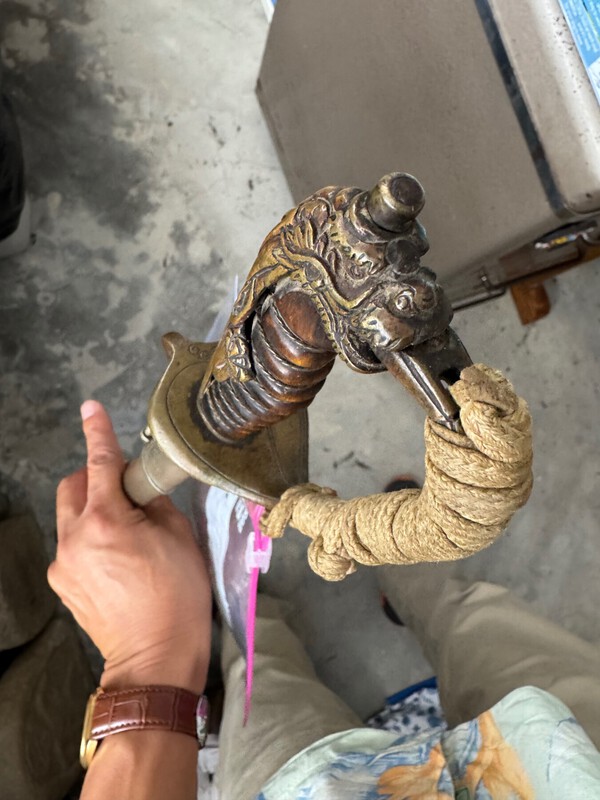
-
I think I am noticing a trend among some Japanese nihonto websites to no longer display the asking prices for some items. Is this perhaps an unintended consequence of NihontoWatch?
-
It's hard to tell from photos, but this could be a good sword in somewhat rough condition. Best to take good care of it until it can be evaluated in hand by a Japanese-trained polisher or someone comparable.
-
I came upon this auction by accident. Some tsuba, other kodogu, inro, etc. https://www.bonhams.com/auction/31871/fine-Japanese-and-korean-art/
-
- 1
-

-
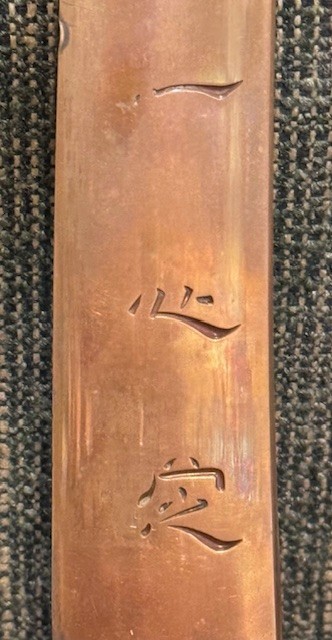
Late, but as requested, here's that whole copper tsunagi. The "nagasa" is 13.5 inches, so o-tanto or ko-wakizashi.


-
I think Steve wrote muneami.
-
Apologies, Curran and everyone, I did not mean to mislead. It's the same copper tsunagi. I suspect it's a copper alloy because there is none of the usual copper oxidation. The color in the photos is pretty close to the real thing. The previous post was about kanji on the blade portion, and I got some very helpful info from Jan. This now is about the nakago portion, and thanks to SteveM for the translation, which seems to make sense even though it is not in the "standard" form of a mei on a sword. Regrettable that there's no Natsuo, Ikkin, Yasuchika, etc, Ian. I have no idea what the original blade was, or if there was one. The shape of the tsunagi (hira-zukuri with sori) suggests to me not earlier than Nanbokucho. I'll post a photo when I return from travel. Les
-
This is the nakago of a copper tsunagi in a wakizashi koshirae. It doesn't look to me like a normal mei. I'd appreciate some translation help.


-
Thank you, Jan.
-
Some assistance please. This is a tsunagi to a wakizashi koshirae. It's made of copper or some copper alloy, with these kanji engraved. Auspicious incantations, perhaps? Les

-
Can we know more about the Ko-Aoe Koretomo? I have a particular interest in this smith. Les
-
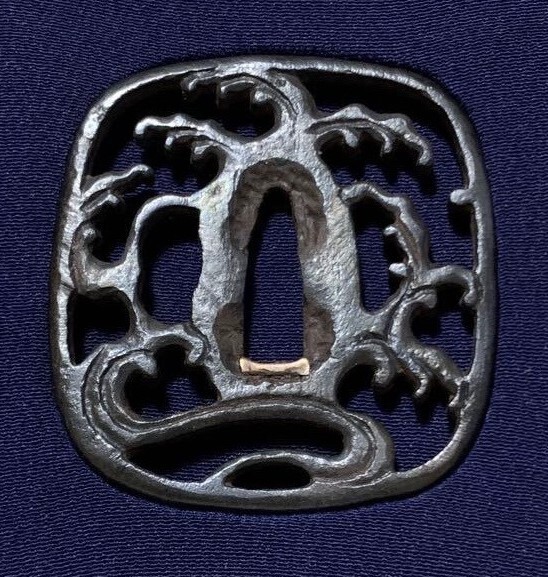
Rather than hijack another discussion, I borrowed this partial photo from another thread just for illustration. And please dismiss me if this has been discussed before. It's about the double cutouts around the nakago-ana in this tsuba, which create a "figure 8" shaped cavity. I see this from time to time, most often on Owari-sukashi tsuba but occasionally also on other iron sukashi tsuba, always on one side only. It's not clear to me that these chiselings alter the dimensions of the nakago opening itself. Does anyone know what these are for?
-
Shinogi-zukuri
-
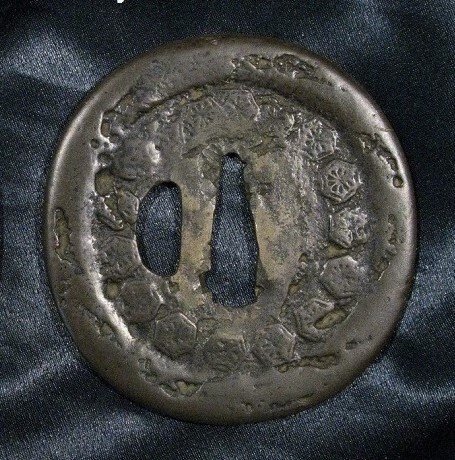
Here's another with features similar to my new one: thin plate with blurry hi-relief images, and the distinctive worm-eaten rim (borrowed from a website for educational purpose). Are we to think these were made by the same craftsmen who made Curran's? Seems unlikely, they are so different. Are these older or younger? Copyright Elliott Long