Kanenaga
-
Posts
319 -
Joined
-
Last visited
Content Type
Profiles
Forums
Events
Store
Downloads
Gallery
Everything posted by Kanenaga
-
Please excuse my ignorance, but what exactly is a kiridashi?
-
Art of the Samurai for download
Kanenaga replied to R_P's topic in General Nihonto Related Discussion
IMHO this was the greatest exhibition of nihonto ever, with more than 20 national treasures (kokuho) on display, and many "lesser" items. The Atsu Toshiro and the Nakigitsune were there, two of my all-time favorites. Those who were fortunate enough to see this in person will not soon forget the experience. Some friends and I were treated to a tour by Ogawa sensei -- lucky us. Thank you, Rayhan, for this and for the other great items you have shared. -
One more by Naruki Issei.

-
Collectors of Shimizu Jingo tsuba are familiar with many kinds of weird hitsuana.
-
Kirill, What a wonderful treatise. Right up there with the commentaries of the immortal Darcy. Les
-
Is there a Professional in the US who could be consulted about hi-cutting? It's been my understanding that the swordsmith usually is the one who does this.
-
There's a sword show in Chicago at the end of this month. If you are serious about wanting the best info about your sword, bring it to the show and get appraisals from multiple dealers and experienced collectors. http://www.chicagoswordshow.com/
-
Moriyama san, thanks for the video link. I wish I could understand it.
-
To be clear, we're talking about a shinsakuto. It has horimono but no hi. Regrettably, the maker is no longer living, so I can't ask him. I like the combination of horimono and hi, which I sometimes see (like the 2 below). Also, like many contemporary swords, it's heavy, so hi would lighten it. Just askin' tho.
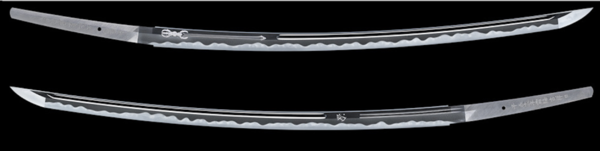
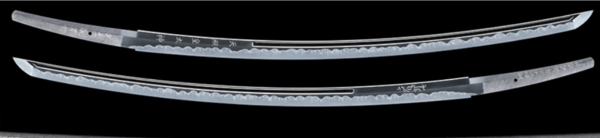
-
I have a katana which does not have hi, but is "crying out" for bohi (or futasujibi). Is it ever reasonable (or feasible) to cut hi into a finished and polished blade? Les
-
Appreciate the suggestions.
-
To clean an oiled blade I sometimes use absolute alcohol, sometimes a microfiber cloth. Neither is very good at getting all the oil out of horimono. Does anyone know a better way to do this? Les
-
Not in my wheelhouse but a very nice package. Good luck with the sale!
-
Likely later.
-
Sukesada, not sadasuke. Large group of swordsmiths working in Bizen tradition during the 16th and 17th centuries, all using the same "art name." Wide range of sword quality. I'd think of asking Brian Tschernega (master craftsman) to take a look at the saya. He will likely be at the Chicago sword show in late April (http://www.chicagoswordshow.com/). Les
-
If like me you find stroke counting tedious, you can try Japanese Art Signatures, by Self and Hirose. Pure pattern-recognition, with special chapters on dates, places, titles, etc.
-
BTW, Lewis, that's not the same katana. Kao/no kao, etc.
-
Kiril, paper or no paper you want to be very careful here. The mei on the katana looks odd, the last three kanji unnecessarily crowded together, and possibly cut with a different chisel (and hand) from the upper part of the mei. Also, $25K is way low for a true Naotane daisho pair of blades, expected retail (based on cruising dealer websites) should be 2-3x. Both swords and papers can be messed with -- we had a recent example here. But I'm no calligraphy expert, so let's see what others think.
-
Your tsuba #1 is a very typical example of this maker's work, both in terms of the plate shape and the characteristic flat-inlay gold decoration of grasses and insects. Instantly recognizable. Regrettably, I can't recall his name, but hopefully one of the tsuba collectors here will. He sometimes signed his full mei, but often just the kao. Dale, where are you?
-
About sword A, from the nakago-jiri and the use of the "mori" kanji (can't make out the other), I suspect this may be a kongobei blade.
-
Member since the AB was formed.
-
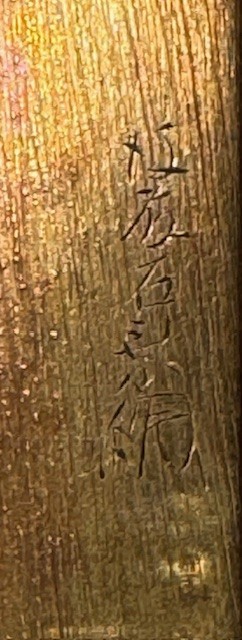
Dear friends, This kozuka came on a tanto koshirae. The mei is cut with a fine chisel, and is not easy to see even with the item in hand, but I finally got a pretty clear photo. Could someone kindly translate for me?
-
Just a quick thanks to the members
Kanenaga replied to Brian's topic in General Nihonto Related Discussion
Speedy recovery Brian. You are not just the owner of this Board, you are its very heart and soul, and we are all very grateful. -
There are several prominent groups of swordsmiths in which the nidai is considered more skilled than the shodai (and priced accordingly): Seki Kanemoto (Magoroku) Kawachi (no) kami Kunisuke (naka-Kawachi) Settsu Tadatsuna (Ikkanshi) Kunisada (Shinkai) Sengo Muramasa So it's not a blanket "shodai was best."
-
Is Ando still in business?
Kanenaga replied to Tom Darling's topic in General Nihonto Related Discussion
Spoke with him and looked at some of his swords at DTI.