


Ken-Hawaii
-
Posts
7,353 -
Joined
-
Last visited
-
Days Won
96
Content Type
Profiles
Forums
Events
Store
Downloads
Gallery
Everything posted by Ken-Hawaii
-
Roger, that depends on the sensei. The vast majority of iaidoka use iaito, which are non-sharpened blades, usually of an aluminum alloy. A very few dojos use shinken, or "live" blades. I've used both for nearly 30 years, & have yet to get cut. It's rally a matter of technique, & then paying attention to what you're doing.
-
Nice package, Chris. From the hada & the nakago alone, I think it's early Edo, at the latest, & possibly older.
-
Mark, you've again managed to ask quite a few questions in a single post. From my limited experience, the cross-section changes as a function of how many times a blade has been polished, as well as which of the nine possible ways to do the forging (kobuse & honsanmai were the most popular). The slimmer a blade's cross-section is, the easier it will cut, but also the more likely it is to bend or break, & the blade will need to be sharpened/polished more often, too. Niku of the boshi is important, but since the actual cutting is done on the monouchi, boshi niku plays less of a role than you might think. Overall blade niku is related to its cross-section. A rather detailed paper was done by a friend of mine, Filomina Salvemini, & I've provided a link to the 1.6 MB file: Salvemini, Filomena - Structural Characterization of Ancient Japanese Swords.pdf
-
Well, that's good news, Piers. What will happen to the blade after the purchase is final? Permanent display?
-
I've seen them both ways, Jean. My sword mentor has one Nanbokucho blade that is utterly straight, but with obvious shinae. Can't really tell on Christian's blade, though.
-
That's a more complicated question than you might realize, Mark. In general, blade thicknesses in all dimensions increased in times of battle. Check out a Nanbukucho blade next to a Kamakura to see how different they look. You can blame the Mongols for scaring the crap out of the Shogunate, because the slim, elegant Japanese swords broke on Mongol armor! The height/thickness of the shinogi, on the other hand, is much more idiosyncratic to particular schools. In general, older Yamato blades have a fairly-thin shinogi, for example.
-
Your blade looks too healthy for the cracks to be shingane, but they are likely small forging flaws (shinae) that don't really detract from it. Oil it carefully (except the nakago, of course), & keep it in the shirasaya when you're not studying it.
-
Her ryuha has many aspects of Katori Shinto-Ryu. The problem that I see is that her waza don't take into account the simple reality that, when you cut or stab an opponent, you can't just wave the blade around afterwards! A tsuki takes time & muscle to pull it out the body, & even a glancing cut slows down the remainder of what you're doing. So, what she's doing looks showy, but doesn't reflect the reality of battodo.
-
Newbie - First Purchase
Ken-Hawaii replied to ScottyT's topic in Auctions and Online Sales or Sellers
Steve hit a very key point. If you put a bare steel blade in a room with any significant humidity, what you'll be admiring is rust! The blade you were looking it is in koshirae, which looks impressive, but was really only used in battle. For all other times, it was stored in a plain wood casing called shirasaya. And most Samurai houses also had specially-made chests called katanadansu (katana tansu) for long-term storage. If you want a blade that you CAN put over your mantel, spend a few hundred dollars on an aluminum iaito, which looks like a Nihonto, but is used in the martial art called iaido. It won't rust, & unless there's an expert visiting, no one will be able to tell the diference, even by picking it up. Welcome to the forum. -
Sharpness of a sword? Auction problem
Ken-Hawaii replied to vajo's topic in General Nihonto Related Discussion
You could have offered to do Kaishaku...if his head didn't roll, you'd refund him. -
Agree there are still stone marks, & that the blade is past its prime. Too bad, as it once was quite nice.
-
Show off your Nihonto book collection
Ken-Hawaii replied to bigjohnshea's topic in General Nihonto Related Discussion
I have several hundred references, but half of them are digital, & easily carried around in my high-resolution Samsung tablet. -
Sharpness of a sword? Auction problem
Ken-Hawaii replied to vajo's topic in General Nihonto Related Discussion
Maybe adding the phrase, "Sold as-is," might address this problem in the future, Chris. -
Sharpness of a sword? Auction problem
Ken-Hawaii replied to vajo's topic in General Nihonto Related Discussion
He probably has his fingerprints all over the blade now, too! -
These won't set you back very much: https://smile.amazon.com/Samurai-Sword-Handbook-John-Yumoto/dp/4805309571/ https://smile.amazon.com/Facts-Fundamentals-Japanese-Swords-Collectors/dp/1568365837
-
Wakisachi for identification
Ken-Hawaii replied to Arno67's topic in General Nihonto Related Discussion
What the buyer is willing to pay. -
Favorite Era for Sword Making
Ken-Hawaii replied to Blazeaglory's topic in General Nihonto Related Discussion
As my knowledge has grown (slowly), I look more & more to Kamakura & Nanbokucho. -
Ken, the whole idea is to study before you buy. That way, you get the most for your money. As an example, this blade would never have been bought by a knowledgeable collector. as there's virtually nothing you can learn from it, & it isn't reparable, even if you paid very little.
-
Wakisachi for identification
Ken-Hawaii replied to Arno67's topic in General Nihonto Related Discussion
Pretty hefty price for a wakizashi. I'd love to see the bare blade when you receive it - not sure those are yakidashi. Could well be suriage suguba. A very nice-looking blade. -
Shipping success
Ken-Hawaii replied to Alex A's topic in Sword Shows, Events, Community News and Legislation Issues
Alex, shipping hasn't been a problem for me. I got the dragon tsuba from you, a tanto from California, a katana from Japan, & several other items from other countries in the past month. Everything showed up on time & undamaged, so I guess that qualifies as "good news." Actually, my only shipping glitch is a hard-drive I ordered from Best Buy on 12/23 - they still don't know where it is! I should have just driven across the island & picked it up, but I was lazy, & shipping was free. -
That hakobore is a big chunk of very-critical metal, Ken. Any force that could cause that severe a ware probably did other damage, so look very carefully for signs of hagire. Please hit the books. If you don't know that Koto is PRE-1600, then you need to do some studying.
-
Yours looks far more professionally done, Lee, & it explains what might have happened with the tsuba I posted. Thanks!
-
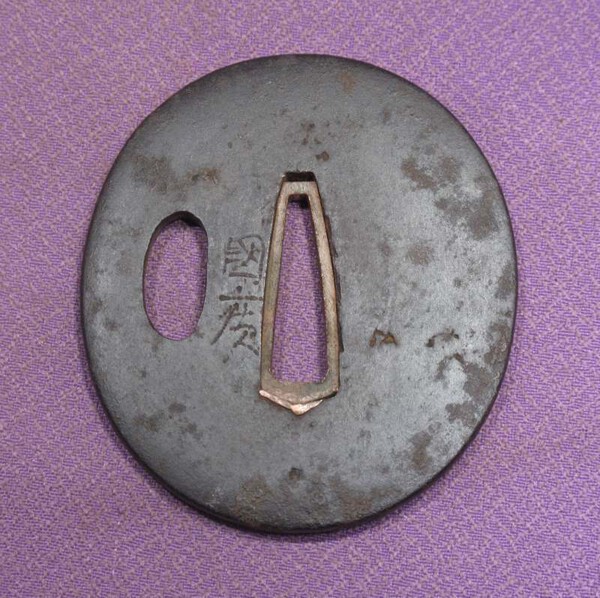
I don't think I've ever seen a sekigane that completely fills the nakago-ana. Is this unusual?
-
I just went back & calculated what the percentage of tax I paid, & it turned out to be Hawaii's rate, including the shipping cost.
-
No, the hamon is each tosho's "signature," not to me confused with the mei. It is specifically created to be the hardest part of the blade, as the cutting edge. Check out http://www.ksky.ne.jp/~sumie99/yakiire.html

