ROKUJURO
-
Posts
7,244 -
Joined
-
Last visited
-
Days Won
40
Content Type
Profiles
Forums
Events
Store
Downloads
Gallery
Everything posted by ROKUJURO
-
Mumei Kanayama tsuba that point to a specific tsubako
ROKUJURO replied to Iaido dude's topic in Tosogu
Glen, I think you simplify things too much. It is not only the shape and design that make a TOSHO or KO-TOSHO TSUBA but there are several criteria. The earlier type is much thinner, almost always large (> 80 mm, often much larger), has a special cross-section and the patina is not at all that easy to reduplicate in my opinion! And I never expect anyone to judge and classify a TSUBA with a 100% 'safety'. Here at the NMB, we have always agreed upon (and respected) that actual ORIGAMI by the NBTHK are educated opinions of a panel of experts who have seen thousands of TSUBA in-hand. Within the existing system of classification, we do not have more expertise elsewhere. But as humans make mistakes, wrong attributions cannot be excluded. But I am willing to learn, so I am looking forward to your proposal of an expanded classification system. The problem might be to convince the NBTHK..... -
Usually, MUNE are only roughly pre-formed on the anvil. Final shaping is done either with grinding stones or with files.. As the back of the blade is not hardened, it is not hard work. Of course, MITSU MUNE is more and finer work. Even the smallest deviation will be seen immediately! Lewis, often, the MUNE was not used offensively, but instead to parry or deflect an opponent's blow. You find KIRI-KOMI regularly on the MUNE.
-
Mumei Kanayama tsuba that point to a specific tsubako
ROKUJURO replied to Iaido dude's topic in Tosogu
Glen, I have always understood pre-EDO MUMEI TSUBA as belonging to a 'style' more than a school or workshop. Take KO-TOSHO or KO-KACHUSHI as examples. We do not know the smiths or 'schools' (or even locations, fot that matter), but when mentioning these types of TSUBA, everybody knows what you are talking about. In so far, the traditional names of traditions or schools are as good as any. As you say correctly, it is purely conventional or for convenience. Introducing a new defining and naming system for TSUBA would need to have superior knowledge about the old Japanese literature on that subject, and we would probably find out that many so-called "facts" were only assumption, especially in the past, but in present times as well. Just think of a feature like TEKKOTSU. Many authors talk about it as if they knew what it is, but there was (and is) no research done in that field (I am working on it). The same applies - in the field of blades - to UTSURI. We get descriptions, but no explanations. I think many names and definitions had to be invented because of lack of safe knowledge, science, and precise information, and the same can be found in many other fields of past times, e.g. archaeology. -
John, why do you think it could be difficult to make MARUMUNE?
-
The HABAKI does not belong to this blade. What are the dimensions?
-
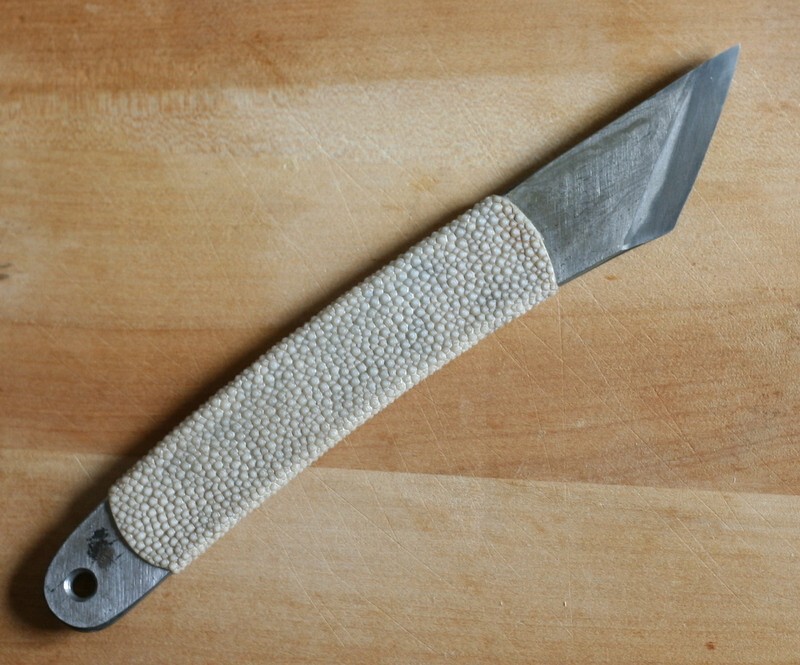
Lee, the knife above is a KIRIDASHI. You may call it a bench knife.

-
Tim, I only posted because you wrote " mei reads: Choshu Hagi Kuwaji Saku " instead of KAWAJI. Small typos often prevent you from finding information online.
-
Source for plain copper or brass fuchi/kashira?
ROKUJURO replied to ithuriel's topic in Wanted to Buy
Mike, well then make your own! You will learn a lot, and it will be much less expensive! -
ARMY MOUNT WAKASASHI- SHIN SHINTO PERIOD ?
ROKUJURO replied to Dogditcher's topic in Military Swords of Japan
Steve, probably not a stamp but a chiseled signature? -
ARMY MOUNT WAKASASHI- SHIN SHINTO PERIOD ?
ROKUJURO replied to Dogditcher's topic in Military Swords of Japan
As Bruce mentions above, you sometimes encounter shorter WWII blades, but as far as I know they were made on an individual basis. But I am not a military man; the experts will be able to reply in detail! -
ARMY MOUNT WAKASASHI- SHIN SHINTO PERIOD ?
ROKUJURO replied to Dogditcher's topic in Military Swords of Japan
Steve, generally, there were no military WAKIZASHI as far as I know. This is probably an older (pre-WWII) blade mounted with a civilian TSUBA (photo upside down) for military use. Spelling: It is WAKIZASHI. -
Need some help translation of a sword I fell in love with
ROKUJURO replied to Steve leon's topic in Translation Assistance
Steve, most NAKAGO photos are upside-down, but as Uwe already mentioned, it is not a Japanese sword. You fell in love with a bad fake.This applies to the mountings, too. -
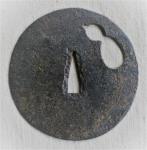
Joe, this is really difficult. Perhaps we can see more with a dark background (for increased contrast) and light from the side. Do you have some dimensions of your TSUBA? It reminds me of TÔSHÔ style, but it is possibly a revival piece, EDO JIDAI. You can see the conch shell (in fact a sea snail) motif from time time.
-
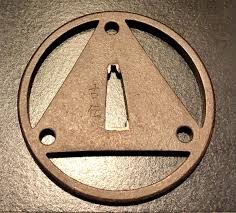
Okan, the three tips of the triangle have been replaced by the small balls/spheres.
-
Tim, it is probably CHOSHU HAGI JU KAWAJI SAKU (https://www.aoijapan.com/tsubachoshu-hagi-ju-kawaji-saku-2/)
-
Help needed/opinions please
ROKUJURO replied to Kyle68's topic in General Nihonto Related Discussion
That is possible, Lewis! -
Help needed/opinions please
ROKUJURO replied to Kyle68's topic in General Nihonto Related Discussion
TSUBA looks like TACHI KANAGUSHI style to me. Photos are not good, so I am unsure if there is some engraving on the blade just above the HABAKI? -
Peter, you could post an additional ad in the "WANT TO BUY" section. We have some members who collect militaria.
-
Okan, that one looks really solid! I like it!
-
Source for plain copper or brass fuchi/kashira?
ROKUJURO replied to ithuriel's topic in Wanted to Buy
You could always ask Artur who is a member here: https://www.flickr.com/photos/artur_drogamiecza/albums/page2 Mail is: drogamiecza@interia.pl -
They will probably offer a discount in case you take two of them!
-
WWII Officers Sword - Tell me what I have?
ROKUJURO replied to BurtMayer's topic in Military Swords of Japan
Burt, it was free. -
WWII Officers Sword - Tell me what I have?
ROKUJURO replied to BurtMayer's topic in Military Swords of Japan
Burt, obviously, you are not informed about carbon dating: Radiocarbon dating (also referred to as carbon dating or carbon-14 dating) is a method for determining the age of an object containing organic material by using the properties of radiocarbon, a radioactive isotope of carbon..... The measuring accuracy is about +/- 40 years, so would not work for WWII. -
WWII Officers Sword - Tell me what I have?
ROKUJURO replied to BurtMayer's topic in Military Swords of Japan
Burt, your blade is obviously not EDO JIDAI. You can see that from the patina on the NAKAGO. If it was made as GENDAITO, it could be that the smith drilled a MEKUGI-ANA right after he forged it. When it was put into military mounts, they had to drill a second MEKUGI-ANA to make it fit. I would not assume a big secret in these notches at the ende of the NAKAGO. Certainly no hidden sign of age or length. This thread should have been posted in the "military" section