ROKUJURO
-
Posts
6,924 -
Joined
-
Last visited
-
Days Won
36
Content Type
Profiles
Forums
Events
Store
Downloads
Gallery
Everything posted by ROKUJURO
-
Calabrese, as I tried to explain, it is SAN MAI. It is not san mei and has nothing to do with MEI.
-
Calabrese, a SAN MAI TSUBA shows three (= SAN) layers in its construction. Often, the outer layers are thin SHAKUDO sheets with impressed decoration, the core is mostly copper.
-
John, as far as one can look into the HITSU, it is probably a SANMAI TSUBA as Mauro stated. As you are obviously able to make some good close-ups, let's have a better look into the HITSU and the NAKAGO-Ana. That should explain it.
-
Rather long arms for a T-REX....
-
Hi AJ, welcome to the NMB forum! Please sign all posts at least with a first name and an initial, so we can address you politely. The images are not helping a lot to say much about the blade. We could speculate about the shape of the KISSAKI which has an unusual curve and looks strange to me. The NAKAGO has an "old" look, but that does not mean much; there are cases of heavy corrosion even on more recent blades. Usually, the SHIRA-SAYA keeps its shape even after a long time, so in your case, it may be indeed that the HABAKI is not original to the blade and prevents a perfect fit.
-
Thank you both! Very kind!
-
Can I please ask for help? Which organization is this? It is printed on an ORIGAMI of a TSUBA.

-
Grev, pictures and text got mixed up in your posts.
-
Stolen sword : Your help is required ! (FOUND)
ROKUJURO replied to Tohagi's topic in General Nihonto Related Discussion
I sincerely hope it will show up finally! I can tell a story about what can happen in the postal world of the 21st century, quite a while after horse carriages and sail ships were in use: Some years ago, I bought an item off a NMB member in American Samoa - not a valuable object. His next bigger post station was more than 4.000 km away from his place, in Honolulu, Hawaii. Somewhere on the long way to me, the parcel was lost. After I was told that I could do nothing about it as the buyer, the seller made a claim and started a serious query. This was not successful, the package did not show up, and he got fully refunded - in addition to what I had paid him already. But he was a gentleman and sent me my money back. The story did not end there. After more than 2 months, to my surprise the parcel was brought to my door by regular post! In the end, I got it for free! S**t happens, but lucky things as well! -
Unusual AKASAKA artist, at least to me. Another one: https://www.militaria.co.za/nmb/topic/46337-sekijoken-oyama-motozane-tsuba/
-
B. Ashton, when you wrote "case" did you mean the sheath of the sword? If so, and if you pushed the paper down, you could take a straight piece of steel wire (2 to 3 mm cross section) and bend a small sharp hook at one end. You should then be able to pull the paper out. Please take care not to touch the blade with your bare hands to prevent corrosion.
-
Deanna, thank you for the link! I have seen a number of videos by SUKEMITSU-SAN. They show clearly that he has a different approach to sword forging. I personally think that the traditional methods are not at all outdated, and there is good reason that the techniques and materials are not free to choose but mandatory for licensed sword-smiths. Of course you could forge a sword in different ways, and it might even look similar, but when I see SUKEMITSU-SAN grinding his blades on a belt-grinder, I don't feel I would want one from him. His is a funny guy, and in one video he is even quite drunk and still trying to speak about his theories, but I sincerely hope that his approach is not something that will spread around in Japan, 'revolutionizing' sword-making.
-
Shinshinto mumei wakizashi identification
ROKUJURO replied to Athanasios Koumantos's topic in Nihonto
Athanasios, SHINSHINTO blades are usually signed by the smith, so there is the question why this one is not. Another question is who told you it is SHINSHINTO? The SUGATA with very little SORI could also mean early SHINTO (KANBUN JIDAI). To get closer to this question of time range, very good photos of the NAKAGO (without HABAKI), made from above (not at an angle), with a dark, non-reflective background, and shown as cut-outs, would help to see more of the patina of the NAKAGO. The KISSAKI photos are not so good, so some better ones (taken as described above) would probably help. If possible, upload the photos here on NMB. -
Herzlich willkommen, Simon! Jean
-
John, for the swords or the girls?
-
Marcin, you do not seem to understand. Colin is perfectly correct in describing differences between the (old) ORIGAMI and the present state. He did not say it was trash, but parts of it look like low quality. In addition to that, I think I can see that the lacquer of the SAYA has been repaired. All in all, I repeat what Colin wrote: ....you are the one with the paper and the koshirae....so you should see if all parts are matching the paper. If not, they could have easily been swapped after the ORIGAMI was issued.
-
John, perhaps the famous MEI? But worthless without ORIGAMI.
-
Did you have a look?
-
It may be a fun game, but I feel there should be some scale or field where these famous names could be put side to side. It could be the celebrity in their time and societies or a comparative standard in their respective field of arts. The artistic relevance in our time or the market values might be another possibility. Interesting thoughts, but I just would like to be able to follow the idea behind it.
-
Marcin, it is not the time spent that leads to results. You have to buy books and study them, see items in museums, in collections, on shows and sword club meetings. And of course look things up in the internet. This takes time and some serious commitment, so be patient and study - the NMB is a very good place for that!
-
Marcin, I think you got everything replied a year ago in this thread:
-
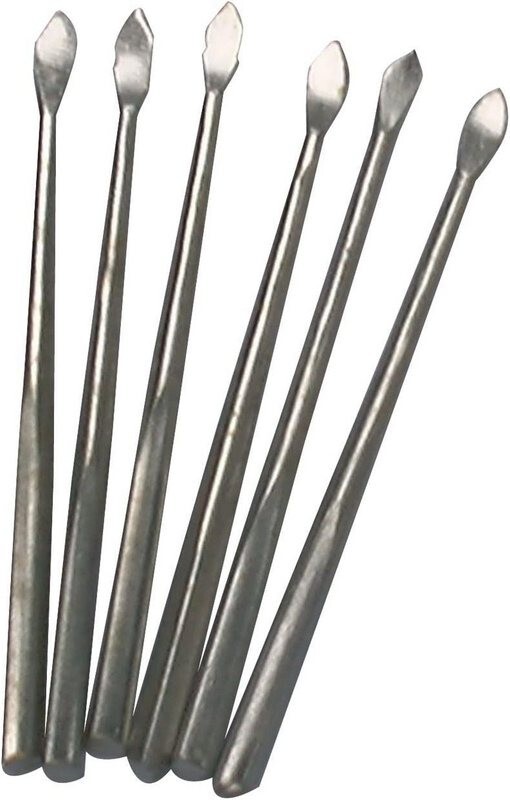
Hi, Piers and John, this thread brings up some really interesting subjects! Let me reply first to Piers' post: I was not there, and I would not deny that they used drills to make small holes. Spindle drills are an old invention, and it could be done, but it certainly was a time-consuming work. The manufacture of hardened drill-bits might also have been a big challenge, but these were even used on much harder precious stones, so why not on iron? (An image of simple drill-bits for a spindle-drill in the attachment) It might be of interest that (cutting) spiral drills were invented by Giovanni Martignoni in 1863. I had a look at a MENPO right now which has a number of small holes in the less than 1 mm thickness iron sheet metal, but the method of making these is not at all evident. Generally, punching holes cold in thin sheet iron is easy, precise, and fast. Drilling might still be more precise, allow for smaller holes, and the flattening of the metal, possible correcting of a distortion, and finishing the holes is not necessary. As I am not familiar with armour, I am unable to proclaim a "last word" on that. John, work-hardening is done on cold metal with a lightweight hammer and very many fast blows on the chosen part of the surface (as in peening a scythe). Cutting/chiselling a signature would not cause work-hardening, and the same applies to punching a MEKUGI-ANA. This is always done on a red-hot NAKAGO, so absolutely no danger of cracking in the quench. We often see NAKAGO of older blades with 2 or more MEKUGI-ANA. Usually, one of them was initially punched by the smith. Later MEKUGI-ANA could not be punched and had to be drilled. There are modern steel alloys with high manganese content (as an example: for rails) that are likely to work-harden so easily that drill holes cannot be pre-punched. The drill-bit would not "bite"! It remains to be researched when drilling iron/steel was first introduced in Japan. I believe that there is quite a difference in work between thin sheet material and 6, 7, or even 8 mm of a steel NAKAGO.
-
Hi Piers, that is very interesting! Is there any evidence available? As far as I am informed, "cutting action" drills are a very late invention, while "friction action" drills go indeed back to the middle stone-age. So, in my experience, a friction drill does not work on iron. Instead, making holes with small punches was quite easy and did not even necessitate heating up the metal if it was thin enough. Drilling in a TSUBA blank or a NAKAGO certainly requires the use of a modern cutting drill. As work traces clearly show, earlier TSUBAKO mostly used chisels and files to create their designs. I have seen some AKASAKA TSUBA where the chisel strokes had not been filed down, probably as design elements. Small holes were always punched as you still can see on KO-TOSHO and KO-KACHUSHI TSUBA. The first cutting drills in Europe were of the "spoon design", but because of the properties of the steel used, they could not be made with small diameters, say 3 to 4 millimeters, and they only worked in wood. Bone, ivory and related materials could be drilled with fine friction drills, working in two directions. Fine holes in iron are extremely difficult to make with traditional tools, so I would really like to know how - as an example - the fine saw-cut designs of the ITO TSUBA school were made, and when.
-
....without damaging the MENUKI.
-
Yes, KATANA or long WAKIZASHI, but there are no fixed rules. There were long swords with small TSUBA as well as with very big TSUBA, depending on era and individual taste.