ROKUJURO
-
Posts
7,008 -
Joined
-
Last visited
-
Days Won
38
Content Type
Profiles
Forums
Events
Store
Downloads
Gallery
Everything posted by ROKUJURO
-
The NAKAGO is astonishingly well preserved and clean for that age. And the upper MEKUGI-ANA looks drilled, not punched.
-
Can you imagine a Japanese owner of a sword hanging it on a wall of a room in his house? I can't, so I don't see a way you could use this except for garden work. Public display may be an idea, but then with a big sign saying: THIS IS NOT A Japanese SWORD! (R. Magritte: Ceci n'est pas une pipe)
-
Lets Play Can You Spot The Crack !
ROKUJURO replied to lonely panet's topic in General Nihonto Related Discussion
Alex, they are right, it is a (potential) cracker! -
Lets Play Can You Spot The Crack !
ROKUJURO replied to lonely panet's topic in General Nihonto Related Discussion
That was obvious: under the HABAKI. -
Matt, on the photo it looks as if the TSUKA-ITO has not been done by a Japanese craftsman.
-
Gerald, to me the NAKAGO looks as if it had been exposed to a fire. What about the rest of the blade? Is there a distinct HAMON to be seen?
-
Tsuba Differences Between Wakizashi And Katana?
ROKUJURO replied to general_piffle's topic in Tosogu
Joel, a lot depends on what era you want your DAISHO to represent. If you look up DAISHO TSUBA, you will find a lot of examples of what a DAISHO was in EDO JIDAI. But in former times, DAISHO could mean a different combination, e.g. TACHI (with huge TSUBA) and TANTO. -
There was a NARA SHIGEMITSU, but I don't know for sure if your's is by him. By the way, I like both, and it is a pity that I cannot enlarge the photos.
-
Yes, I am of no great help concerning the first two KANJI, but ....no KAMI KUNITSUGU.
-
John, no reason to be frustrated as you did not pay much! The 'chisel marks' do not appear as cuts, so it is still not obvious if this is a cast copy or a real TSUBA. One possibility is that the etching/pickling for a patina was excessively heavy on this one, but that is just a guess. The photo of the rim is not really sharp and does not allow a judgement. Best advice I can give is to ask Ford Hallam or Curran or to take the TSUBA to a NIHONTO exhibition and show it to some experts.
-
John, for me, this one is difficult. Very similar decoration on both sides, looking a bit 'amateurish' and not like an expert's free-hand design. The surface seems to be coarse in some places, but I am hesitant to call it cast. Perhaps if you could show more of the TSUBA, e.g. the folding or some close-ups, then a comment might be easier.
-
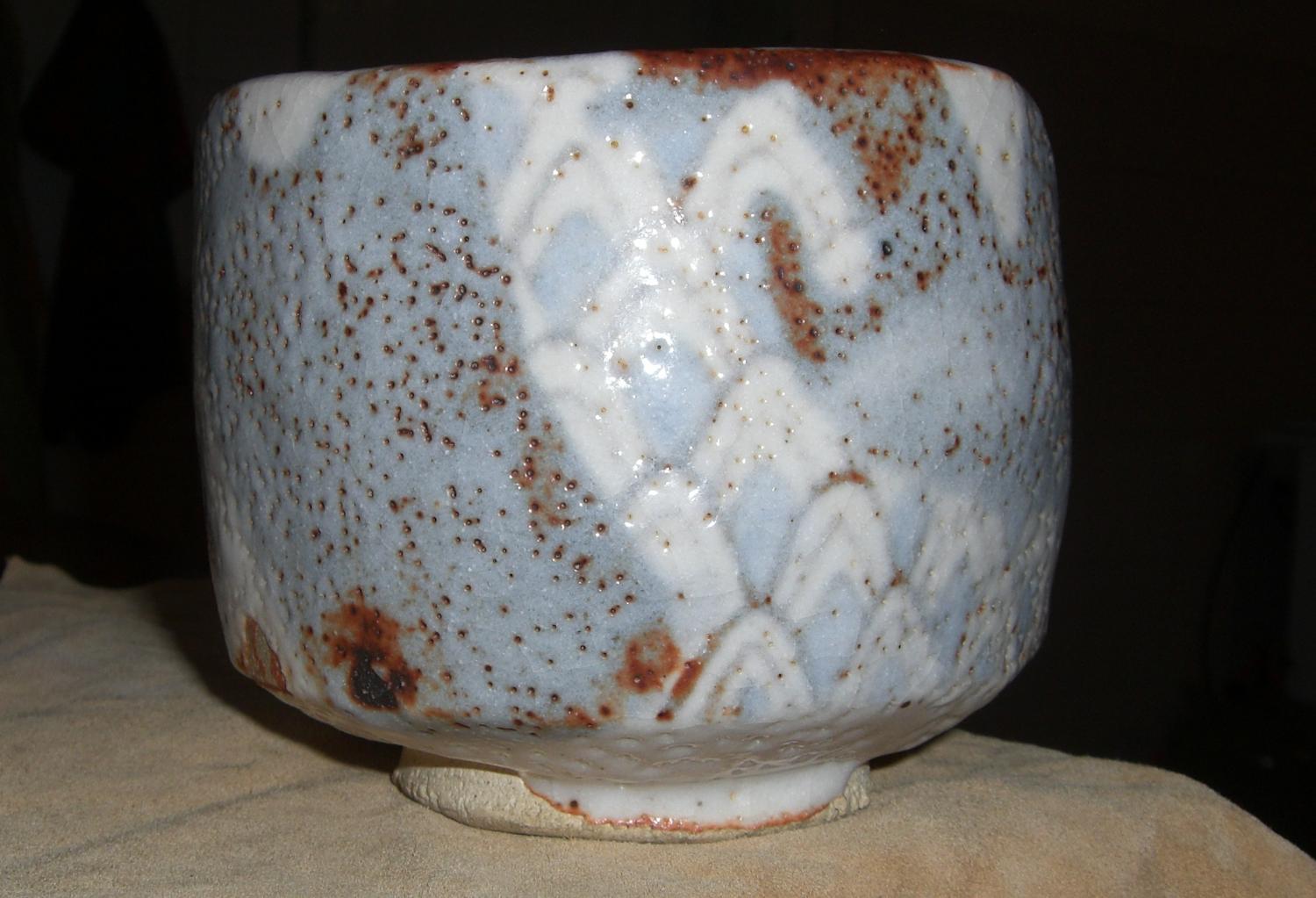
John, are YUNOMI meant for MATCHA at all? I always used a HAN-TSUTSU GATA CHAWAN fot that purpose.

-
Neil, I read that also as YOSHICHIKA.
-
Chris, as I wrote, the chemical composition of iron ore will always differ from one mining location to another, but the iron production process and the high temperature chemistry involved will always remain the same, the physical nature of iron does not change. Trace elements contained in the bloomery may vary a lot, but as long as they remain very small percentages, they will not influence the properties of the steel in a significant way. Of course some elements can have different effects depending on their content. Carbon makes a lot of a difference in the range between, say, 0,3 and 1,5%, but we have to respect that this element is easily introduced into the iron in the TATARA process. Other alloying metals like Vanadium, Tungsten, Chromium, and Cobalt can also change the properties of steel considerably when added in small quantities, but this works only in a blast furnace which melts the iron to a liquid state so the atoms can move freely. The hunt for 'old iron' continues to this day and not only in Japan! I am constantly on the search, and if I find a piece of iron which I can date to pre-industrial production, I can be very sure that it is almost free from non-desired alloy elements. Water kettles are cast iron (high carbon content) and can as easily be recycled in an OROSHIGANE furnace as old blades, nails, and tools. The smith can always test the resulting steel for its properties (= carbon content) and so combine the parts of a new blade. I have no information about raw wootz being traded into Japan, but it would not make sense to me. Wootz has to be treated in a completely different way compared to the Japanese way of the craft. There are many dozens of cycles of heating and hammering the steel necessary to bring out the cristalline structure, and for a Japanese swordsmith, a wootz cake would just be some foreign (very expensive) steel. In addition to that, the very special composition of wootz steel with its 'exotic' alloy elements like Vanadium would certainly have shown up in the steel analyses of Japanese blades. I believe that the introduction of NANBAN TETSU has to do with a certain curiosity of the Japanese metal workers. They may have regarded the West and its technical achievements as superior to their own iron producing techniques and hoped probably for better results. But iron remains chemically iron, so no miracles in swordsmithing happened.
-
Chris, we should not mix up trace elements, impurities, and alloying elements. Not everything in the steels has physical or technical effects. I just got a sample of an analysis of a (probably modern) steel, and I was asked about the possible properties: Iron = 97,07 % Manganese = 1,318 % Nickel = 0,183 % Molybdenum = 0,30 % Vanadium = 0,095 % Platinium = 0,091 % Chromium= 0,082% Mercury = 0,072% Gallium = 0,053 % Arsenic = 0,072 % Germanium= 0,020 % Copper = 0,010 % Palladium =0,020 % Silver = 0,020 % Cadmium = 0,051 % Indium = 0,030 % Tin = 0,051% Antimony = 0,051 % Zinc = 0,010 % Tungsten = 0,025 % Niobium = 0,020 % Titanium = 0,030 % Gold = 0,020 % Cobalt = 0,020% Lead = 0,020 % Zirconium = 0,051 % Iridium = 0,0010 % Bismuth = 0,0010 % Rhenium = 0,0010 % Hafnium = 0,0010 % Rhodium = 0,0020 % Yttrium = 0,0051 % Bromine = 0,0051 % Ruthenium= 0,0051% Tantalum = 0,00012 % We see that the extensive use of scrap steel added to the blast furnace content leads to a strange mixture. These steels cannot be refined/freed from accompanying elements without a lot of work and costs. Bloomery steel - and TATARA steel is basically the same - cannot contain much more than carbon as alloying element. Silicon is brought into the steel from the slag, and the amount of this can be controlled/reduced by refining the steel in the forge. There were scientific researches done on that matter. The SATETSU has generally low amounts of phosphorus and sulphur, and the charcoal used in the TATARA is almost free of these detrimental elements. There are discussions about the effect of Titanium which is brought into the steel via contamination with slag, but there is no evidence and I doubt it will because of the low content. Elements found in Tamahagane C: 1.00% to 1.42% P: 0.013% - 0.042% S: 0.006% -0.008% Mn: 0.006% - 0.11% V: 0.004% - 0.015% Al: 0.003% - 0.02% Ti: 0.003% - 0.0267% Cr: 0.69% - 1.54% Mo: 0.04% Si: 0.018% - 0.02% I will add again, that alloyed steels cannot be quenched in water without the immanent risk of failure, while pure carbon steel has to be quenched this way to obtain the desired hardness. Indian or modern 'Crystallisation or crucible damascus' (also called wootz/bulat) are a completely other cup of SENCHA. Besides others, Vanadium is necessary in this steel to induce crystallisation, while the same element can form very hard carbides (with big particle size) in modern stainless cutting steels. The problem is that the discussion about steel metallurgy is not necessarily related to Japanese sword steel alone. It applies to the physics of iron in general, and any mystification could lead the wrong way.
-
Chris, if you read a little about archaeometallurgy, you will find that the bloomery process (all bloomery processes world-wide!) yields a very pure iron. Besides carbon and silicon, there are only very small quantities of trace elements and they do not influence the properties of the steel a lot. The quality of the iron or steel is much more influenced by the forging process itself, the number of foldings, the conditions and the decarburizing effects the steel is exposed to in the fire. In the bloomery process, alloying elements cannot be added to the steel. For this you would need, as you wrote correctly, high temperatures above the melting point of iron (1.578°C), as you can have in blast furnace. But then you get cast iron with a carbon content of about 4% which is not malleable. In the modern TATARA process, you get the whole range from low carbon steel to high carbon steel to small amounts of cast iron. Not all of this can be used immediately for sword making, but nothing is lost. Non suitable qualities can be reprocessed in an OROSHIGANE furnace (refining furnace). So I think that the main differences between KOTO and SHINTO blades are to be found in way the steel was worked with. But that is only my personal view.
-
Promising Sword Auctioned...
ROKUJURO replied to Hoshi's topic in Auctions and Online Sales or Sellers
I am not so sure about JUYO for a possibly retempered blade of that age. They would not have noted that unless there was a strong possibility for it being indeed retempered. And by this process, the original SORI and features like KASANE and HABA will probably have changed to a degree. The amateurish way they tried to copy the Japanese text with so many mistakes would not convince me either. -
Poorya, welcome to the NBM board! I have never seen a TSUBA with an extra hole in the SEPPA-DAI and I can't imagine the use of it. The design elements do not immediately point to a certain school. Compare AIZU SHOAMI and KYO-SHOAMI for the rim.
-
Family name on KASHIRA may read NAKAMOTO.
-
Mauro, I am not one of the experts, but I also found these mistakes, which led me to make a critical comment about the book. For my education, I need good pictures of high-quality items and a reliable text. This is the reason why I was not enthousiastic. For an amateur author, it is just pointless to write a book about a very specialized subject like TOSOGU without the help of real experts, be that in the subject or in language/translation.
-
Thanks for sharing, but unfortunately, the catalogue is not very educational.
-
Jos. I have a problem with your name. Once you have signed 'Markus', now it is 'Jos.'. Why don't you just adapt the way everybody does it here on board? Give us a full first name to address you, that is all - it won't hurt! The stuck HABAKI (not hakabi) should be removed, the more as you have tried water and soap. Did you really try hot water on the HABAKI? It won't damage the blade if you dry it immediated after the treatment. Did you try WD 40, a bad smelling but efficient lubricant? You can also try with wooden tools, and in my experience this works best. Keep safe at all times using self-adhesive tape to mask the cutting edge and to protect your fingers. With a chance of the blade being a GENDAI-TO, it is worth the effort! Good luck!
-
Dave, I think they are, following the data from OMURA: The chemical components of a Kōa-Issin sword Carbon Manganese Silicon Phosphorus Sulphur Skin steel 0.57 0.05 0.17 0.018 0.003 Core steel 0.23 0.15 0.21 0.020 0.008 In his article he mentions even the absence of titanium, so this steel seems to be quite 'pure' which corresponds to low-alloy. High-alloy steel with considerable amounts of alloying components to enhance the properties would not allow quenching in water. The meaning of low-alloy carbon steel can be found here: http://www.totalmateria.com/articles/Art62.htm
-
Maybe I should have said it using Japanese terms: If you post photos, please show them tip (= KISSAKI) up! The HABAKI should come off with a little, but not too much force. You can read about methods here in the forums as the problem is not especially new. In most cases, crud or corrosion lead to a blocked HABAKI, so it is important to remove it to clean underneath (carefully and not with metallic tools). Please sign all posts at least with your first name plus an initial so we may address you politely. It is a rule here. It is easy to mark it in your profile so it comes up automatically with each post.
-
Markus, are there any stamps on the NAKAGO? (photos always tip up! No HABAKI!) They could help to identify the blade as SHOWA-TO or GENDAI-TO.