Grey Doffin
-
Posts
4,226 -
Joined
-
Last visited
-
Days Won
31
Content Type
Profiles
Forums
Events
Store
Downloads
Gallery
Everything posted by Grey Doffin
-
Showa Ju Hachi Nen Ju Gatsu. October of 1943. Grey
-
 The wood is allowed to sit 10 years so that the saya shi is assured that it is as stable as can be. It would make no sense to go to the trouble to make a saya and find out later that the wood was still moving/shrinking and have a crack develop. The choice of wood for a saya is made to a large degree by the acid content of the wood; low acidity is very important. It is my understanding that saya are traditinally made of Ho (magnolia) wood, not Hinoki. Rot and insect resistance really don't matter much with saya, unless you plan to store your sword in a swamp. Cedar may not be a good choice. Check its acid level before you proceed. Grey
 -
Where do you live, Brian? Grey
-
Am I even close with this translation??
Grey Doffin replied to Cello's topic in Translation Assistance
Hi Marcello, Seeing the last picture it is Sukesada. Many, many swords from Bizen in the Muromachi were signed Sukesada. My understanding that there were shops that turned out swords by the bucket and all were signed Sukesada. There were some Sukesada who were important smiths; usually they had a personal name as part of their signature (ie. Hikobeinojo, etc.). Almost always, when a sword is signed like yours, it is considered school work and it isn't possible to tie it to a particular smith. Grey -
Whether or not the inscription is bogus, I like the piece better with the inscription than without (shortened). If it were mine to decide I'd not have the inscription cut off. Grey
-
Definitely wasn't picked up from the saya between him and you. Have you asked him what it is and how to get rid of it? Grey
-
I think Hidemoto with a kao. Grey
-
Hi guys, Sunday of the San Francisco show, in Japan Town San Francisco, a friend's car was broken into and his day pack was lifted. The Yamakichibei tsuba pictured below was in the bag. The thief will have no idea of value so this might show up at a flea market or most anywhere. Email me if you see it, please. Thanks, Grey

-
Help with ID and tell me about this sword
Grey Doffin replied to GunJam's topic in Military Swords of Japan
Nick, No standard number of holes but all but the very long had only one when they were made. Don't soak the bamboo. Grey -
Chinese Fakes Vs. Japanese swords: what year begining?
Grey Doffin replied to jjsilwm's topic in Military Swords of Japan
Jair, Check out the books that the JSS/US sells. Sue Koto, for example, is 700 some pages and priced at $50 or 60. jssus.org or Google Harry Afu Watson (he sells our books for us). Cheers, Grey -
Help with ID and tell me about this sword
Grey Doffin replied to GunJam's topic in Military Swords of Japan
Hi Nick, Odds are very high that you won't be able to learn anything much about the man who made your sword. Mass produced officer's swords were made by whomever was available to do the work, not by trained swordsmiths. No records that I'm aware of were kept on these sword assemblers. If this is Yoshinaga (not sure about that; he had very sloppy handwriting) there is nothing in any of my books about him. Grey -
Johnb, How do we know that the prior bidders know what they're doing? No one who would buy the tsuba at the top of this thread should be buying tsuba on ebay; he should stick with established dealers until he has more knowledge. Grey
-
Help with ID and tell me about this sword
Grey Doffin replied to GunJam's topic in Military Swords of Japan
Hi Nick, The 1st picture is the signature of the man who made the sword; I can't see it clear enough to read. The 2nd is the date: Showa Ni Ju Nen Go? Gatsu. Showa 20 year 5 month, or May of 1945. Looks to be a standard Showato/Gunto: made for WWII by non-traditional methods by a smith without real training in Nihonto. Grey -
Kunihiro, I believe. No idea about the other side. Grey
-
Help with ID and tell me about this sword
Grey Doffin replied to GunJam's topic in Military Swords of Japan
Prying the screw will damage the tsuka. The hole should go clear through the handle. Push on the point of the screw from the other side as you work on the head with a screw driver. You may have to slide the wrap a bit to uncover the hole. Grey -
TV series needs the name of a 19th century Tosho/Swordsmith
Grey Doffin replied to SimonTV's topic in Nihonto
Hi Simon, Kiyomaro, one of the most important of all smiths ever, worked at the tail end of your date range. Grey -
Help with ID and tell me about this sword
Grey Doffin replied to GunJam's topic in Military Swords of Japan
Nick, What do you see on the other side of the handle from the screw head? If nothing then the screw probably isn't original and no great loss. If there is another screw head then one side is a bolt and the other is a hollow shank that works as a nut. You might try putting a tiny bit of something like WD40 (rust breaker) inside the hole on the screw shank, wait a day, and then try working the screw back & forth to see if the bond breaks. If the head does break off at the top of the shank you should be able to push it out the other side. Grey -
Thanks, Lee. Curious how these characters that no one (Japanese or Chinese) seems able to read easily show up on a tsuba. Grey
-
I agree; obvious fake. Grey
-
Help with ID and tell me about this sword
Grey Doffin replied to GunJam's topic in Military Swords of Japan
Hi, name please, 1. Just a light coat of oil. Do not try to remove the rust because chances are good that you will do damage to the sword and its value. 2. Steel. 3. Maybe $400 to $600, depending on condition and if there is a signature. 4. All Japanese officers had swords during WWII. 5. Your sword is most likely partially hand made out of tool steel, not completely hand made like a traditional Samurai sword. If it is signed it is on the tang under the handle. Here is a site that shows how to remove the handle and a bunch more about sword care. http://www.nbthk-ab.org/Etiquette.htm Note: your sword appears to have 2 pins through the handle. Both will have to be removed to get the handle off. 6. That is a piece called menuki (one on either side of handle) and it shows a cherry blossum. 7. Yes; a whole lot more you should know. Start reading and studying. Grey -
Even without seeing the extra pictures I know this is a fake, most likely from China. Grey
-
Hi Albert, Says made yesterday in China. This is a fake; sorry. Grey
-
Jair, 100% of your sword is Chinese fake; there is no part that is real. Buy books and study; until you do you will only throw away money on fake or bad swords. There is no short cut to learning. Grey
-
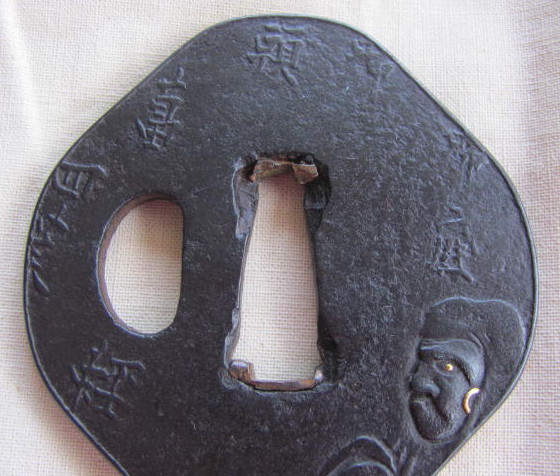
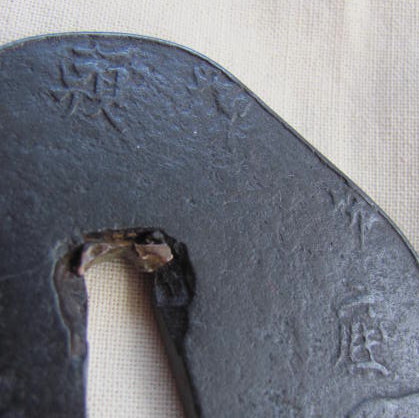
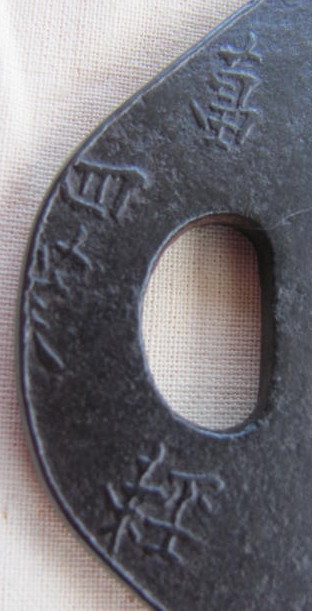
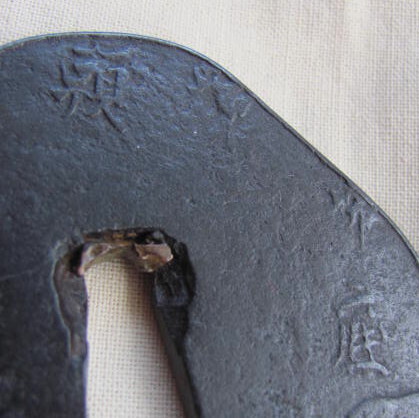
Hi guys, This tsuba will be listed for sale. I'm wondering if any of you can make sense of the Kanji on this tsuba. At the show in San Francisco a couple Japanese gentlemen couldn't read them and suggested that they are Chinese (still Kanji but a different language). Thanks, Grey

-
Unidentified wakizashi in shirasaya
Grey Doffin replied to USkragnut's topic in Translation Assistance
Hi Sean, Actually, I have a list of 18 smiths who signed as Hitachi no Kami, but only 4 of them are included in the references that I've indexed on the online, Index of Japanese Sword Literature. I checked one listing for each of the 4 and found no close match. Your sword may be from one of the 14 other smiths not included in my books, from one of the 4 but with a signature that doesn't match my examples, or it could be gimei (faked signature). This looks like it has always been a wakizashi, never long enough even before shortening to have been a katana. What is the nagasa? (from the point to the notch at the back in a straight line). Possible that it was once a naginata (and now naginata naoshi) or maybe just a shinogi zukuri wakizashi that has lost its yokote to a clumsy polish. Not much more I can say without better pictures, but chances are it will take in hand examination by someone who knows to tell what you have. Grey