Grey Doffin
-
Posts
4,224 -
Joined
-
Last visited
-
Days Won
31
Content Type
Profiles
Forums
Events
Store
Downloads
Gallery
Everything posted by Grey Doffin
-
Hi guys, I've been watching a tsuba on ebay that's set to end in a few minutes. http://cgi.ebay.com/ws/eBayISAPI.dll?ViewItem&item=330560891479&ssPageName=STRK:MEWAX:IT Got me thinking. This tsuba shows obvious evidence of having been cast, especially in the 3rd picture. I don't doubt the authenticity of the piece; I think it was made that way and is real (correct me if I'm wrong). How many Namban tsuba were cast? Not all, I know. One of the Holbrook tsuba I'm currently selling is Namban and it has lamination lines visible on the edge; obviously forged, folded, and carved. Enlightenment will be appreciated. Grey
-
Don't know that I've ever seen the assembly # stamped on the nakago but it doesn't surprise me. Just a way to keep all the parts together. Looks to be a clean gunto, good condition. Most likely a semi traditionally made sword; not Gendaito but not bottom of the barrel either. Grey
-
Blair, By tired, Chris means that the sword has been polished enough that defects have come to the surface. Those in the bottom picture have little to do with rust; they are forging flaws. Before you spend more money on this sword you need to realize that you will never get it back. When the time comes to sell (and it will come, unless you plan to be buried with it), you will recoup only a small fraction of what you have in it. Nagasa is from the tip of the kissaki to the mune-machi in a straight line. Grey
-

Gunto Tsuba Seppa Habaki Interchangebility?
Grey Doffin replied to Chako's topic in Military Swords of Japan
Chako, Seppa might need a bit of filing to enlarge the nakago hitsu-ana; ditto with the tsuba. Almost impossible to get the habaki from one sword to work on another; they are custom made to fit the blade. Grey -
A tsuba auction I won. Thoughts?
Grey Doffin replied to FBJ's topic in Auctions and Online Sales or Sellers
Or an even more obvious question: was this originally a tsuba or is it something else modified to look like a tsuba? Grey -
A tsuba auction I won. Thoughts?
Grey Doffin replied to FBJ's topic in Auctions and Online Sales or Sellers
I'm puzzled by this tsuba. The strange nakago hitsu-ana coupled with the round seppa-dai lead me to wonder what exactly this is. Imagine this mounted on a katana with normal (oval) seppa and tsuka; wouldn't the protruding section of seppa-dai look out of place? But what do I know about the subject? Not much, actually. Hope someone else can enlighten me. Grey -
2 sword dealers were stranded on a deserted island, penniless with but one sword between them. A month later when they were rescued they were both millionaires. Grey
-
Need help with signature on antique katana
Grey Doffin replied to aphelion's topic in Translation Assistance
Hi Neil, There's a large Japanese sword show every February in Tampa; there you'll be able to see and handle a thousand swords. I think there is a suggested book list in the FAQ on this board. Grey -
Need help with signature on antique katana
Grey Doffin replied to aphelion's topic in Translation Assistance
Hi Neil, You can stick it on ebay and admit it's a fake/copy/repro and see what it brings; you'll get some of your money back. Yes, a hard learn, but do learn from it. Nihonto can be a fascinating study and great fun but you need to know what you're doing before you spend money. Grey -
Need help with signature on antique katana
Grey Doffin replied to aphelion's topic in Translation Assistance
Aphelion (is that your name?), As you've been told, pretty much every detail on your sword screams "FAKE". Get your hands on books and read & study. Go to sword shows and study. Do your homework first; then try to buy a real Nihonto worth owning. If it was an old master oil painting that you had purchased with as little knowledge and discovered it to be a forgery, would you be as surprised? This field is as complicated as old masters. Study first or take your lumps. Grey -
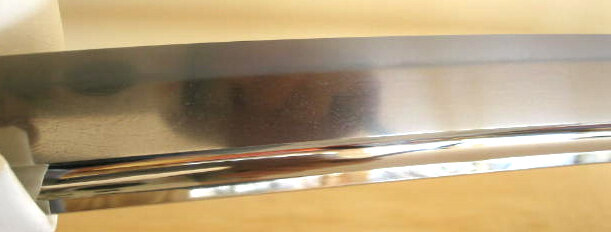
Hi Jim, The paper has this to say about the hada (as translated by Harry Watson): "A mixture of mokume and nagare masame in itame, overall it is hadatachi, with ji-nie, chikei is inserted, jifu is mixed in, and there is a hint of faint shirake." "Hamon: A mixture of k0-gunome in chu-suguba, there is hotsure, yubashiri, and nijuba in the habuchi, there is fine ashi and yo, with thick nie, there are kinsuji and sunagashi, and the nioi-guchi is bright and serene." "Boshi: Shallow notarekomi, saki is ko-maru, and the nie is strong, and there is nijuba and hakkake." And here are 3 pictures; hope they help. Grey


-
Due to the crude script these things (mass produced Gunto) are signed with it will be difficult for a beginner to translate. Try it and if you decide to give up, here's what it says: Grey
-
And, I should add, when I bought this sword it was signed Kunimura (Enju) and had saya-gaki to Bitchu Aoe. Grey
-
Thanks Brian; that's exactly what I was trying to do. Glad I know more about swords than I do about computers. Grey
-
Yep; I was afraid of that. The picture I have is too big for posting and I haven't had any luck resizing or linking to it. If any of you would like to see the picture, email me with the link below and I'll send it to you. Grey
-
If it will help, an oshigata of a very good Ko-Mihara. Grey ftp://ftp.cpinternet.com/homepage/124_2409.JPG
-
This doesn't look like Nihonto to me; my guess would be recent Chinese fake. All sorts of small details here and there are wrong and taken together they suggest fake. I could be wrong but I'd be surprised if I am. OK; so surprise me. Grey
-
That is definitely a modern Chinese fake. Grey
-
I believe this was made during WWII. Either the nakago is too short or the mekugi-ana is placed too low; either way this odd nakago configuration is a common trait of tanto made during the war. The sugata at the kissaki puts me in mind of that period as well. Also, it is not unusual to find "Sanjo Munechika" carved on the blade above the habaki. Certainly not an attempt to fool anyone into believing this is by Munechika; not sure why this was done. Grey
-
Hi guys, Did anyone who knows more about armor than I do (doesn't take much) see the suit on tonight's Roadshow? Here's a link to the spot: http://www.pbs.org/wgbh/roadshow/archive/201002A04.html I'm curious how accurate the appraiser was. Grey
-
Interesting large tanto/small wak...opinions, please?
Grey Doffin replied to cmjohnson's topic in Nihonto
Strange things are happening around the ha-machi. 1st, the blade has been polished badly and the ha-machi is there only because the polisher or polishers stayed away from it, which yields the unnatural flare in the blade above the machi. 2nd, the start of the nakago below the ha-machi is angled unusually steeply down and there is that notch in the nakago a bit less than an inch below the machi. Not supposed to be a notch there. This doesn't feel like Nambokucho to me; I'm thinking Shinshinto but not sure why. I'm interested to see what the others have to say. Grey -
Chicago sword show question
Grey Doffin replied to TomP's topic in Sword Shows, Events, Community News and Legislation Issues
Hi Tom, Feel free to stop by the table I share with Mark Jones. Either one or both of us will be glad to help. Grey -
I have been receiving mine. Grey
-
New sword from Ryujin - buyer's feedback
Grey Doffin replied to Curgan's topic in Auctions and Online Sales or Sellers
So he's not counting on repeat customers? Grey -
Hi Patrick, 3 things to say about restoring your sword. 1. Restoration isn't necessary for preservation of the sword; it will keep fine with just a very light coat of oil on the polished part of the blade (as in the etiquette brochure). Nothing wrong with having it restored and you should have the work done if you like. 2. However, every time a sword is polished some of the blade is lost to the stones. After too many polishes the core steel starts to show on the surface and a large portion of the art and value are lost also. Beginner collectors often don't know how to properly keep a sword in polish; it gets scratched and dinged and soon enough the sword needs yet another polish. If you have the sword polished make very certain you know how to properly care for it. 3. If you have this restored be sure that only properly trained artisans get to work on it. Do not give it to a polisher unless you know he has proper training and is recommended by someone who knows good polish. There are numerous amateur polishers who will do the work for much less money (you can't toss a brick without hitting one; in fact, that's not a bad idea) but don't let them near your sword. Congratulations; nice sword. Grey