Geraint
-
Posts
3,116 -
Joined
-
Last visited
-
Days Won
10
Content Type
Profiles
Forums
Events
Store
Downloads
Gallery
Everything posted by Geraint
-
Yep! Rayhan. http://www.militaria.co.za/nmb/topic/26638-looking-for-a-set-of-fittings/ If he gets this set it would make a stunning koshirae. All the best.
-
Dear Ray. As far as I understand it the haitorei is a specific law issued in March 1876 banning the wearing of swords except for specific groups of people. There were other laws regarding swords issued at other times in the Edo period by the Tokugawa. All the best.
-
Hi Grev, As Jean suggests Ford is your man both to make and to advise on mei. Bye the bye, shouldn't it be utsushi? Look forward to seeing the result. All the best.
-
Dear Dwain. Please forgive me if this is basic to you. Hagire = cracks in the ha, visible from both sides of the blade, usually considered a fatal flaw rendering the sword valueless however I note that Aoi Art has recently offered swords with hagire and given great age or some significance then some people would own it. What this sword has is some pretty serious forging flaws that appear to be deep and ugly, very few collectors want to look at that. What degree of flaw you are prepared to live with is up to you, I think I remember a quote which says, "If you can't live with flaws then don't collect Koto." However there is what might be called some open grain and then there are serious forging flaws. The sword is not in polish and it has no papers and it is coming out of Japan. Really? As regards age the item is headed Nambokucho, however the blurb a little lower down says something like, "I took a guess but don't hold me to it!" If you notice the length of the sword is 38.5 but again lower down that really does mean the length of the sword, not the blade. Blade length is 25.6, just long enough to be a katana. Now this sword is ubu, unaltered.The question you need to ask yourself is, does this fit what we expect from Nambokucho swords? Would you expect to find a sword from this period signed like this? If you don't yet know enough to answer those questions then for pity's sake don't go spending any money on so called Nambokucho swords. Do a bit of research on the swords of the period. Essentially what you are buying is a koshirae. Hope that helps a bit. All the best.
-
Dear Eric. The purpose behind this koshirae is to persuade someone to buy it. This was not done by a samurai or indeed anyone in Japan. A sword with many missing parts has been made saleable but only just. The habaki is meant to be a ganseki style but I think is a modern one and not Japanese. This is a Japanese blade but Jean is absolutely correct. All the best.
-
Dear Dwain. Be thankfullthis one is not yours. "There are some cracks", the seller says and he is not joking. Most people would run a mile form the flaws near the ha. I agree it's quite a nice koshirae, though not blood. Depending on whether you mean the ito on the tsuka or the ito maki on the saya then one seems to be areas here the same has disintegrated and the tsuka core is exposed and the other is discoloured brocade. Enjoy your Koto tanto! All the best.
-
Dear Jon. Well done for rescuing this one. If I weas taking on this task I would use some thin paper to take a rubbing of the area to be replaced and glue that to some sheet brass of the appropriate thickness. Then I would cut it out with a piercing saw and file to fit. Your man has left some brass pins embedded in the stock but you could rotate the design by one lobe and fix into fresh wood. Often these pieces have engraving, how do you feel about taking that on? There may be other pieces missing and you could really do with one as a reference. one you can take apart and copy. Not sure where you are in the UK but someone might have a one near you. Google Saki matchlock and you will find lots of images of course. Looking forward to seeing the results. All the best.
-
Dear John. I can't speak to your attribution but the bent stem of the gunbai and the flying tassels certainly give it a sense of movement which it would lack if the stem were straight. A fan in use rather than simply an object? I have always assumed that a fukurin was a separate component, wouldn't your example be described as having nunome zogan covering the rim? All the best.
-
Design debate! Design debate! I cited Krenov because illustrations of his furniture and designs inspired by him are plentiful on the internet and also because he has quite a thing for furniture for displaying items. I did say that there were many others; in the UK John Makepeace and Alan Peters spring to mind. That Krenov is guilty of self promotion cannot be of itself a bad thing, designer makers need to make a living and sell their work, self promotion is an integral part of that process. The most famous example would be Thomas Chippendale whose "Gentleman and Cabinetmaker's Director", 1754, made him not only a prosperous business man for a time but also a household word for a style of 18th century design. The ubiquity of Krenov's influence, particularly in America, suggest that any future history of design will have to take some account of him. Whether his influence will be seen as positive or not remains to be seen. To accuse him of being derivative is little more than to accuse him of being a designer. It is the business of design history to trace the derivation and influences displayed in a body of work and one can easily accomplish that for any designer. Greene and Greene, (American architects) are regarded as the arch exponents of American Arts and Crafts, a movement that grew out of Arts and Crafts philosophy and design in the UK. Ruhlman is the classic Art Deco designer but the roots of his work can be traced to the Vienna Secession and the Werkstatte. As the designers you suggest are all at work in the early to mid 20th Century it is almost impossible for someone working in the second half to resist their influence. One might react against it but that would still be an expression of influence. And of course all these people were designers, not makers. Nothing inherently wrong about that but I did say that Krenov's influence was as a cabinetmaker. (Generally speaking design history finds it problematic to deal with individual makers as opposed to designers.) A parallel might be Edward Barnsley, fundamentally a furniture maker though also influential through his involvement with education and through his workshop which trained a string of apprentices not least Alan Peters. In the history of design he serves almost as a footnote but in the history of cabinetmaking he is a giant. All of which has little bearing on my reply to Marco but it's fun to debate! All the best.
-
Dear Marco. One of the abiding themes of NMB is people learning to recognise and understand quality. How many times have enthusiastic beginners posted a sword or some kodogu which they are thrilled about but those of us who have been studying for a bit longer recognise as low quality and hardly worth owning? We want them to develop what we call a "good eye", the ability to really see. Exactly the same thing applies to cabinet making, which is what you are considering. A lot of people can make good functional furniture in wood, some have the ability to do things that are sublime. There is something more than technical mastery at work, something to do with design and a lot to do with a desire to make something that communicates significance. The easiest way to see this is to Google Krenov display pieces. Krenov was the most influential cabinetmaker of the second half of the 20th century and is much copied but you will see some truly great work. There are many others but for a lot of people it is just furniture, they don't see what it really is. I suppose that is a bit like fine wine, for some of us it would be worth the money for the pleasure of tasting it, for some a cheap bottle of plonk will do. Of course work of this quality is not easy to find, it certainly isn't cheap and for most people they have a hard time spending that sort of money when it could be buying other kodogu. Would it enhance the display of your favourite pieces? Well if you appreciate the quality of the work then yes it certainly would and the object itself would be a source of great pleasure. On the other hand you might derive real satisfaction from making something yourself, admitting that it isn't great art but none the less it gives you pleasure. OK, ramble over. If you do decide to do either I am sure we would all like to see the result. All the best.
-
Dear All. I have to agree that there is no way I would leave any collection to a local museum as all too often they have curatorial staff who are keen but have probably come into museology because of an altogether different passion. As Gregory Irvine points out in the paper that Peter linked us to there are also problems of staff turn over where expertise that is being built is lost over night. The end result of this is that objects remain buried in reserve collections and sometimes suffer some degree of neglect. However many museums are responsive to serious requests for detailed study of specific reserve collections. More local museums are a little more hit and miss, if the person you get in contact with wants to be awkward they can find excuses to prevent you "wasting" their time. I seem to recall a debate with the Museum in Boston where they were getting sniffy about allowing Nihonto enthusiast to see their reserve collections. Perhaps they were victims of their own success in that they published that fantastic catalogue, (If you don't own it you are missing out on some seriously good scholarship!), and thereby made themselves a bit of a target for everyone with an interest anxious to get their hands on the goodies. Sometimes it is who you ask that counts; I spent several years trying to get to visit a reserve collections of fittings in a regional museum and was always directed to one particular curator whose passion was rocks. Somehow the Japanese collection had slipped into his remit but he had no interest in it and didn't want to waste time with those who did. Eventually a new curator was appointed and wonder of wonders, suddenly my request was granted! In another thread we discussed this issue with someone who was intending to visit the UK and several recommendations were made. It is always worth asking! I shall never forget a visit to the Royal Armouries, wonderfully hosted by Ian B, and the swords I was able to study there. All the best.
-
Dear Bob. This is getting better all the time, fourth picture, the one with the mon, is that the remains of hi I see ? If so it could answer your question. All the best.
-
Hoping For Some Info. On This Sword Please
Geraint replied to bwanapete's topic in Military Swords of Japan
Dear All. I have to agree with you about the blade and fittings but still worry about the metallurgy as someone called it and the mei. So perhaps we have an added mei? Pete, this is getting better, at least it is now looking like a Japanese blade and mounts. All the best. -
Hoping For Some Info. On This Sword Please
Geraint replied to bwanapete's topic in Military Swords of Japan
Dear Pete. I am sorry to be the bearer of bad news but this is not a Japanese sword. It is a recent fake. If you can remove the habaki or blade collar and give us a short of the area there that will confirm this opinion. All the best. -
Dear Edwin. Welcome! Your only protocol failure was not adding your name to your post. The last one says, "Sagami no Kuni junin Hiromitsu". As this is potentially a big name I think we would all like to see more images. Enjoy. All the best.
-
Any Help Regarding My Sword Appreciated
Geraint replied to xmr's topic in General Nihonto Related Discussion
Dear Alex. This picture looks more hopeful than the earlier ones. When you look at it do you see a surface mark on the blade or a nasty jagged depression? All the best. -
Any Help Regarding My Sword Appreciated
Geraint replied to xmr's topic in General Nihonto Related Discussion
Dear Alex. However the good news is that you have a genuine Japanese katana, albeit one that has been a little neglected. The fuchi kashira appear to be in iron with a hare running across waves. Whatever you do don't attempt cleaning or restoration until you have shown it to someone who can advise you having seen the sword in hand. If Ray is correct, and he has a very good eye, and there is a fukure or blister in the hamon then the sword will not repay your investment in restoration. ( I have to say that when I zoom in it does look as though there is a jagged void near the edge just below the point, if that is the case then....) However we are only working from basic photographs, one of our German members might be able to look at the sword in hand and give you some advice. I am assuming that there are no characters on the side of the tang that you did not photograph and so at best what you have is a shinto, unsigned sword. In the collectors market this is not a great thing but it is none the less a genuine sword which has value to you. All the best. -
Dear Guido. Thank you so much for this. A close friend went to a lot of trouble to find me a birthday present which she was assured was Japanese and old. I'm afraid I didn't recognise it untill seeing your post and now I know what it isl Very many thanks, I shall tell my friend. All the best. P.S. Your tosho is great!
-
So not exactly what you'd call Kaga nakago jiri but then this example by Ieshige's son does look rather like the sword we are talking about. http://sanmei.com/contents/en-us/p1950.html All the best.
-
Dear All. Just a thought, the shakudo foil is patinated to achieve that lovely black colour. As the sword is drawn and re sheathed the patina is subject to wear which might account for the fact that you usually see it as the inner part of a niju habaki. I have one sword with a habaki like the one that started this post and I have to agree it looks smart against the gilt seppa! All the best.
-
Dear Rodriguez. Someone has really worked this one over, you have the sword in hand so will see more clearly but from your images.....multiple seppa, questionable iron tsuba, reworked tsuka and fittings, refinished saya, re shaped blade. It's a tragedy. However if it were mine I would be fighting an irresistible urge to get it polished and put it into shirasaya. Stephen is absolutely right, this will never make financial sense especially as the hi have been badly treated but...................... All the best
-
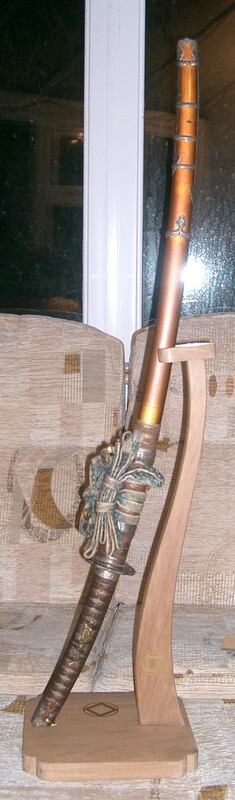
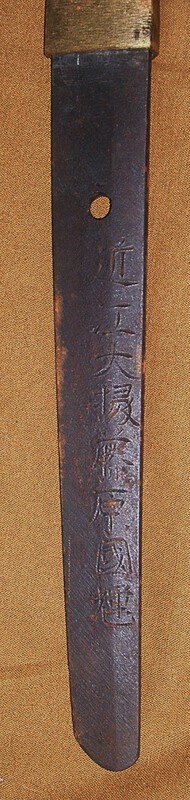
Dear Paul. There is a possibility here that we have not mentioned. There is a type of sword often referred to as a coronation tachi. The story goes that these very recent tachi were produced for the coronation of the Showa emperor. Some of them have Gendai blades made by smiths working at the time, some have older blades. It is conceivable that this rather utilitarian sword was recruited to serve in this capacity and that the rather sketchy horimono and mei were added to reference the tachi that Matt names, the "Kimi Banzai Tomonari". Perhaps someone with a distant family connection to the sword wanted to carry it as a symbolic reference to a great past. Whilst this will not satisfy your search for an oshigata for comparison purposes it might provide an answer that accounts for the fact that this is a true Japanese sword but with more recent horimono and mei. I have an example with a mei for Kuniteru though the blade is clearly of very recent make and has nothing to do with the smith named. All the best.
-
Dear John. It is not all that unusual to have a copper insert, usually gilt, to add a rim to the top of the fuchi. As this one is missing it's tenjo gane I presume the seppa was added to give it a completeness. The only iron fuchi that I have has a standard copper tenjo gane and is of standard shape but for some interest see the link at the bottom. If you scroll down there is a diagram of how some shapes of iron fuchi have the tenjo gane fitted in a different way. Given the shape of yours I can only assume that it has been lost at some point. I have seen iron fuchi which never seem to have had a base fitted but only on what used to be called Rebellion mounts. All the best. http://www.ksky.ne.jp./~sumie99/fuchikashiramade.html
-
Dear Harvey. It is hard to see but I think the third kanji might be no Kami. Have a look at Kawachi no Kami Kunisuke, I am fairly sure that the fourth kanji is Kuni. Hope this helps. All the best.
-
Dear Eric. Forgive me, I am not quite sure what you are asking. I would say that both examples are of medium quality though if I were to chose it would be the dragons. The blossoms are quite worn and of a type that is often seen, almost mass produced. If you want to understand quality in fuchi kashira you could do worse than go the the For Sale section then go to the Fuchi kashira Orphanage at about 6 post down some from Dale Garbutt. Good images of some lovely fittings. All the best.