Geraint
-
Posts
3,095 -
Joined
-
Last visited
-
Days Won
10
Content Type
Profiles
Forums
Events
Store
Downloads
Gallery
Everything posted by Geraint
-
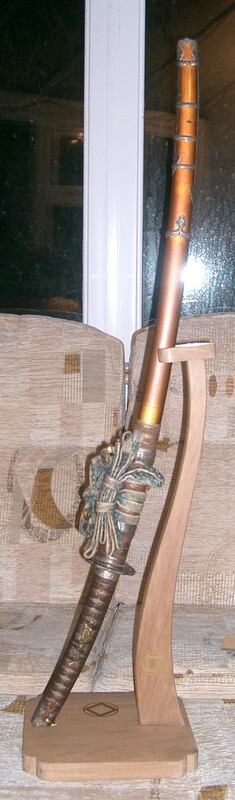
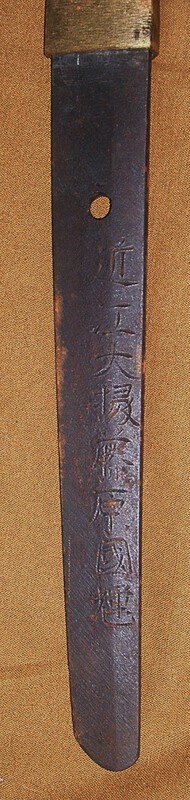
Dear Paul. There is a possibility here that we have not mentioned. There is a type of sword often referred to as a coronation tachi. The story goes that these very recent tachi were produced for the coronation of the Showa emperor. Some of them have Gendai blades made by smiths working at the time, some have older blades. It is conceivable that this rather utilitarian sword was recruited to serve in this capacity and that the rather sketchy horimono and mei were added to reference the tachi that Matt names, the "Kimi Banzai Tomonari". Perhaps someone with a distant family connection to the sword wanted to carry it as a symbolic reference to a great past. Whilst this will not satisfy your search for an oshigata for comparison purposes it might provide an answer that accounts for the fact that this is a true Japanese sword but with more recent horimono and mei. I have an example with a mei for Kuniteru though the blade is clearly of very recent make and has nothing to do with the smith named. All the best.
-
Dear John. It is not all that unusual to have a copper insert, usually gilt, to add a rim to the top of the fuchi. As this one is missing it's tenjo gane I presume the seppa was added to give it a completeness. The only iron fuchi that I have has a standard copper tenjo gane and is of standard shape but for some interest see the link at the bottom. If you scroll down there is a diagram of how some shapes of iron fuchi have the tenjo gane fitted in a different way. Given the shape of yours I can only assume that it has been lost at some point. I have seen iron fuchi which never seem to have had a base fitted but only on what used to be called Rebellion mounts. All the best. http://www.ksky.ne.jp./~sumie99/fuchikashiramade.html
-
Dear Harvey. It is hard to see but I think the third kanji might be no Kami. Have a look at Kawachi no Kami Kunisuke, I am fairly sure that the fourth kanji is Kuni. Hope this helps. All the best.
-
Dear Eric. Forgive me, I am not quite sure what you are asking. I would say that both examples are of medium quality though if I were to chose it would be the dragons. The blossoms are quite worn and of a type that is often seen, almost mass produced. If you want to understand quality in fuchi kashira you could do worse than go the the For Sale section then go to the Fuchi kashira Orphanage at about 6 post down some from Dale Garbutt. Good images of some lovely fittings. All the best.
-
Yoshifusa, Previously Known As Tadafusa [Tadayoshi School]
Geraint replied to KarlPeterSmith's topic in Nihonto
Dear Steve, The freedom for which you fought also includes the responsibility to analyse critically and to form reasoned judgements about what is said. Critical debate is what freedom of speech is all about. No one has silenced this post, indeed some of us have worked at understanding it's central point. As this is not the first time that we have encountered that difficulty with this series of posts some members have made a critical observation. If I had laboured long and hard over an intellectual study and shared it I would want others to understand my point, if they did not then I would be at pains to explain it. All the best. -
Dear Chris. Like Stephen I have a fondness for copper fittings. I would suggest falling rain as a them and a koshirae like this would suit I feel. But of course that is a matter of taste and aesthetics. It's a nice tsuba! All the best.

-
Dear Paul. Can you remove the habaki and take a shot of the area underneath it? That might help us. Also if you can get up to London to one of the Token Society meetings and show it to some of the guys they will be able to see much more with the blade in hand than we can from these images. I'm a fair step from you but if you happen to be coming down this way on holiday I'd be happy to oblige. One other thing, does it have koshirae and if so what's that like? Still hoping for a positive outcome on this one. All the best.
-
Dear Charles. Your memory is serving you well, ireko saya, have a look here. http://www.militaria.co.za/nmb/topic/19657-my-new-ireko-shirasaya-by-john-tirado/ All the best.
-
Dear Chris. Interesting seppa dai, don't you think? All the best.
-
Dear Arnold. What do you feel about the hada as far as it is visible in image %? All the best.
-
Dear Bill. I think Arnold may have been referencing a typo in your first post. An interesting and unusual koshirae! All the best.
-
Dear Scott. As this is a well known smith there will be abundant evidence available however, while comparing mei is useful what does the rest of the sword tell you? If the sugata is right for the period and the work in the blade corresponds to what you would expect to see from the smith then it's worth showing it to somebody. All the best.
-
Dear James. Welcome to NMB! A good find. You are correct in that it looks to have been mounted for use in WWII. If the length from tip to machi is 25" then it is a katana, the dividing line is 24", I believe the mei says, "Hizen no kuni no ju Norisada", if I have missed something then I will soon be corrected. It looks like civilian tsuba and tsuka which is not that uncommon and as far as that part of the sword goes some menuki and a re wrap and it will be as good as new. The blade needs some TLC at the moment and you are probably going to have to decide whether it deserves a proper polish. I would suggest the first thing to do is lightly oil it and then try to get it to either one of the members here or a sword club or show and show it in hand to someone who can advise you about what to do. Don't rush and above all don't give it to anyone who tells you they can polish without checking here first; many think they can polish and many ruin swords in the process. I can't tell you if the mei is genuine but there is a lot of information out there about Hizen swords and several people who focus on them as a collecting area. Enjoy! All the best.
-
Dear Claudio. Welcome! Please add your name to your posts as we all do here. I am sure that you know what you have got; the habaki is pretty standard though with some decoration, the menuki looks quite nice, the kashira are past it I think. Habaki do not command much value on their own as they are made to fit a specific blade and the chances of getting this one to match a blade are very slim, good to look at it and see how it is made. For the other fitttings photographs of the backs will tell us more. If you look at the Links at the top toolbar you will find many things to help you learn what good fittings look like and to put yours into context. Above all else enjoy! All the best.
-
Dear Arnold. I think the devil is in the wording here. As a young cyclist I was told that filling down the lugs on a cycle frame to a taper removed metal but made the frame stronger. Like you I found this implausible but it turns out that it is correct because the thinning of the lug alleviates a stress concentration and hence potential crack. In this specific case I think the best analogy is an I beam. Under load the tendency for the beam to distort is greatest at the horizontal planes of the top and bottom of the beam, so the vertical section of the I serves to keep the two horizontal sections in position but adds little to the overall strength of the beam. Bo hi in swords create almost the same structure and reduce weight without significantly weakening the sword. Hope this helps. All the best.
-
Patric. As Stephen and Ray confirm this is a Chinese fake of a Japanese sword. It is not going to get any better no matter how many times you post it. All the best.
-
Dear Richard. You can add your name to your posts so that it appears every time. If you can find a video of a smith signing a sword you will see that the chisel is used in a way that will generate this stepped appearance to the strokes. Part of the way of looking at a a mei is the way in which the discrete strikes of the hammer generate the single stroke of the kanji. All the best.
-
Dear Kubur. In the short term tying some matching thread around it to hold it in place is all you can do. Once it has reached this stage it is very weak and will sometimes fall apart at a touch. Re binding is considered a standard restoration and will add to rather than detract from the sword as long as it is done well. Something to think about when you are ready. All the best.
-
And a nice tsuba! Congratulations. All the best.
-
Dear Kubur. Your sword seems to have a very elegant sugata. Could we see a picture of the whole blade, nakago included? That will help with the date. It's a nice find, you will have to consider the restoration at some point but take it slow and seek advice. Looking forward to what this one turns out to be. All the best.
-
Nice helmet Maurice. All the best.
-
Dear Ray. I suspect that it might have to do with the koshirae, tachi koshirae are not that common, even these recent ones. All the best.
-
Help Authenticating Some Swords
Geraint replied to Tdognc's topic in General Nihonto Related Discussion
Taylor. I agree with Brian and you have already got good instincts. The first two are the only likely candidates but they are in poor condition and will not repay restoration costs. The leather wrap is genuine, not a vet modification though something strange has happened to the kashira, like it's been replaced with an odd fitting. The sword with the blue wrap has been redone badly and all in all you have two pretty low quality swords. I don't think I'd be parting with any cash for these, even if they are really cheap all you will end up with is a sword that no one wants to see or own. I still have the one like these that I fell for. Pre internet a friend went to see it at auction and said it was in amazing condition for it's age. Well,...........let's just say it's a good way to learn about flaws and draw a veil over the thing. Don't give up, a trip to the show will blow your mind as will a trawl through the link that John suggested. All the best. -
Saw a fascinating programme a while ago which looked in detail at the Chinese fake porcelain market. Two experts, both Chinese, one a collector and one a dealer explored the fake market and found out some interesting things. The quality of what is being produced at the top end was so good that neither of them could tell which was genuine and which was fake even after detailed in hand examination. As the market for high end Chinese porcelain has gone through the roof recently it was worth the fakers time to produce forty or fifty trial fakes of a specific piece in order to get one that was just right. It would then find it's way onto the open market via a western auction house where silly money would be exchanged for it and it would be brought back to China to reside in a collection or museum. Several years ago there was a bit of a furore in Japan when a number of very early swords started turning up in remarkable condition, many of which were papered. As I recall questions started to be asked and a symposium of experts and smiths discussed these swords and recognised the hand of a fellow smith. Very close to where I live there was a very gifted metalworker who resented the old saying, "You can't get work of this quality anymore." It was said to him by the owner of a collection of fine antique guns. The metalworker accepted the challenge and made an exact copy. He used the correct materials and made it just as the original would have been made. The collector was impressed, so much so that he couldn't resist the urge and asked the metalworker for some more examples. You can guess where this is going, can't you? Before long they were entering the market and a well known and respected local dealer who did not spot them had traded many of them all over the world. An expert at a major London auction house finally spotted something fishy and when it all came to trial the local dealer testified that if the man had lived in the 18th century he would have been acclaimed as one of the great gunsmiths. As it was he ended up in court. The point of all this is that what we love is the product of human endeavour, albeit sublimely skilled. Given enough determination and skill there will come a time when we really won't be able to tell the difference. Some of us have spent many thousands of hours getting our eyes tuned in and can spot the fakers relatively easily still. However this particular forge is making quite a bit of money, presumably out of people who have not quite got their eyes tuned in. Given a year or two the swords will have acquired a bit of age and will be harder to spot. Makes for interesting times, don't you think? All the best.
-
("Name please". It's at the top of his post Grey.) Michael, lots of Japanese swords have no signature for varoious reasons so don't believe all you have been told. Grey has given you the answer, it's a genuine sword though it has been mistreated. Follow his link and see if you can get ti to one of the sword society's for someone to have a good look in hand. Take care of it and don't be tempted to have a go yourself. Here is an example in good condition, https://www.aoijapan.com/wakizashi-tango-daijo-fujiwara-tsuneshige/ Just to get you interested. Welcome to NMB and this crazy world. Enjoy. All the best.