Geraint
-
Posts
3,109 -
Joined
-
Last visited
-
Days Won
10




Geraint's Achievements






-
Dear John. I think that if you look closely at the top kuchibeni in the third picture you can see that they are solid inserts. All the best.
-
Japanese sword, mumei, civilian mounts, WWII adaptation?
Geraint replied to Nafta's topic in Military Swords of Japan
Dear Naftali. As Lewis has pointed out the ha machi and mune machi, the shoulders where the habaki sits, are not level and this is a characteristic of Chinese fake swords. However in this case I suspect that someone not familiar with Japanese swords has made a new habaki and modified the blade to 'make it fit'. A proper habaki should have a notch in the back that slips over the blade and fits against the mune machi, the step at the back, while the edge side should have a slot that fits closely around the edge of the blade. If you look closely at the shoulder next to the edge can you see if the blade has been recently modified there? If this is the case then an amateur habaki might also account for the extra set of seppa. All the best. -
translation requested shodai Tsuhuguhira Wakizashi's sayagaki
Geraint replied to Volker62's topic in Translation Assistance
Dear Volker. I believe the paper specifies nidai, the two kanji in parenthesis after the signature line on the origami. All the best. -
Dear Aaron. Welcome to NMB. You have done nothing wrong I assure you, it is simply that getting you any further forward is almost impossible. There are between forty and fifty smiths recorded signing Yoshikuni with these two kanji and while most of them can be discounted because of the age of your sword there are few indicators that might lead to an attribution. Add to this the possibility that this might be a spurious signature, called gimei, a very common thing especially with the names of good makers. However I think it unlikely that this would be the case with a two kanji mei like yours, after all why not go the whole way and sign the full mei if you want to deceive? To quote from a 2013 post by Gabriel, 'The second smith or smiths, Onizuka Yoshikuni (YOS 275-279, not clear which of these is one smith or multiple), is much closer in terms of the handwriting style, but close inspection yields several possible differences in chisel marks and angles. What is more, Onizuka Yoshikuni smith(s) allegedly signed with at least Onizuka Yoshikuni, not just "Yoshikuni" on its own. Based on these two points, I'm not certain one could connect your blade to this series of smiths based on the mei alone.' I am sure that others will add opinions, it would help to have some good photographs of the blade and its workings. Whatever the outcome it is a very attractive blade and I do hope you enjoy it. Your only certain option is to get the blade to a properly accredited shinsa team, sometimes these are arranged to coincide with Japanese sword shows in the US. All the best.
-
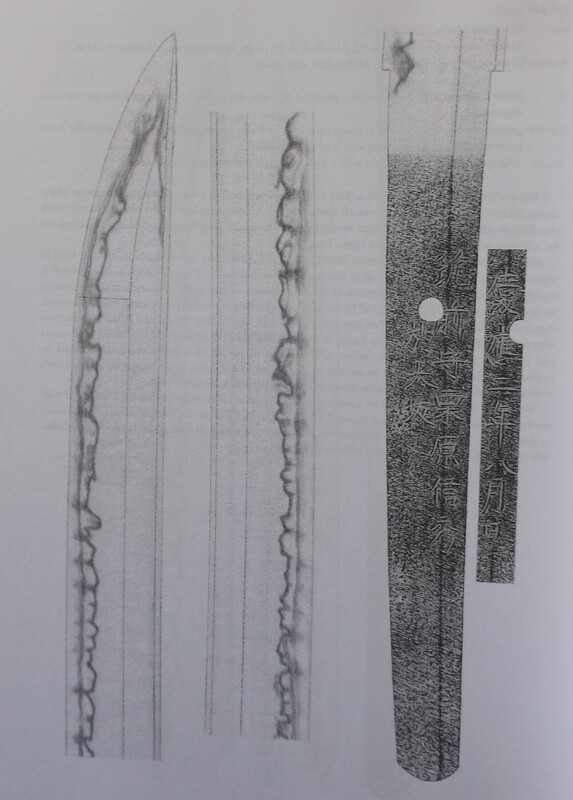
You did what? Most of us would have expected an extra nought on that I guess. Here is some relevant information from Markus Sesko, 'Shinto and Shinshinto Kantei' to be going on with, well worth getting a copy. All the best.

-
Steady Boy, steady! Whatever happens this is a very nice sword in attractive koshirae, you did well. It will still be that even if you conclude that it is gimei. Remember that big names are often gimei though it is distantly possible that this came to the UK soon after it was made. Lots of possibilities. Now come the hard yards. You need to start comparing papered examples and soaking up the detail, nakago jiri, yasurime, placement of the mei, style of kanji and so forth. Take it to a Token Society meeting and see what others think. ( Don't be tempted to take a low ball offer.) This is why this hobby is so exciting so enjoy! Just got back home so will do a bit of digging. All the best.
-
Dear Mark. I will have a look through my sources later on today but for now have a look here, page 31 I think, https://new.uniquejapan.com/wp-content/uploads/2015/06/21-Antique-Shinshinto-Japanese-Swords-For-Sale-From-Unique-Japan.pdf You know the mantra, big name smith likely gimei until proven otherwise, the fact that you do not see a match in a web search of papered examples suggests this to be true for your sword. Forgive me if I state the obvious but a Shinshinto sword, unless badly neglected, ought to have a nakago which shows clear detail and so the shape and the yasurime as well as the position of the mei should all be easy to see. Another factor is that some smiths have very distinctive 'handwriting' and that should be an easy thing to spot. If you have an image of the whole nakago that might be useful. I'll see what I can find for you later on. All the best.
-
Dear Sebastien. What a nice problem to have. Some questions to ask in your search. Are the HIrata the only people who understood shippo? Clearly not. Does this kozuka fit into the known body of Hirata work? Well most examples of Hirata work do not look like this. In another thread on NMB someone lamented that most of the pieces revealed by a search were attributed by Bonham's, herein lies the problem. Almost everything with shippo is claimed to be Hirata, especially by those selling the piece. Your butterfly appears to have gold cloisonnes and to be finely done. Is this a kozuka by Hirata or one with added decoration by them? A bit of information here, https://www.silk-road.us/hirata.html The tsuba in the link without the shippo would have been suggested to be Ichijo or one of his atelier, was he capable of doing shippo of this standard? Almost certainly so. Was the Hirata school capable of making a plate in this style? Certainly. Whatever you conclude this is a lovely piece to have in your collection. Enjoy as I am sure you will. All the best.
-
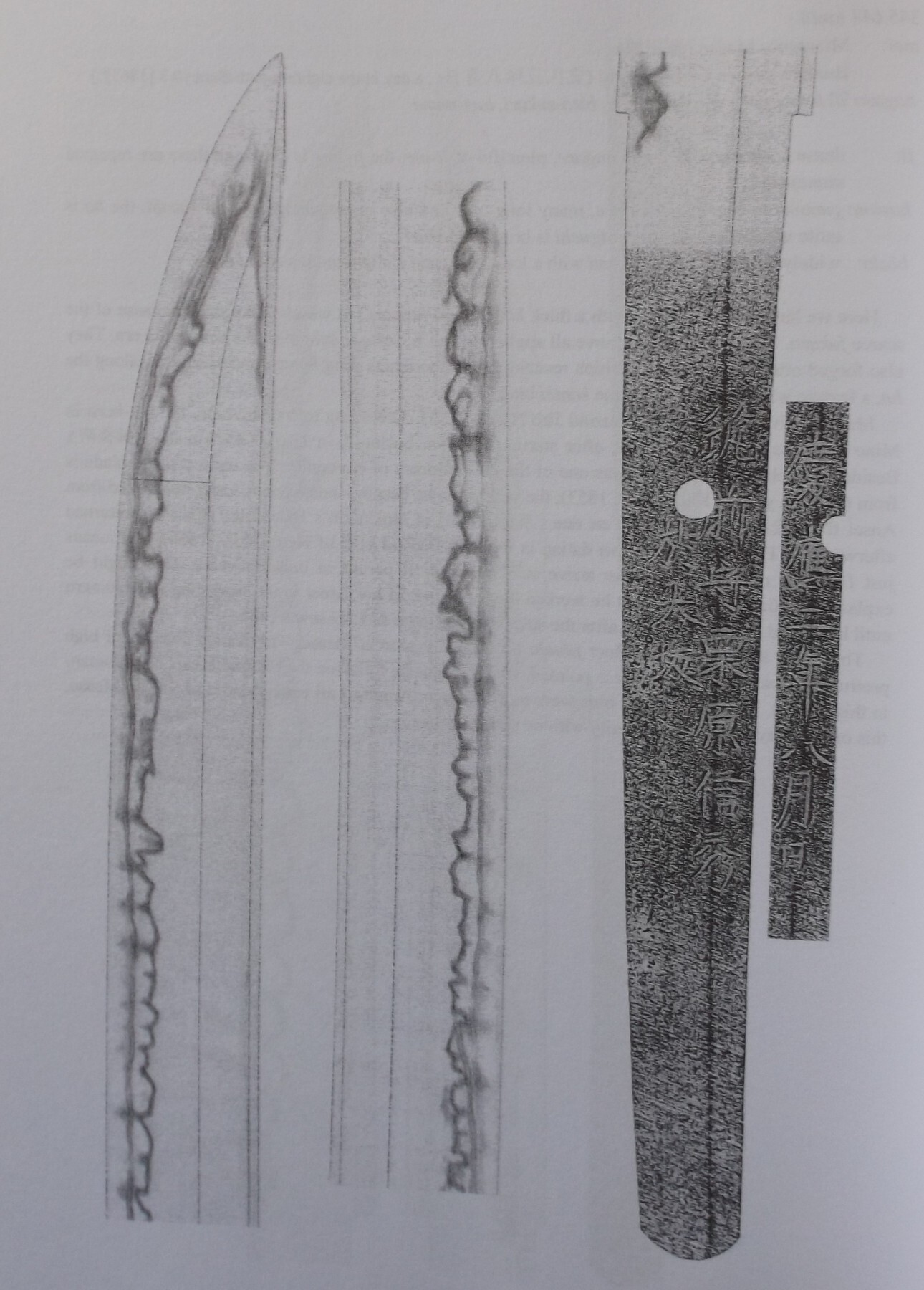
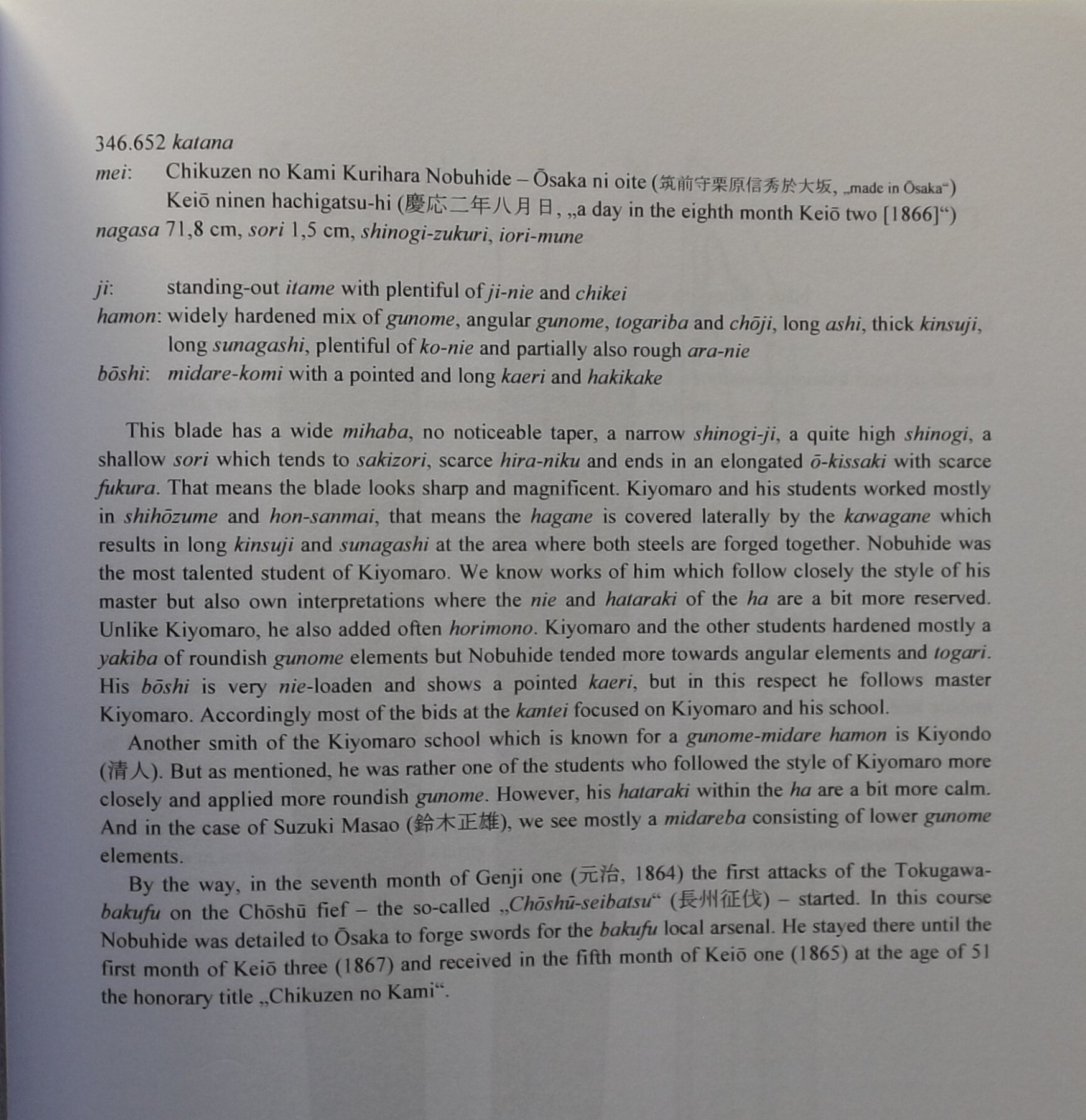
Dear Mark. Well you're in for some fun! Start researching Chikuzen Nobuhide. All the best.
-
A Naval Kyu-Gunto by Teruhiro
Geraint replied to Marcus Devonport's topic in General Nihonto Related Discussion
Dear Marcus. What's not to like? Super blade in good polish with papers and accompanied by Naval mounts in great condition with a silver Saki mon. Pleased for you that your negotiations payed off and that it now resides in your collection. All the best. -
Fukurokuju is often depicted with a scroll, and the pyramid shaped item on the fuchi is his backpack? Anyway, check him out and see what you think. All the best.
-
thoughts on this mei please. Kikumon mark.
Geraint replied to Damian's topic in Translation Assistance
Dear Damien. You might have a look at this thread, Ignore the first one and take a look at the second example posted. Not sure how much you already know so please forgive me if I state the obvious. When a sword is signed by a well known smith there is always a high percentage chance that it is gimei, a false signature. The placement of the signature on the nakago, the style of the cutting, the file marks and the shape of the nakago all come into play. That may or may not be the case here but whatever the outcome this is still a nice sword and mounts. A picture of the whole of the nakago/tang might be helpful. Enjoy. All the best. -
Dear Max. I don't see a problem with your tsuba. The auction house were optimistic likening it to lot 81 in the Goodman sale as that one is larger, signed and of better execution than yours, they would have been more truthful to compare it to this one, https://www.bonhams.com/auction/22472/lot/79/a-soten-style-tsuba-edo-period-19th-century/ Yours seems to have been mounted with consequent wear on the seppa dai but I can't see any red flags. Enjoy. All the best.
-
Dear Richard. I agree with Oliver that these are a nice pair of blades and that these are by the two different smiths. An examination of the three kani that the blades have in common suggests that they are by a different hand. Hawley supports the text that Oliver has supplied listing Unshu Takahashi Naganobu as a student of Tsunatoshi and working 1830 - 64 while Unshu Takahashi Ribei Naganobu, working at around the same time is the one for whom the brief note that 'he never signed the same way twice' is added. Looking at available papered examples on the internet I think I can see a pattern emerging where both these sets of kanji are echoed, also have a look at nakago jiri, again I think there are two styles. For what it is worth I take the remark about signature variations in Hawley to mean that he inscribed different things on his swords rather than that his handwriting, as it were, changed. (Given the change between kaisho and gyosho) If there are two smiths then for all the examples I have seen so far everyone assumes that their sword is by the most well known smith and hence the most valuable. Where biographies are given they are almost identical and probably from the same source. I have only done a fairly cursory search using easily available sources but if the nakago jiri on your swords are different then here are some possibilities for you to consider. 1 The same amith changed the way that he inscribed his signature and the nakago jiri that he produced, possible as a consequence of studying with Tsunatoshi and both your blades are by him but from different periods in his career. 2 Two smiths exist and you have a blade from each of them in your daisho. Have a dig around and see what you conclude. Of course it is possible that this conundrum has already been researched given the significance of Naganobu and that another member will come in with an authoritative answer. Hope that I haven't muddied the waters. All the best.
-
I do love the Wallace Collection. Not very much at all Japanese, last time I visited I think two or three swords, but extensive collections of European arms and armour including some very early pieces and a fantastic selection of very fine indo Persian weapons. If you don't know it there are some excellent videos with Matt Easton of Scholagladiatoria and Dr, Tobias Capwell from the Wallace Collection on Youtube. Might whet the appetite! All the best.