


paulb
-
Posts
3,046 -
Joined
-
Last visited
-
Days Won
73
Content Type
Profiles
Forums
Events
Store
Downloads
Gallery
Everything posted by paulb
-
Dear Vincent Blades can be easily damaged if they are heated. In a country where buildings were primarily made of wood and paper and where there was almost continual conflict over the centuries fire was a major problem. As a result many blades were damaged in fires. Taking a blade above 500 deg c will destroy the hamon so it was not unusual for blades to be retempered. In Markus Sesko's book on Masamune I think there is at least one blade that was retempered by Yasutsugu on instruction from the shogun. The problem with retempering (re-hardening) a blade is that the resultant shape and hamon are no longer the work of the original artist. It is a little like having a severely damaged painting restored by more than 50% by another painter. While it may be competent it isnt original. Therefore it is not regarded as being completely authentic. I know that very important blades which were fire damaged were retempered. I am guessing that it was also financially preferable to have a sword retempered rather than replaced, which would explain why what might be considered as lesser works might also go through the process. I am not aware of this being done as an attempt to modify or disguise a work in an attempt to make it look like something better. While not always easy identifying saiha blades is not that difficult to a trained eye and immediately devalues the piece. therefore I doubt it would be undertaken unless it was really needed.
-
Well done Barry and especially Andrew. It realy is a beautiful piece and the polish looks fantastic you are rightly proud of it. When I met Andrew in Japan last October we discussed the merit of sending swords from Europe to Australia as an alternative to getting tied up in the logisitical and communication issues some have experienced in Japan. The evidence of this work makes it look like a very real alternative I look forward to seeing more examples of your work in the future Best regards Paul
-
Small Reputation - No Masterpiece
paulb replied to BIG's topic in General Nihonto Related Discussion
Franco you are absolutely right. I confess I have seen blades attributed to top smiths that I found as appealing as a yard of pump water. I am still not sure whether it was simply my lack of understanding or the smith having an off day. But I have then seen work by the same man that I believed absolutely fabulous. As an example I remember seeing an o-suriage Juyo Rai Kunitoshi wakazashi at a well known saleroom some years ago that seemed devoid of any activity. Soon after I bought an o-suriage Enju piece that I still have and which I regard as absolutely stunning. Of the two I know which I would prefer to have and it wasnt the famous smith's work. . Each sword has to be judged on its merits and against your own personal preferences. (BTW I have since seen several Rai Kunitoshi works that confirmed my original high opinion of this master smith) -
Hi Vincent No it wasnt the one I was thinking of. Its a little like being in the same industry for many years you start to think you have seen everyone you meet before! Thank you for the extra images which confirmed it wasnt what I remembered. I think I would stick with one of the more country schools as have been mentioned previously, Kongobye or Uda are certainly worth investigating but there are several others around the same area and period producing similar. I think you need to see it in hand to understand what is going on with the strong masame running towards the hamon. I would be interested in hearing more from you as you study it in hand and research it further. good luck Paul
-
Small Reputation - No Masterpiece
paulb replied to BIG's topic in General Nihonto Related Discussion
Hi peter It is often said that all schools and smiths have their masterpieces and certainly I have seen a number of blades that seem a level above what you might expect from a given school or smith. I think you see it more often in Shinto and shinshinto work simply becasue there are more of them around in good condition. Lesser koto work was either destroyed in use or worn away. so relatively speaking only the better work was cherished and preserved in really good condition. -
I think your opinion is always worth listening too and on the plus side I think your Uda suggestion is perfectly feasible so dont be too hard on yourself
-
Hi Vincent I am probably wrong but I feel I know this sword, It might be one I sold for a friend some while ago. I remember the painted horizontal 3 on the nakago What did the seller say about it? I think the horimono is a later addition not least becaue of its placement on an O-suriage blade. I dont believe whatever it symbolises relates to the smith. While it looks to be a perfectly reasonable blade from the images I dont think it is Rai. I can see why you might think Yamato but would also look at Kongo-Bye as another possibility or other Yamato based schools such as Kanabo. Regards Paul
-
Possible Nidai Tadahiro - Hizen School Sword, Need A Little Advice
paulb replied to Gingerbeard's topic in Nihonto
Higlenn Good news from Roger and certainly he has a much deeper knowledge of Hizento than me (or probably most everyone else). Let us know how you progress with this, if you take it to shinsa and the result good luck Regards Paul -
Possible Nidai Tadahiro - Hizen School Sword, Need A Little Advice
paulb replied to Gingerbeard's topic in Nihonto
Darcy As always I enjoy your thought processes when looking at blades and I agree with you 100% that Nidai Tadahiro showed great variation in his work over a very long period of time. I studied Hizen blades for many years prior to falling victim to the koto bug and have held several in my collection over the years. . While I agree that the sugata varies a lot one thing that is constant is his blades always have an elegance about them. I think that is lacking in this sword. whether that is due to subsequent alteration or damage I would not like to guess. Again the mei did vary a lot over the years and this variation added to with Daimei but the characters on this sword look very clumsy and contrived. I would never try and reach a definitive conclusion on a blade in this condition or from images (in fact I am not sure I would ever reach a definitive conclusion) however based on what I can see, the fact that there are very many gimei inexistence and there are so many question marks I would tend towards the gimei rather than anything else. Of course to progress the blade would need to be polished and put in front of a shinsa panel for a more definitive conclusion -
Possible Nidai Tadahiro - Hizen School Sword, Need A Little Advice
paulb replied to Gingerbeard's topic in Nihonto
Unfortunately the condition of the blade doesn't allow sight of any detail so initial assessment is based on what you can see which is thee shape and the mei. My immediate feel is that the mei is wrong. It is clumsily cut and thee characters just don't look right. However this is done from memory so it does need to be checked against valid signatures. As your original advisor said Nidai Tadahiro made a lot of swords in a career that extended for more than 60 years. Having said all that I still think it is gimei. Second is the shape. This lacks the elegant proportion you expect to see in a Hizen blade. Again it should be assessed in hand The above does not mean it is a bad sword if you are going to try and pass off a blade as being by one of the best Shinto smith it has to have some quality. So I think it would be well worth taking it to someone with more experience at a show and let them see it in hand -
The Atari (correct) answer in Nbthk kantei is, as Jean says, given to different answers. However this follows fairly strict guidelines. If it is recognised that smiths of a given school all produced very similar work as is the case with ko-Enju, Awataguchi, Hosho, Kozori etc Atari will be given for smiths recognised as working at the same time alongside the signed smith. Also Teacher/student or father/son relationships are often accepted. These are judged on a case by case basis. Going back to the original reasons for doing kantei which was to date a blade agree oin its quality, school and then smith in that order. The key factor I have found in accepting alternatives is related to period. If it is the same school and named smith but you are out by a couple of generations it will not be accepted
-
Hi John Biggest initial problem is that someone has cleaned the nakago which will immediately reduce the value.
-
James You have just proven to yourself and I hope many others something a number of us have been pushing for some time. Kantei is an excellent learning tool, regardless of whether you get to the right answer or not. As you said it forced you to study a tradition and school you might not have otherwise looked at. As a result you have learned more about Yamashiro work than you knew before. BTW two hours is nothing, I can spend days on some of the NBTHK kantei when things dont seem to fall in to place. Well done in reaching the right result.
-
Dear??? Pictures will help when you can post them but based on what you have said some points to consider: 1. Someone took a Sue Bizen blade and added a signature to increase value. Older doesnt necessarily mean fmore valuable, and certainly a Yoshimichi would be worth more than a sue Bizen mass produced blade 2. Not all Yoshimich blades have a kiku mon or sudare-ba 3. If the mei doesnt match any illustrations you have found and there are none of the common charateristics you would hope to find for the named smith then your first impresion of it being gimei is probably correct. As said above when you can post some images it would help answer in more detail Regards Paul
-
Dear Vincent This has been much discussed not only here but in most sword groups around the world and there are differing opinions. The following is my opinion nothing more and others may differ in their view You are correct that the problem originated around lower level papers issued by branch offices of the NBTHK. There are many theories as to how and why but basically inaccurrate, optimistic or just plainly wrong papers were prodcued. It is unlikely that these were produced in large numbers. However the fact they existed at all cast doubt on others to the point where some seem to believe that all and every earlier paper was fraudulent. I seriously doubt this to be the case. However the lack of confidence in the earlier papers led the NBTHK to introduce the current papering system and invite swords to be resubmitted. I think you are right in assuming that papers issued by the HQ are more likely to be accurrate than not. Also higher level papers were faked less ( I am not aware of any Juyo papers being discussed in this context) I think many, in fact most, green papers are accurrate. Especially those issued in Tokyo HQ but as collectors in general become increasingly to reliant on papers to confirm authenticity the fact that fraudulent ones exist destroys confidence and credibility. The best way to reach a conclusion is to study the sword in detail compare it to published examples in literature and if possible in hand. Or resubmit it for repapering.
-
Dan you are absolutely right that Kantei is a very useful learning tool, if not the best. Originally the process was aimed at establishing 1. Is it a good sword 2. What period does it come from and finally 3. What School and if possible smith The form Jean uses is great I came across it for the firs time at the kantei event at the DTI last year and asked Robert Hughes for a couple of copies. I think it forces you to look in a disciplined and logical way at the features that wil leadyou to an answer. Regarding Jean's sword, which I think is stunning I am going to decline to comment as I think I know it quite well and to offer an answer might be considered cheating
-
Which "other" Category Is Most Complementary To The Sword?
paulb replied to seattle1's topic in Other Japanese Arts
Hi Arnold As Brian says it is a big question. Along the way in my sword studies I have found that I have been increasingly drawn to other fields. The obvious next step was in to fittings but I have tended to find it difficult to understand some of the aesthetics of tsuba that seem to excite the more knowledgable. I then started looking at other metalwork such as bronzes, vases etc where similar skills in working metal and patination are applied. Then on to painting (I was already there with a love of European art) and woodblock prints. More latterly my wife has been leading me in to ceramics as well. So I guess it is all and everything. However I still believe that looking at a fine blade encompasses so much of the skills seen in other fields it offers a concentrated "hit" of the Japanese aesthetic. -
Still Trying To Narrow Down-Muromachi-Too Long? Hada?
paulb replied to jensen6865's topic in Nihonto
Dan Attached an image of a section of a Shikkake blade which shows nie in both hamon and jigane. If you want some additional examples from other schools let me have your email via pm and I will see what I can find.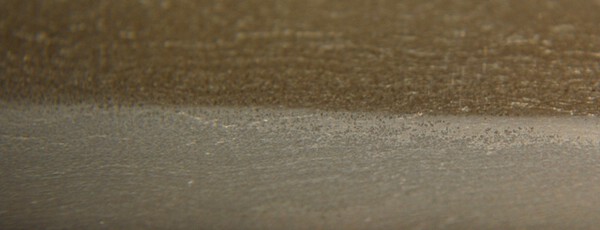
-
Still Trying To Narrow Down-Muromachi-Too Long? Hada?
paulb replied to jensen6865's topic in Nihonto
thank you Jean that is a much more concise description than my rambling -
Still Trying To Narrow Down-Muromachi-Too Long? Hada?
paulb replied to jensen6865's topic in Nihonto
Hi Dan I can only tell you what I mean by tight nioiguchi but it is not a formal definition. When you look at the hamon on some blades the line of nioi that creates the hamon is relatively broad with "soft" borders (In NBTHK Kantei desriptions you oftern find the term "worn down" to describe the look), look at blades by Osaka smiths such as Sukenao, or Sukehiro to see this, On others the hamon is more narrow and much more clearly defined as can be seen in your sword. This is what I mean by "tight" (others may call it something else). I have seen this clearly defined hamon on Enju and Mihara blades and I am sure on many others. I thionk it is more prevalent on swords between the end of the Kamakura period and the begining of the Edo period, so later koto works. but I am sure there will be examples from other periods as well. -
Still Trying To Narrow Down-Muromachi-Too Long? Hada?
paulb replied to jensen6865's topic in Nihonto
Dan I am not going to be help you too much as I cant see enough of the detail you describe in the images (partly my eye sight , partly images and partly polish) In the kantei sheet you mention Rai hada. Rai hada are dark patches of grainless steel within the jigane. They are similar to Sumi-tetsu in Ko-Aoe blades and Enju hada in Enju. My feeling is they are all much the same thing which are patches of very hard steel within the laminate. There is a school of thought that it is core steel (shingane) showing through but this is generally courser and more open in texture. I cant see evidence of Rai hada in your sword. I do not think your sword is a Rai blade, I cant really pin down why, it just doesnt look right for one. The tightness of the nioi guchi which if it also includes a lot of nie as you suggest might indicate enju or mihara work. I know you mention it doesnt have a high shinogi and discount mihara but these features are relatively subtle and t the comparative height of the shinogi not always apparent. On the sheet you describe it as koshi zori, can you check this as it could be important. When a sword is shortened you loose a lot of the original shape a koshi-zori blade will become straighter and torizori. If there is still koshizori present in your sword? it suggests either it has not been greatly shortened or it had a hell of a koshizori kick originally. Try and imagine what the original shape would have been this will help you a lot with both period and school. The problem is is that as you move in to the muromachi period much of the work of Bizen, Mino, Yamato all start to share common features as they try to emulate the popular Soshu work. Therefore telling the difference between soden Bizen, Sue Seki or Sue-Mihara, Enju etc especially when a blade is out of polish, tests even the most experienced of apprasiers (which I dont think any of us claim to be ) It is an interesting work with some potential. I would get it in front of a qualified polisher and get their opinion regarding whether it will take a polish (cant see anything to suggest it wont) but until all detail is clearly visible you are going to struggle to get much beyond where you are. -
I wrote to FeDex last week both via there customer service email and in hard copy (that really confused the man at the end of the phone as he had no idea what their mailing address was) I received their standard email reply saying they hoped to respond within 24 hours. They didnt. I emailed again today sending another copy of the letter. I have been given a contact name and told they will contact me shortly. I will update you if and when I hear anything Regards Paul
-
At the Chiddingstone event last year Raoul gave a lecture about the use of polearms. Unfortunately because of other duties at the time I only caught part of the lecture but if I understood correctly he was dispelling a number of misconceptions regarding the use of naginata as a defensive weapon or by women. His view was that certainly pre Edo it was used effectively on the battlefield as an offensive weapon capable of inflicting great damage. I wonder if the idea of it being used by women came out of martial art practices where women with naginata competed with men with swords (not my area so this may be more common than I realise) rather than historical use as weapons.
-
Shipping With Fedex To The Uk
paulb replied to Nickupero's topic in General Nihonto Related Discussion
Hi Nick I have started (today) a detailed correspondence with FedEx to try and see what has motivated this change and if we can get them to reverse it. I think the important fact is that similar moves by the Japanese postal service have been modified (I am told) and now FedEx competitors stand to gain at their expense. More importantly it has had a major negative impact on their reputation amongst our global community. watch this space but dont hold your breath. Re smoothing the transisition I am afraid EMS/parcelforce are inconsistent, it depends who is on duty and the current workload. The only thing I can suggest is to make sure all the supporting documentation is fixed on the outside of the container. This should have invoice, a photocopy of any papers and a statement which includes the tariff code. The more you show you know what you are talking about the less likely they are to question it. But as I say they are not that consistent. It takes longercan be frustrating but things do get where they are supposed to be and the charges are in line with government tax policy. -
Shipping With Fedex To The Uk
paulb replied to Nickupero's topic in General Nihonto Related Discussion
I regret the situation seems to be changing rapidly and not for the better. I have always relied on FeDex as their ability to clear customs quickly made them a better option than Parcelforce (same group as Royal mail) However when I asked them recently they told me they would not ship swords in the future. I understand from a recent post that Royal Mail have softened their stance on antique swords but havent tried it. Parcelforce who typically handle EMS and USPS deliveries dont seem to have a problem delivering but do take their own sweet time getting things cleared through their customs centre at Coventry. Having said that a friend received his sword from Japan EMS/Parcelforce with no prblems less than 3 weeks ago. As you say they key point is having very clear and accurate documentation. This may change again but was the case in February. Regards Paul

