paulb
-
Posts
3,046 -
Joined
-
Last visited
-
Days Won
73
Content Type
Profiles
Forums
Events
Store
Downloads
Gallery
Everything posted by paulb
-
pm sent
-
As it is confession time I admit the sources of the two scars on my hand couldn't be more different. The first, totally not Nihonto related was a severe slash inflicted by a baked on piece of roast potato I was trying to seperate from a baking tray The second which is sword related was a Friday night expereince. I used to work for an incredibly talented but flawed gentleman who was in the habit of drinking too much and then calling members of his sales force to give them a hard time. His aim to prove he was in charge and hopefully ruin their weekend. This Friday was my turn and at 9.30 pm as I sat with a sword in hand the phone rang and the rollicking began. Half way through I stood up and watched with horror as the blade slid from the saya. I tried to catch it, which with hindsight was a mistake. 10 minute later I was still trying to get the drunk off the phone and stop bleeding on the floor at the same time. Moral of the story don't talk to drunks when you are holding a sword and beware of savage pieces of baked vegetable waiting to inflict pain
-
JP its a good question and unfortunately there isn't a conclusive answer. I think other than through destructive analysis once a sword is made you cannot conclusively tell whether it is made from Tamahagane or not. Some would argue that many of the features you see are in part due to the composition of the steel and you can get a very good indication but not 100%. The only way to be sure is to see it being made. Regarding smiths such as Yasutsugu who proudly inscribed they were using Dutch imported steel I dont think they were using it exclusively but as a component. The bulk of the blade was still made using traditional material. There is some debate as to whether it offered any benefit. The main one seems to be it was cheap and available. Also it offered an exotic twist in the sales approach "Using the latest innovation and foreign steel"
-
I go along with that. If size of library equated to understanding Iwould be issuing my own papers!! None the less I really love my books and yes they take a lot of room and no I don't use them as much as I should but when I need them they are there and full of helpful information.
-
Gentlemen, Please don't let an interesting thread sink in to a tit for tat debate. In reality it doesnt make any difference as long as you are clear on what you are talking about. My understanding has always been Showa-To- a sword made in the Showa period Shingunto - A new army sword. Over time they have come to have different emphasis but are not wrong. Coming back to the main point Should Shingunto have some form of authentication purpose that recognises their importance as a part of history? personal opinion Yes Should this be through the current authentication papers via NBTHK or the NTHK's? personal opinion no with the exception of those made using traditional material and by registered smiths. Regardless of how good the others are they are not Nihon-To in the true definition. To argue otherwise detracts from the value they do have as historical artefacts. With this in mind they should have a separate system (could still be via the previously named bodies) which clearly differentiates them from the original subject of papers but confirms their authenticity. I admit as a non Shingunto collector I feel I am trespassing a bit but I think the current situation has the potential to confuse and be detrimental to all.
-
no swords didn't only have one purpose. While their form followed functionality and that function was to fight, and yes kill, the resultant item transended that functionality in to something that has, for more than 1000 years, been regarded as art. It also represented something much deeper and dare I say more spiritual to the man carrying it. There is no doubt when holding a Kamakura period sword that it was a very effective weapon. The fact that so many have survived for 900 years in pristine condition suggests that many samurai regarded it as far more than just a weapon. JP I agree with you 100% that gunto blades have their place in history and are worthy of authentication and preservation. As said previously I think this should be done in a separate system that reflects their historical importance rather than trying to qualify them in a scale and system that they was never intended for them.
-
Hi Neil I think you make a very valid point and I can understand the passion and commitment shown by people who specialise in this area of collecting. It is no differnt to the passion others have for different areas of collecting. If I have an issue/concern about papers being issued for non-traditionally made blades it has nothing to do with the sword but what papers are for. There appears to be a shift in the reasoning behind issuing papers. Again this is fine if it is recognised and specified. what shouldn't happen is it sort of creeps in through the back door and then is justified after the event. Thats what appears to be happening at the moment. Originally (or at least as I understand it) papers were issued to help the occupying forces distinguish between traditionally made "Art Swords" and mass produced blades which were and still are regarded purely as weapons. The comments from the NTHK now seem to say that papers are being issued to recognise the historic significance of something and that it represents a period or a conflict in history. Again nothing wrong with that it just isn't what the authentication process and papering system was originally intended for. In being done this way without any official policy statement change and while, as far as I am aware Showa-To are still illegal to own or purchase in Japan it offers all sorts of possible interpretation. To the cynic this might appear that someone has made a mistake and papered something they shouldn't and subsequently tried to justify it. I confess military swords are not my thing but as said can appreciate that they are for others. What they are not are traditionally made Art Swords as defined in the original papering system. If they need authentication for all the reasons being suggested I wonder if it might be better to introduce a sperate system which puts clear water between true Nihon-To and military blades.
-
H ray, It depends at what point you consider an extended chu-kissaki to be an O-kissaki. I have seen a number of Aoe blades (see oshigata below) datng from the very end of the kamakura that appear to transition towards the oversized nambokucho look. They are large (but not as large as you see a little later) and fairly thich but the kissaki has started to stretch. If looking for the origin I would be tempted to look at either Mino or Bizen as they ppear to have been the most experimental at this time.

-
Stephen I think the modern problem is one of space. Most people coming newly to the subject prefer to have references on their computer or phone than on paper. It takes up no space its more easily accessible and I absolutely hate it!! Personally My library of reference work has reached bursting point but I still don't think you can beat leafing through a good reference book with a lot of oshigata. I continue to be tempted when something of interest appears. The problem is I sometimes forget what I already have and find I have duplicates! BTW After 35 years+ I still consider myself a newby and doubt I will ever think anything else.
-
I think the intent here has become a little confused but the original post was not, as Chris stated, an attack on the current seller. It was asking if at some point in history someone had shortenned a Shodai Tadayoshi blade in an attempt to pass it off as an earlier work. (I hope I got that right Chris) Subesequent views revolve around whether it is a good or bad prurchase as a mumei sinto blade.four possibilities exist based on what we know of Shodai Tadayoshi: 1. It was made this way as a copy of an earlier work at the request of the buyer. 2. It was made this way by Tadayoshi as an outright fake. Although a number of smiths were known to do this Tadayoshi has no record of doing so, nor did he need to. His work was well appreciated and he worked exclusively for the Daimyo so I think this can be dismissed as a possibility. 3. Someone at a later date thought it would have greater sale value as suriage Rai or Enju blade than as a Hizen work. 4. Somehow the hilt was damaged and the blade needed to be fixed. Regardless of which was the case (if any) you are faced with a mumei, possibly O-suriage shinto blade with Hozon papers to an important smith. Rayhan's point is perfectly valid Under normal circumstances there is no justification for shortening a Shinto blade and if it is done it has has generally been done to deceive. Also for those for whom level of paper is the guiding factor as a mumei shinto work the Hozon paper is about as high as it can go. However on the counter to that is you have a sword attributed to one of the best Shinto Smiths. From what can be seen I think it looks to be a good work and has been said above it is for sale at a fraction of the price a signed work would command. So as a potential buyer do you follow the published intelligence and ignore this as a shortened shinto blade? or do you look at it like the quality, accept it will never gain higher papers and may be more difficult to sell in the future as this potential market will be restricted, and buy it because you like it and as a blade represents better quality than you might normally be able to buy. As always its up to the guy with the money in hand. We all have an idea of what we would do and all are equally valid.
-
Also Shodai tadayoshi didnt make swords with classical Hizen konuka hada (at least not until late in his career) konuka hada really became the norm with the second generation and after. The first generation produced copies of earlier work styles.
-
J.P. I am not disageeing with you necessarily but how can you say "No doubt" ? what can you see that is telling you this is a blade made using traditional material and techniques? As said you may be right I am just curious as to how you are so confident.
-
no that would be classified as "Daimei" made by the master but the signature applied by a student. The other variant seen is Daisaku which is made by a student but signed with the masters mei.
-
Georg, Regardingthe second part of your question about trust. The names being recommended are at the top of their field. As in any other discipline they have achieved their reputation through being good at what they do,. They also know (especially in such a small community as the Japanese Sword World) that they need to preserve their reputations if they want to enjoy the level of patronage they would like. All of them have been transparently honest in any dealings I have had with them. I have known the gentlemen recommended here for many years (although Tanobe Sensei only though correspondence and via other peoples direct expereince) And would have no hesitation in using their services on any of my swords. Good luck and I hope it works out well for you. Paul
-
Hi Brian To be honest I don't know. The overall shape and hamon reminded me of two blades I have seen recently both by Oei Bizen smiths. If you check Markus' kantei second supplement volume page 117 there is a wakazashi by Sukemitsu that has a lot in common with what can be seen on this blade.
-
Jean Having held it in hand I can confirm the shinogi is not rounded I think you may be being deceived by the hi and the poor photograph (I took it)
-
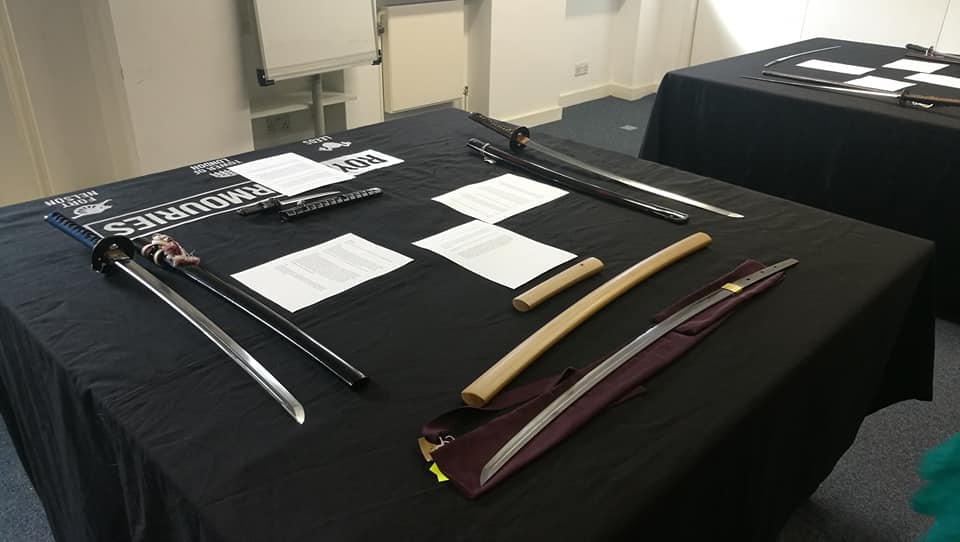
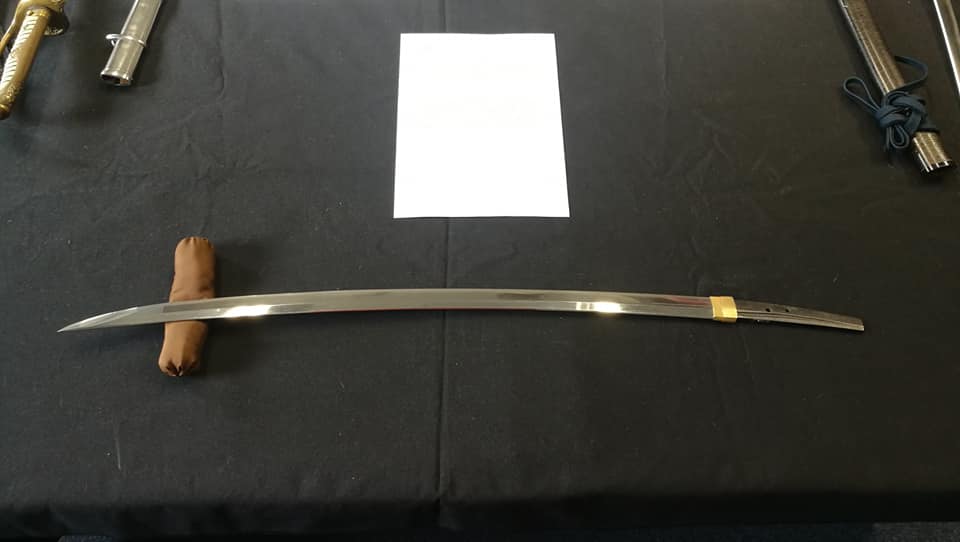
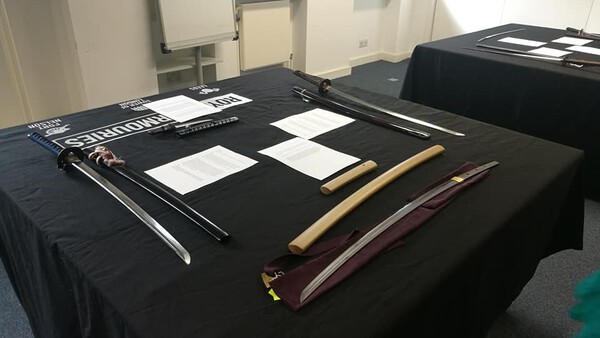
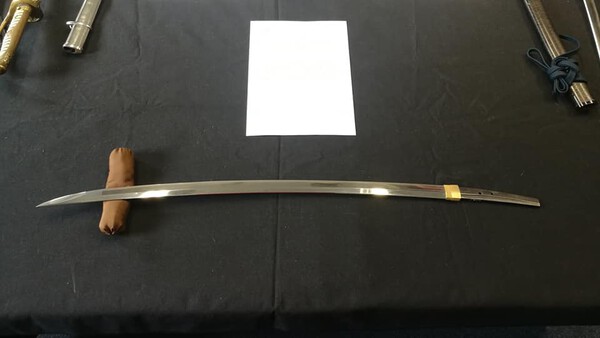
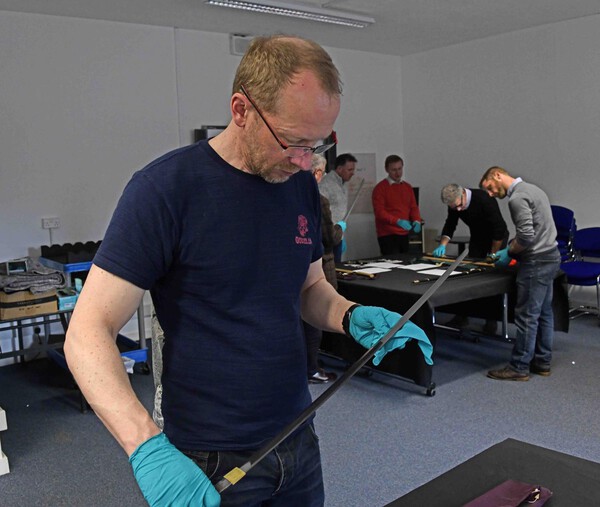
 unfortunately we dont have any better images of the blades. While the light was ok for viewing it didnt lend itself for detailed images of the swords on the tables. Regarding handling I admit to being in the old school on this (and talking blades only) and go with Piers on the bare hand approach. I think silicon can be dangerous and slippy and cotton lulls people in to a false sence of security. I have seen some touching blade with grubby cotton gloves believing they were being careful.
 -
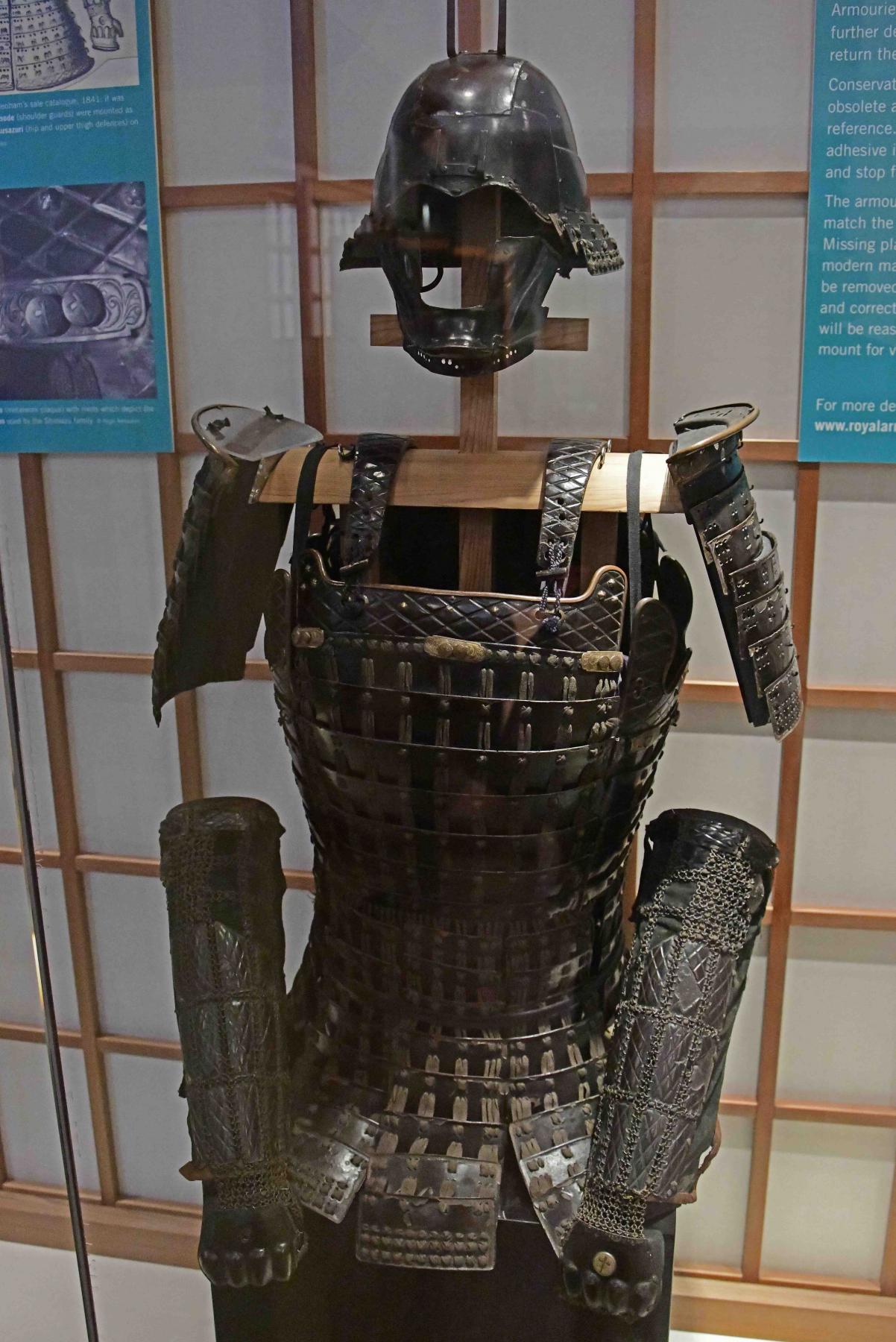
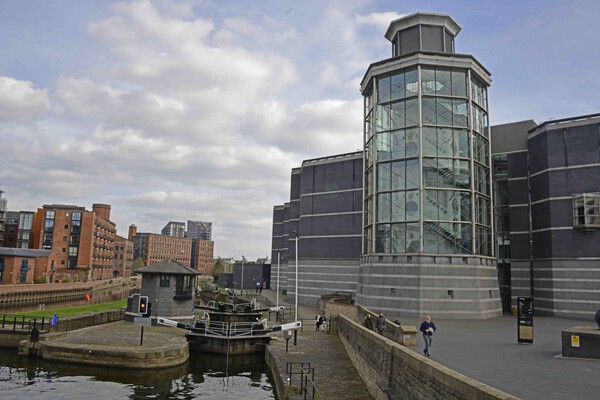
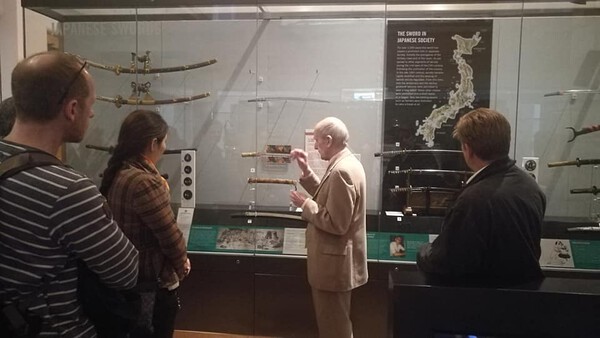
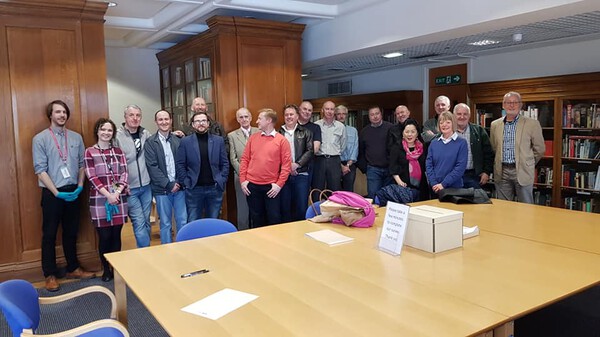
Dear All On Saturday 6th April the Token of GB held a second study day at the Royal Armouries museum. The day was devided in to two sections in the morning following a brief introduction to the day, Ian Bottomley gave a presentation about Armours given as diplomatic gifts to various nobility within Europe and traced their history after arriving. The presentation was the accumulation of many years of research by Ian and offered a fascinating insight in to the political map of the times. The second part of the day was focussed on hands on study of swords from the Deryk Ingham collection and viewing the collection of arms and armour within the Japanese gallery. In all we viewed 16 swords some of which had been taken off display for our benefit. It provided us with a rare opportunity to view some very special blades in hand. It also offered a great illustration of collecting in the second half of the 20th century. No internet, Facebook or Instagram (My god how did they survive!!!) Amongst the swords were some personal favourites including a Juyo nagamaki naoshi attributed to Unji (Ex A.Z Freeman collection "Ishigiri" ), A TH katana attributed to Naotsuna and an O-suriage wakazashi attributed to both Bungo Takeda and Osafune (whoever made it it is a stunningly beautiful sword) As always the museum team looked after us very well and went to great length to ensure we gained maximum benefit from the day. For those unfamiliar with the museum it holds perhaps one of the most comprehensive collections of arms and armour in Europe, if not the world. It is a purpose built museum built in the 1990s to house the collection the majority of which had previously been in storage at the tower of London. If you have the opportunity to visit you will not be disappointed. Some images attached to give a flavour of the day


-
What blades are Members interested in buying?
paulb replied to barnejp's topic in General Nihonto Related Discussion
The blade I still dream about was a Yukimitsu tanto orginally seen in Dr. Compton sale and then later with Michael Hagenbusch. I didn't believe you could see so much beauty in a few inches of steel. -
What blades are Members interested in buying?
paulb replied to barnejp's topic in General Nihonto Related Discussion
Chris This is the destiny for most collectors and students. The more you study the more you understand what makes great swords great and the further out of reach (for most of us) they become. Catching the Awataguchi and Soshu bug and then to compound it wanting them in good koshirae means you have a lot of money making time ahead -
I think there are some very good and interesting points made here. It also highlights some of the challenges faced today which were not so prevalent in the past. At risk of sounding like an old codger reminiscing, 20 years ago there was far less on an internet based sword community and far fewer papers flying around the market. People bought swords from dealers they knew and trusted (rightly or wrongly) and if they were unsure they sought the help of someone with greater experience. If I am honest I think we were possibly a little less obsessed with pricing and potential resale value but then again the amounts being paid were generally lower, not in real terms, but because we generally only had access to lower and mid range blades. Today the market is more open the Internet has created a virtual community and the amount of information, good and bad, the number of swords and the volume of papers has exploded. Hence we get the discussions like the one above and the old clichés such as “buy the sword not the paper” and all the counter arguments appear. As I have used the aforementioned cliché let me explain my thinking. It is not an exhortation to rely on your own expertise which would require a great deal of study and confidence. What I mean, and maybe others too, is that your focus when looking should be the sword. Look for a Bizen Ichimonji, or a Hizen Tadayoshi or whatever (maybe just a blade with the hada you like) But don’t set out with the intention of “buying a Juyo”. Basic Principles I have tried to follow: 1. Like the sword you intend to buy 2. Buy the best you can afford (without over extending your finances) 3. Do not buy a sword as an investment. Accept that after many years of enjoyment you may not recover all of your initial investment. 4. If buying unseen (i.e. via the internet) buy from a buyer you trust. If it involves a large amount of money then I would always want some form of authentication such as a sayagaki from Tanobe sensei or a paper from the NBTHK. The type of paper isn’t actually that relevant its purpose is to validate the attribution. You should satisfy yourself regarding quality (do you like what you see) and condition. A beginner 30 years ago spent a couple of hundred dollars on a WWII Showa-To and was happy to have that until they learned more and moved it on. Today many buyers here spend several thousand dollars on their first sword and through choice without access to the network of support available in the past through active clubs, shows etc. papers have therefore become more important. For the record the most expensive blade I ever bought had a Hozon paper (it also had an older shumei and sayagaki by Tanobe Sensei)
-
I am with Bazza based on the quality of the kanji but then have to question why would anyone fake a relatively unknown Hizen Smith? normal targets for fakes would be Tadayoshi/hiro Masahiro and such.
-
There has been much said before and again here about "buying the sword and not the paper" It is something I largely agree with. I always get nervous when someone tells me they want to buy "A Juyo" doesn't matter what as long as it has that magic piece of paper. However If I am spending a large amount of money (I wish) I would certainly draw comfort from the fact it had papers from a well respected appraisal authority. I also believe it would be much easier for me to sell it on in the future if it was supported by a high level paper. There has been and continues to be much debate as to which body offers the best attribution and adds the greater value. Much of this discussion is, regardless of whether we admit it to ourselves or not, based on what results we got and whether we were pleased or disappointed. JP was partially right, at one point the original NTHK followed the traditional wording on their papers which "absolutely guaranteed" that a piece was genuine. I am not sure if this is still the case but certainly it is a guarantee that is impossible to make in reality. At the moment greatest commercial security appears to come with NBTHK attributions. They are the only ones I have seen with Japanese dealers and for a number of auction houses the only ones they list in a description. I tend to agree with Luis, at the moment I place the greatest faith in sayagaki written by Tanobe Sensei. There are few that would dispute that he is probably the greates expert in this field at present.
-
based on swords I have actually seen in hand I would fully support the opinions on Taima, Tegai Kanenaga and Shikkake Norinaga. The Taima blades in particular were stunning and as Ray said previously if they are considered close to Yukimitsu then you know they have to be very good indeed. Within the past couple of weeks I had the chance to look again at a signed wakazashi by Kanenaga which is a very unusual thing and stunningly beautiful. I have also spent a lot of time studying a Norinaga Nnaginata naoshi which is out of this world (in my opinion). I have seen few Hosho works but those I have have always been of very high quality. While not as beautiful as Taima they are very good indeed. Something I don't think has been mentioned in detail is ko-Senjuin. Based on only one piece I saw more than 20 years ago I was smitten by the quality of what I saw. While different from the others it was equally beautiful and screamed quality. I think the disparity in opinions tends to relate to later wok of both Senjuin and more especially Tegai where the quality certainly seems to have slipped away as with so many other schools of the time.
-
Chris Please feel free not to visit our horrible country. BTW shipping pinfire revolvers to the the USA has not been a problem from the Government, if there is one and I m not sure there actually is, it is lawyers employed by Fedex (correct me but are they not an American company) who decided they wouldnt ship anything that might result in them being sued should it be used to commit an offense. Thus no tools, kitchen equipment, sporting equipment etc. Our Idiot Government as you describe them are far from perfect and have far from bathed themselves in glory recently. But look around at what others are doing and I think many deserve your sympathy more than we do. Edit: Ed my apologies for diverting your thread which is very interesting. To get back on track: Many years ago I think I saw something similar come up for auction in a well known auction house here but that is the only one I have seen in more than 40 years of collecting