


paulb
-
Posts
3,046 -
Joined
-
Last visited
-
Days Won
73
Content Type
Profiles
Forums
Events
Store
Downloads
Gallery
Everything posted by paulb
-
Not sure it still holds true but the old intellingence always said that on shorter Bizen mei the use of Bishu was more indicative of a bundle sword and Bizen a better crafted work. As John saya the presence of a longer mei was also a sign of higher quality. As always there were exceptions and it may be that later research has disproved the theory. Certainly it doesnt seem as prevelent as it was.
-
 I was there in 2016 and had a great time at both events. If you are there it should be a no-brain decision to attend (wish I could)
 -
Yamato Den Shizu: Why No Bids?
paulb replied to Prewar70's topic in Auctions and Online Sales or Sellers
There is a very interesting write up about the use of Den by Bob Benson which I was sent some years ago. It points out that many collectors in the west view the appearance of "Den" as being negative which is absolutley not the case. It may be used when a sword by a certain smith exhibts features the panel would not typically expect to see or lacked some the might expect. Or its better than they would expect from the named smith. Basically it means it's a bit different from the norm , not necessarily worse and often better. Den.pdf -
Thanks Jussi and an excellent write up much appreciated
-
Good Morning Jacques Sorry for not being clear but thats what the sentence you quoted says or at least implies. konuka hada is more typically associated with the second generation and later. As this isnt konuka hada if it were a Tadayoshi then it would have to be the shodai and I did not think the mei was right for him.
-
lots of warning bells without looking at the sword: 1. Old papers- these have been discussed numerous times here in the past and very recently. Regardless of where you stand on the validity or lac thereof the fact this is a sword by an important school and in Japan you have to ask why it has not been repapered. 2. No returns policy- I can accept it isnt easy to re-import but others accept returns so difficulty in re-importation is a questionable reason. Looking at the sword: the hada is A-typical for Hizen Certainly later generations (2nd and after) and the mei doesn't look right(in my opinion) for the Shodai If this were right and in Japan it should have been repapered and would sell for considerably more I think.
-
Hi Franco Yes I think you are right I am afraid old habits die hard and one of my favourite swords for for many years was one that a friend bought from the A.Z Freeman collection and which now resides in the Royal Armouries. That was a typical long naginata naoshi but described in the catalogue as a Nagamaki-naoshi. I think it has stuck in my mind since I first held it. It is now on display at the Royal Armouries Museum in Leeds and a beautiful example of Nambokucho Bizen work.
-
In 1993 a Kiyomaru daito sold for more than $400k in Sotherby's London. At the time I think it was a record price paid for a Japanese sword at auction outside of Japan. A wakazashi by the same smith and in the same sale made approx $75k. The buyer of the long sword was Tsuruta san of Aoi-Art. While many would argue that prices have dropped since the time of this sale I dont think that is the case for work of the top smiths and few are more popular or sought after than Kiyomaro so I think this pair would be well above the $500k mark.
-
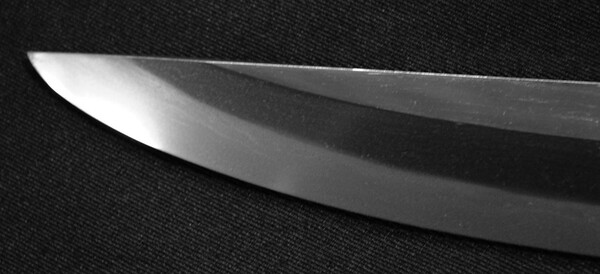
To try and clarify this a little more: The blades on Darcy's site are 75cm and 68cm respectively. Below is a naginata naoshi by the Shikkake master Norinaga and dates from much rthe same time as the Naoe Shizu, perhaps 50 years earlier. the sugata is 49cm and from the positioning of the hi I would guess originally it would have been no more than 52cm. The two longer blades are likely to be in an unaltered state other than a shortened nakago and the machi moved up a couple of cm. Typically these longer naginata/nagamaki did not have the exagerated recurve one sees on original shorter naginata. The one below would have had a much deeper return than either of the longer blades and the top section would have been removed. I think, based on the positioning of the hi the blade illustrated in the OP was of the shorter type. therefore I would expect it to have originally had a greater return at the kissaki and for this to have been removed when the blade was modified.

-
Michael you are absolutely right but we are talking at cross purposes a little. both of the blades on Darcy's site are what I would call nagamaki rather than Naginata. I know this is no longer strictly applied as it tends to relate more to mounting than blade. But in the past these much longer blades fitted on a shorter pole were identifed as nagamaki. They did not have the deep turnback of the kissaki more typically seen in naginata and therefore did not require the end of the kissaki to be removed. In the OP the position of the hi if original suggests this was a shorter blade therefore naginata.
-
Michael I think the answer to your question is no. The modification to the shape taking it from a naginata to effectively a wakazashi is necessary to enable the blade to function in its new intended purpose, i.e. as a short sword rather than a blade on the end of a pole. The deep curve typically at the end of an original naginata makes it impractical unless it has that curve considerably reduced. This is the case regardless of who made it. There might be an argument not to change it at all if it were by a very highly rated smith but I think as there are examples of blades by some of the finest smiths being modified over time I think it unlikely. The other point regarding this practice is that if a family had a blade that was especially precious to them but not longer needed as a pole arm they would have it modified to enable it to continue to be used. The process of changing it's shape is time consuming and difficult so to go to the likely expense it would seem reasonable that it was a good sword in the first place.
-
Hi Rob I dont think it is an Edo piece. The steel looks old (to me at least.) I am also struggling to see Rai in this not only the hada but the shape even allowing for it being heavily modified would seem A-typical. Not sure about the enthusiastic attribution to Naminohira but then I haven't studied that school too much. What is leading you and "others" in that direction? As Geraint said this doesn't detract from the blade which I think is interesting and worthy of having some time spent identifying the detail of what you are seeing..
-
Michael To add to Franco's point. It is generally not possible to convert a naginata into a naginata naoshi without modfying the kissaki and therefore the boshi. Almost every naginata naoshi I have seen have a yakitsume (no turn back) boshi as the top end of the blade has to be reduced from the original stronger curve seen on naginata. The amount of metal removed will obviously vary considerably and depend on the original shape. I have had several interesting discussions recently about how this amount of metal was removed with apparently not effecting the integrity of the remaining boshi. I am guessing it was ground down but if anyone else knows or has a better idea I would love to hear it.
-
Jean Our sincerest condolences. As you may recall Pam and I went through a similar experience just before we met in Utrecht. Just remember the quality of life you gave to Riesling and the pleasure he gave in return. We are fortunate to have the opportunity to share our lives with these beautiful animals and as Ted says we always wish for longer but would really like it to be forever. We are thinking about Best Regards Paul
-
Just to throw another thought in to the ring without too much confidence: A number of people have suggested Yamato influence but have then ignored the most obvious Yamto influenced school which is Mino. I agree that the O-maru boshi pushes towards enju but as Michael suggests I dont think the hada is fine enough for Enju. Also the "hazy" Nioiguchi is not what I would expect with Enju most examples I have see have, if anything, a tighter than average nioiguchi. The hazy hamon suggests some Soshu influence. In addtion there is shirake utsuri which while also seen in Enju is more typically regarded as a Mino characterisitc. Therefore this blade has a shape which suggests late kamakura/early Nambokucho. It has hada which suggests Yamato influence, the thickness again points to Nambokucho and Soshu. There is shirrake utsuri which as a first call would suggest Mino. Taking all the above in to account a first stab on this might be Shizu. or tying it down a little further Yamato-Shizu. If nothing else this blade proves how similar many of these works were/are and many examples have features that you might not typically expect to see.
-
The Legitimacy Of Shinsa's
paulb replied to Tom Darling's topic in General Nihonto Related Discussion
Following up on Franco's point with observations from my own expereince in helping with Shinsas in NTHK shinsa in the UK some years ago. At the first shinsa many signed blades failed shinsa as gimei. For the second people realised that if they submitted unsigned blades they would at least obtain a paper which for some (by no means all) at that time was the main goal. As a result there were a greater number of mumei blades submitted to the second shinsa. In addition the condition of many of these blades was to be honest borderline for submission. If you cant see the detail then it is likely the panel cant see it either. Their opinion is based on what they can see. On more than one occasion they gave an answer but with the caveat that if it were polished it could well be by a different and in some cases better smith. I believe that the condition of swords submitted in Japan is better than many seen at the overseas events. I would even suggest that we are more used to trying to find detail in less well polished blades. We also have much longer to look at them. Taking all the above in to account I think it is not surprising that different attributions can occur. As said above while not perfect the current system is the best available to us, could it be improved? yes of course but this will not be achieved by the Shinsa panels alone. Those submitting should ensure that when they present a blade for shinsa it is in the best possible condition and polish to enable the features to be clearly seen. If they do this the chances of accuracy would be greatly increased. -
The problem with setting goals, for me at least, is there is a danger of becoming so focussed on achieving your goal you become blinkered and fail to see real beauty and opportunity that is staring you in the face. I have gone through various phases of focus and goals and as my expereince and understanding have increased (hopefully) those goals change. Goal number 1 collect what you like, and I mean really like. If it doesn't make the hair on the back of your neck rise when you look at it and it doesn't make you catch your breath then you probably don't like it enough. Goal number 2 Don't buy it just because it is from the school/tradition/period you think you want refer to goal 1 Goal number 3 buy the best you can afford. Fewer good blades makes a much more interesting collection than multiple mediocre. Jean's collection is a great example of this He has focussed on the Gokaden but has allowed himself some leeway within that range. He has also bought the best examples he could find and only blades that he truly likes. All three goals met well done Jean
-
Hi Dave Like most things its practice.Over time small details lead you in to an obvious direction. There are of course always exceptions but normally a kantei blade should be representtive of it's period and tradition (otherwise you cant really learn from it) Generally once you get in to practice looking at the shape and dimensions should give you an idea of period. hamon and description of hada points to a tradition/school. After that its a case of hitting the references but at least you have narrowed down the possibilities. BTW the above is not a claim to expertise its just based on doing it for a long time!!
-
Dwain I wasn't specifically taking a swipe at you, although I used your post as an example of what I was trying to illustrate. We agree 100% that kantei should be fun and I think those who took part in Rayhan's recent post said they had enjoyed it. When done properly it offers a disciplined and effective way to learn. The best lessons should always be fun but should also have structure This approach has been used in Japan as the way to learn. While I am sure it isnt perfect it is better than anything else available to us. If we treat it too lightly and without the seriousness it deserves the benefit can be greatly decreased. That doesn't mean it cant be fun! As in everything else our motivation for doing things are as diverse as we are. The important thing is to base the way we approach doing kantei with a reasonable understanding of what it is about and what we are trying to achieve, and to be clear of the benefits of doing it that way (or not)
-
Dear All, I wanted to touch on the am subject. Rayhan's extremely generous project sparked a lot of interest and enthusiam. It motivated people who had never tried to do kantei before to have a go. This exercise has been followed by a number of other kantei exercises from Uwe, based on his exceptional images and more latterly with Dwain and his nakago. As an advocate of the value of kantei I think it is great to see this activity increasing, I think doing kantei properly is the greatest way to learn. The key word here is properly. The correct way to do kantei is to view a sword in hand, to identify the relevant features and to try and draw a conclusion from what you see. This isn't always possible and the fallback is a Shijo kantei as seen in the NBTHK monthly magazines. Here you are presented with an oshigata which shows shape and hamon, and given a description of the sword. This might be considered a "halfway house" as all the features have been identified for you but if you can't see them there is little choice. In the board kantei people setting the questions (including me) tend to use photographs which obviously show more of the hada but still don't offer the same detail you might expect to see in hand. My point is that if we are to continue to attempt these exercises on the board, and I really hope we will, we need to supply sufficient information to enable participants to work toward a conclusion. I have copied below the content of an NBTHK kantei description. It gives full details of size and describes hada and activity. Even with some of the excellent images we have seen on the board I think unless you have the sword in hand it is important to have a description of the jigane and activity. Armed with this information the study and working toward an answer becomes much more meaningful and we learn a great deal more from it. Without it we are doing little more than guessing, which may be fun but doesn't contribute to our understanding too much. Please lets continue doing kantei on the board and supporting them when they are posted but can we make sure we supply at least the minimum information needed to make it worthwhile. NBTHK example: Doc1.docx
- 10 replies
-
- 11
-

-
Wanted: Tōken Bijutsu (Nbthk Magazine) Issues
paulb replied to Jussi Ekholm's topic in Wanted to Buy
Hi Jussi While I want to hang on to the later copies I do have around 300-350 NBTHK magazines which date back to no. 60 and I think 1969 ( doing this from memory) If they are of interest I can get you more detail but be aware that the total are VERY heavy and shipping, even within Europe is likely to be expensive. -
Work on the principal that using acid is a bad thing. I believe polishers do use various finishing compounds in the final phase of polishing to enhance the finish. Many of these compounds are of their own composition and not greatly discussed. However there are numerous examples of blades which have been badly damaged by untrained people using acid as a quick fix to "enhance" hamon and hada. sorry Brian beat me to it mods please delete if appropriate
-
Mario This is a major contrast from your stated ambition of an Omi Daijo Tadahiro. You obviously have a very broad range of appreciation. Congratulations on your sword and good luck with your continued hunt for the Omi Daijo.
-
Congratulations Bazza, it couldnt have happened to a nicer guy! Also a very large thank you to Rayhan for his generosity,which stimulated a lot of people to try doing kantei for the first time. No one gave 3 totally correct answers. However it is worth remembering that the original purpose of kantei was firstly to determine the age of a sword and secondly its quality. The refinement in to school and smith is a progression beyond these two fundamental starting points. Virtually everyone got the period right on at least two of the three swords which is pretty d**** good. So all who took part deserve a pat on the back for their answers and for having a go. It is also worth highlighting how many people who hadn't tried before said how much fun it was and how much they had learned from the exercise.
-
me too

