Kurikata Posted January 25, 2022 Report Posted January 25, 2022 Hi, any help on the artist transalation would be an help. I guess it is Tanaka Aki Yoshi - Haruaki school but translation of the certificate would confirm. Thank youtsuba542-certificat.pdf 1 Quote
uwe Posted January 25, 2022 Report Posted January 25, 2022 Certificate states: 銘 “明義” + 花押 (Akiyoshi + kao). Mei and seal are very similar to this pupil of Kōno Haruaki. I’m not very knowledgeable when it comes to tsuba though… 1 Quote
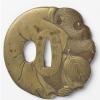
Kurikata Posted January 25, 2022 Author Report Posted January 25, 2022 Thank you Uwe. Any informatioin on the design ? It is probably a legend but which one ? Quote
Kurikata Posted January 26, 2022 Author Report Posted January 26, 2022 Thank you Brian for your interest. Could you move this thread at "Tosogu" in order to have potential information on my tsuba topic. Who is the Guy on my tsuba ? Quote
SteveM Posted January 26, 2022 Report Posted January 26, 2022 The certificate lists the theme as 獅子王図 (Shishiō-zu). Shishiō is literally "Shishi King". Shishi-lion King, if you like. I looked around on the internet to find out more about this theme, but nothing seemed to hit the mark. Nothing showed a similar figure as yours (and all of the results contained shishi-lions). A bit of an enigma, this one. The certificate is from 1952. It's one of the oldest ones I've seen. 1 1 Quote
Kurikata Posted January 27, 2022 Author Report Posted January 27, 2022 Thank you Steve. This information is very precious to me despite the fact that I didn't find any information on the net. Nothing either in my books as "Ko ji Ho Ten" or Joly's "Legend in Japanese Art". Quote
Bugyotsuji Posted January 27, 2022 Report Posted January 27, 2022 Shishi-O is described here stopping the Nue: 『平家物語』と『源平盛衰記』は、獅子王は都を騒がせた鵺を仕留めた恩賞として天皇から源頼政に下賜されたとものであるとの伝承を伝えている https://ja.wikipedia.org/wiki/獅子王_(刀) 2 1 Quote
JohnTo Posted January 27, 2022 Report Posted January 27, 2022 Hi Bruno, I have a tsuba inscribed (I never say signed as too many gimei) Akiyoshi. It is a shakudo nanako tsuba with a simple decoration. The signature on yours and mine look similar, but photo is too blurred to see clearly. My research is as follows: Akiyoshi does not appear in any of my reference books but may be attached to the Kono School in Edo during the 19th C. Markus Sesko’s genealogy charts (p. 43) show that Kono Haruaki (1787-1857) had 12 students who used the same ‘Aki’ kanji as the first character of their names. Akitatsu, a student of Haruaki, in turn had a student named Tasuyoshi of the Kobayashi family. Akiyoshi may be an unlisted member of this school, or may have changed one or more kanji in his name during his career, as Japanese artisans often did. Another reference (The Japanese Toso-kinko Schools, translated by Markus Sesko) lists Akiyoshi (civilian name Tanaka Bunjiro) as a student of Kono Haruaki. An entry in ‘The Early Famed Works of the Kyoto Smiths (Kyomono no Ko-Meisaku)’, tanslated by Gordon Robson lists a tsuba by Akiyoshi with a shakudo ground. The text states that ‘Akiyoshi is among the skilled kinko of the Aizu during the late Edo priod’ ‘There must be some connection with Kawano Haruaki, and because of his signature and kao, we can agree to such a conjecture.’ There appears to be a similarity between the kao on this tsuba and examples attributed to Kono Haruaki, so it looks like the artisan of this tsuba is probably the one referred to. Best regards, John 1 1 1 Quote
Bugyotsuji Posted January 28, 2022 Report Posted January 28, 2022 Three 金工 kinkō metal artisans are listed here with this name, in Edo, Aizu and Kyōto (Yamashiro). That might explain the differences in the two interesting Tsuba shown above. 1 Quote
Brian Posted January 28, 2022 Report Posted January 28, 2022 It's high quality work. If we go by the work and not the signature, then it looks good for shoshin imho. Look how well done the nanako is, and how evenly spaced. 1 Quote
Kurikata Posted January 28, 2022 Author Report Posted January 28, 2022 On 1/27/2022 at 8:02 AM, Bugyotsuji said: Shishi-O is described here stopping the Nue: 『平家物語』と『源平盛衰記』は、獅子王は都を騒がせた鵺を仕留めた恩賞として天皇から源頼政に下賜されたとものであるとの伝承を伝えている Piers, a great thank you for this very precise information. But I still do not see the link between the sword 'Lion King" and the old man scaring away a flight of cranes or storks, on my tsuba. Is it a hidden message related to the story if the Emperor Narihito thanking Yorimasa for killing the Nue ? 1 Quote
Bugyotsuji Posted January 28, 2022 Report Posted January 28, 2022 Consider the birds and the smoke in Wiki’s description, Bruno.(?) The Heike Monogatari and the Settsu Meisho Zuefrom the Settsu Province, tell the following tale of the killing of the Nue: In the closing years of the Heian period, at the place where the emperor (Emperor Konoe) lived, the Seiryō-den, there appeared a cloud of black smoke along with an eerie resounding crying voice, making Emperor Nijō quite afraid. Subsequently, the emperor fell into illness, and neither medicine nor prayers had any effect. A close associate remembered Minamoto no Yoshiieusing an arrow to put a stop to the mystery case of some bird's cry, and he gave the order to a master of arrows, Minamoto no Yorimasa, to slay the monster. One night, Yorimasa went out to slay the monster with his servant Ino Hayata (written as 猪早太 or 井早太[9]), and an arrow made from an arrowhead he had inherited from his ancestor Minamoto no Yorimitsuand the tailfeathers of a mountain bird. An uncanny black smoke started to cover the Seiryō-den. Yorimasa shot his arrow into it, there was a shriek, and a nue fell down around the northern parts of Nijō Castle. Instantly Ino Hayata seized it and finished it off.[10][11] In the skies above the imperial court, two or three cries of the common cuckoo could be heard, and it is thus said that peace had returned.[10] After this, the emperor's health instantly recovered,[12] and Yorimasa was given the sword Shishiō as a reward. 1 Quote
JohnTo Posted January 28, 2022 Report Posted January 28, 2022 Piers, Thank you for the additional information. It will give me hours of fun translating. I think I was lucky buying this tsuba at auction in 2019 together with three other equally good tsuba in the same lot. By chance I later came across this tsuba in a Sotherby's auction (Nov 199, lot 627) and recognised it as the same tsuba by the small blemish in the nanako. I paid almost exactly the same price for the four as the Akiyoshi sold for in 1996. Maybe tsuba prices are falling. Best regards, John 1 Quote
Bugyotsuji Posted January 28, 2022 Report Posted January 28, 2022 John, if you get stuck with the translation there are plenty of people here who will gladly help. Quote
Kurikata Posted January 28, 2022 Author Report Posted January 28, 2022 John, comparing our tsuba mei, they look quite different especially at the Kao level (despite the bad picture quality). Piers' information that we face 3 different Aki Yoshi tsuba makers makes sense. Quote
SteveM Posted January 28, 2022 Report Posted January 28, 2022 The three Akiyoshi are (according to Wakayama) 1. Akiyoshi of Edo, who was the student of Haruaki. Of the Gotō line. I think this is whithout a doubt the smith who made John's tsuba above. 2. Akiyoshi of Edo and Aizu. Shōami school. Wakayama says he signed as Bukō-jū Akiyoshi (kaō). It doesn't say if he used other signatures. I think this is the best candidate for Bruno's tsuba. 3. Akiyoshi of Kyōto who signed Akiyoshi-saku. Mid Edo. Not much known about this smith. These are more or less consistent with the smiths in Piers's post. 1 Quote
suketaka Posted January 30, 2022 Report Posted January 30, 2022 Which Akiyoshi is mine? Maybe - Haynes 00089.0 Kyoto, 1830 - 1895. Different Mei to the other before. 3 1 Quote
Kurikata Posted January 30, 2022 Author Report Posted January 30, 2022 The 3rd one!!!!! But the Yoshi kanji. Quote

Recommended Posts
Join the conversation
You can post now and register later. If you have an account, sign in now to post with your account.