

Pete Klein
-
Posts
2,984 -
Joined
-
Last visited
-
Days Won
27
Content Type
Profiles
Forums
Events
Store
Downloads
Gallery
Everything posted by Pete Klein
-
Just got to thinking about this line: "What do you think of farmers? You think they’re saints? Hah! They’re foxy beasts! They say, “We’ve got no rice, we’ve no wheat. We’ve got nothing!” But they have! They have everything! Dig under the floors! Or search the barns! You’ll find plenty! Beans, salt, rice, sake! Look in the valleys, they’ve got hidden warehouses! They pose as saints but are full of lies! If they smell a battle, they hunt the defeated! They’re nothing but stingy, greedy, blubbering, foxy, and mean! God damn it all! But then who made them such beasts? You did! You samurai did it! You burn their villages! Destroy their farms! Steal their food! Force them to labour! Take their women! And kill them if they resist! So what should farmers do"? Mifune, 'Shichinin no Samurai'. Of course, it could be argued that the Ronin in the film were exemplary Samurai in comparison to the average Daimyo of the day.
-
I would suspect that Hosokawa Tadaoki aka Sansai as one of the seven disciples of Sen no Riikyu was educated in the principles of wabi cha and therefore would have had the ability to coordinate stylistic pairings of tea wares and artworks for the tea ceremony. He also was directly involved with Oda Nobunaga, Toyotomi Hideyoshi and Tokugawa Ieyasu in important campaigns and would have been exposed to many cultural occasions. He and Furuta Oribe (another of the seven disciples) were the only ones to see Sen no Rikyu off to his death, and later saw Oribe off to his. He brought Hirata Hikozo with him from Tango (where he had worked along with his father Matsumoto as kinko to the Hosokawa) in the move first to Buzen ~1603 and then to Kumamoto (Higo) Domain in 1632 when his son Tadatoki was given the region by the Tokugawa. There Hikozo, and after his death in 1635 his son Shosaburo influenced the makers Nishigaki Kanshiro (who had come with fro Tango), Hirata (to become Shimizu) Jinbei (he was the first Hikozo's nephew) and others. It would seem that much of Sansai's life was spent prior to the move to Buzen/Kumamoto and therefore any stylistic ventures would not be 'Higo' influenced but would rather become the influence to Higo style. Suffice it to say I would imagine Sansai would have been capable of designing a koshirae, or at very least have known how to conceptualize one. The influence of wabi cha would most likely be a component. https://en.wikipedia.org/wiki/Kumamoto_Domain https://en.wikipedia.org/wiki/Hosokawa_Tadaoki
-
As long as you have the menuki in Japan anyway you really should consider submitting them to the NBTHK shinsa in October for Hozon paper just to corroborate the validity of the attribution. You are dealing with a big name here and menuki by Misumi go for high prices but without NBTHK paper there will always be doubt which will decrease valuation. The price of the NBTHK paper will be more than compensated by the increase in price potential.
-
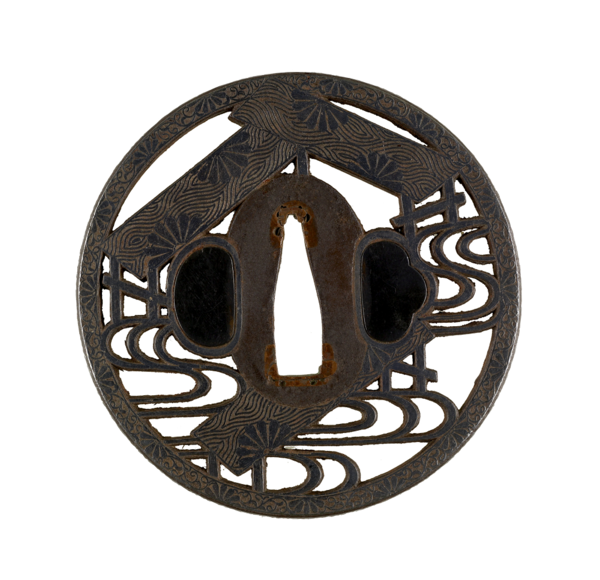
http://art.thewalters.org/detail/28056/tsuba-with-the-eight-plank-bridge-yatsuhashi-from-the-tales-of-ise/
-
...then add a pinch of Yatsuhashi:
-
For The Historically Minded
Pete Klein replied to seattle1's topic in Auctions and Online Sales or Sellers
Guido should write Tsuruta san about the kashira - name for the little flaps - and see if he knows as he had asked about this recently. -
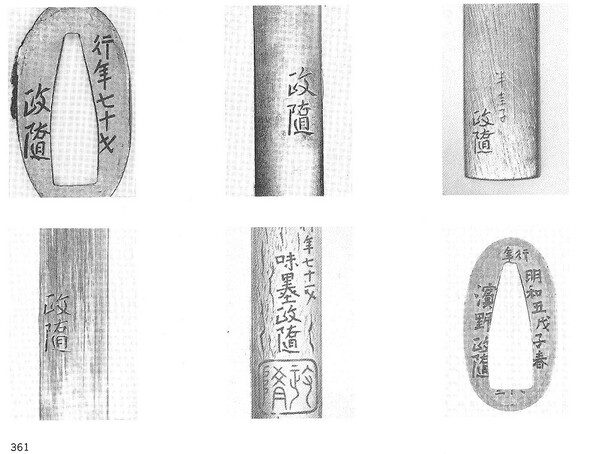
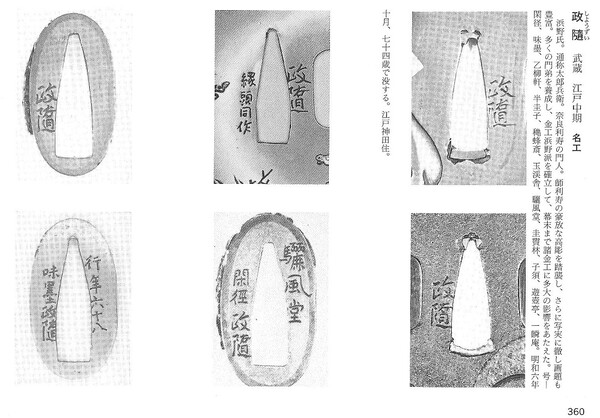
Pronounced 'Shozui'. Born in 1696, he was a student of Nara Toshinaga and went on to found the Hamano School. There is a good write up in Sesko's, 'The Japanese Toso-Kinko Schools', page 150 - 151. Here are examples of his mei from the 'Shinsen Kinko Meikan':
-
Just a reminder that the San Francisco show is August 7th -> 9th: http://www.ncjsc.org/sf_token_kai.htm
-
Thanks for the ideas. The only things I can think of are either it was the old classification or that it's a step up for a tsuba which is carved and not welded such as this one. I'll have it at the San Fran show if anyone wants to see it. PS: if anyone here is going to the San Fran show please stop by and say hello.
-
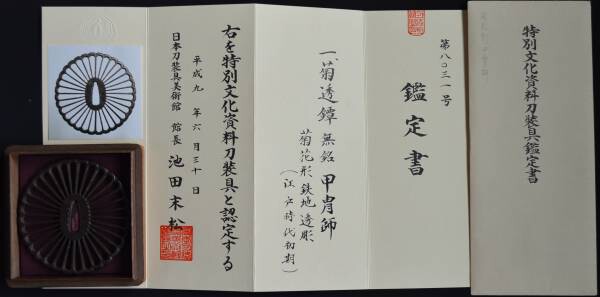
I have this tsuba and find it interesting that the Fittings Museum paper attributes it to Kachushi and not Saotome. I have also seen similar attributions in older reference books. Does anyone know why there is this distinction? PS: this is really large at a bit over 10 cm.


-
http://www.e-sword.jp/ This is a very well established business. I doubt seriously they would mis-represent.
-
http://www.aoijapan.com/?s=Heianjyo Ken, the four listed in this search are all attributed to Edo Jidai. Which ones are you referring to?
-
http://www.token-net.com/juyotoken/juyo-dai46tsuba-1.html Juyo
-
Guido -- yes, you are correct. I found a number of dai sho sword sets on-line and all had such tsuba.
-
I sort'a doubt it as they both have two hitsu ana and if they had been made as a 'Dai-Sho' set (as in custom order) that would be improper. Having said this, it's always possible to have two tsuba be 'Dai-Sho' but without them being with the original koshirae I'd lean towards 'No'.
-
I believe it was three years ago at the San Francisco show that the NBTHK-AB had an exhibition of member's Mainline Goto works of all generations except for the last (technical glitch of some kind) which was incredible. The tables ran the entire length of the study room (~ 35/40'). The Japanese dealers/guests present were commenting that they hadn't seen this in Japan outside of a museum and even then it was rare. That was a great compliment to the organization and the members who made it happen. This August there will be an NBTHK-AB members conclave to discuss anything with the board and a meet and greet. It will be a lot of fun and educational also. I for one am looking forward to it greatly!
-
LOL -- I'm just having fun, in more ways than one.
-
"The patina on your's Curran made me think of sea salvage"... Good innuendo is priceless! LOL
-
Thanks Barry and thank you very much Morita san. I have saved the translation to file with my images. They are good words indeed. Peter
-
Yes Morita san. Aside form the listing title I recognized his seal (shubun). He authored , 'Tsuba Geijutsuko', 'Tsuba Kanshoki', 'Toso Soran' and several other treaties on fittings and swords. The English language book, 'Tsuba an Aesthetic Study' is the translation of 'Tsuba Geijutsuko' in collaboration with his student Robert Haynes.
-
I recently acquired this kakejiku and would be very appreciative for a translation of the script. The artist is actually well known to the fittings collectors here. I found this by pure luck. Thank you so much in advance, Pete

-
When The Collecting Is Over
Pete Klein replied to Davis's topic in General Nihonto Related Discussion
My books and collection is willed to a member of this board but they will have to wait until I croak to find out who they are. (lol) -
I'm sorry -- I can't look any more -- my eyes are burning... (sort'a like the first one that's been in a fire or had acid thrown on it by a deranged ISIS member). If you got $550 for this mess you deserve a hug! LOL
-
I would say 'very'. The few I have seen were all due to rust at the intersection points causing the mimi to fail.
- 1 reply
-
- 1
-



