cabowen
-
Posts
6,786 -
Joined
-
Days Won
10
Content Type
Profiles
Forums
Events
Store
Downloads
Gallery
Everything posted by cabowen
-
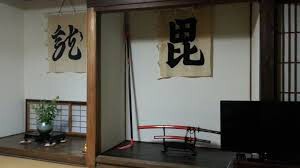
Traditional Japanese homes have a tokonoma, which is sort of the spiritual center of the home and where a kakejiku (scroll), ikebana (flower arrangement), swords, or other family treasure might be displayed. There is no link between the kakejiku and the sword other than they are both usually placed in the tokonoma...
-
In a word, decarburization. Actually, it would have to be some serious decarburization I think....I wonder if the thickness of a tsuba plate would make that practical, or even possible...
-
Looks to be a well made blade! I think it will be really nice when polished. Keep us posted...
-
Mei translation and or authentication
cabowen replied to D McCutcheon's topic in Translation Assistance
Pretty sure this is Sueksada 祐定 -
don't see why not....
-
Hagire usually form during the heat treatment, which is extremely stressful as the edge tries to expand while the back resists as the steel cools extremely rapidly. Run a glass under hot water then quickly quench it in cold water and you will get the idea.. Sometimes a blow against something very hard, a bend, or a twist can also crack the edge, which is quite hard and brittle and is nowhere near as ductile as the body of the blade. It usually doesn't have a lot to do with the forging; it is more about the brittleness of the edge.
-
Sometimes, as Barry has mentioned, you can get lucky with placement and remove it. It is possible, if the hamon is wide and the hagire shallow, sometimes it can be polished out, but that is pretty rare...
-
"Jiro Dreams of Sushi"....should be required viewing for all trying to gain a deeper understanding of the shokunin spirit....
-
Is it possible to buy genuine magatama?
cabowen replied to Drago's topic in General Nihonto Related Discussion
Like a lot of other things, "genuine" may be hard to determine... -
If you are buying a sword directly from a vet family and it has kiri-komi, unless they have two swords, the kiri-komi are often original and not done by an 8 year old. If they have more than one sword, and there are hako-bore in the other sword, then it is most likely abusive damage. Also, the number and placement of the kiri-komi can often times be telling whether they are original or the result of play. It takes a substantial blow with something much more than a steak knife to put a good kiri-komi in the mune of a sword. Additionally, many times questioning the family about how and where the sword was kept will give you insight. For example, if they tell you they found it in the attic/basement/crawl space and no one knew uncle/grandfather/dad had it, odds are good it was kept hidden and not played with. Most of the time, if it has been abused, they will tell you that as kids, they played with it, or it was used to weed wack, etc. Also, keep in mind that fresh kiri-komi look quite different from those that are older and have been through a polish or many. Hako-bore and broken kissaki are the more common sign of abuse. I once was at a small historical museum to evaluate their "sword". They pulled out a nice, long, Sukesada with full mei and date. It had a serrated mune so I asked where the other sword was..sheepishly, they then pulled out a beautiful Masahide wakizashi with amazing horimono. Sadly, very sadly, the edge was now serrated with hako-bore, almost perfect 1/4" chips all down the ha...Now, either this the lost "Nokogiri Masahide", or some kids had at it...When I asked whose handy work this was, the curator admitted that as kids they had "sword fought" with them, and showed me the cuts in the trim around several doors in the place. They were lucky they hadn't lost any fingers or worse. Unfortunately, the Masahide was ruined and the Sukesada would need considerable steel removed to ever look remotely normal....What a shame.... Of course, if you buy it from a dealer or other party removed from the original bring back, all you have to go on are the type, location, and number of kiri-komi for a hint at what happened and can never know with certainty.
-
I agree, looks bogus to me....
-
UNL To no Kai
cabowen replied to Peter Bleed's topic in Sword Shows, Events, Community News and Legislation Issues
Bravo! -
South Manchuria railway company presentation Tachi
cabowen replied to Medina San1's topic in Military Swords of Japan
No idea but I would suspect it would be even more desirable (not that it isn't already to a certain slice of collectors) if it was clear that the blade hadn't been previously drilled. I, personally, don't like to see gendaito with more than the original mekugi-ana and tend to avoid them in most cases. It is really a rare and interesting item regardless and as said, no doubt quite valuable. Congrats! -
South Manchuria railway company presentation Tachi
cabowen replied to Medina San1's topic in Military Swords of Japan
It was remounted for the tachi mounts.... -
Hm... and given to a shrine? That would have been disrespectful, no? MIshima Taisha had some blades that were pretty beat up so I don't know for sure....Don't forget many of those Nara temples/shrines had warrior monks and veritable arsenals...I'm just saying it is a possibility...
-
Or it was broken and reshaped.... It is possible though that it was made as a throwback to an earlier age, which happens from time to time. That is what makes things so interesting...
-
First one in Hattori Kiyonobu. Second is Ichino Kenji. This seems to be a personal, rather than smith name.
-
Do we know with certainty that the horimono in that piece are not ato-bori? We do know that rather intricate horimono are well known in the work of the Nobukuni group in koto, and later, in Sue Soshu from Odawara.
-
Not to mention the hada! :lol:
-
I can't say with certainty what the NTHK-NPO would do. My best guess is they would pass it (provided everything else is kosher) but it would probably score low. I can't speak for the other organizations.
-
maker might be: 元公 genko/ganko
-
maybe an old collector or ? reference number..seems to say 七0番 number 70 maybe....the left side is missing...
-
In this case, it looks like it could be removed by a slight reshape of the kissaki so I would say no, it isn't fatal.
-
This is an NCO (non-commissioned officer) sword from WWII. They are machine made and not traditionally made Japanese swords. There is considerable collector interest in them from those that collect WWII memorabilia. I would suggest checking ebay for NCO Japanese sword. I have no doubt you will see several for sale at any given time. One rare variant, with a copper handle I believe, seems to fetch several thousand dollars. Best of luck.
-
Doing yaki-ire and forging are extremely educational and provide insights first hand that really can't be found anywhere else. I would strongly encourage those with an opportunity to do so. And it is indeed a great deal of fun.