reinhard
-
Posts
799 -
Joined
-
Days Won
1
Content Type
Profiles
Forums
Events
Store
Downloads
Gallery
Everything posted by reinhard
-
Maybe Guido can tell us something about Chinese sense of humour. A good laugh it was anyway. reinhard
-
sorry but in my previous listing the pictures dissappeared
reinhard replied to gumanthon's topic in Translation Assistance
This particular mei is somewhat tricky indeed. Hawley mentions it one time as FUJISHIRO and and a second time as TOSHIRO (written with the same characters). In both cases, he is said to have signed MASANAGA earlier in his career. Obviously this is the same person and FUJISHIRO/TOSHIRO, although a common name as well, is supposed to be taken for his artist-name. This is in accordance with your sword. The nakago seems to be unshortened. The mei is complete and not part of a longer one cut off since. Unfortunately it seems to be very difficult to find any reference material for comparison. This is neither good nor bad. Maybe someone else comes up with more material on this subject. reinhard -
sorry but in my previous listing the pictures dissappeared
reinhard replied to gumanthon's topic in Translation Assistance
This is kind of strange. Your previous thread about the same issue is still posted and all you have to do is re-uploading your pictures there. As I said: The mei probably reads: Mutsu Aizu TO-SHI-RO If the mei turns out to be genuine, the sword was made during early ShinTo-period in Iwashiro province. reinhard -
token ichi
reinhard replied to shrinkjag81's topic in Sword Shows, Events, Community News and Legislation Issues
If I got this right, the "iai-face" is oscillating between being constipated (Ford) and heavenly relaxation afterwards (Guido). Thank you, gentlemen. reinhard -
Tokubetsu Juyo Chogi @ Christies, spring 2007
reinhard replied to Darcy's topic in General Nihonto Related Discussion
So do I. And I don't want to know what some of these swords look like some years from now. It is bothering me for some years now, to see old and precious heirlooms in the hands of complete ignorants, who don't know how to spend or invest their money anymore. Let's hope they'll disappear untouched in a safe until the oil and gas-barons have all dripped dry. reinhard -
Sword Display
reinhard replied to Chishiki's topic in Sword Shows, Events, Community News and Legislation Issues
Congratulations for doing a great job. reinhard -
token ichi
reinhard replied to shrinkjag81's topic in Sword Shows, Events, Community News and Legislation Issues
I've always wondered what "iai-faces" look like. Are there any pictures? reinhard -
Where did the pics go? reinhard
-
Despite of its qualities, this is a typical example of a Hama-mono, made for export during later 19th century. reinhard
-
This mei might read: Mutsu Aizu TO-SHI-RO (early ShinTo-period in Iwashiro) reinhard
-
Request with Hira-zukuri Ko-wakazashi please
reinhard replied to D-Lewis's topic in Translation Assistance
Jean, The blade you are showing was originally made as a naginata. Most of the nakago was cut off and the point-section reshaped. As you probably know, naginata exist in various lengths since very early times. Therefore it is no contradiction to the afore-said statements. reinhard -
Request with Hira-zukuri Ko-wakazashi please
reinhard replied to D-Lewis's topic in Translation Assistance
Hi Doug, The idea of wakizashi existed only rudimentary before early Muromachi (Oei) period and certainly not before Nanbokucho period. During Nanbokucho period tanto became exaggerated in measures, slightly exceeding one Shaku (30.3cm) in length at the beginning. Technically they must be named (ko-)wakizashi nowadays, but they were actually made in the shape of very big tanto in hira-tsukuri shape. During middle and late Nanbokucho period, when extremely huge o-dachi were made, the size was sometimes extended again and these (few) blades can't be called oversized tanto anymore. There is a hira-tsukuri wakizashi (juyo token) by Yoshii KAGENORI, unshortened, signed and dated Joji third year (1364) with a nagasa of 49.2cm. The difference to your blade is the sugata. The KAGENORI blade is still made in a shape reminding of tanto, whereas your wakizashi clearly shows the idea of wakizashi. I'm afraid I can't explain this in short terms. J&J de France are both right: Condition of nakago and mei suggest a date of manufacture not before later Muromachi period and true wakizashi dating from Kamakura period just don't exist. To your question about sori: It is quite tricky to tell from amateur pics, but the sori of your blade seems definitely to be saki-sori. The center of curvature seems to be at least in the middle of the blade and the curvature towards the point is very strong. This is more obvious on the lower pic. reinhard
-
Request with Hira-zukuri Ko-wakazashi please
reinhard replied to D-Lewis's topic in Translation Assistance
Hi Doug, What I can tell from your pictures and infos: A hira-tsukuri wakizashi of 44cm+ with a mei > hardly shortened or ubu > not older than later Nambokucho period Obvious saki-sori > not older than later Muromachi period (Tenmon to Tensho period) Hamon seems to be a mixture of notare and gunome midare with togari > Soshu and Mino roots The mei "SUKEMUNE" (associated with Suruga Shimada-school) fits in quite well there and the mei looks quite similar to some reference material I found, but there is one irritating thing: The Kanji for "SUKE" is missing the very first stroke to begin with and I can't find any genuine example parallel to this. Eventually someone else can. reinhard -
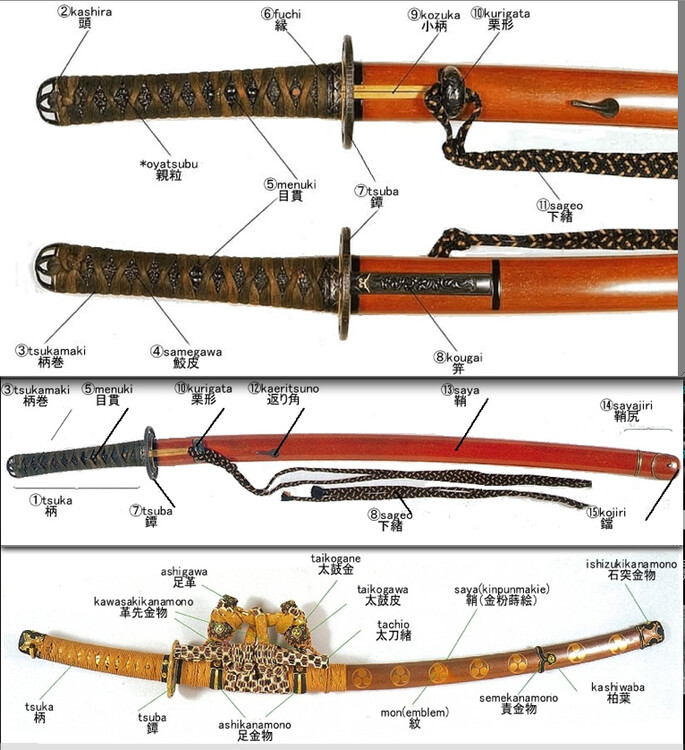
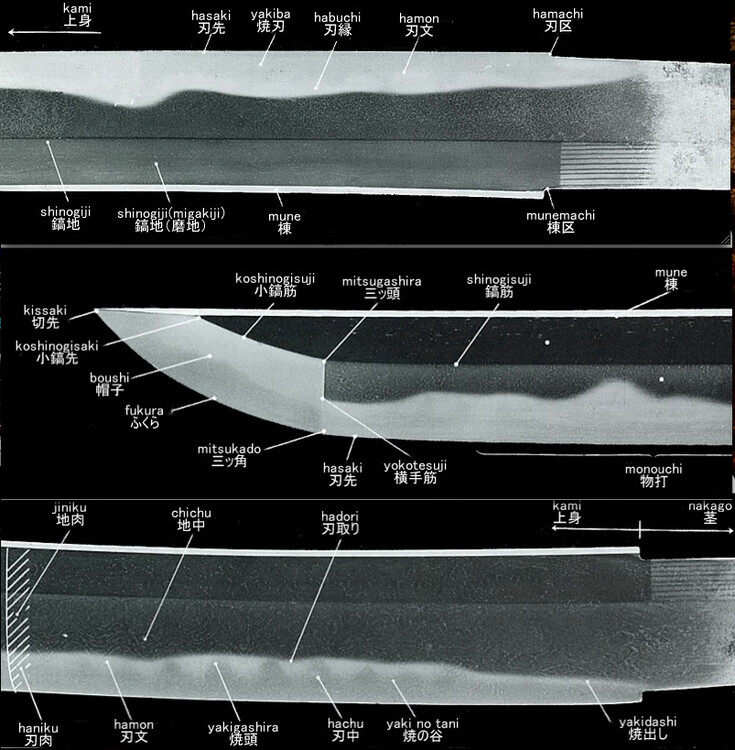
It's no secret: The images are an assembly of reduced and rearranged screenshots from the Ginza Choshuya site. This particular page is online for the public for some years now. My idea was basically to create a stable point of reference somewhere on this forum without posting a link, that will become more and more difficult to find in the future, to a page, that will eventually disappear some day. This doesn't have to be necessarily the collage from Choshuya. It just seemed to be a good starter. Moriyama-san is correct, of course, when pointing to the copyright here. On the other side: If copyrights for every single picture taken from books or web-pages are to be taken 100% seriously, half of all posts on this forum needed to be deleted. Sorry for stepping on toes here. reinhard
-
It might be useful to have a reference point for checking terminology within this forum. Feel free to correct/ add to this first suggestion. reinhard
-
Thank you Morita-san, For those unfamiliar with Kanji, the mei reads: Kato (family name) JUMYO (artist name) reinhard
-
WW2 blade brought back from Papua New Guinea
reinhard replied to Rich Thomas's topic in Translation Assistance
The third year of Meiji era was a kanoe-uma year, but not knowing how to write the name of your emperor properly is more than suspicious. reinhard -
Just guessing: Unless of extremely high value, they were probably transformed into implements of every-day use. Problem is: One cannot separate softer (and cheaper) Shingane from harder Kawagane after fusing them into one blade. I just cannot imagine a samurai buying a blade on which his status (and, in extremis, his life) depended, made of mixed and recycled softer and harder steel for discount reasons. The only exception I can imagine, are some of the mass-produced kazu-uchi mono handed to Ashigaru during Muromachi period. Maybe some of our Japanese friends come up with more profound information. reinhard
-
It was invented by famous philosopher and philantropist Mr.Hugh Hefner. reinhard
-
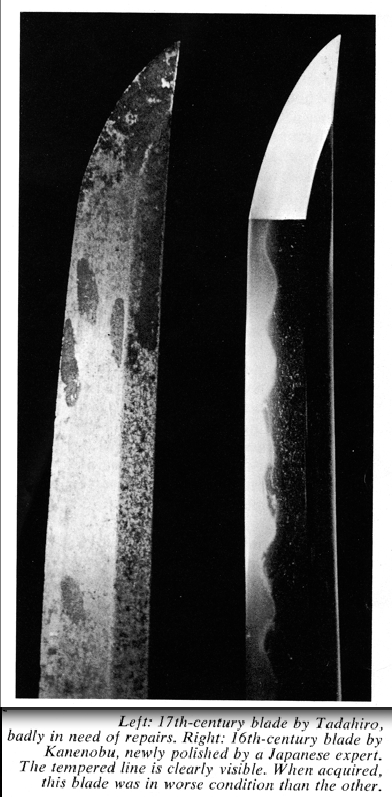
Rust on forged steel is quite difficult to interprete. I've seen blades with tiny spots like freckles, which turned out to be rotten to the core and others with a thick, ugly layer, but turned out to be still healthy. Illustrating what I mean, I would like to show you an example from Royal Ontario Museum, taken by Mr.David Pepper. reinhard
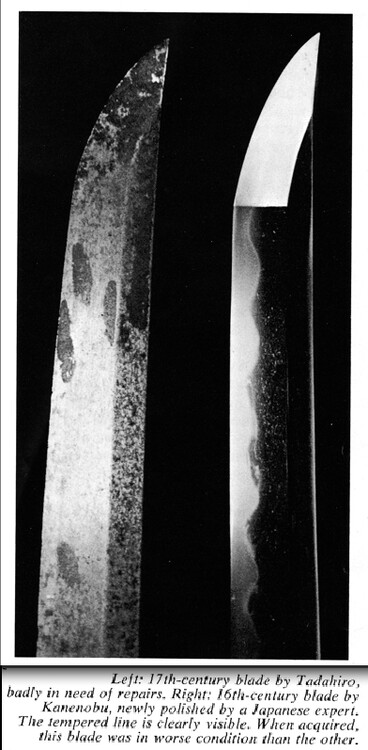
-
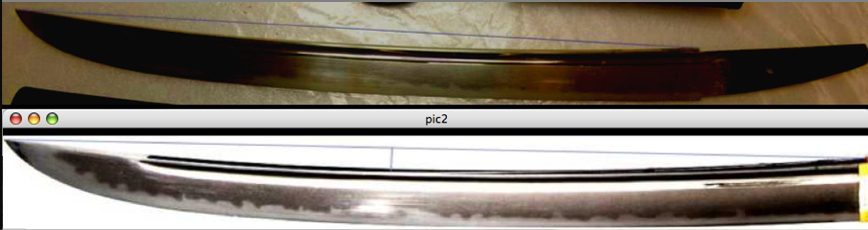
Jacques wrote: "light never plays with lines it always follows them" Sounds nice, but is a classic mistake by someone not familiar with photographical principles. Highlights CAN distort lines, especially on highly reflective surfaces like steel. reinhard
-
Frank, What I was trying to show you was: After the dispersal of the Mino smiths at the end of Muromachi period, the name KANESAKI went to the provinces Bizen, Kaga, Etchu, Omi, Tango, Tanshu and one LINEAGE was working in Mimasaka around Keicho era. Obviously their mei are not very uniform. This could mean, your blade might fit in there as well. If you want to be sure, you better check the blade first. Does it have Keicho ShinTo sugata and characteristics of Mino heritage? If yes, you can still hand it in for papers to make sure. Not even oracle JdF can do this for you. If you are seriously interested in the subject, I recommend the book about Mino Toko during Muromachi period and their lineage .It contains a small but informative section about KANESAKI and his followers in Mimasaka. (Japanese without translation). ISBN number is: ISBN4-89806-250-4 reinhard
-
A daywalker I can handle garlic every now and then, but when it comes in clusters I prefer to stay in my cozy coffin. reinhard
-
The name KANESAKI derived from Mino province and was spread over many provinces during early Edo period. There was a toko working in Tsuyama, Mimasaka province, during Keicho era and he is quite well documented. Two mei for reference attached. reinhard

-
Novice Question about Temper Line
reinhard replied to itsoverthere's topic in General Nihonto Related Discussion
As a footnote: Those of you, who have the opportunity of visiting the exhibition about swordsmiths of the Tokaido in Sano museum, should examine closely the first sword of the Ise Sengo school by shodai MURAMASA. Nioi-gire in its hamon is quite obvious. reinhard