reinhard
-
Posts
812 -
Joined
-
Days Won
1
Content Type
Profiles
Forums
Events
Store
Downloads
Gallery
Everything posted by reinhard
-
Spoils of War or War loot?
reinhard replied to MassiveMoonHeh's topic in General Nihonto Related Discussion
"Regardless, very few - if any - of these pieces will ever make it back to their original owners - and perhaps that's exactly the way it should be. The more the rich and powerful lose personally, the less they'll feel inclined to start another war." (Hector) You missed the main point. Stealing the cultural heritage of a community grown over a very long time won't change a thing for good in the future It's just theft. "...Emperor Hirohito (a man who should, by rights, have joined Tojo on the gallows." (Hector) What rights? To my senses president Truman was class-A war criminal. reinhard -
Question regarding preservation.
reinhard replied to French nihonto's topic in General Nihonto Related Discussion
Whatever you put on a blade. Some of it will stay in the saya. reinhard -
Spoils of War or War loot?
reinhard replied to MassiveMoonHeh's topic in General Nihonto Related Discussion
It's quite simple. Officer's swords were of no importance as weapons during WW II and most of their blades were poorly made. Their value consists only in their emanation of a militarism gone mad. The war was fought with rifles, machine-guns, tanks, airplanes, battle-ships.....and so on. Therefore it was reasonable to confiscate these Gun-To, separating the so-called "ancestral blades" before and destroying the rest. The other side of the "winner takes it all"-attitude is: Important swords with no connection to the actions of the Japanese Imperial Army at all were stolen from temples by marauding GIs looking for souvenirs. Important swords handed over to allied forces by major Japanese families or even by the Tenno himself just disappeared after the war. This was just a primitive theft of cultural property and these spoils should be returned to their former owners. Some smart-asses in the Nihonto-market see these matters differently, of course. Time will judge. reinhard -
tachi Can someone tell me if this is fake. Thanks
reinhard replied to deldoe's topic in General Nihonto Related Discussion
Steve, "..had to be read from right to left" was too restrictive a formulation. You are right there was no law and both directions of writings were possible. It depended on the media and the purpose. In this particular case it just doesn't look right. reinhard -
tachi Can someone tell me if this is fake. Thanks
reinhard replied to deldoe's topic in General Nihonto Related Discussion
And a rare goodie for you all: A photograph of the great Kano Natsuo from an old Japanese newspaper. Text must be read from right to left. reinhard
-
tachi Can someone tell me if this is fake. Thanks
reinhard replied to deldoe's topic in General Nihonto Related Discussion
Further information about writing direction of kanji: https://teamjapanese.com/Japanese-read-right-left/ reinhard -
tachi Can someone tell me if this is fake. Thanks
reinhard replied to deldoe's topic in General Nihonto Related Discussion
The "Machida" inscription on the kashira is irritating, politely said. Japanese Kanji written horizontally had to be read from right to left until the end of WW II. This is not the case here. So this gun-to koshirae was in all probability made after WW II. reinhard -
The meaning behind the name Hon'Ami
reinhard replied to MassiveMoonHeh's topic in General Nihonto Related Discussion
Interesting in this context also: "The Sword and Samé" (ISBN 0 900 470 35 6) edited by Henri Joly and Inada Hogitaro. Pages 127 to 132. "Honcho Gunkiko" by Arai Hakuseki can be considered a quite solid source of information. So in all probability there was a "Mio Honami" at the times of Ashikaga Takauji. He was said to be "a very clever judge to discriminate the age of blades, and wether genuine or imitations; besides he was a very clever polisher." reinhard -
Tricky to tell from a few pixels, but: The imozuru ("potatoe runners") in the ji are pointing towards later Satsuma work. reinhard
-
The mei on your sword is very close to Kajihei's, as far as I can tell, Nicholas. reinhard
-
Nice riddle. It is about tiny details. From left to right: shoshin (genuine) Kotetsu, Kajihei and the mei in question. Can you see the "catch me if you can"-attitude? reinhard

-
I can understand where this confusion is coming from. It is based on the character No.4903 in Nelson's dictionary. It is translated as CHIN or shizu(maru); also used as "shizu" in given names. Doesn't mean much when it comes to given/artist names hundreds of years ago. reinhard
-
Sorry Ray, but it is "Shigetomo" not "Shizutomo". A line of smiths with this name and title was working in Iga province during 17th and early 18th century. upper picture: The paper was handed out by the NTHK and is stating the blade is "shoshin" (genuine) and is "o-suriage mumei" (fully shortened without a signature). They attribute the blade to the school (den) of Hizen-no-Kami Shigetomo. The paper was handed out in year 14 of Heisei era (2002 in Christian calendar). lower picture: The blade is described as o-suriage mumei. Followed by specifications of hada, hamon, boshi etc. It is said to be made in Iga province during Kan-ei era (1624-1643). For whatever this "expertise" is worth. reinhard
-
We are talking about a blade atttributed to a "Omi-no-Kami Tsuguhira....." with a nagasa (according to a dubious torokusho) of 65.1 cm and very little sori of 1.1cm. There were smiths with this name and title working during later 17th/early 18th century. No others. Kin-zogan (gold inlay) or Kin-pun (gold lacquer)-mei were never attached to o-suriage Shin-To and Shin-Shin-To blades. Partly shortened blades show clear distictions between the remaining original nakago and the shortened blade section. They are missing here. The disintegrated look of the nakago looks artificial and covers almost all of the nakago. Anyway: Within a strange and dubious setting like this, further research doesn't make much sense. reinhard
-
The whole package is a fake. Why? Study basics! reinhard
-
I've got the printed book, but the link to the PDF is much appreciated. One of those exhibitions and publications that will become rarer and rarer, I'm afraid. Thanks!
-
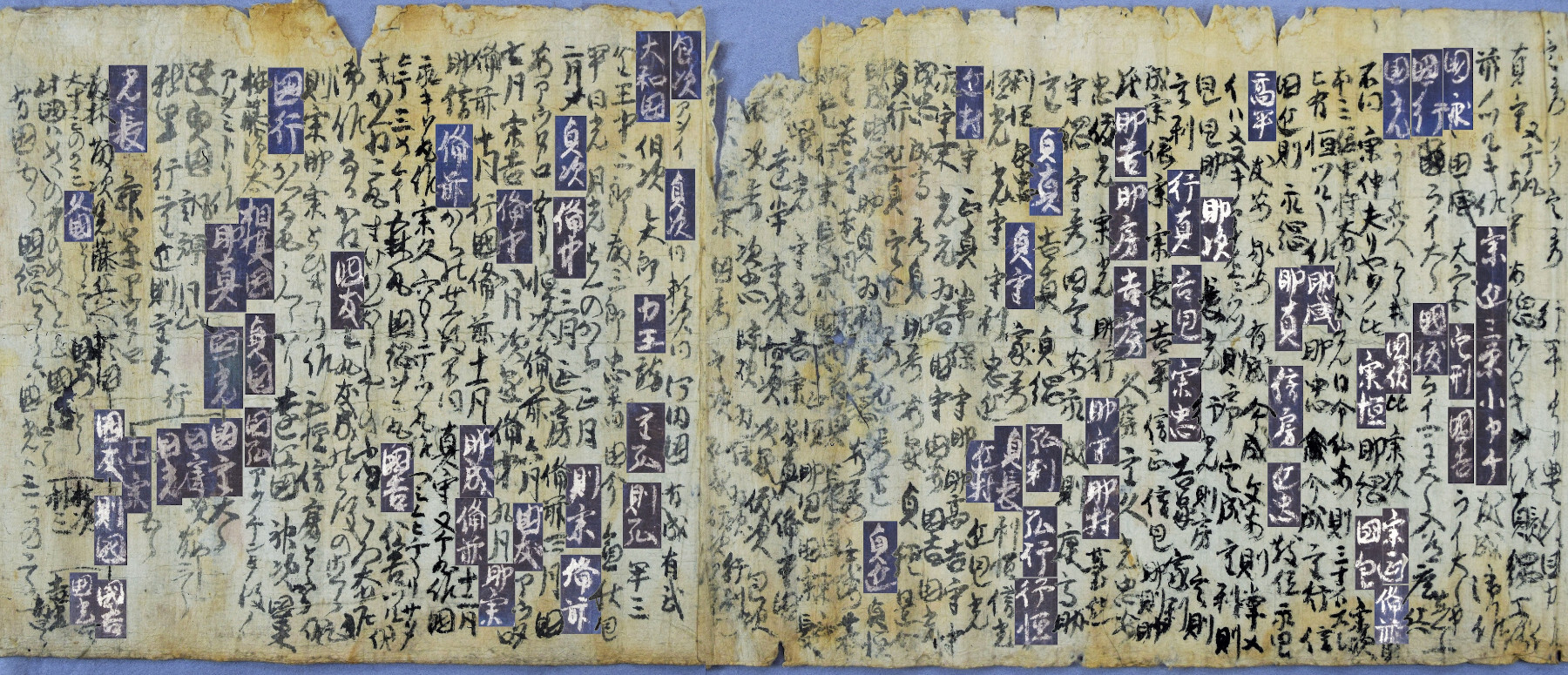
As Markus wrote the text about the swordsmiths had been written on a sheet whose backside was later used to note household economics of the Ryuzoji-family. Obviously the text about the smiths was considered expendable shortly after. This explains the two different handwritings, of course. reinhard
-
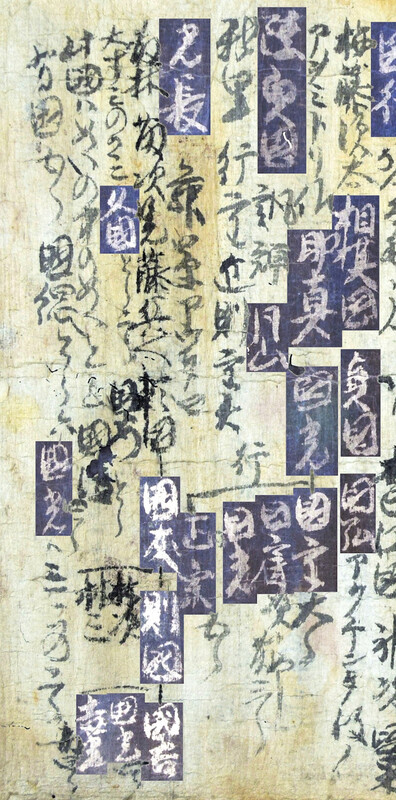
Hello HB, There are a few mistakes in your interpretation of the text: In your upper pic you identified (shodai) Shintogo Kunimitsu correctly. The Kanji 行 just means "leading to" and is not related to a name here. (shodai) Shintogo Kunimitsu was followed by Masamune, (nidai) Kunimitsu, Kunihiro and Kunishige (not Kuniyasu). In the lower pic the name is Norimune not Norishige, but the name is outside of the Sagami section anyway. Please note the text is structured despite of its chaotic appearance. The section about Sagami begins with "Sagami no Kuni" followed by the names of Sadakuni and Kunihiro. Next column is about (Kamakura Ichimonji) Sukezane followed by (shodai) Kunimitsu and four followers. Since this spreading of the column left some space, the author used it to fill in "Mutsu no Kuni" and Gassan smiths. For better understanding I copied the left section of sheet 2 again. I'm afraid you will find no absolution for your Tanto with the Kunimitsu mei here. Even if the text is as old as it is said, there is no guarantee the author was profoundly informed. He may just noted hearsay like many others. Anyway, the text is some fun to research. reinhard
-
This "mei zukushi" manuscript is a bit of a mistery to me. The first sheet is dealing with household economics of temples in Hizen and Chikuzen. Kasei in Japanese and of little interest to us. It is clearly structured and written with a subtle and well controlled brush. The second sheet however is a rather chaotic collection of "knowledge" about swordsmithing and was definitely written by another hand. It starts on the right with "Munechika Sanjo Kokaji" and ends on the left with a lineage of Awataguchi smiths. Inbetween the exact turns of the Go-Ban Kaji and another Sagami-lineage. However: It's just another collection of hearsay, no matter how old. For those of you interested in translation of old manuscripts I give you a version of sheet 2 with a few hints. reinhard

-
Hello Richard, As far as the tanto is concerned: The jihada makes a rough and rustic appearance in hadadachi-style. With this lack of elegance I would not consider it an old Yamato-work. The jigane is open and flowing itame with some mokume interspersed. Masame is basically visible in the point-area. Without seeing the blade in hand and shooting from the hip I recommend to search further in the area of Etchu Uda. reinhard
-
Just a wild guess from a distance, but the surface steel seems to suffer from lenghtwise cracks appearing when a bent blade is straightened again. reinhard

-
Strange 'shrimp' tanto on Yahoo
reinhard replied to Hector's topic in General Nihonto Related Discussion
No. -
Strange 'shrimp' tanto on Yahoo
reinhard replied to Hector's topic in General Nihonto Related Discussion
"Just for fun, here is a micro tanto. I havn't yet seen one so detailed and wonder about its origins." Don't believe anything you come across in the web. What is this "micro-tanto" made of and how was it made? reinhard -
Strange 'shrimp' tanto on Yahoo
reinhard replied to Hector's topic in General Nihonto Related Discussion
There is a difference between Japanese folk-art and Chinese junk. One is the blueprint for the other. Since Chinese fakers are still operating on a shitty level as far as imitating advanced Japanese objects are concerned, they are focussing on simpler objects. I might be wrong, but the prawn-koshirae has a different quality than the toad and lotus crap. reinhard -
Strange 'shrimp' tanto on Yahoo
reinhard replied to Hector's topic in General Nihonto Related Discussion
I like it. Workmanship and patina of the koshirae are pointing to Meiji or Taisho era. Although not of high level craftsmanship it is of Japanese origin, way too good to be Chinese. The blade and its particular shape is of no interest here. The package once made a nice gift on a special occasion. A bride's gift for her new husband at their wedding for example. reinhard BTW: Not all blades made in Japan were meant to be Nihon-to for samurai. Just for consideration before posting mischievous comments.