reinhard
-
Posts
798 -
Joined
-
Days Won
1
Content Type
Profiles
Forums
Events
Store
Downloads
Gallery
Everything posted by reinhard
-
Novice Question about Temper Line
reinhard replied to itsoverthere's topic in General Nihonto Related Discussion
There seems to be a basic misunderstanding about the nature of nioi-gire here. What can be seen on your pic is the white, artificial "make-up" drawn by hadori-finish. Nioi, which is a crystalline structure in the boundary area between Ji and Ha, is seldom visible on amateur pics and if so, only over a very small area of the hamon. To make nioi (and eventually disrupted parts) visible over the entire length of a blade, it takes special measures. The best photographer of Nihon-To of all, Mr.Fujishiro Okisato, gives an example of nioi-gire in Meito Zukan, vol.11. It depicts a blade by Sue-Soshu FUSAMUNE. In order to find nioi-gire, you have to check the blade under good light conditions from bottom to top on both sides. reinhard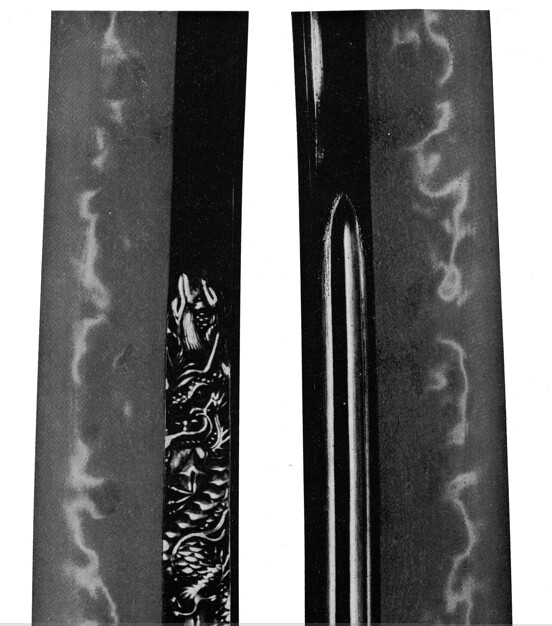
-
Can you see,let alone translate this mei?
reinhard replied to shan's topic in Translation Assistance
The "chin" kanji (in "myochin") is a rare one and hardly ever used but in the context of the name "myochin". "Fujiwara" is quite obvious, but I don't intend to speculate about the other indiscernible remnants of the mei. Maybe you should focus more on the quality of the tsuba itself. reinhard -
Can you see,let alone translate this mei?
reinhard replied to shan's topic in Translation Assistance
I agree with Daniel Lee. The mei reads "(Myo)chin Fujiwara (no)....(illegible)." Proportion and setting of the mei make this judgement reasonable as well. reinhard -
I think you're on the right track. reinhard
-
Je vous salue mes petits Gaulois. Some things never change, do they? In order to tell if a mei is genuine without doubt, it is necessary to have reliable reference material. In the case of ShinTo or ShinShinTo blades there are usually enough swords surviving from every single smith to tell the difference. Going further back in time things become more and more tricky and speculative. If we're lucky, there are many signed specimen left as by Osafune NAGAMITSU or Rai KUNITOSHI f.e.. It is different however in the case of Hosho SADAMUNE. In Hosho-school there were several Toko at the end of Kamakura period working on a very high quality level, but with hardly any INDIVIDUAL traits. Among them SADAOKI and SADAYOSHI are quite well documented by several signed blades each. Unfortunately there are hardly, if any at all, signed specimen by SADAMUNE surviving. Every newly discovered blade with (Hosho-)SADAMUNE mei is put to quality test first. Here's where most of them can be excluded as gimei, for it is extremely difficult to copy top-class Hosho swords. Even shodai KUNIKANE from Sendai clearly failed. Now, when a new blade with SADAMUNE signature, made in the style of and with the qualities of Hosho-school is showing up, it cannot be attributed to SADAMUNE easily because of lack of reference material. One single mei for reference, even if it is a JuBi, is simply not enough to make judgement waterproof. As I tried to explain, this is because of missing individual traits within the Hosho-school: The blade could have been made by SADAOKI or SADAYOSHI and turned into (more prestigious) SADAMUNE later. As far as Juyo Bijutsuhin is concerned: Understanding of NihonTo has improved during the past sixty years. Pre-war standards like JuBi cannot be considered the final and undeniable truth in every matter. This goes for some (not all) of old(er) literature as well. reinhard
-
Thank you for your welcoming me back (I'm sure, some others don't like the idea). I'll do some further research on Hosho-school; until then, you better believe Ted. He did a great job on the subject in his post. - As a footnote: I would like you to consider: Juyo Bijutsuhin is not an undeniable truth, for the criteria back then were based on derivation more than on quality and scientific expertise. reinhard
-
There is still an axe to grind. Nagayama Kokan mentions Hosho SADAMUNE as the actual founder of Hosho-school. Fujishiro also names SADAMUNE without giving an example (oshigata). Both assume Hosho KUNIMITSU as the mythical founder of Hosho school without any blade surviving. Dr.Homma, who came across almost every important blade in existence, never mentioned a single example of Hosho SADAMUNE. NBTHK is not perfectly consistent. In English Token Bijutsu magazine No.40 they say:"...pinning down to SADAMUNE should be avoided, because his authentic works are quite rare...". In No.50 (1992) they say:"...Since SADAMUNE is represented by no definitely genuine specimen, it is desirable not to mention his name in kantei..." However, gimei in his name are quite frequent and Iimura's example in Koto Taikan has not been published ever since (at least as far as I know). Let's stick to "Sam the mune" from Soshu (sorry Guido, I couldn't resist), for he was a hell of a Toko. reinhard