reinhard
-
Posts
798 -
Joined
-
Days Won
1
Content Type
Profiles
Forums
Events
Store
Downloads
Gallery
Everything posted by reinhard
-
I'm afraid, some of you lost grip during this thread. It might be interesting to know what "koma-nagura" etc. is all about and put it into relation to the sword in question. There are different stages of polishing: Foundation polishing, using stones named "ara-to", "binsui", "kaisei". Further polishing is done using "nagura"-stones, differing in fineness, and later "uchigumori"-stones: one for the ha, one for the ji. After that small and thin wafers of uchigumori-stones are used: They are called: ha-zuya and ji-zuya. Then a powder named "nugui" is applied to bring out contrasts. If wanted (and most collectors do), hamon's outline is masked by a kind of make-up, called "hadori". You can see these 11 stages in the attachement (from top to bottom and from right to left). The misunderstandings in this thread are due to a general misconception of "hamon" and second to an information in the book "The Craft of the Japanese Sword", which can be easily misleading. It is said there: "But at this stage (koma-nagura) the hamon has become clearly visible." It is visible to the polisher, but not to the viewer of the pics! Actually true hamon is visible in some of the pics BEFORE hadori was applied. Now, looking at worn blades, backward engineering doesn't work anyway. Older stages of polish don't come back again after long and/or exaggerated sword-care. All you can see in pics (like the one in question) is the ha (hardened edge) and its outline. As Carlo pointed out: This is true for oil-quenched blades too and they don't have a hamon, just a hardened cutting edge. Illusion of hamon, however, can be created by "hadori" at all times. - This is no judgement of the blade in question here. Again: Pics are no reliable source of information, especially when it comes to NihonTo. reinhard

-
This is interesting. Chu-nagura is definitely out of question. Can you provide us with any visual evidence related to the pic(s) in question? reinhard
-
An Invitation for Complaining
reinhard replied to reinhard's topic in General Nihonto Related Discussion
Much bigger, and it should not be abused for trying to establish the "actual dominant alpha male". reinhard -
An Invitation for Complaining
reinhard replied to reinhard's topic in General Nihonto Related Discussion
This excellent quote should be understood in relation to "respect and politeness" and their true meaning. Nobody on NMB is expecting anybody to crawl in the dust, pretending to be humble and submissive. There's nothing wrong with speaking out loud and I do encourage newbies not to be shy. Like Ford (and others before him) said: "There are no stupid questions". All that is asked for is a little awareness of his/her own limits. - Apart from this, there is a fake "politeness". The notorious "IMHO" can express honest modesty (and in most cases it does), but sometimes it is used only as a key to play games. By now it doesn't mean anything anymore. Just for consideration. reinhard -
Since my ways have been criticized lately in hijacked threads, I would like to start a new one without bothering other people, who are asking questions about real objects. It's true: I'm not particularly diplomatic, but just as a sidenote: Learning about NihonTo in Japan, you will eventually get addressed to in a far less diplomatic way, always in a polite manner though. Diplomacy and politeness are sometimes confused, I think. - This is "Nihonto message board". It is not "Japanese sabre massage board". Every now and then some of the statements on NMB remind me of creationist's, claiming evolution is nothing but a contestable theory. - It's true: NihonTo is no exact science, but a lot of research has been done. Most of it was never published outside of Japan and even less so in non-Japanese languages. This makes it difficult at times, not always, to establish a constructional dialogue with somebody, whose knowledge is mainly based on unfiltered, western websites and a couple of outdated books, saying: "...but I don't think so....I believe that....and my opinion is as good as anybodys (especially yours)!!!!". I'm sorry, it's not. NihonTo is not about "thinking", "believing" or insisting. It is part of Japan's history of art and can be learned to some extent. - Everybody is free and wanted to ask and contribute, of course, but not all members are talking on the same eye-level as far as knowledge and experience is concerned. I've never pretended to be the ultimate oracle around here, but I often add some evidence to what I'm saying; using more recent, waterproof material if available. Sometimes I don't, when things are just too obvious. Sometimes I'm wrong. - But what really annoys me, are people intentionally abusing a thread in order to play silly games, as happend recently. So....Anybody disagreeing with these points of view or the way one of my posts is written, is kindly invited to post it HERE and not hijacking other people's threads. (If you wanna tell the bastard where to go: PM me. I can take it). This will bring a little relief to the mods, for I intend to clean the mess on this one myself. reinhard PS.: My English is not very good and rather rusty. I'm begging for a little indulgence for semantic misunderstandings in past and future.
-
Steve, It's quite difficult to make hamon visible by photography. First of all you need to to know what "hamon" is. Obviously you don't. It is built of nioi and sometimes additional nie, which are micro-crystalline structures visible ONLY under proper light-conditions and viewed from a proper angle. In order to make hamon visible on their pics, some of the more advanced photographers change camera-angle from full frontal to a lower angle almost pointing towards light-source. There are two or three photographers, worldwide, capable of capturing hamon within full frontal view, showing it all over the blade, but they don't work for hobby-collectors. What can be seen in most of the pics by amateurs, is the "make-up" only: the artificial, whitish trace left by final stage of polishing, but this is not the hamon itself. You better not confuse these two "ideas" of hamon. I wish I don't need to tell you what kind of pic we are talking about here. Which mei is it, I "stated unequivocally to be fake when it isn't"? Unless backed-up by incontestable authorities, I don't dare making statements like these. I would like to know what thread you are refering to? reinhard
-
Patrick, I don't have access to the page of imageshack with the hi-res image (maybe registration is needed). Posting a pic and short description would be useful. reinhard
-
There is no hamon visible on this pic, only kesho-polish outline and some dark patches within habaki area. This doesn't mean, it's not there. It's just not visible on the pics we can see here. reinhard
-
Jean, It's like Ted said: Age doesn't necessarily dictate quality. Some of late Kamakura/Nambokucho period swords are inferior to the better works of Ise Sengo school. I was just stressing the fact, that seeing MASAMUNE and MURAMASA almost side by side (as it was in this particular exhibition) the deviation in quality is stunning. This should be considered by all people still thrilled by the popular myth of "sinister MURAMASA" and his "bloodthirsty" swords being almost equal to MASAMUNE('s). Sengo work is not even close. reinhard
-
That's what the better (idealistic) part of us is here for, but since we're scratching copyrights all the time and some minor subjects are taking advantage of this, I have full understanding for those providing informations only with a reserve. - Furthermore I like the idea of "no pain-no gain". "Convenience" and "getting all there is to know online" is definitely beyond understanding NihonTo. BTW: "swordsmiths along the Tokkai-do" was a minor exhibition and publishing a catalogue was probably not within financial limits anymore. reinhard
-
The picture is not misleading. In fact, it is quite instructive. The first kanji reads "KANE" and the last one: "SAKU", but it doesn't really matter, for yasurime and writing style give it away as a fake, probably made outside of Japan. I was just wondering, if it's written upside-down. It looks like that on the pic, but this could also be due to camera-angle. reinhard
-
Whatever it is. It seems to be written upside-down and not of Japanese origin. reinhard
-
Many of the western visitors tried to get a copy, I was told, but with all respect: This is a silly attitude. A lot of time and (professional) knowledge was put into this exhibition and its visual display. Expecting to get this highly advanced product just like that for the price of any CD/DVD-ROM is a little naive. It would have been ripped and spread all over the place by now. Japan is a hi-tec nation and the charming lady responsible for this project is by no means naive. (I had the pleasure of meeting her) As for MURAMASA: I agree with Ted and the exhibition at the Sano Bijutsukan showed it clearly: MURAMASA-smiths didn't belong to the top-league of sword-makers in Japan and their fame doesn't depend on their works so much as on the myth surrounding them. They are no match at all for Shintogo KUNIMITSU, YUKIMITSU, MASAMUNE or SADAMUNE displayed in the same room; not even for top-class Sue-Soshu masters like HIROMITSU and AKIHIRO a few yards away. reinhard
-
Brian, The mei "(Ichi) Dewa(no)Kami YUKIHIRO" was used by shodai YUKIHIRO and by later generations from the third one onwards. Mei put on sashi-omote of a wakizashi is not a problem here and most of the nakago's features look OK as well as the mei itself, but there is one doubtful thing about it: There was a particular treatment of the kanji "DE" in "Dewa" in this school and this mei is not showing it. The last(5th) stroke is supposed to end with a hook turning left. Maybe this sounds like hair-splitting to you, but Hizen ToKo were like this. F.e.the 2nd stroke of the kanji "Kuni" was done in exactly the same way by all nine generations of TADAYOSHI until the end of Edo-period and is an important feature for authentification. I'll provide you with some pictures for illustration. Top three examples are from shodai YUKIHIRO, bottom one is by nidai. - Nevertheless the mei in question could be by a later YUKIHIRO since they are poorly documented. In order to prevent any future "arguments": It is possible to find contradictory examples in compilations like "ShinTo Taikan" by Iimura and others. I'm refering to Fujishiro's ShinTo-Hen, which is still considered to be one of the most reliable sources of information and some other more recent reference material. reinhard

-
Hi Brett, Young blood and a fresh view on NihonTo are more than welcome. Enjoy your stay, feel free to ask or contribute and take all answers and reactions with reserve. reinhard
-
"Great balls of fire", I know, but consider this: You are little Nemo, swimming in a pool with barracudas, even here on this board. Buying a blade is much easier than getting rid of one. reinhard
-
Henry, "Kamakura era blade" is not a quality label per se. Percentage of great masters was very high at that time, but not every ToKo was a genius. - Focussing on Ko-Uda school, it is said to be founded by Ko-nyudo KUNIMITSU, whose work is poorly documented and remains slightly mysterious. His famous son KUNIFUSA was THE outstanding representative of Ko-Uda school. KUNIFUSA's oldest, dated blade was made in 1389 (though some of his undated works have a slightly older appearance ). Hence KUNIMITSU can be placed at the very end of Kamakura-/early Nambokucho-period. - Focussing on the sword in question: nagasa of 66+cm is at the short end when looking at an o-suriage tachi, attribution is vague and apart from KUNIFUSA, Ko-Uda is not very much sought after. After all, this is a fair offer but no bargain. reinhard
-
Thank you, Ludolf, for this complementary and informative post. Would you mind telling us when Ikeda's books were written/printed? I'm asking for this in order to put his analysis in relation to Tanobe-sensei's lecture. reinhard
-
Thanks, Ted, for saying all there is to say at the moment (and much better than I could). This example was supposed to be, amongst other things, a reminder of our limits. There are many questions on this board about "gimei or not?" and some of the answers appear quite quickly and confident. This can be accepted when a poor gimei is crushed by undisputed evidence, but all of us should be very careful when considering a famous mei for the real thing. These swords (and tosogu) have been chased for hundreds of years in Japan by wealthy men and their sometimes highly educated advisors and many of them were faked on a level beyond hobby-expertise. - It has been said before and I would like to repeat it again: NMB can be a great help, but it is no (pre-)shinsa. reinhard
-
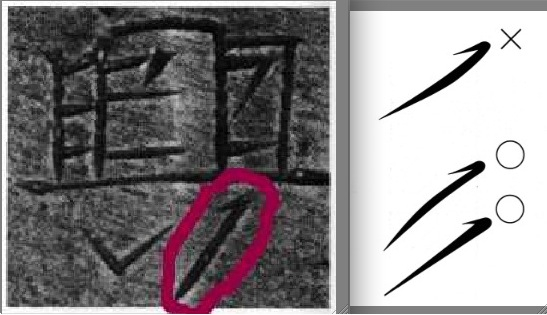
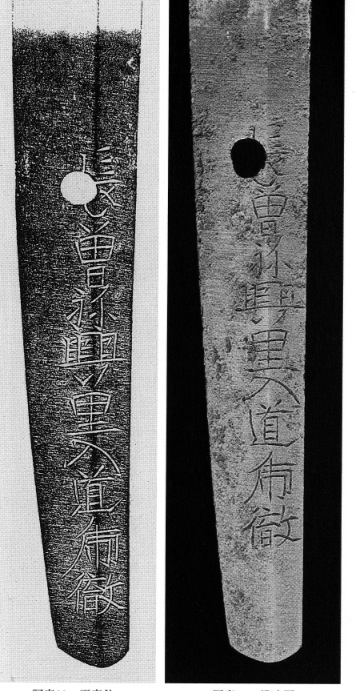
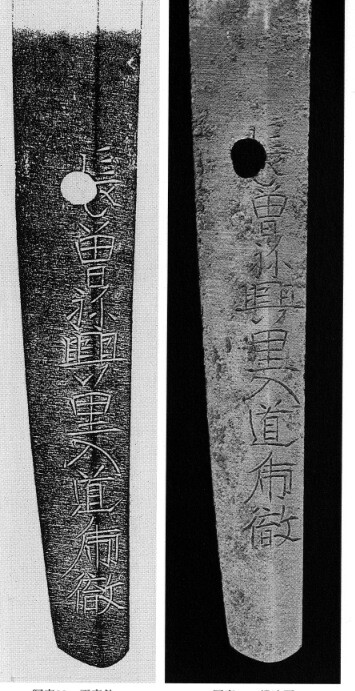
OK, here's the solution: The oshigata on the left is depicting KOTETSU's shoshin-mei. The pic on the right shows a "KOTETSU"-gimei by Kajibei. According to Tanobe-san, it is a tiny detail in the kanji "OKI" that makes the difference. Its last (16th) stroke has to be either straight or slightly curving upwards to be genuine KOTETSU. If it is "hanging down", it is Kajibei's gimei. The pic attached shows a shoshin example. You can forget all the rest. - This comparison is a text-book example for superb forgery and a good reminder of our limited knowledge. A library, no matter how extensive and carefully studied, is not the key to all questions. Anyway, thank you all for playing. reinhard

-
(Naga)SONE is in no way related to SONY . reinhard
-
Not as tricky as Kajibei. All guesses missed the important spot so far, but you are all in good company. Kajibei became a legend for a reason. - Again, scanning libraries can be part of the game, but they are not always at hand. What do you do, when suddenly confronted with one of the two examples? And don't tell me about workmanship in this particular case. Even KOTETSU's genuine works oscillate between top-class and....not so top-class. reinhard
-
Since the topic of gi-mei raised some interest lately, I would like to give you another example to sharpen your claws on. You may have heard of Kajibei before, the "lazy genius", as he was called by Darcy. Capable of copying workmanship of top-class ShinTo masters, he often left a tiny "catch me if you can"-mark within his mei. Again, this is a pic from Menome magazine (please don't spoil the fun, if you know the answer) and it is not a question of workmanship. Kajibei was able to fool experts and scholars at his time. Nagasone KOTETSU was one of his favourite "victims". reinhard
-
This is not about poor fakes. Kajibei was able to copy works of top-class ShinTo masters like KOTETSU, Tsuta SUKEHIRO and others on a supreme level. reinhard
-
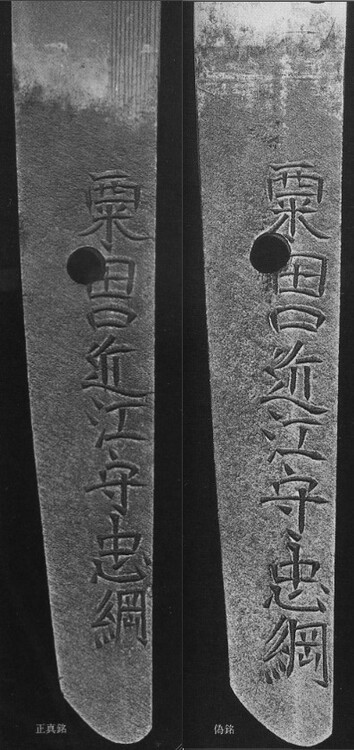
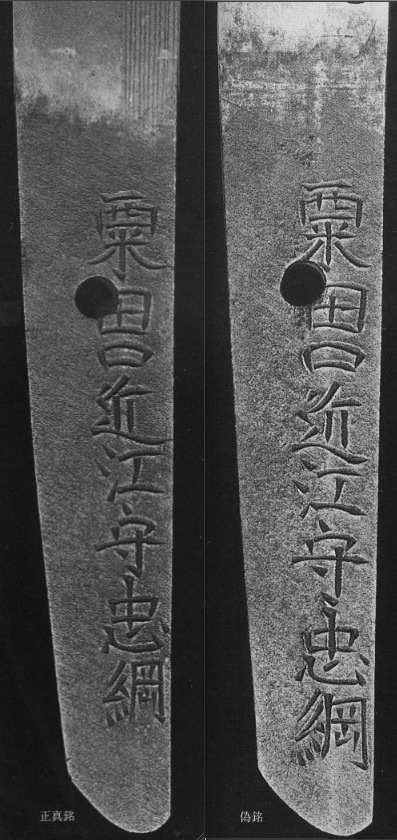
Well done my dear forumites, The left mei is shoshin, the right one is gi. As Brian and others pointed out: This gi-mei is extremely well done. We're looking at an enlarged pic of it side by side to a waterproof reference mei. TADATSUNA's mei varied slightly during his long career and after all, he was no machine. Again, imagine yourselves in a situation with not much time, poor lighting conditions or even worse: a low-res pic posted on a site. You are free to rely on gut-feeling, of course, but in doing so, you are walking on very thin ice. This gi-mei is quite fluently written and rather well-placed. There are some hesitating moments though and what is most important (and cannot be seen properly in a pic): the depth of chisel-marks remains approximately the same in shoshin-mei, but usually varies in gi-mei. reinhard