


noneed2hate
-
Posts
91 -
Joined
-
Last visited
-
Days Won
1
Content Type
Profiles
Forums
Events
Store
Downloads
Gallery
Everything posted by noneed2hate
-
Ebay has been getting rather aggressive with their sellers fees over the last year, additionally they did start reporting all sales to the IRS and are issuing 1099 forms to sellers. That said 20-30% seems a bit high, depending on the item it should be right around 12 or 13 % roughly.
-

Books Marcus sessko encyclopedia of Japanese swords.
noneed2hate replied to Paz's topic in General Nihonto Related Discussion
The Encyclopedia is an excellent supplemental book, glad I picked up a copy myself, but I would go with what the others have recommended first. I find myself using the Connoisseurs Book of Japanese Swords more than most of the books I've purchased in the last year and fully recommend it. -
That looks rather nice! Did you make this one yourself?
-
Hi Bruce, Coincidentally this was posted Yesterday on one of the Facebook groups. Habaki was mounted on a Seki made Showato blade by Inoue Suketsugu. I'll ask the original poster if I can get a clearer photo for you.

-
In my novice opinion, I believe it to primarily be Itame hada with some interspersed mokume variation perhaps or even a very fine ko-mokume with chu-mokume variations, based on this, perhaps a school of or derived from Soshu-den?
-
If a random smith uses the name of another smith on a sword that was not produced by the smith named, I think that would qualify as gimei (not saying concretely that is the case for this particular blade, just generally speaking) would it not? It does beg the question why it was signed with Mino as opposed to Noshu (i.e. if Gimei, was the individual who put the signature confused between the 2 or was there high tolerance on liberties taken with choosing between the 2), they are one in the same according to references Mino (美濃 = Nōshū 濃州) and from what I can tell in my books is that Kanesada (depends on which as there are many) had the honorary of Noshu-ju (at least in part) among a few generations. To list a few from Seskos books: Kanesada 2nd Generation, Eisho 1504-1521 - Noshu seki-ju Kanesada saku (signature does not compare well to his given example in the book) Kanesada 3rd Generation, Tenbun 1532-1555 - Noshu seki-ju Kanesada saku (signature does not compare well to his given example in the book) Kanesada (student of 2nd, assistant of 3rd Gen), Koji 1555-1558 Noshu seki-ju Kanesada Kanesada (son of 3rd Generation), Tensho 1573-1592, Noshu-ju Kanesada Thanks for sharing pictures and observations about your sword, Juan! The Habaki is certainly a good fit for today.
-
I appreciate the observation, what characteristics about the nakago are you observing that would indicate this?
-
Very strange, they have the feedback on ebay (20600+ transactions) to appear reputable, but the sudden nihonto listings are a strange change in dynamic to their usual merchandise they sell. Particularly this one where they have it set to bid only, but say they will only accept the buy it now price in the description: https://www.ebay.com/itm/203830564203?hash=item2f753f956b:g:PiwAAOSwuHZhG76V Name also shows up as sootysmtg for me They are selling this same sword as Katanaboutique but trying to undercut by 3k (not that it matters to them, they don't actually have the sword anyway, katanaboutique does): https://www.ebay.com/itm/203830564206?hash=item2f753f956e:g:eqgAAOSw9Fpg5afx - scootysmtg Suketada katana https://www.ebay.com/itm/255256812253?hash=item3b6e7ddadd:g:eqgAAOSw9Fpg5afx - katanaboutique Suketada katana They also have a photo that says to contact them off ebay with an email etc, Absolute scam, reported on my end.
-
Perhaps I'm slightly confused on how the Sori is determined. Determining Sori with a straight line from Kissaki to Munemachi is incorrect? remeasuring from Kissaki to the nakago-jiri, it does seem to essentially be tori-sori with a slight lean towards koshizori. Seems either method produces similar results at least in regards to this particular blade.

-
Hi Jean, I appreciate you looking this over. It does appear you are correct. I measured things out this time around instead of eyeballing and it does appear the blade is slightly Koshi-zori as you mentioned. Regarding the patination, I assume if it were an older Suriage/O-suriage blade, we would see more variation or I guess stages in the patination that would reflect the nakago pre/post suriage process as opposed to a consistent patina throughout? I am quite embarrassed about my misspelling of Mekugi, my apologies. I'll try to proofread a bit better going forward, thank you for pointing that out. I have included a picture with a crude but decent illustration of where I measured out the widest section of the sori to be. Currently reading up on Utsushimono, this is fascinating stuff. As always, thank you!
.thumb.jpg.cdc1662be6c1714e7009636af6ca27e7.jpg)
-
Small update regarding this sword, I have sent it over to Woody Hall for a window polish. Definitely looking forward to what will possibly be revealed. I'll keep everyone posted.
-
I really appreciate all the replies everyone, this a great learning experience and discussion for me. Here are a few more photos in more natural lighting that hopefully work out a bit better than the harsher artificial lighting I was using in earlier photos. Regarding the Utsuri, I do wonder if that might have perhaps been a slight reflection of my phone Regarding the Yasurime, would it be reasonable to assume the Yasurime may be heavily obscured or worn down through age/patination? I can see very uniform marks indicative of O-sujikai, but they are not deep or super defined. Additionally below you'll find close ups of the meguki-ana themselves for further evaluation. At face value it does appear the mekugi-ana may have been struck, perhaps by a previous owner attempting to drive the mekugi out or during the creation of the Tsuka as it is of recent production (at least the Tsuka core is). Thanks again everyone!
-
Regarding the Chikei, I may have overlooked that but I was definitely curious about these faint black lines approximately 1/3 of the way between where the shinogi would be and the habuchi as pictured below: These were the photos where that is best defined.
-
Hi John, I had neglected to add the boshi photos, but just added them to the main post, my apologies. I'll track down references for those characteristics you mentioned and read through that linked thread, I am quite curious, thank you for the insight!
-
Recent Nihonto acquisition - sword is mumei and unpapered. I believe (and fully understand I am likely totally wrong) it to be either Aoe School or Horikawa school based on some of the characteristics (referencing Nagayamas Connoisseurs book) seen in my baseline analysis as follows: The blade does to appear to be at face value suriage with a chopped nakago-jiri and the presence of more than 1 meguki-ana. Nakago has the presence of O-sujikai yasurime on one side, and the same on the other but running the opposite direction (i.e deep slant from mune down towards ha instead the expected deep slant running from ha down towards the mune.). Yasurime is a bit hard to make out in the photos through the patina, but it is present. Jihada seems to be a ko-masame or perhaps very dense ko-mokume. I'm leaning towards the former as there is the occasional coarse masame grain present (if this is appropriate to call the clear lamination lines). Chu-suguha hamon with ko-nie deki along the habuchi as well as what I believe to be presence uchinoke, ko-saka ashi Chu-kissaki with a Boshi that seems to be ko-maru, the turn back is very faint/thin on one side almost appearing to be ichimonji, but clearly present on the other as ko-maru Other Basic dimensions/sugata characteristics: mihaba 31.1mm, saki haba 25.4mm motokasane 6.6mm, sakikasane 5.2mm nagasa 67.3mm Low-shinogi, blade appears to be very slender, very acute diamond shape. Blade also has a very gentle iori-mune. Sori appears to be Saki-sori, though I'm not certain what the considerations/rules are for determining this if it is in fact a suriage blade since this would likely change. Kata-chiri bohi is also present which I feel is adding to the slenderness of the blade as a definite shinogi line is not present up until around where the yokote is. Koshirae is a mish-mash by the previous owner to make the blade useable for Iai, saya is a loose fit and likely not original or meant for this blade, but the rest of it I feel seems passable. Fuchi is signed shige-something 重 _? I was unable to determine the second character. Based on my initial observations, I believe the blade to have generally originated either from the Aoe school or the Horikawa school. To be perfectly honest, I made just a few correlations and fixated on those two schools going forward so I likely may have missed other schools that may have similarities. That said, I believe if it is a Koto blade, then Aoe may be the clear choice. However if it is a Shinto blade that did not go through the suriage process, Horikawa may be correct as they are described as trying to replicating koto blades and utilized kiri/ichimonji nagakojiri. I'm leaning more towards the former than the latter, but will be comparing to examples of those schools going forward as opposed to the checklist approach via book I just utilized. Does anyone have any different takeaways for this sword or any corrections to any of my observations above based on the photos? There's quite a few photos but I'll try to keep it to as few for reference as possible, the remainder will be in the following album if need be: https://imgur.com/a/VdC6pR5, please let me know if any further/clearer pictures will be required. I look forward to the discussion
-
Beautiful blade, thank you for sharing!
-
Looks to be a predominantly Mokume along the hira-ji. Hada along Shinogi-ji does look to be a bit straighter, more in line with Masame perhaps.
-
I believe this seller has a pretty high turn over rate and prices his stuff to move accordingly based on what I've seen on his page over the past few months, so I can only assume the descriptions are pretty haphazard hence potential inaccuracies. He does have a good variety of swords at various price points with some that actually may be worth consideration as John mentioned, but concur as others have stated that it's best to save up and study as much as possible.
-
Beautiful blade, congratulations on the acquisition!
-
Hello Steve, Thank you very much for your input. I've since bought a microscope so hopefully that will yield me more accurate observations on my part (as much as possible given the current state/polish) than the magnifying glass I currently use. In any case I do really like the blade as a whole and it seems like a good candidate to pursue professional polishing/restoration and I suppose that's the most important thing. By the way, does anyone have ideas on what the tsuka could be wrapped in? Seems to be some sort of lacquered fish skin perhaps as it's slightly coppery/silvery, but I'm uncertain. Thanks -George
-
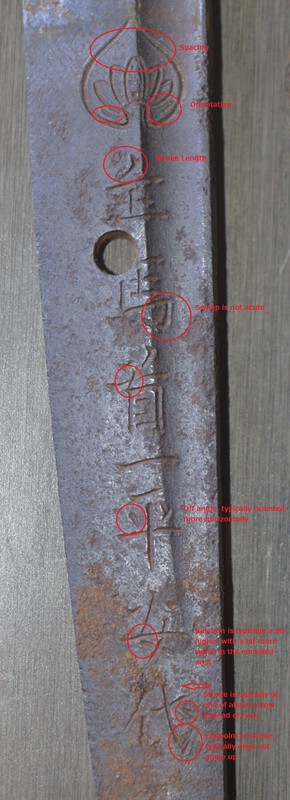
Thank you for those signature examples Jussi, and very much appreciate the kind words Sunny. After staring at various examples of Yasuyo signatures for hours, I've the notated the following inconsistencies as far as I can tell on my blade. A lot of the signature/aoi mon examples seems to be also somewhat inconsistent among each other. Sadly I was unable to find any examples of his signature with the Shinogi Hi (I incorrectly called it Bohi earlier) running through the signature space. I've circled each point of inconsistency in red with a brief explanation of the difference in this blades signature/aoi mon compared to Yasuyos works as presented in Seskos books, Fujishiros books, and the ones Jussi provided. I did point it out in the picture but the Aoi-mon does seem not quite as bulbous/circular with the upsweep of the outer portion of the hollyhock happening almost immediately compared to confirmed examples . I did briefly look at the possibility of it being a Daimei by one of his students, but looking at Yasuari (Yasuyos primary student) signatures, to include a Daimei for Yasuyo, I confirmed this is not the case as his strokes are much more squared off/uniform as far as I can tell. Any other input would be greatly appreciated.
-
Greetings Mojmir, Those photos are a hard read being upside down, but I was able to download it and flip it. I am reading the Kogatana as 三完包吉 Misada Kaneyoshi, not too certain on if the second character is fact 完/sada, but that's my best guess. Other than that I'm not too familiar with that name or their work. I'll defer to those with more experience for further input. -George
-
These look very nice, I'll take the green one if still available. Thanks! -George
-
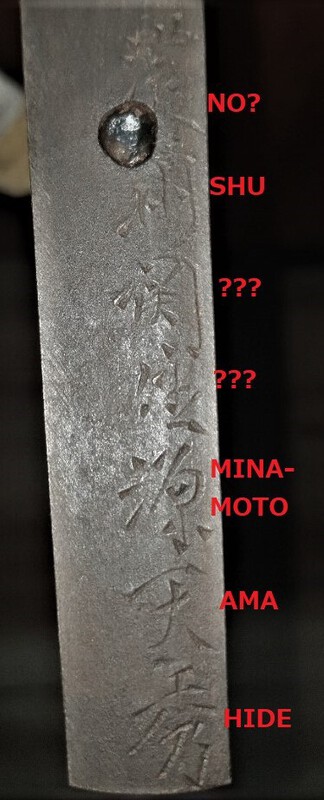
Not able to immediately find the middle two kanji in my reference material but here is what I've got thus far in the attached picture. These are my best guesses. Great looking blade by the way. I concur with Victor on this blade having been shortened slightly. The filled mekugi ana and chopped nakago are fairly good indicators of this.
-
I had spit out my coffee when I saw that posted a couple weeks back. Wild stuff.




.jpg.5bd0a147b4cb852bd41e81d7461471ff.jpg)


