Toryu2020
-
Posts
2,497 -
Joined
-
Last visited
-
Days Won
21
Content Type
Profiles
Forums
Events
Store
Downloads
Gallery
Everything posted by Toryu2020
-
Dai Token Ichi 2022
Toryu2020 replied to Keichodo's topic in Sword Shows, Events, Community News and Legislation Issues
I think everyone on this forum that has the chance to attend should post a picture of themselves holding that Sadamune!! -t -
Biggest surprise for me was I bought a pair of tsuba with a bid I figured would get easily surpassed but then premiums and shipping added more than three hundred dollars to the price!! -t (guess I shouldn't have been surprised...)
-
Japanese Spears Book: Roald knutsen questions
Toryu2020 replied to Tensho's topic in General Nihonto Related Discussion
Both are excellent books. Bugei Marketplace has NIHON NO MEISO on sale right now on Facebook if you're interested... -t -
Question about katana length to height.
Toryu2020 replied to Barrett Hiebert's topic in General Nihonto Related Discussion
Barrett - Several factors at play here; 1. height - hold the sword naturally in your right hand - let the tip down to the floor - a longer sword will touch the floor a shorter one will clear it - about an inch from the floor is pretty standard length. 2. Monkey factor - hold the sword naturally in your right hand - with the sword horizontal - place the tip at the center of your chest - a blade that is short of the center on right on it is pretty standard length - if the tip is well past the center it is a longer sword and you may have trouble with noto. 3. Ryuha - what school do you practice? does the art favor longer swords or shorter ones? Does your teacher have any input on your decision? What does he/she have to say? 4. Personal taste - it takes about two years of regular practice to develop the feeling of taste in swords - do you like a deeper curve - okissaki - longer blades or shorter ones - heavier blades or lighter ones - this cannot be taught - it is something each individual has to develop. Keep in mind 167 cm would make you the tallest man in most rooms in Japan 100 years ago - so a standard length of 2.3.5 would probably suit you just fine - afterall it worked for generations of swordsmen before you... -t -
Annual gift-giving for the Shogun... -t

-
I do not believe the Hon'Ami "cooked up" swords, certainly there were generous attributions given for generous patrons but they didn't need to fake things to make a living. If you believe everything is cooked then there is nothing to believe in, time to move on to another hobby. Generally they do not put gimei on poor swords - there is most often an attempt made to match workmanship to the spurious attribution/false signature. Of course there are some really clumsy examples out there. Yes there were blades probably cut down to try and get a better attribution but this is not why there are so many osuriage mumei blades. Not all merchants were criminals. As stated there were annual ceremonies where swords were given as gifts, the list of appropriate makers was pre-set, the ceremony prerequisite so of course the name on the label (saya) was more important than the actual work inside. Tatemae and hone. It was an accepted reality that all participated in. They still do - if you've ever participated in a Japanese wedding and seen the number of envelopes passed around you would understand. If you've lived among the Japanese you would see the sheer honesty and pure integrity of the average Japanese, living someplace uncivilized like America it is easy to think that "everyone is out to screw me", there is no place like Japan to restore one's faith in humanity... -tch
-
羽 前 関
-
Indeed Terumasa -t
-
Reviews of each generation help us see who were the more reliable appraisers, but every generation was subject to "political influence"... -t
-
Well when you don't have rice-lands to gift as reward for service it is only natural that you create a system that values swords, armour, horses, falcons and tea ceremony goods equivalent to land and castles... -t
-
Paz - you'll find that Fukunaga Suiken writes extensively on these questions - Markus Sesko does great research in this area, I recommend joining his blog. Many many writers over the years have covered, sword makers, schools of swordmanship, famous samurai and their relationships. This is an area of interest for me and what is often surprising is that while some groups, like Mito Samurai seemed to have patronized their local smith, many famous persons were seen to carry blades from all over Japan. So there seems to have been quite a currency especially in the Edo period. -t
-
An old mirror in tensho calligraphy
Toryu2020 replied to paul cavallier's topic in Translation Assistance
KITA北 MINAMI南 NISHI西 HIGASHI東 -
An old mirror in tensho calligraphy
Toryu2020 replied to paul cavallier's topic in Translation Assistance
Have you tried the four directions? -t -
Piers - follow the original thread the page is much clearer there... -t
-
"Sadamitsu - Yamashiro A student of Gassan Sadakazu lived in Yamashiro, Heianjo - used the go Ryuunsai, made mostly tachi, wakizashi and tanto are rare" The rest is a description of his workmanship... -t
-
From the single volume Shishin-to Taikan - Keio date - The Meikan only lists Keio dates so your work represents new information about this smith... -t

-
Sorry Bazz - just randomness from the interwebs... -t
-
Piers is right! Your dad has started you out on a terrific journey, and you are in the right place to find help along the way. -t
-
Wondering did I post this previously?
-
A Nihonto Holiday, Tips please.
Toryu2020 replied to Nicholas Fu's topic in General Nihonto Related Discussion
Okayama - visit Setouchi City IF (check beforehand) if they have the Yamatorige on display at that time of year. Also Ando Sword Shop in Okayama City. Nagoya - Atsuta Jingu has a brand new museum displaying many of the great swords that have been donated to the shrine over the centuries. Nagoya Castle. Sanmei Tokugawa Arts. Kyoto - not a lot of sword shops but as stated the whole town is a museum. Fushimi take the sake brewery tours. Osaka - Meirin Sangyo. Tokyo - Ginza has the highest concentration of high end sword shops, many of the same dealers will be at DTI. Robot restaurant. Traditional Dance Restaurant. Samurai Restaurant. Don't know if there is Yakata-bune this year. Temple of the 47 Ronin. Edo-Tokyo Museum. Eisei Bunko, check to see what is on exhibit. -
I vote wakizashi - for photos try the "dark room" trick - set it up in a completely dark room and then use the flash on your camera - surprising things are sometimes revealed... -t
-
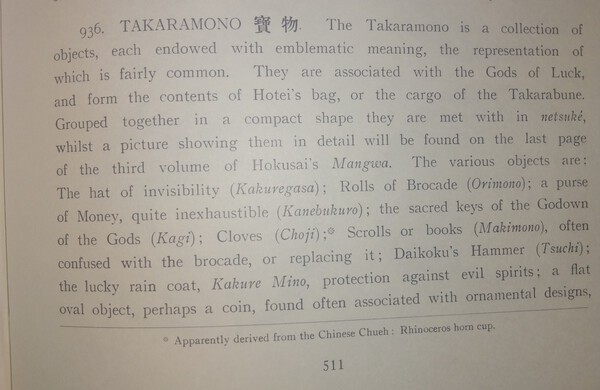
I believe you're second tsuba does not feature the moon but rather a magatama. It is very roughly done but I think your theme is takaramono.

-
I think you are correct Thomas. -トム
-
I think you need Sakana-kun!!

-
Someone needs to file a claim with the postal inspector...