Lewis B
-
Posts
1,803 -
Joined
-
Last visited
-
Days Won
10
Content Type
Profiles
Forums
Events
Store
Downloads
Gallery
Everything posted by Lewis B
-
 Not sure that is correct. The earlier extant work (predating 1423) I was referring to was the one that states Norishige was a student of Shintogo Kunimitsu, a statement that flies against the long held dogma that he was one of the Masamune Juttetsu. That publication is the Ki'ami-bon Mei-zukushi (喜阿弥本銘尽), dating back to 1381.
 -
I think you'll be disappointed with the offerings at the V&A. Poorly illuminated cabinets and uninteresting specimens. I would skip unless you wanted to see something else eg ceramics, fabrics, Middle Eastern art etc.
-
Fascinating and what a great discovery. The link to the transcription of the 2 page document is no longer active? Is there another? What was the date of the previous oldest nihonto text? From the 1370's? https://www.militaria.co.za/nmb/topic/24440-early-sword-reference/
-
From Markus Sesko's swordsmiths reference it appears to be by one of these Fujiwara Kinmichi smiths. Most likely 2nd or 3rd generation as they carved chrysanthemum on the nakago. KINMICHI (金道), 1st gen., Keichō (慶長, 1596-1615), Yamashiro – “Kinmichi” (金道), “Iga no Kami Kinmichi” (伊賀守金道), “Iga no Kami Fujiwara Kinmichi” (伊賀守藤原金道). He was the oldest son of the Seki-smith Kanemichi (兼道). He had accompanied his father in the second year of Bunroku (1593) with his three brothers Echigo no Kami Rai Kinmichi (越後守来金道), Tanba no Kami Yoshimichi (丹波守吉道), and Etchū no Kami Masatoshi (越中守正俊) to Kyōto where they settled in the Nishinotō´in (西洞院) neighborhood and where Kanemichi founded the Mishina school (三品). The name Kinmichi was in back then read Kanemichi but to avoid confusion, more and more the reading Kinmichi became common. He received the honorary title Iga no Kami on the 19th day of the second month Bunroku three (1594) and worked also for the Imperial Court from that time onwards. Shortly before the Battle of Sekigahara, Tokugawa Ieyasu ordered 1,000 tachi from him and due to the skillful management of all the workers he was granted with the honorary title Nihon-kaji-sōshō (日本鍛冶惣匠, lit. “master swordsmith of Japan”). With that title, he had a certain influence at court on the granting of honorary titles for other swordsmiths. The title and the advisory function at the imperial court were hereditary and held by successive Kinmichi generations until the bakumatsu era. The 1st gen. Kinmichi died on the eleventh day of the twelfth month Kan´ei six (寛永, 1629). His blades have a sakizori and his rather wide mihaba does not taper that much. The jigane looks hard and the jihada is a standing-out ko-itame with nagare and masame along the mune. Ji-nie and chikei occur. The hamon is a notare mixed with gunome and togariba or a ko-notare mixed with gunome. His works in the Mino tradition are somewhat different from his works in the other traditions, i.e. the hamon is in this case an ō-midare mixed with yahazu-midare or hako-midare with irregular nie. In addition, sunagashi and kinsuji appear and an influence of the Shizu school or of No-Sada can be seen. The bōshi is a Mishina-bōshi. wazamono, jō-saku KINMICHI (金道), 2nd gen., Kan´ei (寛永, 1624-1644), Yamashiro – “Iga no Kami Fujiwara Kinmichi – Nihon-kaji-sōshō” (伊賀守藤原金道・日本鍛冶惣匠), real name Mishina Kanbei (三品勘兵衛), oldest son of the 1st gen. Kinmichi and the older brother of Izu no Kami Kinmichi (伊豆守金道), the 1st gen. received as mentioned the honorary title Nihon-kaji-sōshō but it was the 2nd gen. who signed that title for the first time, he also carved a chrysanthemum onto his tangs which looks like a stylized cartwheel, he died on the 21st day of the tenth month Enpō eight (延宝, 1680), itame mixed with masame, suguha, gunome-midare, often sunagashi, Mishina-bōshi, wazamono, chūjō-saku KINMICHI (金道), 3rd gen., Jōkyō (貞享, 1684-1688), Yamashiro – “Iga no Kami Fujiwara Kinmichi” (伊賀守藤原金道), real name Mishina Kanbei (三品勘兵衛), he received the honorary title Iga no Kami on the 28th day of the first year of Jōkyō (1684) at the age of 30, the title Nihon-kaji-sōshō was granted to him in Kyōhō six (享保, 1721), he changed the characters for “sōshō” from (惣匠) to (宗匠), in the seventh year of Kyōhō (1722) he worked at the invitation of the bakufu in the Edo-bakufu residence Hama-goten (浜御殿), he and all of his successors carved a chrysanthemum on their tangs, because of an illness he was supported by
-
https://www.japanartfair.com/
-
No worries. Hopefully Chris doesn't mind me posting his FS listing. I bought it here... Since you're in the Netherlands I would seriously recommend you attend at least one day of the Japan Art Fair in Utrecht in mid June. Its a unique opportunity for Nihonto, Tosogu and Katchu collectors in Europe.
-
I have a fuchi signed Shoami Masanori (founder of the Kyoto Shoami school), although its apparently difficult to distinguish between shodai and nidai work as they both signed 'Shoami Masanori' and produced similar quality pieces.
-
This is quite an unusual one. Sorry for the poor quality reproduction. Does the design hold some particular symbolism?

-
I think he means he found NMB by Googling, at least that was my interpretation.
-
Yes, you correct. I didn't recognize the name of the owner. I thought it was owned by a Chinese Singaporean.
-
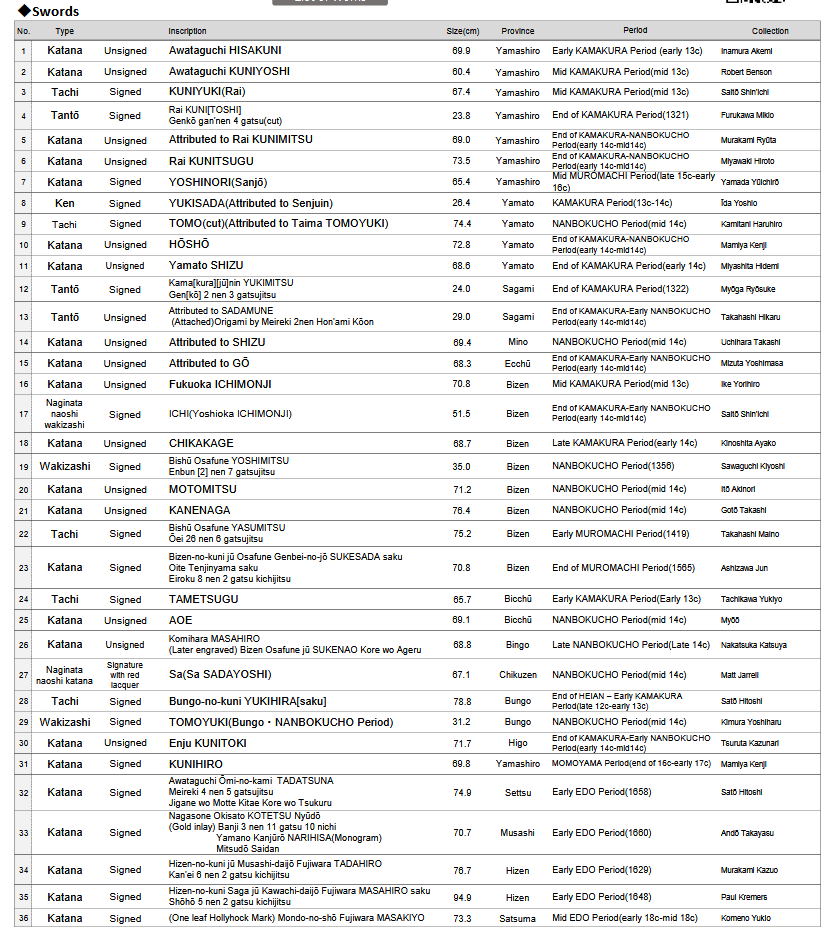
Shame photography isn't allowed but understandable since the swords are privately owned. I would like to have seen the Go, Yukimitsu and Sadamune tanto and the Fukuoka Ichimonji katana in particular. Only 3 non-Japanese owners are represented including Bob Benson and Paul Kremers (congratulations to those gentlemen).

-
Adam Savage checks out a sword
Lewis B replied to Brian's topic in General Nihonto Related Discussion
The kozuka and tsuba are exceptional quality. Mr Mansfield had a very good eye for the aesthetic. -
Photographing nihonto is one of my most enjoyable aspects of the hobby. A good macro lens mounted on a tripod is definitely the way to go. The lens sees more than the eye although as Brian says the flaws appear far more significant than to the naked eye. Try different light sources, incandescent vs LED vs high intensity metal halide or halogen. Each will bring out different features on the blade. Having access to high quality photographs of swords only helps us to appreciate the finer qualities. I recommend people to check out FB "Shiotsuna" who regularly posts high quality photos of masterpiece blades and koshirae from major exhibitions in Japan. This koshirae for a Shintogo Kunimitsu tanto owned by the Date Clan is a case in point. Incredible workmanship.

-
Translating fuchi and blade inscription
Lewis B replied to Ecclesiastical's topic in Translation Assistance
I get decorative wallhanger vibes. The carving is very crude. -
"mrtierney50" is making my spidey senses tingle.
-
Adam Savage checks out a sword
Lewis B replied to Brian's topic in General Nihonto Related Discussion
We always remember our first. I was fortunate to be invited to visit the home of a German collector in May 2024, where I was given the opportunity to study 3 Juyo blades in hand. I held the nakago of the first blade so tightly and so intensely, the owner even commented on the heat transfer. He was probably hoping I wasn't related to Uri Geller.- 22 replies
-
- 10
-

-

-
Kissaki has been slightly reshaped. Still a nice sword in a very nice koshirae. The price reflects the condition so you would be getting a fair deal.
-
I met him at the Japan Art Expo last June in Utrecht.
-
Need help identifying and getting do's and don'ts for this blade
Lewis B replied to majorFALfan's topic in Nihonto
Similar features, Mei placement, futasuji-bi to this rare Bizen Ugan school Sumimoriji sword. https://www.touken-sato.com/event/katana/2014/03/TC-moritsugu-01.html I would get this blade in front of a top US based togishi. Could be well worth the investment to restore it. Nick, I'm sure I speak for many here, but we would love to hear the story of the blade and how comes to be in your possession. -
Yes, it does look to have been modified slightly. The kissaki might have been tipped or chipped at some point. Some better images of the boshi would be worth acquiring before making a decision.
-
I really like the fittings on this koshirae. The signed tsuba, fuchi, kashira and menuki would not look out of place on a much higher priced blade. The quality of the workmanship is very clear.
-
Agreed. So long as we know what we're talking about it's all good. Whats the saying don't let perfect be the enemy of good. In any case I get the impression that some here have dyslexia, making things extra troublesome.
-
Forging looks a little too proficient for Mino Senjuin. The mitsu mune cannot be ignored, again not a feature for Senjuin. My guess is Yamato Shizu, (after further research, quality is lacking for Shodei work). My final answer is the backup => Naoe Shizu.
-
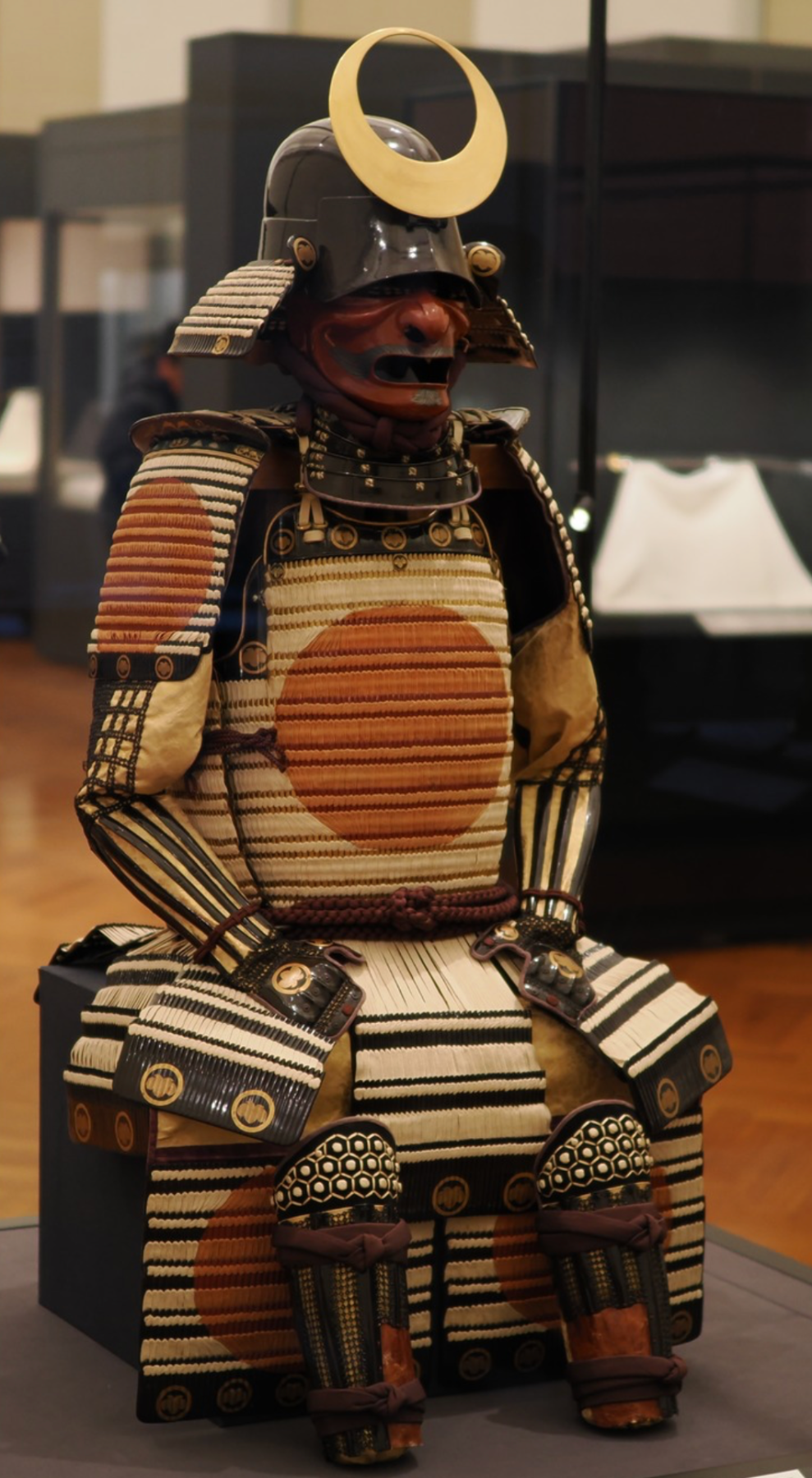
Sure, currently exhibited in the Tokyo National Museum and purportedly once owned by Matsudaira lenori (1575-1614), a Samurai lord from Central Japan https://www.instagram.com/p/C0TZLMDpUss/?hl=en&img_index=3 And you're correct it's the gapping gap to the sides and rear that caught my attention. Looking at other high level suits it's not uncommon. Perhaps because these leaders were unlikely to see combat so maybe its a case of comfort over protection.
-
What makes me curious is the length of the shikoro. Doesn't seem to offer much neck protection even if the kabuto is sitting slightly proud on the stand.