Lewis B
-
Posts
2,050 -
Joined
-
Last visited
-
Days Won
11
Content Type
Profiles
Forums
Events
Store
Downloads
Gallery
Everything posted by Lewis B
-

The power of a good polish...
Lewis B replied to MassiveMoonHeh's topic in General Nihonto Related Discussion
Are those nie crystals in the Hi or an artifact of the scanning. If the former thats impressive. Peak Soshu? -
The power of a good polish...
Lewis B replied to MassiveMoonHeh's topic in General Nihonto Related Discussion
Is it possible the kikko mon was added much later after a suriage? -
There is nothing on their website. And if you weren't told in writing before commissioning their services that is a huge red flag.
-
My brother visited the exhibition yesterday since he had several hours to kill in London. Was quite disappointed saying there were only 4 swords and not notable ones either.
-
This is very poor service. Shipping without insurance is unbelievable. Do the Bensons published T&C's categorically state they accept no liability in case of handling damage or shipping issues or that shipments aren't insured? I have seen this exclusion written by other intermediaries in Japan and this immediately excluded doing business with these individuals. Blades are moved around frequently (to togi-shi, saya-shi, Shinsa, sayagaki etc) and I expect some due care and attention and not I-wash-my-hands, if your valuable blade goes AWOL. On the upside no to very low value might deter potential opportunistic thieves. I still think USPS have it somewhere in their system. I would start contacting USPS immediately. Some info here: https://www.usps.com/help/missing-mail.htm And some phone numbers To investigate lost USPS mail, file a Missing Mail search request online at USPS Missing Mail after checking tracking. For assistance, contact USPS Customer Service at 1-800-ASK-USPS (1-800-275-8777) or submit a help request form. For potential mail theft, contact the U.S. Postal Inspection Service at 1-877-876-2455. Key Contact & Investigation Steps: File a Missing Mail Search Request: This is the primary method to find missing items. Submit a Help Request Form: Submit a form online at USPS Email Us to have your local post office look for the item. USPS Customer Service: Call 1-800-ASK-USPS (1-800-275-8777) Monday–Friday 8 AM–8:30 PM ET, Saturday 8 AM–6 PM ET. Mail Theft/Fraud: Report to the U.S. Postal Inspection Service (USPIS) at 1-877-876-2455 or online at USPIS Report. Employee Misconduct: Contact the USPS Office of Inspector General (OIG) at 1-888-877-7644 or USPSOIG Hotline. Don't give up hope. It's going to be a bit of a frustrating journey but there is a lot at stake and worth the effort. Packages go missing regularly and turn up months later. The important thing is to be in direct contact with the last sorting office.
-
Looking for a Tameshigiri Signature Sword
Lewis B replied to Hooting Mandrills's topic in Wanted to Buy
Try contacting Nick Rupero at Nihontoart.com Nick regularly gets interesting blades with Tameshigiri inscriptions. This is currently available https://nihontoart.com/shop/10th-generation-retainer-kanesada-with-difficult-2-body-test-cut/ This is a 2 body test cutting inscription done by the famous Asaemon family dating to latter part of the 17th century. Well priced I think for a gold tameshigiri inscription by a well known family of testers, although price reflects the condition. https://www.nipponto.co.jp/swords11/NT335063.htm -
Sorry to hear this. But I'm not so sure this package was stolen. Have you filed a missing package report with the Postal Service and an insurance claim? What was their response? I sent a bicycle wheel to my brother in San Diego last year from Germany. It reached CA within the expected time with regular updates, but then went to AZ for some weird reason, then back to CA, then nothing. The tracking remained dormant for 7 weeks. About 8 weeks in I filed a missing package report with DHL and they contacted USPS. The package was eventually located and made it on to my brother. Whats important is to be proactive. Contact the sorting office responsible for the last scan as well as the dept handling missing/overdue deliveries. Keep pestering them and file a police report. The box is probably sitting somewhere in a sorting office/warehouse same as my brothers bike wheel. Good luck.
-
Kunzan believed this to be a signed Go tanto. Although attributed by the NBTHK in mid 70's to Senjuin Yoshihiro, the quality of the jiba exceeds that of the SY blades he had examined. An important reference work.
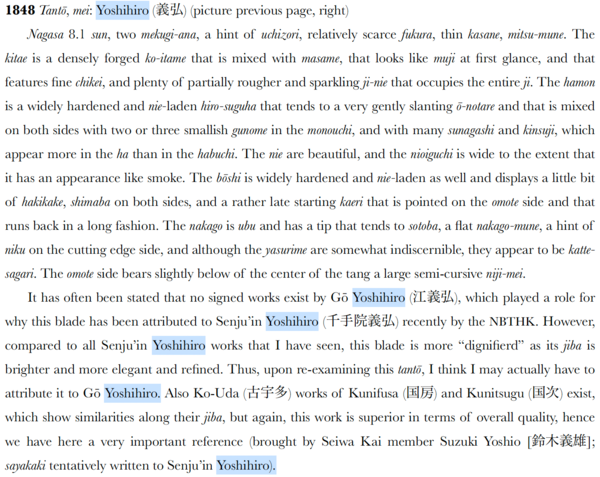

- 1 reply
-
- 5
-

-
Setting up the notifications I find the options a little generic and not adequately customisable. Like if a want to receive notifications for specific rather obscure makers eg Senjuin Yoshihiro. A keyword search function for notifications would be useful. Or maybe I've overlooked this option.
-
Hi Hoshi, They eventually arrived but had expired by the time I input the codes. Can you extend the allowable time to say 30 mins?
-
@Hoshi FYI Seem to be having an issue logging in. I had previously registered my account in early March. Now when I try to log in the platform says it's sending a code which never arrives. Tried twice over a 20 min period. OK, they eventually arrived but had expired by the time I received them.
-
You know me too well. Excellent capability. Who doesn't want to know a Norishige posts 15 mins after it hits the dealer site.
-
@Hoshi, is there a notification feature? Where you can set particular smiths or schools, paper levels etc.
-
Controversial was the right descriptor. While it's a nice bedtime read I'm just not buying a lot of the suppositions and personal hypotheses of the Soshuden origins being founded in the Mokusa Kaji, after relocating to Kamakura (either forcefully or by choice). The references to Shintogo Kunimitsu in particular are hard to swallow, since he forged blades in a supremely refined and elegant style, really more reminiscent of the finest Yamashiro Kaji of the time. I'm not seeing any misconceptions in saying his origins are most likely founded in the Awataguchi tradition of sword making. Similarly Yukimitsu's origins as suggested in the manuscript are hard to comprehend. Son of the second gen Bungo Yukihira and blending this father's and Sensei's name for Yukimitsu is a believable leap. Masamune on the other hand, based on his jitetsu beggars a little more consideration. I would concur that if he were adopted or actual son of Yukimitsu he would by tradition have carried over some element of the name into his art name. The authors reflections on this individual having roots in Hoju Mokusa, and bringing some of their techniques into the early Soshuden style are a little easier to digest. Later Yukimitsu in particular shows a clear transition towards the classic Soshu style (in particular after the death of Shintogo) with a larger proportion of extant Masamune blades having these characteristics. Might be a good time to revisit this discussion.
-
The article seems to have created a bit of controversy back in 2011. Even so I would love to read it if anyone has a copy. The link is dead and I can't find it in the archives. TIA

-
Japanese Sword Museum Juyo Exhibition
Lewis B replied to Takezo's topic in General Nihonto Related Discussion
Thats the feeling I got. Typical AI polish. -
Did someone ruffle his feathers?
-
"Tsuba: The R. E. Haynes Study Collection" Auction
Lewis B replied to Promo's topic in Auctions and Online Sales or Sellers
Ouch, that's bad -
Yamatorige @ Bizen Osafune Sword Museum
Lewis B replied to MassiveMoonHeh's topic in General Nihonto Related Discussion
I think I see shintetsu -
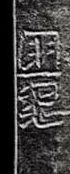
Something that has always made me think is why Shintogo would sign his Mei the way he does in that unique style. The books suggest his father was Awataguchi Kunitsuna and that connection may explain why for example he strikes the vertical radical for kuni in a centrally positioned, straight line. Maybe because this is how his father chiselled the kanji? The positioning and dimensions of the tachi mei are also very similar placed, being placed high up the nakago near the munemachi and along the shinogi-ji. Here is one example from the famous Onimaru Kunitsuna tachi.
-
PS You don't need to give your 'actual' name.
-
I thought this was an exceptionally rare early koshirae and fittings that the NMB might like to see. Posted by Keisuke san of the katana_case_shi shop. The blade is a Heian period Ko-Naminohira tachi. https://www.instagram.com/p/DWfMwIpGO3G/?img_index=1
- 1 reply
-
- 4
-
-
The impression I got was the book was printed in Italy on demand. So not a limited production run.
-
Excellent resource with opinions expressed from a different period. Not so great for Soshuden and Yamato but for Bizen the reference is quite thorough. I did see a 1305 Shintogo Kunimitsu tanto which wasn't in my records for dated pieces. And the authors emphasised the relative importance of the Shintogo (I assume through the close connection with the Bakafu) and Yamashiro ateliers during this period, and a downplaying of Yukimitsu's contemporary relevance. Only later, after his death, did his work gain significance and appreciation (like Van Gogh).
-
Nothing new. Tamahagane production was centralised back in the Edo period (as a means of controlling sword production by the Bakafu), often said to the detriment of the blades produced since then.