Lewis B
-
Posts
1,572 -
Joined
-
Last visited
-
Days Won
6
Content Type
Profiles
Forums
Events
Store
Downloads
Gallery
Everything posted by Lewis B
-
I remember reading this thread with a great deal of interest 4 years ago before I'd even held a nihonto let alone bought my first sword. My thoughts return to it on occasion and I always wonder about the fate of this Munetada. Like the blade from Court thread, this story is equally as epic and needs to be revisited.
-

Swords of the 47 Ronin
Lewis B replied to Utopianarian's topic in General Nihonto Related Discussion
Forget those low ranked Samurai. I want to see Miyamoto Musashi's swords. Anyone know if they are still extant? -
Does it even have an edge?
-
I think the PS explanation is valid. The PS monkey could have just extended the inner sleeve to over the hamachi. The habachi looks 2-dimensional in the photo.
-
From the sugata I would suggest this is Muromachi and if shoshin either 1st or 2nd gen Yoshimitsu. Hard to tell from the photos but the characteristics nioi deki, gunome hamon etc point in that direction. Mei is quite small so I might lean towards 1st gen. Does the mune remain straight over its entire length or dip towards the tip? The latter or uchizori suggests earlier production blade eg late Kamakura. A straight Chukan-zori mune would be more consistent with Muromachi. You should really consider attending the Japan Art Fair in Utrecht next June. This year they had an informal Shinsa session with some very educated eyes, who could assist with the signature and attribution, which I hope they will repeat in 2026. The show is also very educational and allows you to see many blades in hand from most eras. Here's a taster of what to expect https://youtube.com/shorts/DrrY8G1-4T4?si=U3V_2lzIJNAU-9FG YOSHIMITSU (賀光), 1st gen., Ōei (応永, 1394-1428), Bizen – “Bizen no Kuni Osafune-jū Yoshimitsu” (備前国長船住賀光), according to tradition the younger brother of Morimitsu (盛光), he signed with small characters, gunome-chōji-midare in nioi-deki YOSHIMITSU (賀光), 2nd gen., Bun´an (文安, 1444-1449), Bizen – “Bishū Osafune Yoshimitsu” (備州長船賀光), “Bizen no Kuni-jū Osafune Uemon no Jō Fujiwara Yoshimitsu” (備前国住長船右衛門尉藤原賀光), son of the 1st gen. Yoshimitsu, first name Uemon (右衛門), suguha or gunome-chōji in nioi-deki, sujikai-yasurime, the Yoshimitsu lineage stood somewhat out from contemporary Bizen smiths, jō-saku
-
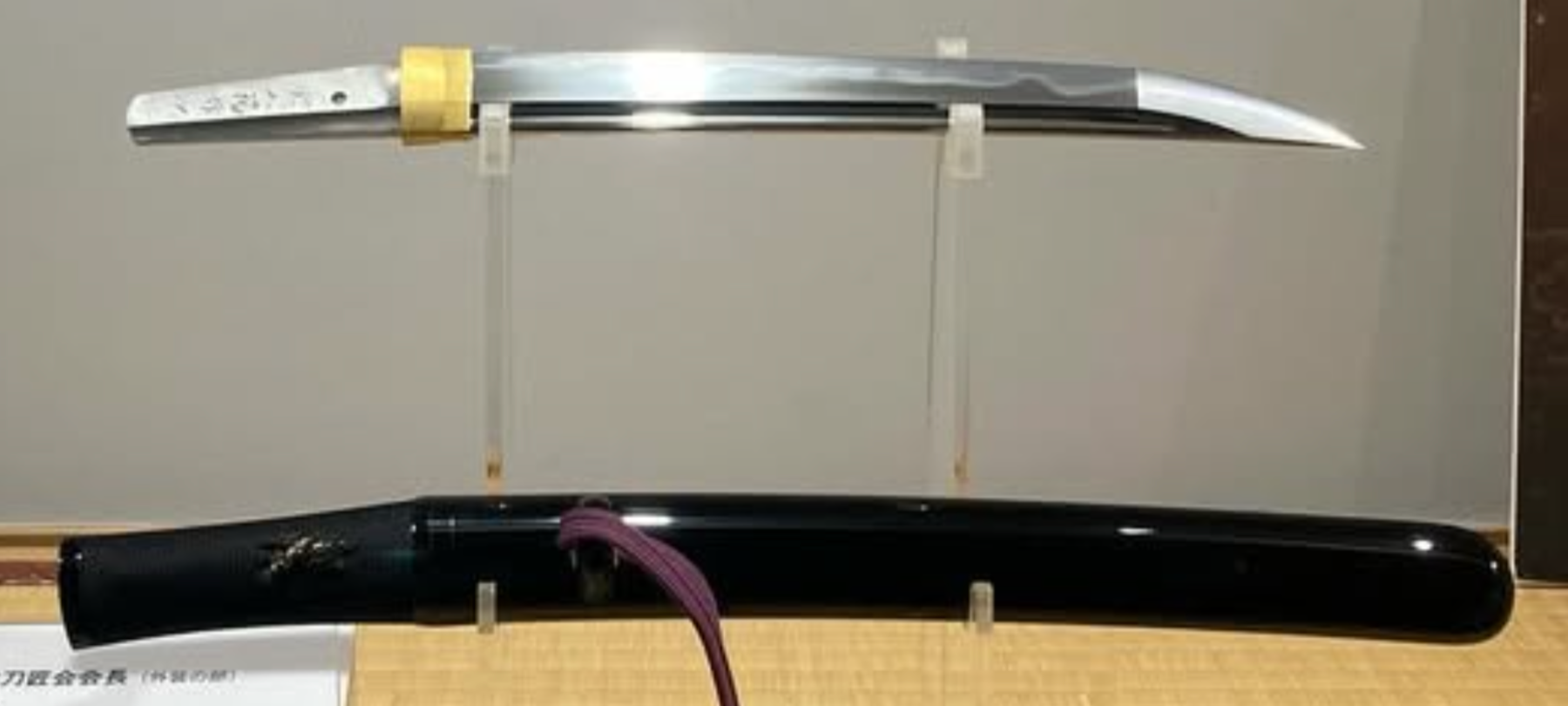
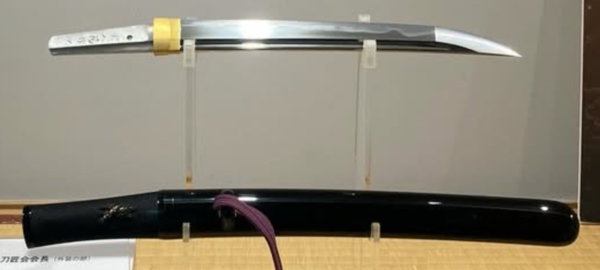
Yes, thats him and same tanto..... with the habaki installed correctly
-
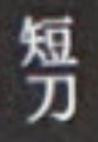
These are the kanji for tanto I think thats what we have here. Bayonets have a very different design and shape. I doubt Tamahagane would be used for such a mundane application. Regarding the habaki I wonder if someone installed it upside down. The design with the step over the hamachi looks odd, as does the mune sitting proud of the habaki.
-
Juyo swords found in Shin Gunto Koshirae
Lewis B replied to PNSSHOGUN's topic in General Nihonto Related Discussion
Yes, Andrew won a prize in this years NBTHK togishi competition. I would put him up against any top level Japanese polisher. His work speaks for itself. Checkout his FB page to see examples of his work including the 2 Go's he's worked on. -
Juyo swords found in Shin Gunto Koshirae
Lewis B replied to PNSSHOGUN's topic in General Nihonto Related Discussion
Spectacular sword. -
Juyo swords found in Shin Gunto Koshirae
Lewis B replied to PNSSHOGUN's topic in General Nihonto Related Discussion
Was that one of the Go's Andrew polished? -
Are you sure? In hand it feels like the menuki bulges give one a little more purchase on the tsuka and offer more control when the sword is wielded. Plus they give the hands reference points when held 2 handed. But the menuki bulges do look a lot more pleasing to the eye.
-
A high-quality Edo-period tsuka for sale $229
Lewis B replied to djcollection's topic in Fittings/Tosogu/Kodogu/Koshirae
Hi Mason, Sorry for the late reply. I was waiting to get the sword in hand before I could decide if it would fit. Its tight but without 1 seppa I'm pretty sure it will work with the existing mekugi ana. My offer is $175. Regards Lewis -
Sage words of advice.
-
Interesting.
-
That was my immediate thought too. Odd place to carve the Hi and I couldn't find a similar example when I had a quick look.
-
Another tidbit that could have some interesting connotations. Norishige produced tanto that have mitsu-mune as well as takenokozori-style tanto with iori-mune. This tanto was made in the latter style with slight uchizori curvature. And as stated by Markus "a takenokozori points to late Kamakura in general and for example to Norishige (則重) in particular." Signed Norishige tanto. Sugata: hira-zukuri, takenoko-zori, iori-mune, nagasa 23.8cm, from the Compton Collection


-
Short reminder
Lewis B replied to CSM101's topic in Sword Shows, Events, Community News and Legislation Issues
While not a style that personally appeals to me I can appreciate a blade for its technical excellence. Could there be more than one Kunishige? Shintogo Kunishige was said to be the oldest son of Shintogo but died in 1302, yet the Soshuden Museum seem to suggest they are one and the same, yet with an active period in Kenmu 1334-38. Kunishige (國重)—Son of Kunimitsu, Shintōgo Tarō (太郎), born in the 8th year of Bun’ei (文永, 1271) and died in his 32nd year in the 1st year of Kengen (乾元, 1302); -
Short reminder
Lewis B replied to CSM101's topic in Sword Shows, Events, Community News and Legislation Issues
It never ceases to amaze me just how strong private collections in Europe are. Gems like this pop up at almost every NBTHK-EB meeting. "Most representative of the entire Hasebe work" and in "excellent state of preservation". Doesn't get better than that. Wish I could have attended but Manching is a little too far from Hannover. -
Thoughts and Attributions on an O-Suriage'd Wakizashi
Lewis B replied to Marcus Devonport's topic in Nihonto
For reference here is a rare signed and dated (1406) Sanemitsu. Nagasa 64cm https://eirakudo.shop/665120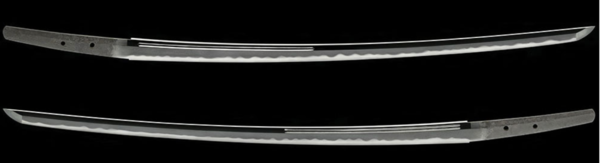
-
Thoughts and Attributions on an O-Suriage'd Wakizashi
Lewis B replied to Marcus Devonport's topic in Nihonto
I would also add Naomitsu in the hat NAOMITSU (尚光), 1st gen., Ōei (応永, 1394-1428), Bizen – “Bishū Osafune Naomitsu” (備州長船尚光), “Naomitsu” (尚光), his early works have a slender and elegant tachi-sugata, at that time he signed mostly with a niji-mei, the hamon is a more or less flamboyant gunome-chōji-midare in nioi-deki, later he hardened a koshi-no-hiraita gunome-chōji which reminds of Morimitsu (盛光) and Yasumitsu (康光), in addition a clearly visible utsuri appears, we know date signatures from the eighth to the 27th year of Ōei (1401-1420) -
Thoughts and Attributions on an O-Suriage'd Wakizashi
Lewis B replied to Marcus Devonport's topic in Nihonto
Some interesting relationships between these three smiths. From Shoshin.com. What makes you think its Sanemitsu, who seems to have favoured bo-utsuri ____________________ SHINZAEMON SANEMITSU(1) O-EI 1394 ___|_____ SANEMITSU(2) CHO-ROKU 1457 SANEMITSU(1) O-EI: SHINZAEMON. SANE form: JITSU "Truth." It is taught that MORIMITSU, YASUMITSU and SANEMITSU collaborated on the making of a sword, it is taught that their styles are the same and that they signed in the same way. His MOKUME HADA will have the OEI style, standing BO-UTSURI. His HAMON will resemble MORIMITSU and YASUMITSU's OEI KOSHI-HIRAKI GUNOME-CHOJI BA. The MEI appears with the old and familiar O-EI hand. SANEMITSU BISHU OSAFUNE SANEMITSU BISHU OSAFUNE SHINZAEMON SANEMITSU SANEMITSU(2) CHO-ROKU: From BUN-AN 1444 to EN-TOKU 1489, when he moved to IYO to make swords. MOKUME HADA. SUGUHA and GUNOME HA. Possibly incorporated his father's name to his MEI. BISHU OSAFUNE SANEMITSU -
Thoughts and Attributions on an O-Suriage'd Wakizashi
Lewis B replied to Marcus Devonport's topic in Nihonto
This was the fingerprint that caught my attention. Maybe its an artifact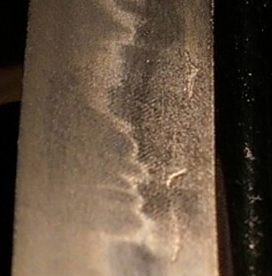
-
Thoughts and Attributions on an O-Suriage'd Wakizashi
Lewis B replied to Marcus Devonport's topic in Nihonto
Very nice what appears to be midare-utsuri. Since utsuri is said to have disappeared after the late Muromachi, its presence would date the blade to end of the Muromachi at the latest. I'm not very familiar with Bizenden so curious to hear what others think. I think I can spot a couple of fingerprints so I would wipe the blade carefully with a soft lens cloth and apply the thinnest coating of oil to slow down oxidation.