george trotter
-
Posts
3,007 -
Joined
-
Last visited
-
Days Won
14
Content Type
Profiles
Forums
Events
Store
Downloads
Gallery
Everything posted by george trotter
-
Yes, I read it the same way. Regards...
-
Nice work Bruce...looks like (in general) the split between Type 98 and RS with brown GUNZOKU tassel is about 50 / 50...with a few 'odds & ends'. Regards...
-
Many thanks Matt...too bad there was no additional history but I appreciate you trying, Warm regards, George.
-
Thanks guys...that helps.
-
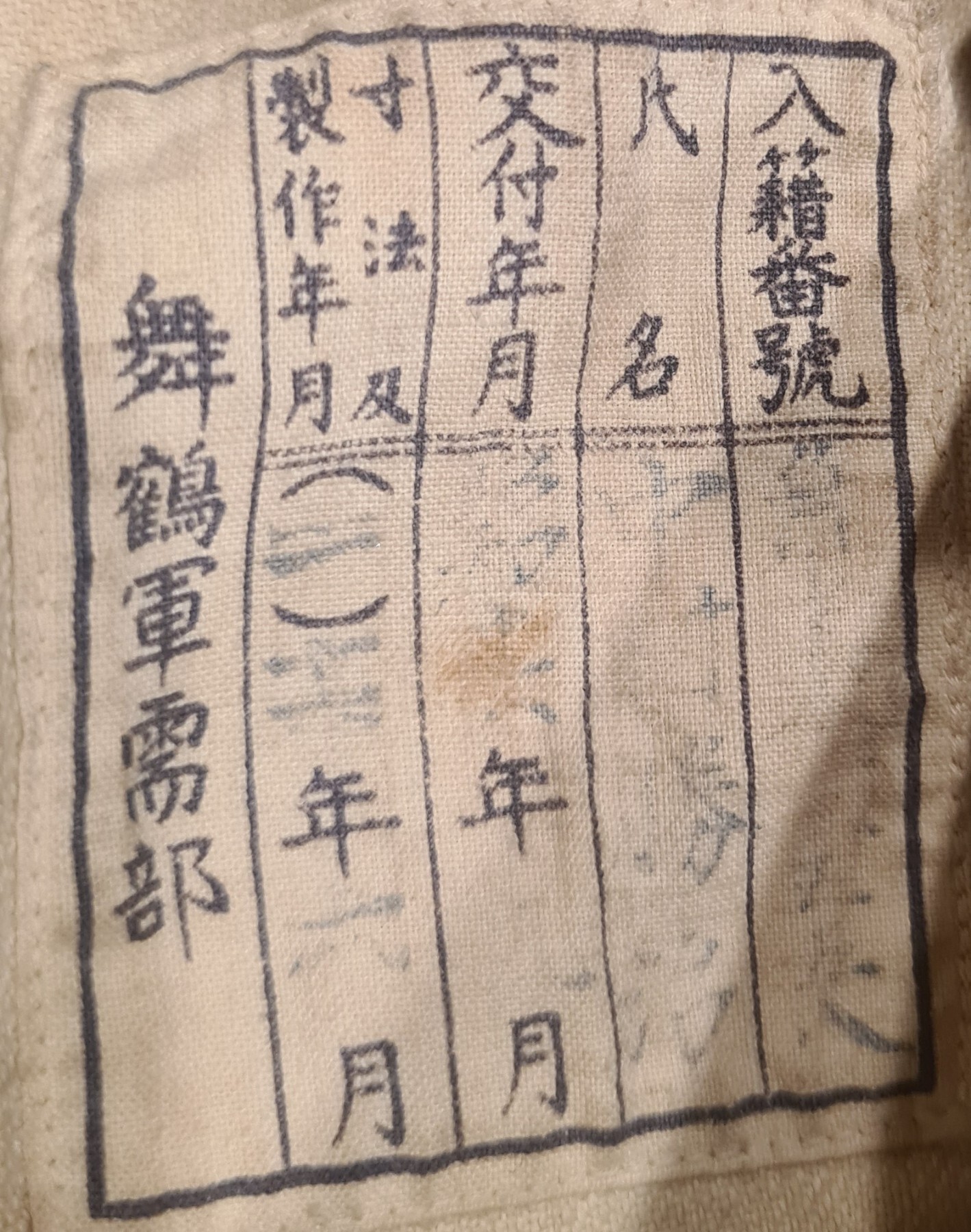
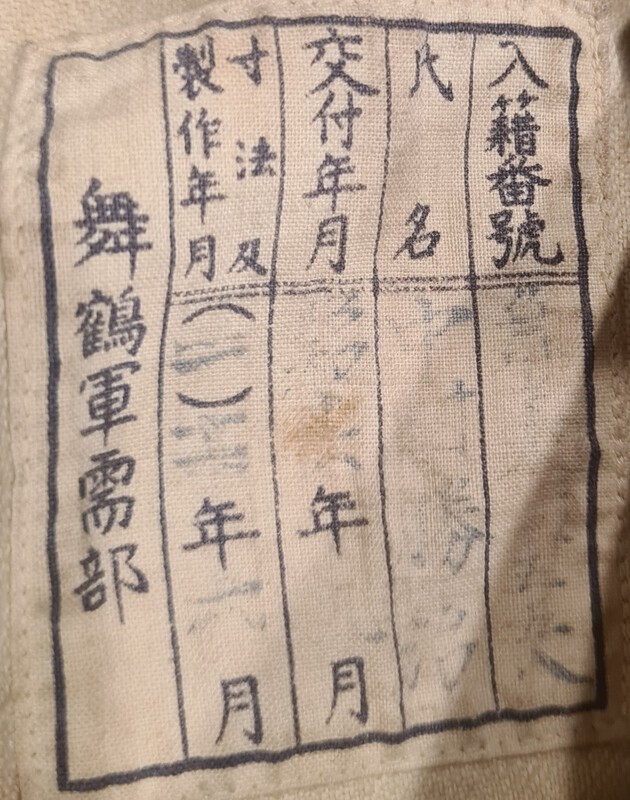
Hi all, I am away from home so no books. I was asked by an elderly gentleman to translate these details in a navy capo. I can read the name NAKAMURA KATSUHARU and some of the faded numbers etc, but could you guys tell me what the printed boxes say and also what the faded numbers/months/years are? Thanks...
-
Hi again Matt, you said you would check with the person you bought this Kanehide sword from...just wondering if you got any feedback on this? Regards.


-
Interesting Bazza. First people of Japan....I've often wondered if they were the first people of western Canada also. In my young years 1969-1971 I spent some time in the Queen Charlotte Islands off the coast of British Columbia. I have to say that the graphic designs of the Haida people there are very similar to the Ainu. Also are their art, costumes and 'looks'. They are 'sea people' and have been there for some 12,000 years and are known for their seamanship, totems and wooden building designs. Just me thinking out loud, but wow...they look the same to me.

-
From the dates/numbers it looks like he was producing his 10 swords/month as required by the RJT scheme. I have seen these blue kanji/numbers on other RJT smith swords also...eg, Yamagami Munetoshi of Niigata - star 19/3 (all kanji TAI 78).
-
Hi Matt, thanks for your kind words. Yes, I was very lucky to get the exact right stuff to do a correct restoration of this hilt. All parts correct. In fact, I am sure the hilt I "raided" was from an identical style RS from Seki...only 'flaw' is a spot of paint we can see on the ito. And thanks for offering to check with the collector you got this from, I would appreciate any info you can dig up on this sword's history. Just on the saya colour, this one and all those others of this type from Seki I have seen are coloured what I would call "light khaki"....not "gray". Regards
-
Hi Matt, YES, that is the Kanehide I bought from you in 2012. And yes, it had no hilt binding or same when you sold it to me. I rebound it using original ito, same and menuki from a spare RS hilt I had found somewhere, so it is actually a totally correct WWII Seki RS binding. I took that photo of it to "commemorate" my one and only attempt at binding. Here is another pic of the finished job...turned out well I thought. I actually put that tassel on to "make it look good" for the photo, but later took the tassel off again as I didn't think it was "right". I still appreciate that sword...a good sword from a good maker. (and purchased from a good NMB member). Regards, PS the blue painted "ku 52" is not on the tang...can't remember if it was there when it arrived or whether it was partly worn off (except for the 'ku' over the kanji 'Seki'), and, the 52 being painted over the mei, I rubbed these off so the mei was easily readable?...anyway, it was a historical 'dumb' thing I did...live and learn eh!. PPS...for my file, do you remember who/where you got it from? Any WWII history?
-
Just in the interests of accuracy on sword fittings/tassels...I have to say that this sword had no tassel when I got it... I just put one on (briefly) for a photo. Sorry. BTW the balde is a star stamped example by Nakata Kanehide of Seki dated 1944...VERY good smith. I am just wondering out loud but probably? a gunzoku would not be able to buy a RJT blade from an Army Kokeisha store?...probably sales were limited to Army officers and not permitted to "attached" civilian type gunzoku officers (doctors, engineers, admin guys etc)....one for Bruce to investigate? Regards (sorry again I put a tassel on a sword without knowing what tassel it should be).
-
Chikugo no Kuni-jū Mutō Hidehiro 1942
george trotter replied to Nicholas's topic in Military Swords of Japan
Me again. Thanks Trystan, I have this list and it refers to those smiths who became gunto makers in Seki in WWII...pretty sure these smiths were not RJT, just "Seki smiths"? As promised Bruce, I had a look through my 'Nihon Toko Meikan' again and while it mentions many smiths who were RJT, it rarely gives the date/year they started. I did find one however...p.160, smith name NIWA Kanenobu of Gifu born Meiji 36 (1903). It says that in "Showa 15 (1940) at the Kokura Arsenal No. 1 he became Jumei tosho". I am no expert but it it seems that as I said, maybe those smiths working under the Army at their arsenal forges were the first to become RJT (maybe even had their tangs stamped with the Army star? - I also think Kanenobu tang would have the 'ko - ho' stamps). As the demand for swords grew and the Yasukuni could not keep up, in 1941 the call went out from the army to begin the RJT scheme and from late 1941 - early 1942 it was established. I know that the establishment of RJT schemes in various prefectures was not "all at once". The Yamagami brothers in Niigata starting as RJT in Sho 14 and another of my smiths Tsukamoto Masakazu of Fukushima starting in late 1942/early 1943. I suppose in reality this issue is not that important, just of interest that the "rolling out" of the RJT scheme is "staggered" across Japan - probably due to sorting out details for the supply of tamahagane, mounting shops, local supplied charcoal and shipping details etc, etc. As it stands, on this TINY amount of info, it seems that the arsenal smiths would be more likely to have early start dates as they already had guaranteed supply of army-owned materials to the arsenals. Lots of fun, -
Chikugo no Kuni-jū Mutō Hidehiro 1942
george trotter replied to Nicholas's topic in Military Swords of Japan
Thanks guys. Yes Bruce, putting it on your list and keeping our eyes open for an actual signed/dated/star stamped example is probably the only thing we can do about this so far (unless someone finds some more actual reference to it somewhere - I will keep browsing and see if I can find any more references). In the meantime, I hope we get a bit of feedback from the RJT knowledgeable...might be a good conversation. I know that of my 4 star stamped blades 1 is dated 1943 and 3 are dated 1944 so well into the RJT period we know of, and of my 3 blades by smiths who are known RJT (but no star), 1 is undated, 1 is Sept 1941 and 1 is April 1942, so presumably they were not yet RJT at those dates. So this statement I posted regarding Hidehiro translates as " #3 Showa 14 nen 6 gatsu Rikugun no Jumei Tosho to naru." (1939 June, Army no Certified Swordsmith became) is so far the earliest RJT start date I have seen mentioned - and - it only refers to this one smith Hidehiro, it is not saying that this 1939 year start refers to the whole RJT scheme across Japan. I suppose only the seeing of an actual tang with a name, a 1939/1940/1941 date and star stamp will confirm an early start year (for some smiths only?), and so far we have not seen one. Regards, -
Chikugo no Kuni-jū Mutō Hidehiro 1942
george trotter replied to Nicholas's topic in Military Swords of Japan
Hi Bruce, that image of Muto Hidehiro with the statement that he began as a RJT in Sho 14/6 (June 1939) is from Ono, 'Gendai Toko Meikan' 1971 p.100 (look at image page and read column #3 (this is the earliest RJT start date I have seen). I posted it as I thought it might be worth a chat with the RJT knowledgeable on the start date of scheme. Just my "feeling" on this is that maybe thoise smiths who were closely linked to Army swordmaking were the first to be offered a RJT position...or maybe Ono has made an error? I will have a look at my other books and if it says anything further I will let you know. Regards, I had a quick look through my books and while all mention Hidehiro was RJT only the page I posted gives a start date....sorry. This is maybe a question that needs looking at by RJT specialists... -
Chikugo no Kuni-jū Mutō Hidehiro 1942
george trotter replied to Nicholas's topic in Military Swords of Japan
Hi Bruce, I also found a RJT star stamped Muto Hidehiro rubbing with KOKI date 2/1943. This has the ko ho marks on mune. (wish I still had that sword - sold it c.1982 and the buyer "polished" it himself - ruined!!!!). Hope this is of use for your records. Regards PS, I just added in the note on Hidehiro - column 3 says he became a RIKUGUN no JUMEI TOSHO in Sho 14/ 6 (June 1939). Not sure about RJT start dates, maybe they mean he started doing work for the Army in that year (a mystery of the RJT scheme for you to solve Bruce - whoohahaha).

-
Attention Mantetsu Owners: A Survey
george trotter replied to Bruce Pennington's topic in Military Swords of Japan
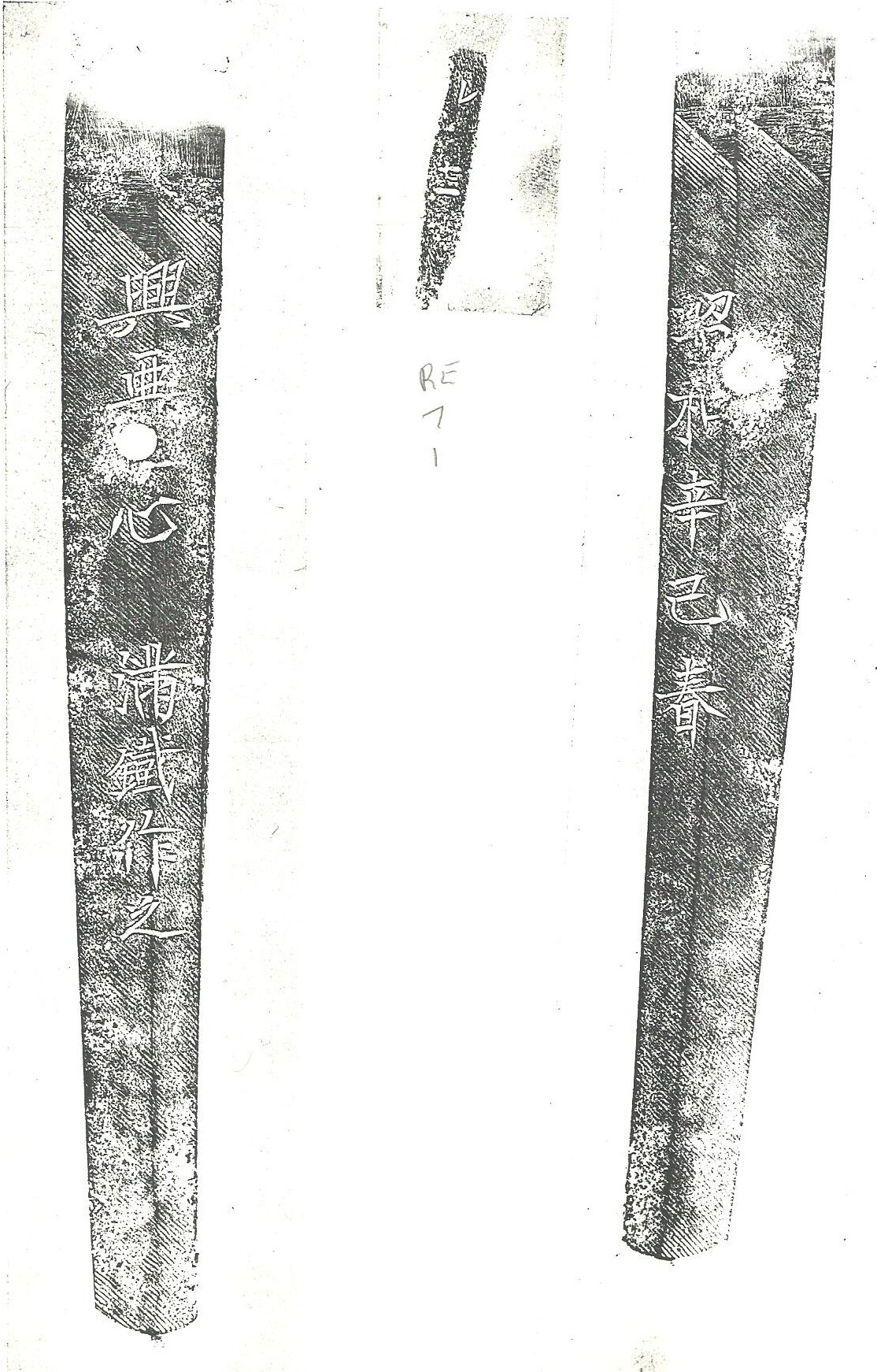
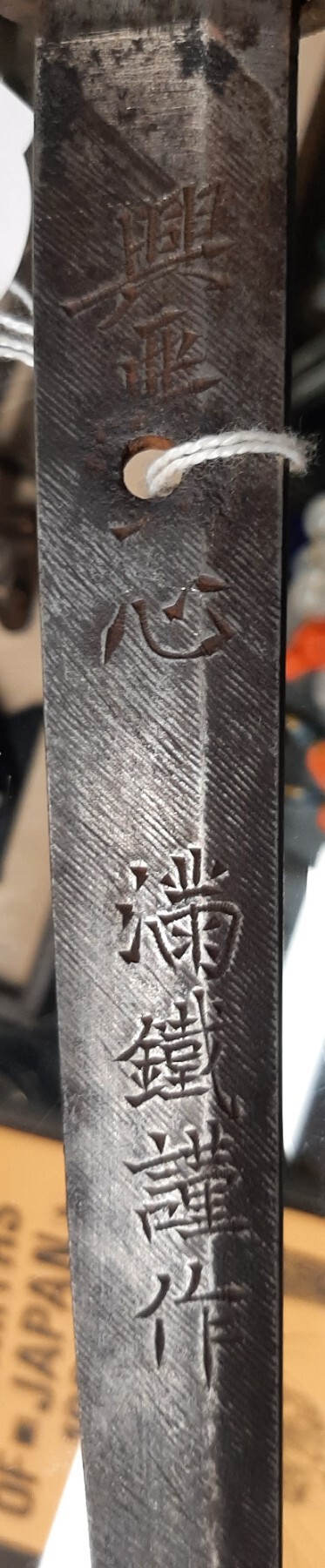
Hi Bruce, I found a Mantetsu rubbing in my "box of odds and ends" - forgot I had it. Tang is dated 1941 spring and has the mune mark/no of RE 71. I can't find very many of this RE on your list, so may be of interest? Regards,
-
Chikugo no Kuni-jū Mutō Hidehiro 1942
george trotter replied to Nicholas's topic in Military Swords of Japan
Hi Nicholas, Yes gendaito by a good smith. Muto (Hideyoshi) Hidehiro of Fukuoka. Dated KOKI 2602 year (1942). Born Meiji 24 (1891) died Showa 46 (10 Mar 1971). Regards, -
Attention Mantetsu Owners: A Survey
george trotter replied to Bruce Pennington's topic in Military Swords of Japan
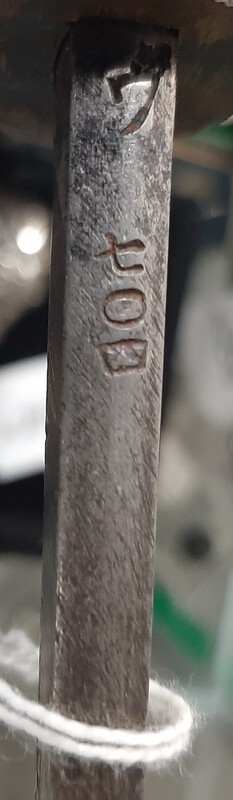
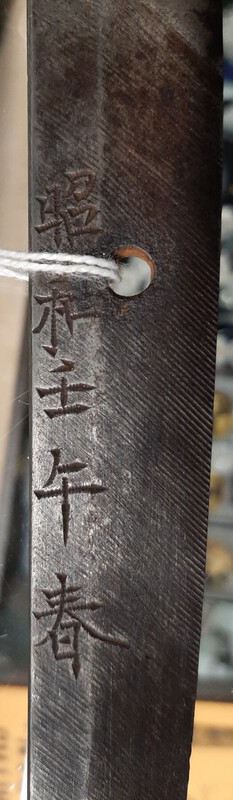
Hi Bruce, A friend picked up this Mantetsu blade (no fittings). Here are the markings for your records. Mune 'U' 704 dated spring 1942. Hope this is of use, Regards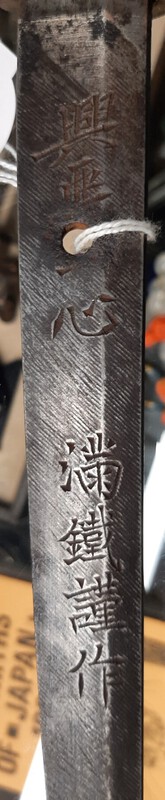
-
Can anyone put me out of my misery?
george trotter replied to Brian's topic in Translation Assistance
Brian, My book 'Nihonto Meikan' by Homma and Ishii 1975 shows in the index of titles (shogo) on p.16 (1539) has 9 smiths who used the this shogo. 2 from Showa, 2 from Meiji and 5 from earlier. This list gives the page number where you can read about the smith, his work etc. (has no images). I would send you the references but my computer is causing problems with images right now so I can't copy the pages for you. Maybe someone who has this book can help you? Regards... -
Hope I'm not intruding, but the answer to the question on whether the tassel was attached directly to the pommel is...yes. The sarute, if seen, appears to be a personal preference of the officer. This drawing from a 1944 booklet on the Rinji Seishiki shows the 'correct' way to attach the tassel. Hope this helps.

-
Hey Joel, go easy man. Brian is a good guy who puts heaps into this site. His comment on writings sometimes found on hilt wood is that basically, we cannot tell much from them. Even when clear they cannot prove if the writing refers to the hilt craftsman, the shop name, the person who ordered the mounting or the blade owner. I have asked this exact same question in the past and I know how much we can attribute to the sword's history based on ink markings on hilt wood. There are so many possibilities that the "answer' is usually whichever we choose to attribute to the marking to. I know this as I have chosen not to attribute anything firm to my hilt markings as it is un-provable and would (as Brian said) not be of any real help to do so. I'm not speaking for Brian but I am saying that he was being helpful (as he has always been in the past). So, please don't take offence where none was intended. All the best.
-
Nearly hree days since I asked, and no one seems to have seen reisho script on a Showa era blade tang.... Looks like my hunch that they are rare is correct...interested if another one turns up. Keep us informed guys.
-
Just out of interest... Referring to my 'reisho script' signature above, can I ask if any member has, or has seen, another example of reisho script on a Showa era blade? (picture, details?).
-
Here is an unusual inscription on a WWII sword I acquired in 2010. A very good sword with interesting mei scripts. I have shown these before - hope I'm not being boring here. Mei in reisho script right hand column: "Minami Shinshi (ni oite), Daitoto ju nin Seisui saku kore" (In Southern Shinshu (Shinano/Nagano), Great Eastern Capital (Tokyo) resident Seisui made this). Morita san translated the left column, a sword fighting kata? in sosho script for me...it means "One step forward, thrust, One step forward, slash". The date in reisho script says: "Showa 19 year, 12th lucky propitious day"...12th January, 1944. Good sword, good mounts, interesting inscriptions...very unusual for WWII swords, but it is privately made by an unknown smith.


-
Naga 'X' Suke 'X' - Help!
george trotter replied to Bruce Pennington's topic in Translation Assistance
Bruce, bit hard to see...might be Nagata Sukenori? edit...Oh, I see Jan has beat me to it.