Ray Singer
-
Posts
5,275 -
Joined
-
Last visited
-
Days Won
143
Content Type
Profiles
Forums
Events
Store
Downloads
Gallery
Everything posted by Ray Singer
-
 I would likewise recommend against experimenting with chemical rust inhibitors on an old and valuable sword. Choji oil will come off fully in one wipe with a $10 microfibre cloth off Amazon.com. - Ray
 -
Just a note that this is a sword I encountered about 15 years ago. It was owned by a friend/local collector and I gave serious consideration to buying it (at a much higher price than is being asked here). A very beautiful, healthy sword. Good luck with your sale Rohan... Best regards, Ray
-
A Most Interesting Wakizashi Listed On Nihonto.us
Ray Singer replied to nagamaki - Franco's topic in Nihonto
Gone. -
Nagamaki Naoshi?
Ray Singer replied to DaViebaPutkataMamina's topic in General Nihonto Related Discussion
What I am seeing is a fairly coarse jitetsu with openings and, as Ron mentioned, a turnback. It is difficult to evaluate in the photos you have taken, but looks like it may have saki-zori as well. My impression is Sue-koto. Not a Nambokucho-period naginatanaoshi. -
Wakizashi Cutting Test
Ray Singer replied to Prewar70's topic in Auctions and Online Sales or Sellers
Refer to the June 3, 2015 post. https://www.facebook.com/groups/collectingjapaneseswords/search/?query=gore -
A few suggestions for polishing agents: Bob Benson, Paul Martin and Mike Yamasaki.
-
Any Help Would Be Appreciated
Ray Singer replied to DaViebaPutkataMamina's topic in Translation Assistance
I would not use the sword below as a reference to value your Jumyo. It is priced as it is because the owner has placed a high value on the koshirae. The blade (in shirasaya) itself is one I personally would value around $5,000. This is comparing apples to kumquats, as that sword is 29", recently restored and flawless, but is also shinshinto and mumei. - Ray -
Tsuda Echizen no Kami Sukehiro
-
Any Help Would Be Appreciated
Ray Singer replied to DaViebaPutkataMamina's topic in Translation Assistance
I was referring to locating that page from the journal, which should specify the generation. Please share your findings here after a copy is located. -
Any Help Would Be Appreciated
Ray Singer replied to DaViebaPutkataMamina's topic in Translation Assistance
If the blade was published then your answer is there. Contact individuals from one of the two current NTHK organizations and see if either can help locate a copy. I suggest Chris Bowen and/or Gordon Robson. BTW, if the sword was published in the NTHK's journal then the kanteisho would also have been from the NTHK. Ray -
Paul Martin is a great choice. Good luck and let us know how it goes after evaluation.
-
Hi Sly, While offhand it does not look like a good mei for Saburo Kunimune, it looks like an interesting piece and it is certainly possible that this is Nambokucho or earlier. Given the abuse, deep scratches, hakobore etc... it is especially important that any polisher that works on the sword is a skillful one, to avoid making a bad situation worse and risking the sword not surviving its next polish. Please let us know if you need any help making contact with someone who can have the sword evaluated by (and potentially restored by) a licensed togishi. Best regards, Ray
-
It is an effective approach if someone's intention is to disguise a missing boshi, nioi giri, etc (a section of the sword) rather than saiba in which the entire hamon would need to be recreated. If the majority of the original hamon has been preserved there is a greater likelihood that the flaw will pass unnoticed. I am not advocating this practice BTW, most times the intention would be to deceive potential buyers and it is certainly better to preserve the sword for what is rather than drilling a number of holes in the blade. Some may not agree, but I also prefer not to see umegane done for the same reason.
-
Based on Tsuruta-san's description, this is most likely only the kesho (hadori) that is applied in finish polish. From the photo below, it does appear that there is only a sleepy remnant of the original yakiba. https://www.aoijapan.com/img/sword/2016/16583-4.jpg It is possible that the sword was in a fire or exposed to heat at some point which caused the hamon to mostly fade away. BTW, polishers can do remarkable things to disguise a missing hamon or boshi. This includes inlaying small pieces of hard steel to replicate the appearance of nie. There was one such sword at a recent sword show, where the lower half of the blade had a "hamon" consisting entirely of inlaid nie and a simulated yakiba done through skillful polish.
-
Wow This Is Such A Bargain!
Ray Singer replied to Dereksure's topic in Auctions and Online Sales or Sellers
Shinto blades are often masame in the shinogi-ji. That is one important kantei in determining when a sword may have been made. A sword must be submitted separately to shinsa for Tokubetsu Hozon. It is not a given that a sword with Hozon can be upgraded to Tokubetsu Hozon. Receiving that level is a factor of the sword's health, quality, etc. There is a specific ruleset which also determines if a sword is prequalified to receive Tokubetsu Hozon, such as the fact that a Shinto blade must be signed with an authentic signature to be considered to receive a kanteisho at that level. -
Wow This Is Such A Bargain!
Ray Singer replied to Dereksure's topic in Auctions and Online Sales or Sellers
Sadakuni was a Jo-saku smith, rather than a Jojo-saku smith. The Jojo-saku comment was one of Tsuruta-san's sword-specific rankings which relate to a completely different blade and have nothing to do with this one. It is worth noting that the sword has quite significate kitae-ware and areas of coarse hada. IMHO, not a sword I would be scrambling to buy. Not long ago I was able to purchase a nicer, flawless, ubu, papered example by Hojoji Masahiro in koshirae for less than the previous asking price. -
Hi Joe, moroba tanto such as this are often seen in Sue-Bizen. Choji coming from both sides can create a hitatsura-like appearance. See the two examples below. One us a Katsumitsu / Munemitsu gassaku yari, and the other is a Sue-Bizen Sukesada in moroba-zukuri. http://www.sho-shin.com/katsumits-munemits.jpg https://www.aoijapan.com/img/sword/2012/12187oshigata.jpg Best regards, Ray
-
Strongly recommend John Tirado for the types of work you have outlined. John is the only individual I have used stateside for such work over the past 20 years and I have never been disappointed.
-
This is very clearly a Showato as others have said. A mass produced blade of 20th century manufacture. The same signatures are often used by a number of smiths from different schools and time periods. This sword has no relationship to the Kamakura period Rai smith.
-
Copying over my comments from the duplicate post. Hi Krist, First, please don't give to an amateur polisher for restoration. You have Andrew Ickeringill in Australia who may be able to connect you with an agent for the shinsa process to authenticate the sword and confirm whether or not you have an actual Niji Kunitoshi. That said, can you provide us with more details and give background on why you believe it to be a Kunitoshi? Even if authentic, I would not encourage you to have the expectation that the sword will be designated a National Treasure. One of the most popular dealer's sites, aoijapan.com, had a signed (gakumei) Juyo Niji Kunitoshi wakizashi which they sold for around $25,000, based on the JPY / USD exchange at the time. Look forward to seeing photos when you able to share them. Kind regards, Ray
-
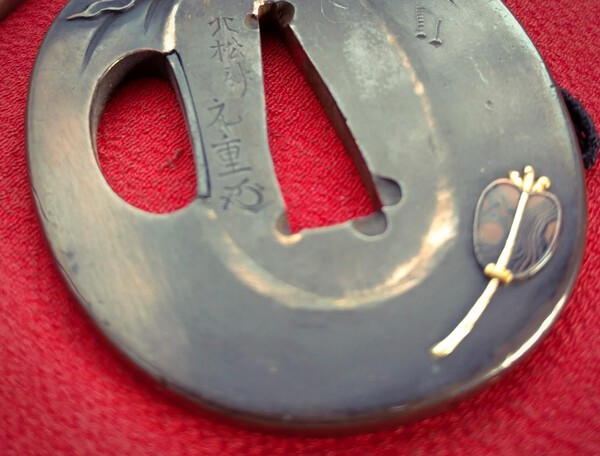
Would greatly appreciate assistance with the researching a tsuba. I am trying to identify the artist who made the attached piece, found at the recent Tampa sword show. It is an interesting tsuba with a fan done in mokume. I assume this is a Hotei motif. If anyone has thoughts on this mei / kao, please let me know. Best regards, Ray
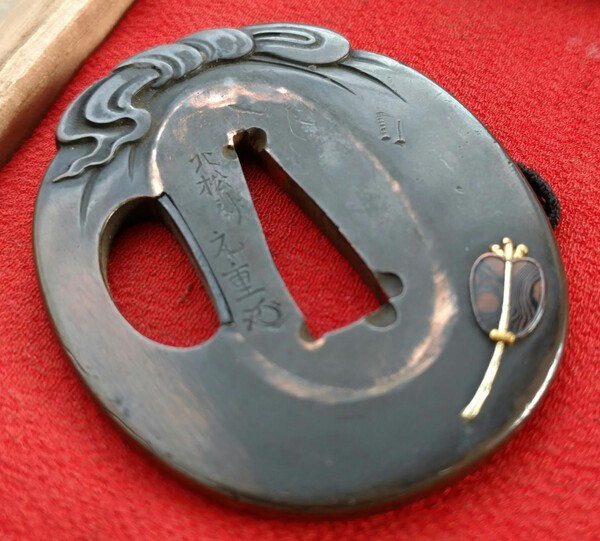
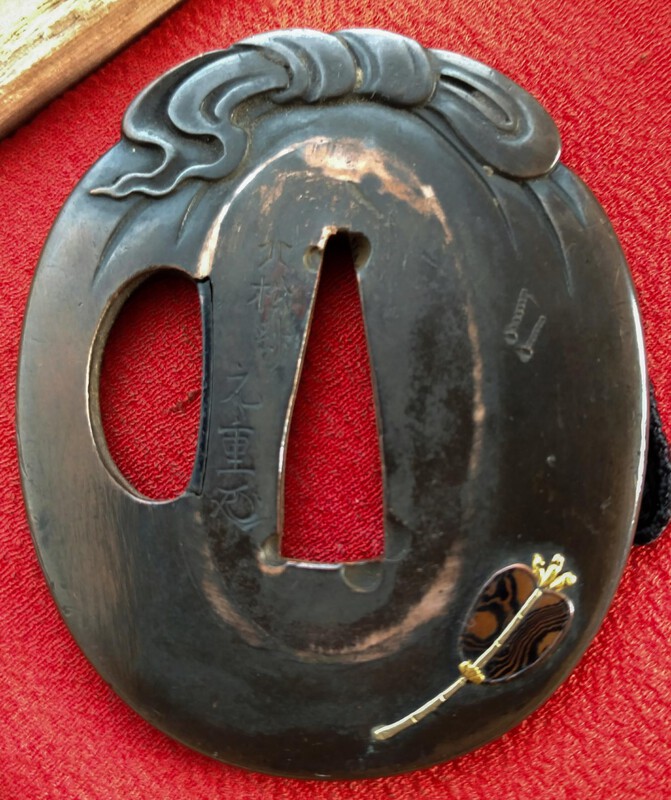
-
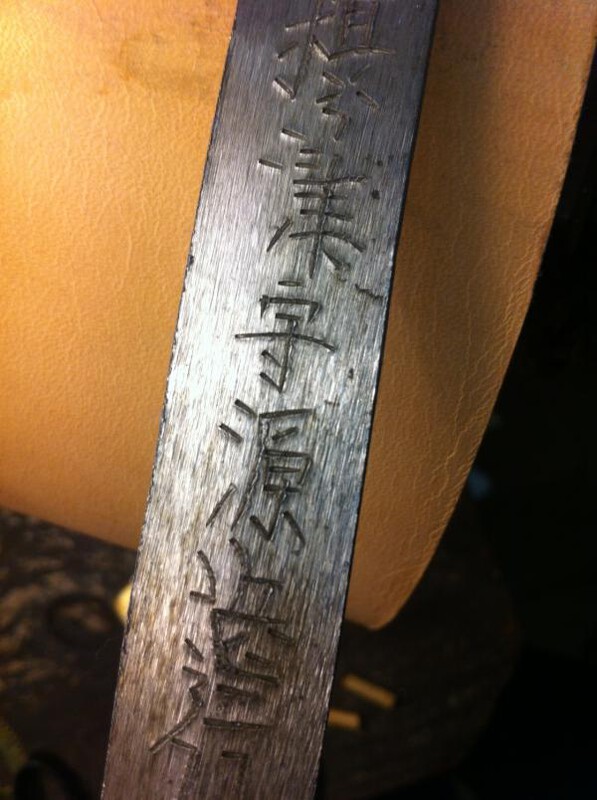
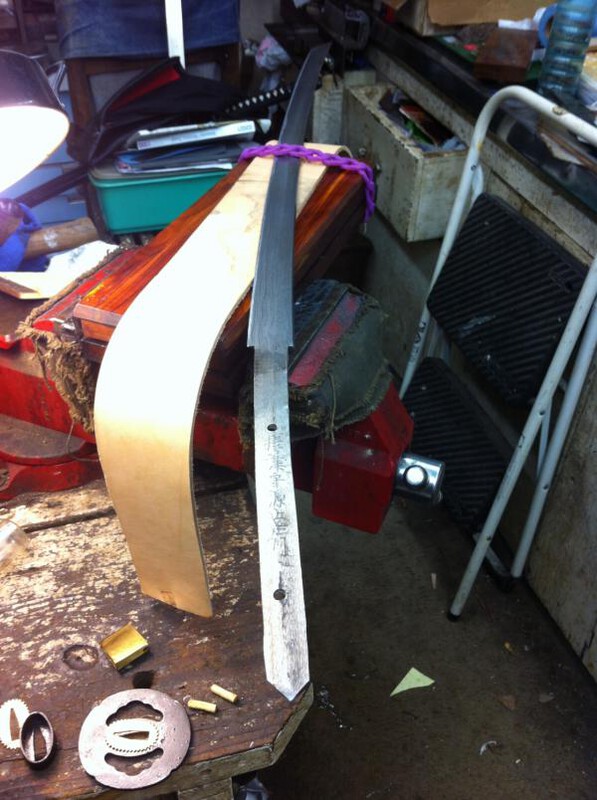
Interesting, I just did a quick search for a Tadayuki mei to attach as reference and this one turned up. https://nihontoclub.com/discussions/2013/12/10/Sword-Identification
-
To me it seems clear that this was meant to follow the format of a Japanese mei: (LOCATION) - (TITLE) - (CLAN NAME) - (SMITH NAME) Specifically the intent was to pass of as the mei of the well-known smith Awataguchi Tadayuki: The missing kanji I did not include above appears to be TADA. 摂津守源忠行
-
Agreed.
-
Hi Rob, this is may be due to the yari having been polished down and the hamon pattern degraded. This is something you very often see with somewhat tired Sue-Bizen, where the choji-gonome hamon breaks down to areas of suguha with small tobiyaki from what was once the heads of choji. I would guess the originally intended hamon on your sword was a continuous togari-gonome. Best regards, Ray