

Bugyotsuji
-
Posts
14,623 -
Joined
-
Last visited
-
Days Won
292
Content Type
Profiles
Forums
Events
Store
Downloads
Gallery
Everything posted by Bugyotsuji
-
Once you have taken a shot with your iPhone, go to the photo and edit it. (Any little thing is fine, sich as cropping it slightly or altering the colour or light/dark contrast.) Then push 'done'. At that point the photo should be fixed, and will not swivel when posted here.
-
Sure thing, Peter!
-
Barry, thanks for the pm with link. As John says above. They tend to be listed and collected by Netsuke enthusiasts, and besides the appellation Chato, you will also see them referred to as Doctors' swords, or Bokuto for Doctors, for the tea ceremony, etc. Admittedly they cause some scratching of heads and some debate as to who would have worn these, why and when. They do come up now and again. You can see examples in museums. Last week I saw one in the Pitt Rivers in Oxford. There were a couple on sale in an antiques shop in London. There is a thread somewhere on the INS Netsuke Society pages: http://forums.netsuke.org/
-
Freezes my screen so I have given up trying to see it.
-
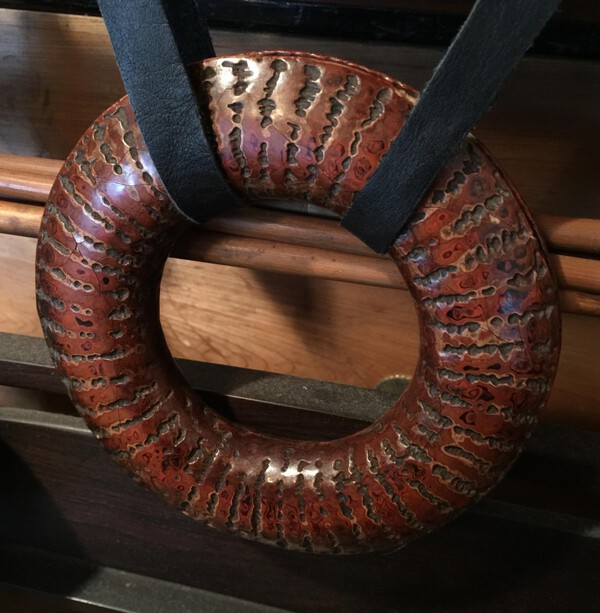
Although the linked discussion supposes that these tsurumaki disappeared with the advent of guns, they continued to be worn as a kind of symbolic part of the armour. I wear one when we dress up for displays, a genuine old one. If you think of the vestigial Gyoyo which hang from the strings above your Dou, and the vestigial fukigaeshi on your kabuto, you will see that some shapes just look better there, preserving the spirit of some ancient function.
-
Knowledge Request And Opinions On Hand Cannon
Bugyotsuji replied to dale's topic in Tanegashima / Teppo / Hinawajū
That's the jobbie!!! -
Knowledge Request And Opinions On Hand Cannon
Bugyotsuji replied to dale's topic in Tanegashima / Teppo / Hinawajū
Hmmm...I see what you are saying. Looking a bit closer, it looks more like a truncheon or something! Weird. Giving up for now. -
Knowledge Request And Opinions On Hand Cannon
Bugyotsuji replied to dale's topic in Tanegashima / Teppo / Hinawajū
You are welcome Dale. It's a fascinating subject. If you run searches you will come with early Chinese and European versions, mostly in bronze but some in iron. The patination/rust can tell us many secrets. No mechanism, no sights, just point and fire. Upgraded versions had three barrels off one pole. -
Denis, your thoughts above trigger off many other associations. Re reputation, the name Kunitomo for example still has a strong ring of reliability to it. Any gunsmith producing a shoddy gun there would have besmirched the good name of the whole community. Some Kunitomo gunsmiths were especially prized above the rest. I guess there was pride and competition among them to produce ever finer, more accurate, reliable and good-looking guns.
-
Ah, yes, thank you Paul. Sendai smith, 芳賀十太夫豊成 (Haga Judayu Toyonari). Let's go with this one then, second generation, if no-one has any objections. As to fouling I discovered during one blackpowder matchlock display in my early days that after seven or eight shots the barrel gradually became too hot to hold. Each castle gunner would ideally have had two or three guns at his disposal and a team of loaders and cleaners at his back. On an active battlefield you may not have had time to fire more than two or three shots before fighting became hand-to-hand.
-
Knowledge Request And Opinions On Hand Cannon
Bugyotsuji replied to dale's topic in Tanegashima / Teppo / Hinawajū
The design is based on a hand gonne or pole gun. Before stocks and butts, a pole was fitted into the rear socket. The barrel was filled with coarse gunpowder, stones etc., and the thing was fired by application of fire to a touch-hole, like a cannon. Often there was a metal flange or hook on the barrel to place over a fence or wall and prevent kickback. -
Knowledge Request And Opinions On Hand Cannon
Bugyotsuji replied to dale's topic in Tanegashima / Teppo / Hinawajū
To me it looks strongly like a (Chinese?) repro, with the holes to stop someone attempting to fire it.(?) -
That's good, and still on track. You are now down to the Toyo 豊. There should be one more below that, however faint. The last character will be the key to pinning down which generation, first second or third.
-
He is properly Sawada Taira, (although nicknames abound). You have not erred in the least, Peter. Koshiki Ju is the set phrase for old-style guns, you are correct. The title of the book however is his choice of wording and is not a cliché with a fixed way of reading it.
-
日本の古銃 Since there is no English version, take your pick! (Koju sounds a little stiff and formal and hard to understand when spoken, but Furuju gives a better impression of the meaning to a first time Japanese listener.) Most Japanese I have met seem reluctant to pronounce it out loud.
-
Jan, that has to be a distinct possibility.
-
Peter, I agree. Not perfect, not easy to find and not cheap, but probably the best out there.
-
With Ian on my side I ride happily into battle.
-
Incidentally it was the second of the three quoted smiths who included the forging comment on one of his barrels. Does this suggest that they were still experimenting with the right hardness of steel for a barrel, or is it a mark of satisfaction I wonder?
-
Nothing more on all three facets then? OK, forgive me! Now with those fine new shots for which thanks, I think we can just about confirm the 'long shot' above. Agegitae, Jotan, meaning what? In swords basic process (下鍛 = Shitagitae) completed, plus further process (上鍛). Or does it mean superior workmanship or superior forging? See No.3 on this page for the expression Agegitae, where it means continuing to hammer and fold steel to produce skin steel or harder, less malleable outer layer of a Nihonto blade. http://www.touken.or.jp/seisaku/koutei.html
-
If .75 bore is 19.05 mm, then this gun is a 10 Monme (11 to be exact but people tended to round them off), a Shizutsu 士筒 or samurai zutsu, much larger and heavier than a typical ashigaru battlefield weapon. A serious piece, designed to impress. It looks good!
-
国友津右衛門安行作 Kunitomo Tsu-uemon Yasuyuki Saku must be the reading, although for some reason I can find no other record of this smith. The closest I can get is Group 3 at Kunitomo where there were a Kunitomo Tsudayu 津太夫 and 津太夫能当, both using this unusual (within Kunitomo) Tsu kanji. Do you have any more pics of gun or inscriptions?
-
Small oops moment. Slip of the pen(?) When I originally wrote the smith's Romanized name of 芳賀 as Hōga, it should have been Haga, an alternative, but in this smith's case, probably more correct reading. Difficult for most Japanese to know how to read it, it seems. These two Kanji you have found are pretty well unreadable for me. I suspect there may be more kanji on the facet to the 'right' of the Mei as you hold the muzzle upwards. The only long shot is another gun from this gunsmith which bears the inscription 鉱鉄上々鍛. Could what you have uncovered be 上鍛, I wonder, i.e. Superior forging?
-
Bizen Swords
Bugyotsuji replied to Stephen's topic in Sword Shows, Events, Community News and Legislation Issues
Opened with no trouble on my iPhone. Clear and informative piece. Thanks for posting! -
When I get back to Japan I will check the passage again and translate it, but from memory my impression is that notes and references are not Sawada Taira's strong suit. He has taken much material from older books and rehashed it, adding illustrations, but he has also undertaken much of his own research. Talking with people I did get the feeling that certain merchants could be permitted wakizashi and up to 3.5 Monme guns, similarly. I will keep my eyes and ears open for possible sources to back that up.

