
PNSSHOGUN
-
Posts
6,139 -
Joined
-
Last visited
-
Days Won
50
Content Type
Profiles
Forums
Events
Store
Downloads
Gallery
Everything posted by PNSSHOGUN
-
My only thought is a field made example.
-
Hi Yonie, welcome to the forum. There is a useful instructional video on how to remove the Tsuka, make sure the small peg is removed and go slow without using excessive force.
-
There are some better photos and discussion over on the WA forum, it's rather unlikely to be a genuine Rai Kunimitsu sword: https://www.wehrmacht-awards.com/forums/forum/ken-jasper-international-militaria-forums/Japanese-militaria-forum/15628044-thoughts-on-this-bring-back-sword
-
https://www.samuraishokai.jp/sword/19166.html
-
Nice looking sword, my immediate thought was also Sue Bizen from the Sugata and Nakago-jiri. It seems these short Gunto were not always for pilots, tank crews, submarines, hot air balloonists etc etc, and were simply made to the whims of the officer. In the thread below you can see many period photos showing full size swords being used by pilots and tank crews.
-
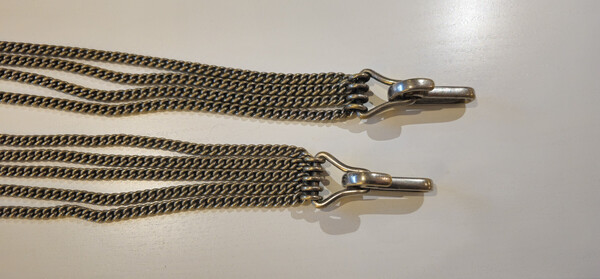
An example with five strands, not sure what dictated the number of chains. One imagines these multi strand examples were inspired by old Tachi hangers, like on the National Treasure Hojo and Uesugi Tachi Koshirae.




-
Great to see you back
-
Appears to be a "Sam Browne" clip type from the missing bottom attachment. It's difficult to say with these as original Japanese types have been found with the clip.
-
 That may have been a trick of the light/frame rate, in other slow motion videos of cutting the blade only flexes side to side once it contacts an object.
 -
Let's not get too carried away, it's clearly the number "8" used as an assembly mark.
-
Unless it is really cheap (hundreds of dollars), best to wait for something better to come along. This is really crude and doesn't really offer much else beyond the size.
-
Hi Bruce, the full inscription reads 夛賀大明神 - Taga Daimyōjin and the blade was made in the mid 1930's by Kojima Kanetoki.


-
Onkashi-To should be signed with "Kinsaku" after the Mei and placed below the Mekugi-ana. A clear put together.
-
Whenever you need a good laugh, heading to the lanes armoury site and reading the latest high fantasy they've dreamed up never disappoints. Hollywood could take some notes on the cultivation of sheer suspension of disbelief these fellows pull off.
-
Very low Showa 26 torokusho registration number
PNSSHOGUN replied to Gerry's topic in Auctions and Online Sales or Sellers
From memory the registration numbers were contextual to the prefecture. That seller has many suspicious items, the kinpun mei is dreadfully poor. -
Some dealers appear to use the please enquire for anything over say three million yen, however after emailing them the price was well below that. In some cases it may be the terms of the consignor.
-
Certainly very interesting and a relatively small price for what it represents. If given a choice, I would prefer an O-suriage example that was healthier and possessed all the attributes the Ichimonji school is so revered for.
-
Juyo swords found in Shin Gunto Koshirae
PNSSHOGUN replied to PNSSHOGUN's topic in General Nihonto Related Discussion
The below order of battle lists one other; Maj. Gen Senda Sadasue. You can tell the Sadakatsu is a different sword than the one he's holding in the portrait below, although senior officers were known to own multiple swords. https://www.ibiblio.org/hyperwar/PTO/Iwo/IJcmd.html Bio: https://asiamedals.info/threads/lieutenant-general-senda-sadasue.28983/ -
Dawson offers far more value and useful detail for the money.
-
Rivikin beat me to it, but thought it to be classical Yokoyama work.
-
MILITARY books By Richard Fuller & Ron Gregory
PNSSHOGUN replied to Rawa's topic in Military Swords of Japan
They all have their respective value and contain various pieces and information not present in one or the other. What none of them do is show good photos of the blades themselves, the book "Modern Japanese swords: The Beginning of the Gendaito Era" is the closest to seeing good photos of interesting military swords and mounts together. -
MILITARY books By Richard Fuller & Ron Gregory
PNSSHOGUN replied to Rawa's topic in Military Swords of Japan
The larger volume is more comprehensive, though I find use for both volumes and would advise anyone to have both if they can find them both at a reasonable price. -
Bizarre: https://www.ebay.com/itm/157830755961
-
You've done really well here, would you mind sharing some pictures of the full Koshirae?