IJASWORDS
-
Posts
1,945 -
Joined
-
Last visited
-
Days Won
85
Content Type
Profiles
Forums
Events
Store
Downloads
Gallery
Everything posted by IJASWORDS
-
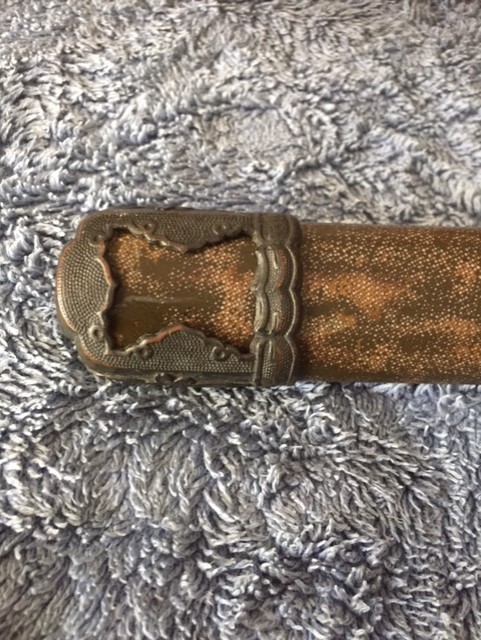
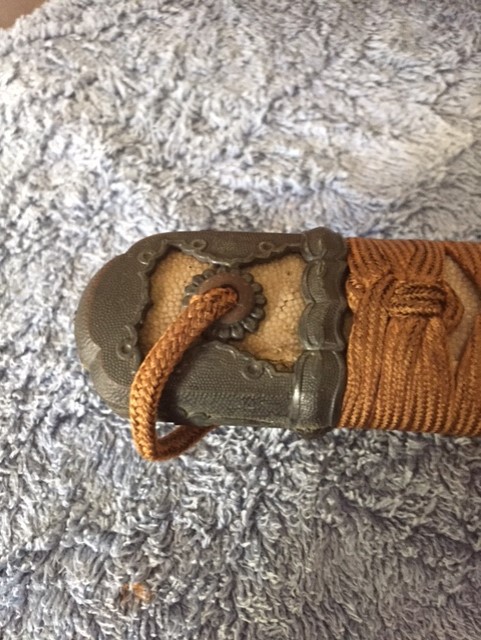
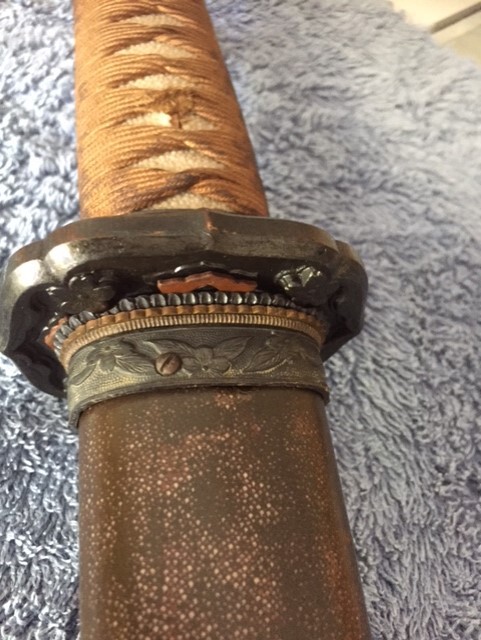
Hey guys, this a silver plated example of mine, on shark skin Saya. With a Shinto blade. So they do exist, and to my experience, were on up market outfits.
-
Sorry, Type 3, or marine landing, what ever you call them.
-
Guys I tested all my copper looking pattern 3 copper "looking" fittings with a fridge magnet, all were attracted. So copper plated and painted iron. Don't use a file!!!
-
PHEEEWWW. Looks good from that side. So probably only a opened lamination.
-
Just be careful it isn't a rewelded break, and regrind. Not sayin' it is, because photos make it hard to tell. I have seen a few repaired like that in the same area over the years. Hope its OK.
-
Hi David, pcay has a good reputation. KANENORI was a very prolific sword smith, and I think every starting out collector of GUNTO should have one in their collection to study. He is very representative of his craft of the period.
-

Koa Ishin Mantetsu Gunto On Aoi
IJASWORDS replied to Vermithrax16's topic in Auctions and Online Sales or Sellers
All good. There is still some mystery associated with the MANTETSU blades. What locations were they made, who made them, what is the meaning of the numbering system on the mune. There is also conjecture on the types of forging processes. It has long been thought that a soft iron (lower carbon) rod was inserted into a harder tube (higher carbon), and drawn out by heating and hammer welding, but not folded. This obviously gave a extremely heat treatable outer skin, whilst providing a resilient inner core. BUT, some members on NMB have posted photos of their blades which show a defined HAHA. So the theory of multiple locations, multiple smiths and a variety of process makes for good study. -
Koa Ishin Mantetsu Gunto On Aoi
IJASWORDS replied to Vermithrax16's topic in Auctions and Online Sales or Sellers
Hamfish, if you read carefully, they were not put in any "quality" category. My comment was based on what blades would be interesting to study, for different reasons, from different origins, that would make an interesting Gunto collection. I enjoy my three examples for different reasons. I have done enough research to know the differences. -
Spot on John.
-
Chris, a great example, looks pristine, the type3 is one of my favourites, and yours is superb.
-
Koa Ishin Mantetsu Gunto On Aoi
IJASWORDS replied to Vermithrax16's topic in Auctions and Online Sales or Sellers
No GUNTO collection is really complete without a MANTETSU, MINATOGAWA and YASUKUNI to study and appreciate. Emura and Nagamitsu are great Showa smiths, as are many many others of this period. Swords sell for what a buyer is willing to pay, and it just so happens that there is a big demand for good Gunto, especially the less common ones. So don't be surprised at current prices. -
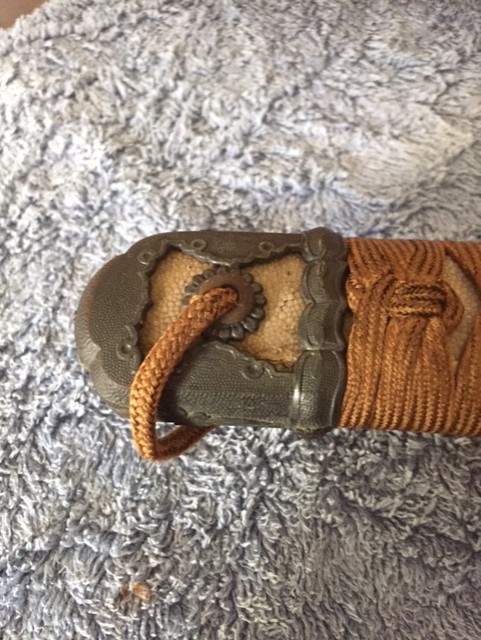
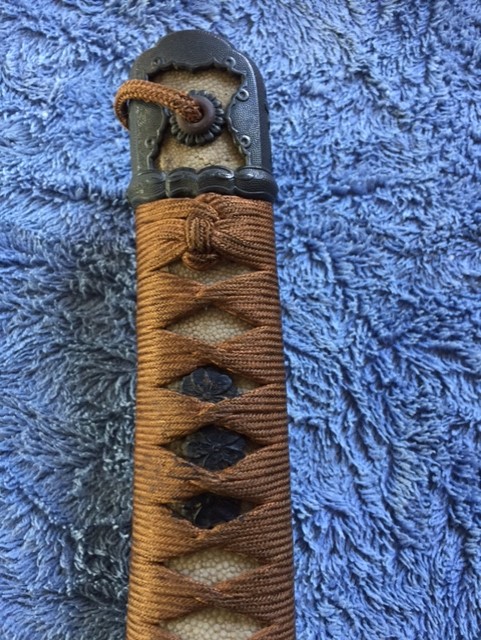
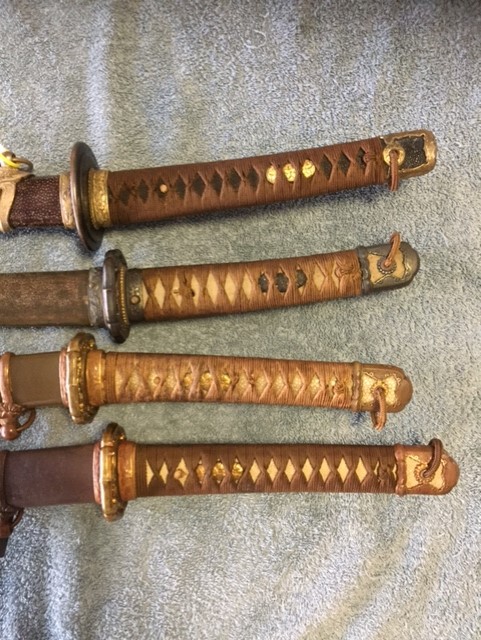
Another interesting observation is that the colour of the cord SARUTE normally matches the colour of the wrapping of the Tsuka. See first photo above. Leading me to believe the cord Sarute was probably almost a fashion statement by the owner. Many complete examples survive, which is testament to their robustness, and functionality.
-
I would question the "stealth" option, as I have cord SARUTES on Navy Kai Gunto. I would also question whether it is a "cheaper" option, as I have them on really high grade outfits with high status blades. See attached photos.
-
Dave, I once purchased a similar blade in original type3 mounts, very reasonably priced as well. When I got it home I found a Chinese blade fitted to the WW2 mounts. It now resides under my bed in the event of unwelcome guests, and obviously not with my gunto collection. A worry to me on your outfit (other than the blade) is the mix of fittings which it was not be originally fitted with. This shows some fiddling after war. I am in agreement with David Flynn, who I know has great experience with Gendai/Showa blades. You have asked forum members for help, and you have received information that you probably didn't want to hear, but that is the nature of this "free" advice. Looking through previous topics, nothing generates more discussion than blades of "questionable" origin.
-
Dave, as a "Darksider" like you I really appreciate Gendaito/Showato in Gunto mounts. But can a mill steel blade even if folded be made in the 'traditional way"? My thoughts on the matter relate to how traditional nihonto were made from laminated steel. Shigane (soft) core steel. and Hagane (hard) outer or case steel. YEP, you can fold and heat treat mill steel, but laminated it is not. I have blades made in the 1940's which actually say in the mei, made in the KOBUSE manner (soft steel core). Your thoughts and comments on my theory would be welcome, as I am always willing to learn from more enlightened folk.
-
Update On The Sword Shortage
IJASWORDS replied to Bruce Pennington's topic in Military Swords of Japan
Great topic, and also answers the question why so many 21.5 inch "old" blades are found in Gunto mounts. Even to the extent where the shorter blades are housed in longer Saya, to may be make them look regulation size. Thanks Bruce. -
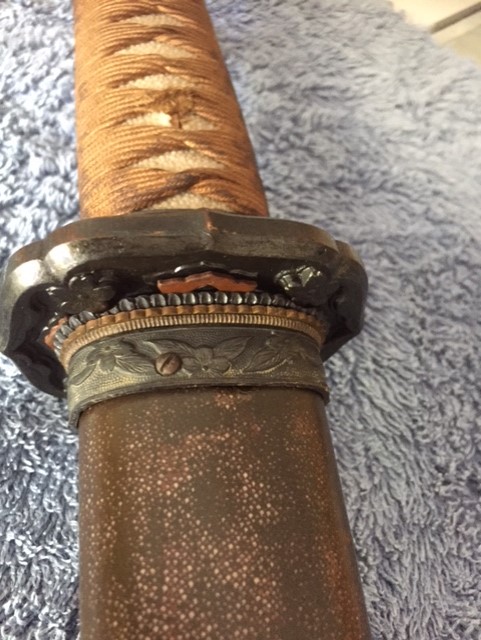
I like a GUNTO with the uncommon "blackened" fittings. This one is on an equally uncommon shark-skin saya. The black is not a paint, but appears to be an oxidized silver plating. Even the Menuki are blackened. High class? Don't know, rare, YEP.
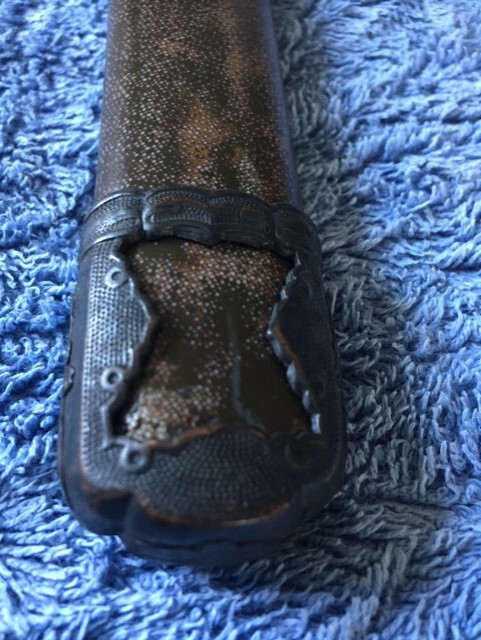
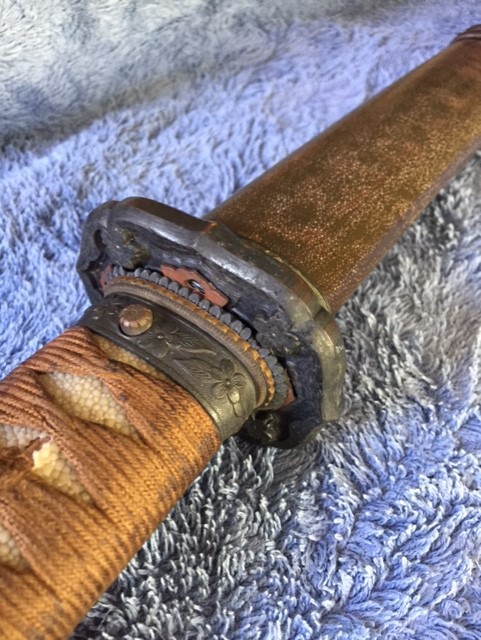
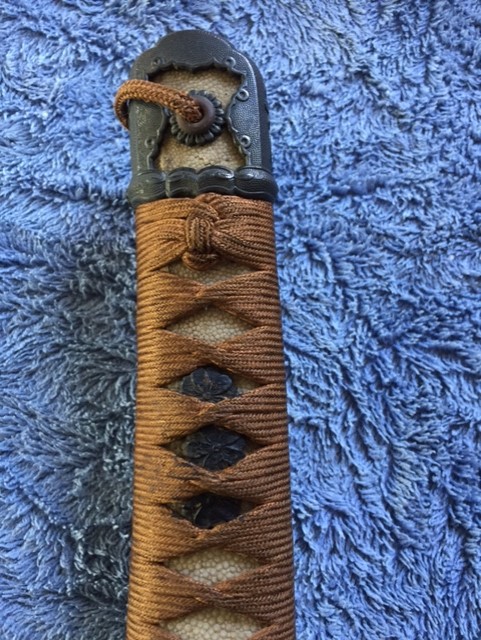
-
Nice John! This is a great thread to see what exists out there in the hands of GUNTO collectors. Could we see more posts, as I love seeing what exists hidden away in collections.
-
Really good photos of really good KAI's. NICE!
-
I think that if you look at any hobby, you buy what you love, and love what you buy. I collect WW2 swords because I love them, and some times pay over the market price because I am after a specific example to study. Never as an investment. A swords value is what it is worth to a specific buyer, ie, no published general price list. To answer your question specifically, prices will trend upwards as the demand for GUNTO exceeds the supply on the market. SHAMSY'S NCO example is spot on, as demand is increasing for a limited supply. Even the NIHONTO are not always 'good investments", you only have to look at the for sale section, and a lot of listings will say a sword is for sale "less than what I paid for it". Why? Generally you pay what it is worth to you at the time, with little bearing to the market.
-
Naval Katana For Questioning Please
IJASWORDS replied to matthew's topic in Military Swords of Japan
A mixture of army and navy bits and pieces, with a machine made stainless steel blade. Not a fake but a lot of odd bits thrown together. -
Gunto Mei, Please Double Check Translation
IJASWORDS replied to Ontario_Archaeology's topic in Translation Assistance
The KAI GUNTO that Hamfish sold was a bargain of a life time. I am sure the buyer is ecstatic. The fittings were of the rarest type and top quality. And the blade looked top drawer. I am sure it would be called "museum quality". Neil. -
Hi Ed, is it possible to take a clear photo of HAMON? That will help identify steel, if it is quenched, etched or mechanically applied. Neil.
-
Hi Ed, nice KAI GUNTO. Is the blade made from the "rust proof steel" or stainless steel? They are very interesting examples. Neil.
-
Japanese Military Sword Please Help To Identify
IJASWORDS replied to angus's topic in Military Swords of Japan
Hi, if you are a serious collector, don't monkey around with it. It is a war relic, and ANY THING harsh you do to it devalues it to future collectors, even possibly removes some thing that is unseen to you. To remove dust, use nothing more than a DRY old tooth brush. For the blade, repeated wiping with a soft rag, and some thing like gun oil will help, and prevent future corrosion. Read some posts on sword preservation before you attempt to ruin it. DON'T use a bronze brush, bronze is harder than the brass the fittings are plated with, and as I said it could take off fine detail.