IanB
-
Posts
1,778 -
Joined
-
Last visited
-
Days Won
23
Content Type
Profiles
Forums
Events
Store
Downloads
Gallery
Everything posted by IanB
-
Jan, Simply the character for 10 - 'ju' in a circle. Why it was chosen I don't know. You can see why they changed it if you imagine the above with the lower leg extended. As I have said, on the kanamono of the armour is a small tick at the base of the lower leg but it is almost invisible unless you are looking for it. Just when the Shimazu changed their kamon I don't know. The Tensho Mission left Japan in 1582 with the armour as a gift so it was in use before that date. One of the daimyo funding the trip was Otomo Sorin (he was baptised as Francisco at the time) who fought the Shimazu at Mimigawa in 1578 when I assume he obtained the armour (it does have minor battle damage on the left kote). So it seems the Shimazu were still using the old form at that date. Hideyoshi had 26 Christians killed in 1597 to discourage conversion to that religion so I would suggest that is when the Shimazu changed their kamon. Why it occurs on later Edo period items I don't know - perhaps for nostalgic reasons when the Christianity problem had far less importance. Ian B
-
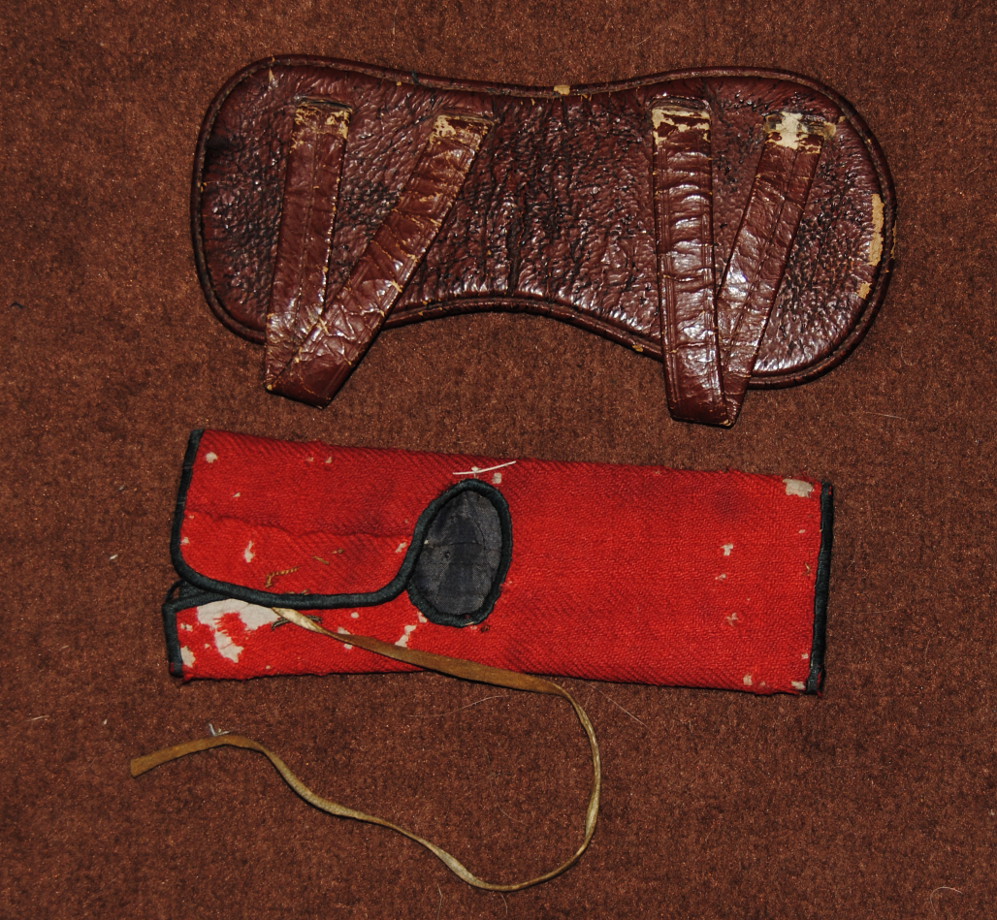
Piers, Here is the tube item whose name I have never known. I also included the koshiate since they were both handy. Ian
-
Jan, I have pulled this off the internet but it is almost the same as that on the armour. The major difference is that the armour version has the lower leg rather more extended, and hence looks Christian, and has the outer ends of the arms expanded. The family changed to the form that Piers' piece has during the Momoyama to avoid being thought Christian. Remember Hideyoshi proscribed the religion - although he didn't really enforce his ban. Ian

-
Sadly it is impossible to guess what the kashira date was like but gilded leather was the normal material being strong and light. Judging by the size of the tsunamoto it was something reasonably tall. I had thought an ichi no tani shape but doubt that a European would call it a panache. They tended to be tall and fairly narrow, often jewelled or similarly decorated. Sadly the illustration by Jan and your kamon Piers are the wrong one. The armour was made when the Shimazu used the character ju separated from the circular frame. For years the Royal Armouries thought the kamon on the kanamono was a Christian cross in a circle (and they really do look like one) but with a glass you can see they have a tick at the base of the upright. Ian B
-
Brian, Piers, Sadly I feel you are right, most Japanese, as well as most Europeans, have no regard for their heritage. My rummaging in Japanese flea-markets (I was going to use the older term fossicking and realised most people wouldn't understand) turned up many pieces that I regard as absolute treasures, but caused their vendors to look at me as if I was totally out of my mind wanting such rubbish. On one occasion I found a small fabric tube, about 6" long lined with silk and shaped to fit on a saya around and below the kurigata. I bet nearly every samurai had one, but how many do you see? It was to stop the saya of the two swords rubbing together and damaging the lacquer where they cross under the obi. Similarly I once found a simple koshiate that fitted around a katana saya under the obi. It is trivial, just a few bits of leather, but again I would imagine most samurai on the daimyo gyoretsu wore one to stop their left hip bone getting pounded to shreds marching day after day for sometimes months on end whilst wearing a katana. These are the kind of trivia that would have been commonplace, but were discarded for exactly that reason when the wearing of swords was abolished. This type of item, and so much else, were not the kind of items the tourists to Japan in the 19th century thought to acquire with the swords, armour and other weapons they were buying as souvenirs. As a result they almost never feature in the study of swords and other military equipment since I suspect few today know they ever existed. Ian Bottomley
-
Jan, The mark is interesting. Although it can mean 'top' or 'upper', I cannot see someone trying to put the maedate on upsidedown so I don't think it is being used in that context. As has been mentioned it occurs inside helmets before signatures were common as a quality indicator. Again it seems improbable that it is being used on a maedate with that meaning. One possibility is that it is being used to indicate the association of the maedate with a particular helmet. If there were several similar maedate and helmets kept together, it would seem sensible to mark them to show which belonged to which. That being the case, I would have expected numbers - but who knows? Perhaps it shows this maedate belongs to a more superior helmet or a helmet marked in the same way. Ian Bottomley
-
Jan, Your maedate is splendid, but as to age -who knows? Judging from its appearance it looks to have considerable age, but that could be just the life it has had. For some reason almost all the helmets I ever get my hands on have the maedate missing - I suspect that somewhere there is a warehouse full of the darned things. As for the potential age and textile component of your maedate - the Tensho Mission from Japan to Europe gave King Philip of Spain an armour in 1585 that is described in a movement order of 1603 instructing a Franciso Berdugo to transfer the armour from the Palace to the Armoury. The document says it had:- A black morion (open helmet) of the same, with a mask -?- and a crest of gilded leather and in the front a gold cross on a green field and in front two tufts (or tails) (of) black hair, and a (baruas?) in black and white.. This armour is now in the Royal Armouries in Leeds but sadly missing its crests. The helmet in question is a zunari kabuto with two large prongs (tsunamoto) on the top of the bowl that held the crest of gilded leather (actually described in the text as a panache - these were commonly used in Europe on such things as tournament helmets). On the front was a maedate of the Shimazu kamon (described by the clerk as 'a cross of that country' ) 'on a green field'. The armour still retains a few kanamono with the old Shimazu kamon of the character 'ju' in a circle. The green field is unlikely to have been metallic or lacquer so I can only think that this was of openwork gilded copper backed with a leather or textile. On either side of this was what is described as 'tufts, bunches (like a little girls' hair) or tails' of black hair. This I interpret as being a pair of kuwagata shapes, but covered in black fur with the kamon between them. In fact very similar in overall conception to yours. What the 'baruas' in black and white was I cannot imagine - possibly a helmet cord. I recently saw a helmet at an arms fair with a helmet cord made from two colours of hemp cloth rolled into cords and twisted together like a rope. This would accord with the description but I have yet to find the term baruas. With this kind of description you must realise the poor old clerk writing out the document had no idea what he was dealing with and just used words that seemed appropriate to him. Ian Bottomley
-
Barrie, There should be a leather band around the 'waist' of the yazutsu that has a metal ring on it and at the side a leather strap that ends in a loop. A heavy cord goes through this loop, around the waist and ties to the ring so that the quiver is positioned on the right waist. The lid hangs from loops of cord that fasten together with a toggle (kohaze), and is kept closed by a leather strap ending in a metal ring. This is fixed to the side of the yazutsu, then goes over the lid and the ring hooks over a stud on the other side. The tie at the upper back mystified me for years until I saw how it was used in a painting at Nikko Toshogu. It would normally be just a short length of cord that goes through the two eyelets and is tied in a knot. I always thought it was for hanging the quiver up, but no - a thin cord was tied to the loop that went over the left shoulder and tied either to the obi or to the armour. Its purpose was to hold the upper end of the quiver at the correct angle so that the lid was just in front of the right hip. Ian Bottomley
-
Jan, How I wish I could have revised that book years ago. When it was in the final throws before printing, the editor ( ) had deleted all the Japanese terminology and replaced it with what she thought was the corresponding English. As a result it went to press with all manner of errors - even to odd paragraphs being missed out. Still it made a start. Piers, Not really clever at all - what other kanji would you expect on the front of an armour box? I knew it wasn't normal but thought the general form was right. After paddling around in the pool of Japanese arms and armour for 50 odd years I have come to expect anything. Ian B.
-
Jan, Sorry but is a kamon I have not come across before - not unusual. The kanji is easy - 'FRONT' Ian Bottomley
-
samurai exhibition in Rotterdam
IanB replied to Luc T's topic in Sword Shows, Events, Community News and Legislation Issues
Piers, Luc, There were a number of gifts sent to various European monarchs and dignitaries in the final days of the shogunate. The stand of arms sent to Queen Victoria has been partially published, but the full extent of the gift is still obscure (at least to me). It included the famous o-yoroi by Myochin Muneharu in the Victoria and Albert Museum together with the horse harness now on loan from the same museum to the Royal Armouries, but there was a vast array of other stuff. The RA have about 30 matching yari with raden shafts and there are others scattered between the V&A and Windsor Castle. I suspect the total may well have been 50 or so. There are two magnificent naginata, stirrups and other bits of horse gear. Somewhere there will be swords but I have never seen them described. Similarly, on a visit to Torino in Italy I saw in stores an absolutely knockout daisho which the conservator told me was a similar gift and there used to be a magnificent do-maru, only the helmet of which now seems to survive, that may also have been a gift. I would guess that similar gifts were sent to other royalty that have now been relegated to storerooms, unrecognised and relatively unloved. There is a research project here for someone who has the time and patience to hammer away at officialdom. Ian Bottomley -
Having collected for some 50 plus years there are bits and pieces all over the place as well as being concentrated in my armour room. I know my two sons are terrified by the idea of having to deal with it all when I finally fall off the perch. One thing I did do, whilst being treated for cancer (which concentrates the mind wonderfully) is to start a file of photographs and descriptions of the major items with a general idea of what they are worth. Although I did manage to cover a reasonable amount of ground, there are still a hundred and one bits and pieces that need to go in it, but every time I think about getting back to doing it something else distracts. I have sold off a few minor bits and bobs of late, but couldn't bear to part with armours I have owned for nearly 50 years - they are too much like good friends. Perhaps it should concentrate on the minor bits, in themselves not terribly valuable, but aggregated would be. The major pieces are obvious. Ian Bottomley
-
Ed, Although it may have been put together a long time ago, what you have here is an Etchu hanbo to which an upper part has been added. The filed lines on the lower part are a give-away. Ian Bottomley
-
All, I recently had a major purchase from this seller and had nothing but the most courteous service from him. Not only was the item exactly as described and photographed, he went out of his way to give me a better price than I had initially offered, and he also sent regular emails informing me of the progress he was making in obtaining all the required export documents. I'm sure that in the case of this yari he does not know exactly what he is selling. If my memory serves, his shop tends to be mainly ceramics and the like. Ian Bottomley
-
Ed, What is often called an 'archer's helmet' because of the hinged fukigayeshi, although why make both of them hinged? The use of kylin as decoration is unusual, but that may be an Edo enhancement. Having said that, it was more normal during the Edo period to engrave the outline of the design before applying the gold and silver. I could go with Momoyama as well. Ian Bottomley
-
Ed, Wondeful pair of sode - makes you wonder what the rest of the armour was like. I note the kanamono on the top plate are shakudo, another sign of quality. This kind of embossed work is normally Myochin, but they were inveterate advertisers and I am surprised they are not signed. I have seen a few examples where signed Myochin panels have been incorporated into the work of others. The Royal Armouries have a pair of sode with russet panels superbly embossed with Bishamon on one and Fudo Myo - o on the other. They are signed and dated by Myochin Muneakira (if I have remembered correctly) but clearly mounted on Kaga sode. The other is an obviously Unkai armour (again Kaga) with a signed embossed plate by Muneakira on the front. The Myochin clearly did a bit of trade in supplying these embossed panels to Kaga armourers. Since there were no Myochin working in Kaga until the end of the 18th century, it would suggest there was quite a bit of co-operation between the various armour making groups from different areas. Ian Bottomley
-
Matt, I don't think you will be that impressed at the British Museum either. I went there last year to look at some armour they had in store and took a look at their display whist I was there. Considering that they have hundreds of swords, many of which have recently been re-polished and re-furbished, to see only one armour and one or two swords on display is disappointing. You might try the Tower of London. They ave at least an armour of Takeda Katsuyori on show plus a couple of sword blades. Being the Tower, most space is dedicated to items from its history. The bulk of the Royal Armouries' collection is in Leeds where there are about 15 blades on show. Ian Bottomley
-
Thomas, Two of the armours in Denmark came to Europe with the Tensho mission and were a gift to Francisco de Medici of Florence. I do not know exactly when they left Italy but one is depicted in a painting by Jan Brueghel the Younger (1601-1678) and Hendrick van Balen (1575-1632) entitled ‘Allegory of Touch’ preserved in the Musèe Calvat, Avignon. It would seem that it was painted about 1630 whilst it was on its way to Denmark. There are also some strange swords with lacquered hilts like Dha, but in katana and wakizashi saya. I suspect these were trade goods with SE Asia. Ian
-
All, There is also an event at the Tower of London on the 14th September 2013. The programme starts with me kicking off with the gift armours given to Europeans (Spain, Bohemia, Italy France) by the Tensho and Keicho missions as well as the gift to King James I (and VI) by Tokugawa Hidetada and the gifts to the Dutch etc. Other items on the menu are: The 'Dragon saddle' , Henry V and Sigismund - Karen Watts Henry VIII and the gift armour from Maximilian (horned helmet) - Graeme Rimer Gifts of arms to the Spanish and Russian courts by the Stuarts - Guy Wilson The Asian arms collections of Michiel De Ruyter and Cornelis Tromp - Eveline Sint Nicolass Gifts of arms to the Prince Regent from the Bey of Algiers - Neils Anderson The East India Co gift to the Tower of London in 1851 - Thom Richardson and Natasha Bennet Diplomatic gifts of Japanese arms and armour in the 19th C. - Greg Irvine Should be a good event - there are some good topics here. Ian Bottomley
-
Piers et al, Yes it's I who will be kicking off this seminar. It will of course mean I shall have to redeem the suit from the pawn-brokers before the event, and buy a pair of new socks - but needs must. One of the King James I (and VI) armours, which I have proved to my own satisfaction belonged to Takeda Katsuyori, lives at the Tower and is permanently on show. The other, on loan from the Royal Collection, will probably remain in Leeds since moving it would require Royal approval. There is also the mogami haramaki, which may be moved from Leeds to the Tower for the event. At this stage I know not. That armour we know was given to King Philip II of Spain in 1585 and had belonged to a member of the Shimazu family. Historic stuff! Ian Bottomley
-
Piers, My guess it was used in Europe for un-mentionable items that I understand were worn by chaps of the other gender. Ian Bottomley
-
Roy, I re-did the fabric on one exactly like yours for dear old Bill Galeno. He had bought it devoid of any lining and it looked wrong. I have one like that shown by Eric with the hanging cheek pieces -which i themselves are an interesting example of parallel development. The cheek pieces are virtually the same shape as those on some Roman helmets. Mine has a row of holes along the rear edge of the upper plate and I have always thought it probably had a mail hood at one time. Ian Bottomley
-
Dear ?, In future could you please sign your posts so we know who we are replying to. The medallions you have illustrated are of exceptional quality but probably not from an armour. I say probably because I have long ago learned never to say never. Being bronze they would have limited defensive value, hence they would have been used decoratively. You do get similar roundels fixed to the front of dou but they are usually about 10" or more in diameter and are normally embossed from sheet rather than being cast. I am curious about the coating on the back of the one with the label. It looks like fired enamel that has mainly flaked off. The holes you mention must be very small but I think I can see a couple in the back view. If that is the case, it suggests they were sewn onto a fabric or leather background - but just what can only be speculation. Unless they were made to adorn something for the tourist trade, all I can suggest is they may have been attached to a harness or perhaps something used in a religious context Ian Bottomley
-
Piers, You brave man - sitting on a horse. The guy with the utsubo reminds me of the day I watched the villagers at Nikko preparing for their Spring Grand Festival. Having stood around whilst the gold lacquered armours were dragged out and put on, I noted the 'archers' were tying on their utsubo diagonally across their backs with the door at the top (they are not real utsubo by the way but solid replicas). When I mentioned they should be the other way up at the right waist I was given pitying looks to the effect - what does a gaijin know about our heritage. They then proceeded to show me how you reached over your shoulder to draw an arrow out in the finest Robin Hood tradition as depicted by Hollywood. I have the pictures of about 30 guys marching with them tied on in this position. This when 50 yards away in Nikko's museum are superb paintings of the procession done during the early 20th century showing utsubo being worn properly. It was from these paintings I learned what the loop of cord is for at the upper end of these quivers. I had always thought they were to hand the things up with (another pitying look) . No, it was for a cord that passed over the left shoulder and tied off to the armour to keep the top end of the utsubo up in the air at the right angle to allow you to draw the arrows out. Ian Bottomley
-
Piers, It is part of a pack harness. For some reason they always seem to be red lacquered with lots of gold touches. Just how and where on a gee-gee this particular part fits I have no idea. I'm sure Eric will have at least six complete sets stashed away. Ian Bottomley