IanB
-
Posts
1,778 -
Joined
-
Last visited
-
Days Won
23
Content Type
Profiles
Forums
Events
Store
Downloads
Gallery
Everything posted by IanB
-
Piers, With your command of Japanese surely not. Gyoyo were originally shoulder defences on early do-maru worn by retainers - sitting on the point of the shoulder like the kohire of later armours. When the samurai adopted do-maru they added the o-sode from their old o-yoroi so the gyoyo became redundant in their original role and were swung forward to cover the fastening cords. Far from being decorative, they protect what are the most important cords on the do. George, The date is that when the pattern of leather was licensed for production - Shohei period. Ian
-
Jan, I don't want to rain on your parade, but I'm afraid the Kyubi no ita isn't very old. The cross shapes are in fact shobu gawa - that is they are meant to be iris flowers with leaves each side. Traditionally this was made by clamping strips of wood with carved wooden stamps attached onto the leather wrapped around a drum. It was then dyed with indigo. Where the stamps pressed into the leather the dye was prevented from penetrating thus leaving the design in white on the blue ground. However, the dye did bleed under the stamp slightly giving the design a slightly fuzzy look. The leather on your kyubi no ita is too sharp and has been done with a stencil. I would guess Showa period. Ian Bottomley
-
Luc, I agree the helmet might be Saiga, but I would have expected the eyebrows to be riveted on rather than embossed if it were. It is annoying that we know so little about the people who made these wonderful helmets, but they seem to have been reluctant to add their signatures to anything that was not a regular helmet. It is the same with masks - some of which must have taken great skill and a lot of time to make yet are unsigned. Ian Bottomley
-
Socket (Fukuro) Yari from Showa22
IanB replied to Brian's topic in Auctions and Online Sales or Sellers
A very nice blade but a shame about the pole. Note the ring attached for hanging a label. This was originally a long shaft that has been cut down - tragic. Ian Bottomley -
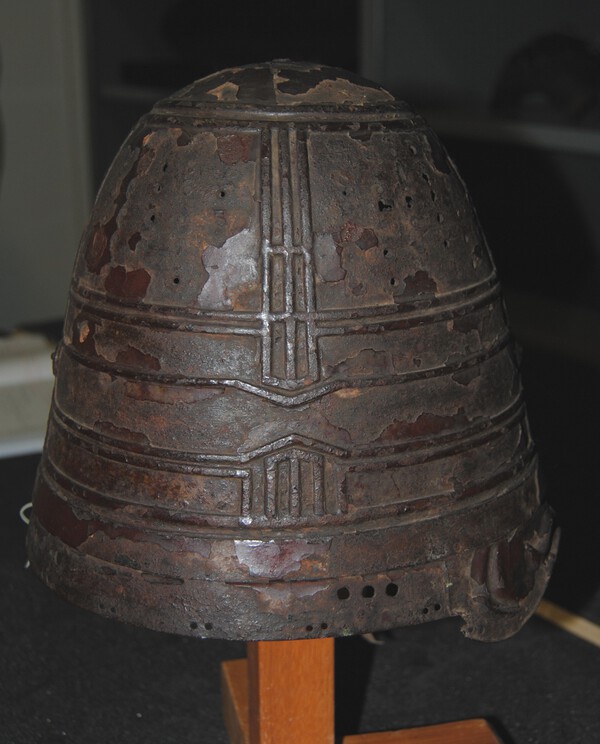
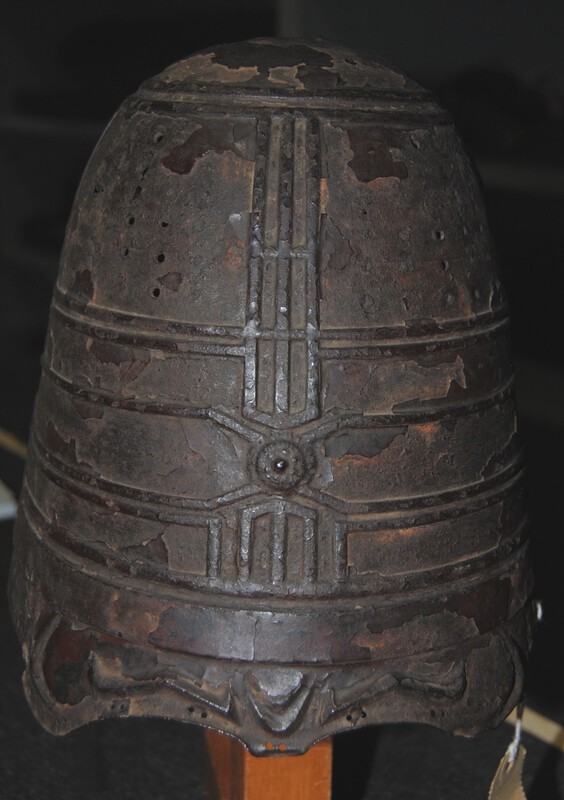
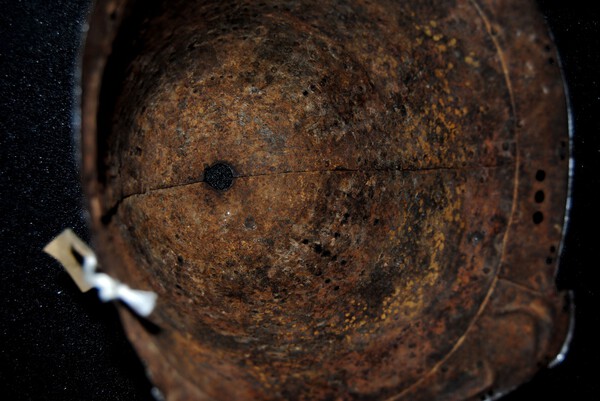
Luc, Attached are the images of the bell-shaped helmet in the Royal Armouries collection. As you can see, it has had a bit of a hard life as well as some modifications. It came into the collection with the purchase of a small collection of armour from an early collector so I have no details of its earlier life. I dated it to the Momoyama period. You will see from the interior view that it is made from two plates. What hasn't shown up are the myriad of tiny rivets holding all of the strap-work to the body of the bell. In the upper part are holes that evidently held domed rivets representing the bosses on a bell. At some point these have been removed, the holes filled with lacquer and a lesser number of larger bosses modelled in lacquer - all of which have now fallen off. On the basis of this I suspect it was originally russet. There is no tehen kanamono nor is there any indication it ever had one. Ian Bottomley
-
Jan, That is a rather nice jingasa. Not tin but sheet iron. It would have been quite an expensive item when made. I still haven't worked out how it has been assembled. The usual way would have been to overlap the edges of each plate and rivet them together. Here they seem to have used a covering strip and used countersunk rivets instead. A nice item - well done. Ian Bottomley
-
Luc, The Royal Armouries Museum in Leeds has a rather distressed example a helmet bowl in the form of a bell. It is made from two plates and all of the applied strips are riveted on with tiny rivets. I dated it to the Momoyama period but it was certainly modified later. I am going into work on Thursday so I will try to get a picture if I get chance. Ian Bottomley
-
Peter, Is the shikoro just detached or has the lacing between the lames of the shikoro deteriorated? In the first case, the biggest problem is getting hold of proper cords and soft-metal rivets if they are missing. If the latter it is a complete re-lacing job. You say the helmet is signed. If the lacquer of the helmet / shikoro is still in good order, the helmet is well worth putting some money into it and rescuing it. As Luc says, re-lacing can be tricky, but not nearly as difficult as binding a tsuka - it just needs a lot of patience and care. By far the most difficult, in my opinion, is sugake lacing (where the braid is spaced in pairs rather than all-over). In itself it looks simple enough, but to get all the plates to hang at the right spacings can be difficult - as can getting the cross-knots to look neat. As you add more plates, the carefully adjusted spacing you have already done alters as the increase in weight stretches the braid. I find kebiki lacing relatively easy once you have worked out how it starts and ends, and know how to insert extra strands to allow for the conical shape. Perhaps it might be worth writing an illustrated essay and posting it. Ian Bottomley
-
Malcolm, An interesting armour in very good condition for one made of nerigawa. They need to be treated with great care since parts can distort if strained out of position for any length of time. As for the padding in the mask, no it was not common. The interior of masks were very carefully lacquered to a smooth finish. If properly fitted to the wearer's face there is absolutely no discomfort whatsoever. In this case the lining is very clean and in some respects self-defeating since it would absorb the sweat instead of allowing it to drain through the hole in the chin. Ian Bottomley
-
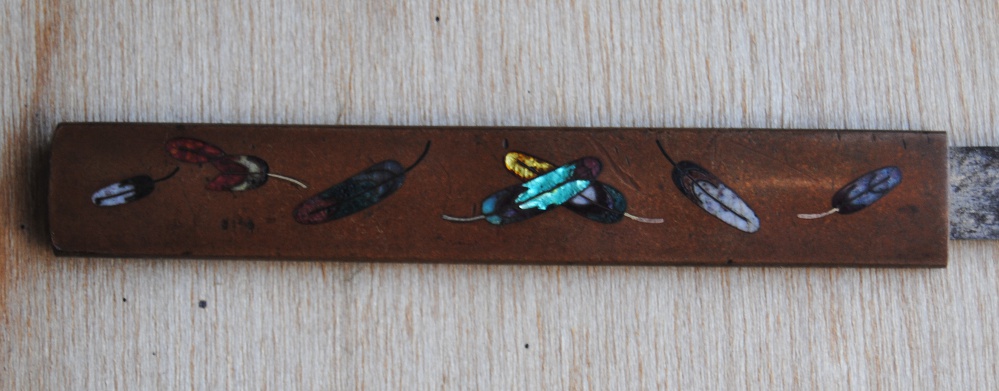
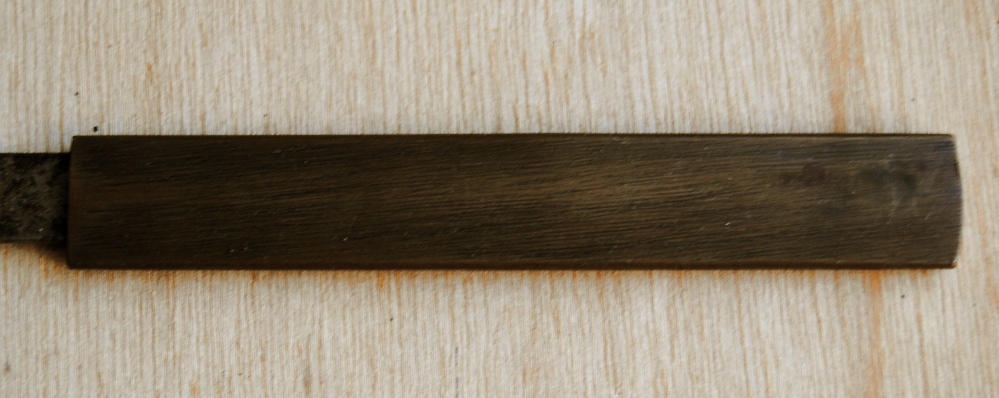
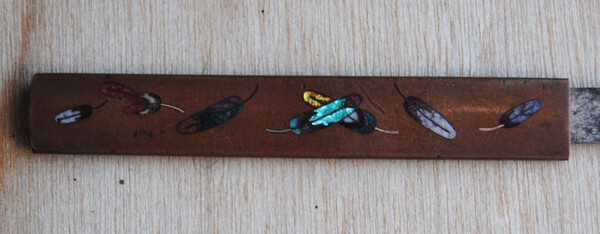
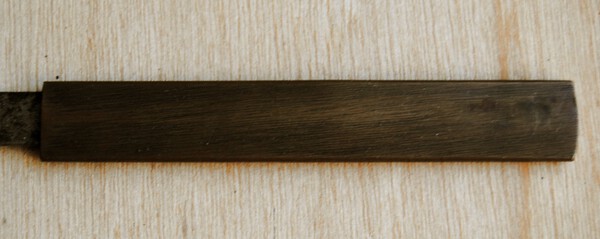
Austin, I may have posted this before, but since it has similarities to your kozuka it doesn't hurt to put it up again. My kozuka is of copper with champleve enamel. The quills are inlaid in either gold, silver or shakudo. Within each feather are small cloisonne wires of copper which separate the different colours of enamel and represent the central rib and vanes. Altogether there are 5 colours: white, green, red, pale blue and dark purple, with the two central feathers done in translucent enamels in pale blue and yellow over a reflective foil. The opaque colours are distinctly muddy and show patches of different colours as if they were contaminated before firing. My first impression was that my kozuka was Meiji period but when compared to the sublime work done in cloisonne enamel during that period, I have changed my mind. Examples of enamelled sword furniture are not that common and seem to have been started by Hirata Donin (d. 1646). Much of the Hirata groups production seems to have been the production of small plaques that were then applied to a separate base to form tsuba and so on. A typical example of a tsuba is shown on the Victoria and Albert Museum's website (http://collections.vam.ac.uk/item/O3908 ... -narikazu/) which consists of small decorative roundels on a shakudo base. The muddy colours and incomplete firing suggest these kozuka are possibly late Edo period. Ian Bottomley
-
Justin, I have already listed the only three smiths who used that Kane character recorded in Shin Katchushi Meikan in the previous thread. Unfortunately there are big holes in our knowledge of armourers and I'm afraid it is something you have to live with. No doubt other names will emerge in due course. My finest armour is by a Ki Yasukiyo and I waited almost 30 years until he emerged from obscurity. Ian Bottomley
-
I was under the impression this technique was supposed to imitate gold brocade. I once owned an tanto with the fuchi / gashira done in shakudo with gold karakusa that had then been given a nanako finish. The effect was very convincing. Ian Bottomley
-
Naginata reshaped into an Wakizashi info needed.
IanB replied to bmoore1322's topic in General Nihonto Related Discussion
All, One point that has not been mentioned is that the geometry of some naginata make their conversion to a wakizashi something of a problem. Early naginata in particular were shaped with a pronounced widening of the blade in that region that might be described as the monouchi. In other words where the blade begins to acquire its pronounced curve towards the point, the distance from the shinogi to the edge increases. It is the line of the shinogi that dictates how the conversion must be done. During conversion the extreme curvature towards the point has to be cut off to continue the line of the mune. The new boshi thus formed having originally been part of the hamon some way back from the original point and hence having no kaeri. Because the line of the shinogi cannot be altered, the only solution to the widened part of the blade is to reduce it from the edge. If the monouchi of the original naginata had a wide hamon this is not a problem. If it didn't, the hamon will be either narrowed or lost in this area. I have such a wakizashi blade where the hamon actually runs off about 2/3rds of the way up the blade, re-appearing after a gap of about 4" to continue to the point. We would consider this a fatal flaw, but it evidently didn't concern the previous owner who had it mounted. Ian Bottomley -
Matt, Well done - an excellent job that has rescued some nice fittings from oblivion. Ian Bottomley
-
Eric, love the 'His 'n Hers' fire gear. Suitably lavish to become roasted in. Ian
-
All, These gauntlets are indeed unusual but not entirely unprecedented. George Cameron Stone illustrates them in his 'Glossary', in addition to a pair of gloves covered in mail and another pair done in kikko. There is a pair of kote in Venice that have the usual tekko extended by additional plates and mail that reach to the ends of the fingers and thumb forming a built-in gauntlet. Just what the purpose of the hooks attached to the wrist-plate is can only be speculation. Catching a sword is a possibility, but their location would have made the operation awkward, needing the wearer to bend the wrist downwards. In this position I suspect the blade would tend to hit the edge of the wrist-plate rather than sliding down into the hook. It would have been more natural had the hooks to be on the inside of the wrists. In addition, why are they fitted on both hands? Had the hooks been shorter I would have said they were to connect the gauntlets to a pair of kote in some way but they seem far too long for that. I'm stumped on this one. It isn't unusual for armours to sprout hooks and other personal modifications. I have a dou with quite a large pivoting spiral hook in black lacquered iron attached over the right hip. On the right breast is a similar but smaller spiral hook, that on the left being a conventional gilded ring. I'm sure the hook on the hip is to fasten the reins of your horse to whilst you shoot with a bow. why it is duplicated on the breast I have no idea. I saw another armour in Tokyo once with a kind of built in support-arm hinged to the left side that was supposedly to help in shooting a matchlock. That was very silly and must have been a real nuisance. Ian Bottomley
-
This Week's Edo Period Corner
IanB replied to Bugyotsuji's topic in General Nihonto Related Discussion
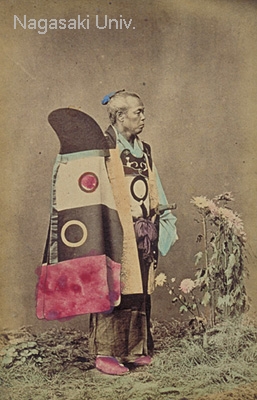
All, To return to a previous theme for a moment. The newly listed images of old Japan contains this image of a guy in fire-fighting outfit including the waist belt. Ian Bottomley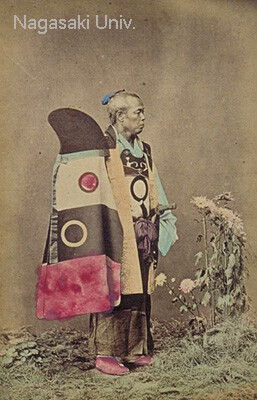
-
Malcolm, I couldn't find that kamon either but that is not uncommon. I keep seeing items with perfectly genuine kamon I have never seen before - some of exceptional quality that suggests the owner was important or wealthy yet seems to have escaped being recorded. I could understand it if it were associated with the lower classes but many of the items are of armours so they were of the military class. Ian
-
Jan, It is a kamon representing a growing fern shoot. I don't know the family sorry. Ian Bottomley
-
Piers, Kanamono like these are fastened in place by pushing the legs of the rivets through the same holes as the lacing. You should not drill any extra holes. I notice they do not seem to have much of a turned down flange at the lower edges which should give you a bit of leeway with positioning. My favourite tool for jobs like this is an arrow head. The long tapering tang is perfect for finding a hole and displacing the braid to one side so that I can get the legs of the rivet through. It is also perfect for straightening out the braid after threading it through a hole and similar applications. The head can be a bit tough on the hand when applying a bit of pressure, but we all have to suffer. :lol: :lol: Ian Bottomley
-
Piers, That is a very thorny question. Whilst I accept that menuki were made by repousse, a lot of pouch clasps seem to have been made in a die or mould. It sounds a lot of work but the silver trade in Sheffield made millions of such dies out of iron, brass or bronze by casting or carving, followed by a bit of tidying up and polishing. Using these they could turn out small decorative elements by the thousand faster than you would believe. In Sheffield they used a kind of drop hammer with the male half of the die on the bottom, pulled up by a rope and released. Crude but cheap and simple. Another way that only needs a female die is to use lead. The thin sheet of annealed copper or shakudo or whatever is placed over the die and covered with a piece of lead. A good bashing forces the lead and sheet into the die so that it takes up the design. After trimming the edges and maybe a bit of work on the outside with a graver or punches, and possibly mercury gilding odd areas, you could turn out very respectable pouch clasps by the hundreds. That this method was used is evident on those ghastly boxes covered in 'menuki' made in the Meiji period. In many cases they didn't even bother cleaning off the excess metal - just cutting roughly around the outline. Ian
-
Jag, Should you wish to join us you would be most welcome. Full details are on our web-site. Ian Bottomley - Member of the Northern ToKen Society of Great Britain.
-
Piers, One very obvious difference between these two similar objects is the thickness of the metal. Most pouch clasps seem to be formed out of relatively thin sheet whereas real menuki have thick walls. I assume the latter were made that way because they had to withstand the pressure on them from the tsuka ito. Ian Bottomley
-
John, Probably not for a woman but possibly from a boy's armour. I have however seen a few armours made for the wives of daimyo. I doubt they ever actually wore them and I suspect they were really symbolic. In Sendai Museum there are the armours of the various Date daimyo and the accompanying armours for their wives. As far as I could tell, there was nothing to really differentiate them from men's armours. One thing that stuck in my mind was that one armour had a curious feature where, by turning part of the tehen kanamono, a kind of iris diaphragm closed off the actual hole. What the heck that was all about I know not - it would hardly be needed to keep out rain. They also have the famous silver lacquered armour of Hideyoshi with the hair covered helmet and crests in the form of gunbai. Talk about small! That armour is tiny - he was a really diminutive guy. Ian