IanB
-
Posts
1,778 -
Joined
-
Last visited
-
Days Won
23
Content Type
Profiles
Forums
Events
Store
Downloads
Gallery
Everything posted by IanB
-
Eric, I know that armour well having sewn the haidate and kote onto new brocade. As you say, a very well made tatami gusoku for a samurai. I have always been unsure exactly why they were made. The usual story is that they were carried when travelling but I'm only half convinced. This one belonged to Dr. Galeno and he also had one made for the Ii family. Its box was about 3/4 the size of a normal gusoku bitsu so I suppose it would have been a bit easier to tote about, but these guys would have had plenty of staff to fetch and carry. Since they suffer from the same problem that mail does - they don't stop the force of a blow, only stopping a sword cutting, why people had them made is perplexing. The only thing that really comes to mind is that they were probably more comfortable to wear, which in a time when you were most unlikely to be attacked, may have been a deciding factor. Ian Bottomley
-
Eric, An interesting kusari armour. Did you notice the following? At the sides of the dou, where the waki ita would be on an normal armour, the fabric substrate is red cloth. This is echoed on the kote with shobu gawa over the tekko. I also like the way they have used heavier links in the mail to create 'shino' over the forearms not to mention the tate waku design over the inside of the arms. By the way, I bet it was a real bas***** to get the two sized links to mesh together so neatly. Now, the suneate are on yellow fabric, yet they have the same mail 'shino' and the same shobu gawa. A splendid example of the old premise that the customer gets what he wants and a complete matching armour does not need to conform to our Western idea of what matches. Ian Bottomley
-
Uwe, All I've done is re-lace the front of the ukebari since the original braid was falling apart. It was while doing that I first noticed the filled holes under the peak. I used purple braid because that was all I had that was narrow enough. Perhaps I should have used blue. Ian
-
John, I am so sorry - I was so carried away with my stream of invective I wasn't thinking straight. Actually there are some quite reasonable English close helmets, although nowhere near as good as German or Italian ones I concede. The problem is that they are never signed or marked and are generally labelled Flemish, despite the fact that most have been found in English churches. Ian
-
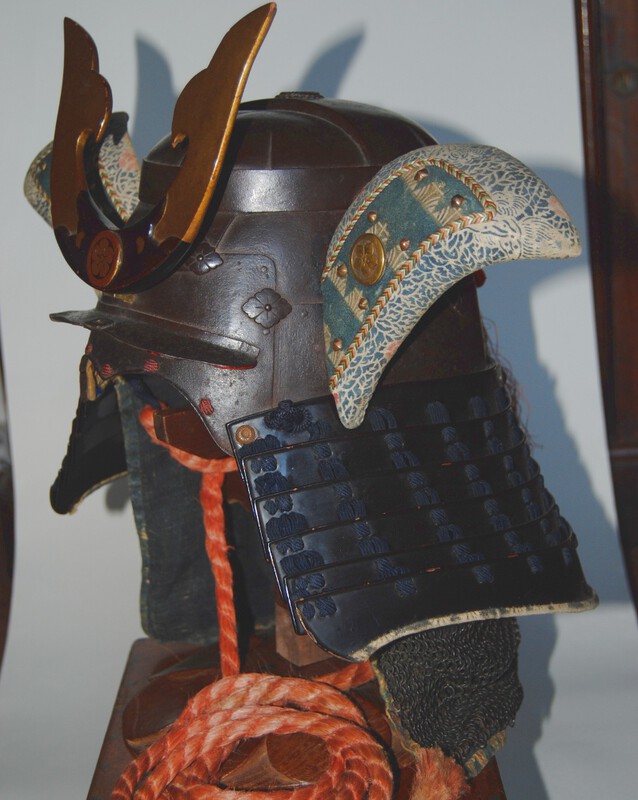
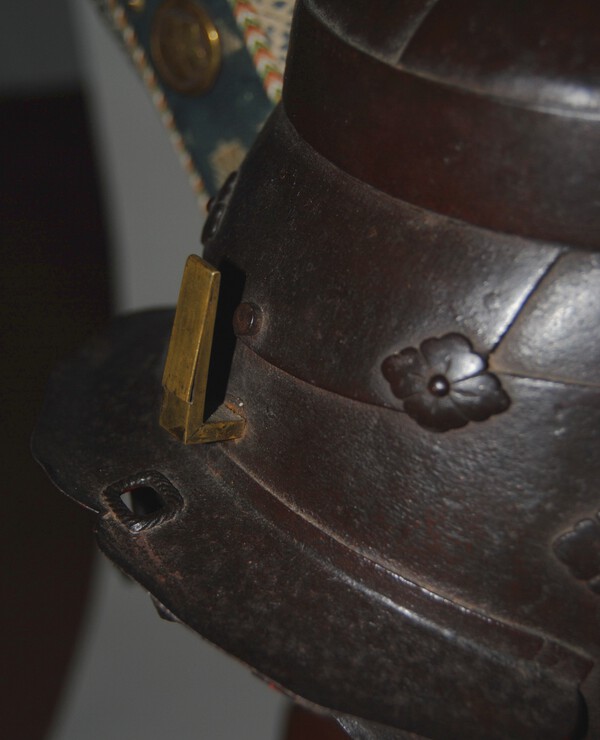
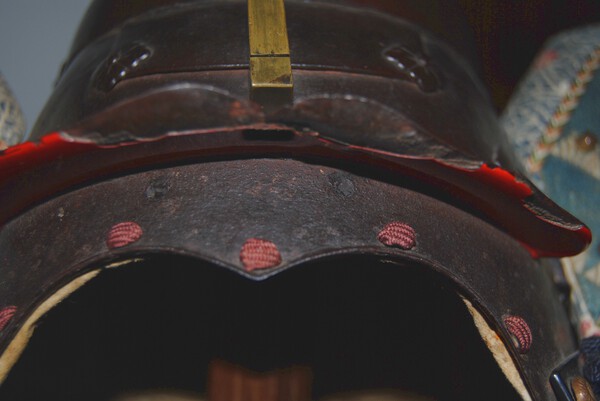
Eric, Your wish is my command. Here is the helmet that seems to have had the nasal bar. Essentially it is a form of Etchu zunari kabuto with a superstructure in the form of a court cap. The tehen kanamono is iron that internally is a thick iron tube that connects the 'court cap' to the medial plate of the zunari bachi - an incredibly strong construction. Originally it has had some form of kashiradate, the tehen kanamono having bayonet socket grooves cut inside. The various ornamental washers under the rivets suggests an Haruta origin with strong Saiga influences. My feeling is that the original bowl is late Momoyama although the present maedate and wakidate are later Edo period additions. Sitting behind the brass tsunomoto for the maedate is an iron stud positioned above the rectangular hole in the peak with its roped border. What function the stud had is open to speculation but it probably carried a socket and thumb screw to hold the bar up or down. The upper part of the tehen kanamono is roped in exactly the same way as the hole in the peak indicating both were conceived from the start. Under the peak are two holes spaced either side of the centre line that are now filled with lacquer. These I suggest held a bracket that acted as a guide to the nasal bar. Clearly it wasn't a success since it was removed. Brian, You like what!!! have you handled civil war helmets. A blind politician armed with a blunt horseshoe could turn out better armour than most of these wretched things display. Most were crude, brutish helmets, churned out in their thousands with little or no regard to either finish or aesthetics. If they could be jammed on somebody's head without causing cranial fractures they would do. Ian Bottomely
-
Eric, You do have a habit of picking up things! I bought that kazaghand for the Royal Armouries' collection about 8 years ago. It is in fact Turkish and is only the second known that has retained its original silk covering - the other being in the Topkapi museum. The Indians did make and wear similar garments and I bought another that was Mughal with a long long sleeves and a full pleated skirt, the mail being confined to the torso and sleeves only. At some point this had been stripped of its outer silk covering leaving only a coarse cotton under layer and wadding over the mail. Interestingly, I did some research on a load of Indian mail and plate coats that had been captured by Mughal forces in the Deccan during the 17th century and which were of some age then judging by the repairs some have. These were found to have been galvanised with zinc, presumably because they were originally textile covered. In fact, I have only managed to find one image of an uncovered mail and plate coat, in a manuscript in the Pierpoint Morgan library. As for the helmet, I will dig it out and take some pictures. My guess is that it was inspired by an Indian or Persian helmet rather than a European one - the Portuguese tending to use Italian armour. European helmets were made with nasal bars, especially during the mid 17th century during the English civil war, but rather too late to have influenced the Japanese. Ian Bottomley
-
Help with date and quality of this modern armour.Late EDO ??
IanB replied to Mark Andrews's topic in Katchu
Mark, As Dave has said, $25,000 will buy you a very good armour, or several of the quality of the one that you showed. Whether an armour is 'homogeneous' or not has always been a dilemma. I have two that definitely are and several that might be. Even those that definitely are could well contain re-used elements that the armourer has incorporated into his new creation. Quite a few daimyo had armours made that incorporated helmet bowls made by famous armourers of the past. Although we know little of the armour trade for the many, I have always been convinced that a middle-rank samurai would select ready-made pieces and have them lacquered and mounted into an armour. What few images we have of armourer's shops show the walls covered with pairs of sleeves, shoulder guards and the like for the customer to make his selection from. Those even lower down the scale probably bought second hand or ready-to-wear, assembled from a mixture of new and pre-used parts. Sakakibara Kozan hints at this. Even in Europe, great princes were sometimes painted wearing armours that were clearly 'a bag of bits'. In battle you wore what worked for you, not what some fashionista thought was stylish. Ian Bottomley -
Eric, Yup - I got a helmet that once had a nasal bar. It was taken off later, but the evidence of its existance is beyond dispute. Ian Bottomley
-
Matt, Why not come and meet the guys at the Birmingham Arms Fair on the 18th November. Ian B
-
Help with date and quality of this modern armour.Late EDO ??
IanB replied to Mark Andrews's topic in Katchu
Mark, The internal ties are what really hold the upper plates of the dou together, the silk lacing being largely decorative. These ties are leather thongs that pass under the silk lacing on the main plate of the dou and out through pairs of holes in the lower edge of the plate above where they are tied off. In effect they lock the upper plates to the body of the dou and to each other. Because they have broken, all the weight has been thrown onto the silk lacing which has stretched. When the ties are replaced, the silk will settle back and look OK. Justin, The fabric on all parts of the san gu is a blue damask with a design of flowers and leaves, and all are edged with ko sakura gawa. The only indication they may have been associated is that the edging of the kohire is a plain leather. However, the edging of the padded collar on the inside is a blue braid. I do find it odd that the suneate are lacquered the colour they are but I have seen armours with what look like non-matching suneate before - they were after all the part getting most 'hammer' when wading rivers or walking over muddy ground. Maybe they don't belong but they have been mounted on the same fabric as the rest. When that was done I cannot tell from photos and maybe even with them in hand. I don't like the fancy knotted green cord and kohaze on the sode, They should be plain loops of blue braid as elsewhere, but the general lacing of them looks perfectly compatible with the rest of the armour. Clearly the tsunamono that should hold the crest has broken off, but I have no problem with the three byo, they are just a bit of fancy and are repeated on the sode. Dave, I'm not sure the lacing isn't plugged - look at the 2nd and 3rd plate up from the bottom of the sode - its not prominent I admit but a couple of pale dots appear. I agree with you about the kamon on the front and on the fukigayeshi, they don't look too convincing hence my comment about seeing several recently. They do not however detract from the armour as a whole and may be easy to remove, provided the dou hasn't been drilled to fasten it on. I still think it is in general a very reasonable armour in good condition. Ian Bottomley -
Help with date and quality of this modern armour.Late EDO ??
IanB replied to Mark Andrews's topic in Katchu
Mark, A good straightforward armour in good condition. I would think late Edo period is exactly right. The only issue I can see is that the internal ties inside the dou are broken and need replacing - a very simple job. At first glance I had doubts about the suneate but despite the colour of the lacquer. the fabric and its edging do match. Interestingly, this is about the third armour I have seen for sale with the same kamon - I wonder if some family are selling their treasures. Ian Bottomley -
Matt, Where in the UK do you live? Ian Bottomley
-
Alex, If it is Muromachi as I suspect (accepting that working from photographs is always subject to caveats) it will not be signed. Signatures did npt really appear on armour until the mid 16th century. Ian
-
Alex, My suspicions are allayed - you have a very unusual and genuine helmet. As Eric said, leather laced shikoro with both the uname toji and hishinui in leather as well. The roped rims (nawa fukurin) to the upper edges of the plates had me scratching my head. They are not uncommon around plates covered with stencilled leather, but to see them on other plates is unusual. I had been struggling to grasp what I was looking at and then noticed on the upper edge of the hishinui no ita that the whole shikoro is leather covered! That explained the odd texture and colour. I note the armourer has also covered the upper edge of the koshimaki with a roped fukurin as well - a style copied from European armour. As for the shape of the bowl, it would appear to be a Muromachi period akoda nari. That would accord with the almost vertical peak. Normally these bowls were black lacquered and fitted with fukurin on the suji and igaki (or higaki) around the base. These may have been removed when the bowl was adapted into its present form. So, What I think you have is a Muromachi period bowl remounted later. The tehen kanamono looks later Edo period and so do the fukigayeshi. The kiku ornaments on the fukigayeshi may well have been added as replacements when the original owner sold the helmet and took off his kamon. Ian Bottomley
-
John, Alex, I agree it is a bit tall for a regular 62 plate bachi. There are a few details that worry me regarding the age of the present assembly. Firstly the kamon on the fukigayeshi. Anything that resembles kiku immediately puts me off. Next the yellow agemaki is a favourite with modern repro armour makers. Also, since there isn't a shot that shows it clearly I'm not sure I am seeing it correctly, but normally the uname toji and the hishinui should be staggered on the lower plate of the shikoro. These seem to line up one above the other - not unknown, but not common. On the plus side, the leathers on the peak seem to be separated by fusegumi rather than jabara - a very time consuming technique that you don't see on copies. Alex, could you take some really clear close-ups of the lower part of the peak and crest holder, a good side view of the helmet bowl itself and a close-up of the lacing on the lowest plate of the shikoro? There are so many good copies of old helmets - some as old as the Meiji period, never mind the thousands of modern ones, it is only when one can see the small details that a judgement can be made. Ian Bottomley
-
Dear Alex, The photographs you show appear to be of a 62 (?) plate helmet with some of the plates covered by gilt copper decorated with shinodare - the pendant, applied arrow-like strips. That, together with the crests and crest holder, the shape of the neck guard and the framing around the edge of the fukigayeshi (turn-backs of the neck guard) suggest the helmet was assembled during either the late 18th or 19th century. It is quite possible. and indeed likely, that the helmet bowl itself is older, but the quality of the photographs is insufficient to be more precise. Ian Bottomley
-
Piers, Matchlock pistols were also made in India and probably elsewhere. The Indians also made all manner of combination weapons incorporating matchlock guns with what amount to barrels. The Royal Armouries has at least two axes with matchlocks in the hafts, a sword with one in the grip and a mace with one in the haft that has blown apart in firing. One of the axes, and the mace have daggers screwed into the barrels. What our military would describe as a 'third strike capability' I suppose. Ian Bottomley
-
Dave, I would love to but it is a heck of trail for me. Travelling to Manchester every couple of months never mind Birmingham, Stockport and other places is enough. Ian Bottomley
-
Samurai-armor restorers Chizuru and Fumio Nishioka
IanB replied to Henry Wilson's topic in General Nihonto Related Discussion
Having known Nishioka San and his delightful wife for several years I can assure you they both live eat and sleep armour. He once made a copy of a miniature armour preserved in the Imperial Collection that was made during the Heian period as a present for his wife. It took him a month to cut the stencil for the tiny piece of leather covering its breast. It was with Nishioka San that Robert Soanes, who has recently appeared on this board, trained. Ian Bottomley -
Piers, A very sensible approach. We have to remember that all real armour is now at least 160 years old and in many cases much older than that. It is our responsibility to preserve what remains as best we can. Ian
-
Piers, Oh dear. As I suspected the shikoro is a modern fabrication. Where the fukigayeshi is riveted to the upper lame would, on an old shikoro, be levelled off with filler. Here the junction has been simply painted over. Again the bead around the plates of the shikoro are just too prominent and look wrong. I am also sorry to say I don't believe the shiten no byo. They would normally be iron not brass and would have a carefully rounded outer end, not the series of flats from either a file or the riveting. On a Muromachi helmet the fukurin covering the suji and the igaki (higaki?) at the base of each plate would be made as one unit. Here the igaki look separate from the fukurin. I'm sorry to have to say there has been considerable 'refurbishing' going on with this helmet. Ian Bottomley
-
Since the hibiki no ana and the shiten no byo are essentially decorative, they could have just as well have been left off rather than being positioned in odd positions. The only use I have heard claimed for them was for a kind of 'rain cover' tied over the tehen kanamono through the loops of braid that are fitted through the hibiki no ana - I even have grave doubts about that. In my view they are just anachronistic survivors that were added because 'we have always done things that way' - like the ring at the back of most helmets that were originally for a jirushi but ending up being something to hang a decorative agemaki bow from. Ian Bottomley
-
Whilst I think the hachi as such is fine (although it may have been lacquered originally) I do have a suspicion it has seen quite a few changes since its inception. To my eyes the peak and haraidate look as if they have been added. The haraidate in particular is too long to fit - positioning the large soft metal rivet being positioned up through the base of the helmet itself rather that through the koshimaki. Similarly the rivets on either side seem a little low unless the koshimaki is very deep over the brow. I also feel the raised edges to the shikoro plates and fukigayeshi are just a bit too prominent and the corners of the intermediate plates too rounded. Clearly the shikoro has been added - see the two soft-metal rivets behind the fukigayeshi instead of just one, the other two holes taking the loop for the helmet cord. Ian Bottomley
-
trouble buying a blade on ebay
IanB replied to zentsuji2's topic in Auctions and Online Sales or Sellers
Ian et al, The rules are that you can import any antique sword into the UK (up to 1947 to allow for gunto) as well as any made by a recognised Japanese swordsmith to the present day. The ban was originally to prevent the import of Chinese and Indian fakes which were being bought by the 'headbangers' for committing evil deeds. However, replica swords could be imported by re-enactors or those used for martial arts - although you would need to prove that was why you wanted one. However some politician who thought he knew better screwed the whole law by insisting that these exemptions should also include any sword that is 'traditionally made', whatever that means. All that is now required is to argue that a replica is traditionally made and HMRC would have to disprove that it isn't to prevent importation. Ian B (the other one) -
Dave, That is how I understand it. What is being described is the overall shape. Turning to my 'bible' on these matters (Nihon Katchu Bugu Jiten - Sasama, p314), those helmets which come to a point with a convex sides he lists as: Shii-nari- acorn shaped. One with straight sides he lists as Sui-nari - conical. Those with concave sides he describes as fude-nari - shaped like a writing brush. All of these shapes he lists as TOPPAI kabuto. Ian B