IanB
-
Posts
1,778 -
Joined
-
Last visited
-
Days Won
23
Content Type
Profiles
Forums
Events
Store
Downloads
Gallery
Everything posted by IanB
-
unique tanto with kogatana mei translation needed
IanB replied to mercierarmory's topic in Translation Assistance
All, There are points about this sword that deserve quite a lot of consideration. Starting with the saya, notice how wide the pocket for the kogatana is. Clearly it has been made to take a very wide kogatana, but I doubt it is the present one with its same covered kozuka and what looks like iron fuchi / gashira. I suspect the present kozuka is someone's latter attempt not knowing what the original was like. Since the kojiri is lacquered in situ, we can deduce that it, and the narrow silver bands were part of the original design concept. Notice also that the gap in the rim of the tsuba has been made to fit an extra wide kogatana, as has the angled cut-away of the fuchi. Again this suggests these elements were specifically made for the sword and whatever strange kogatana it originally had. The brass blade was probably made at the same time as the odd kozuka. The fuchi / gashira as has been noted are very namban and interesting but again not that unusual. However, look and again note that the novel way the kashira is pinned through the tsuka. Now we come to the menuki. They do look too large for the hilt and may well have been applied later. Firstly they look to be by the same hand and look to be of Japanese workmanship. The tachi on the ura side is not too strange but I cannot recall seeing one with a dragon kashira - ho-o birds yes. What interests me is the one on the omote side. Who has ever seen a Japanese armour mounted in this way in Japan? What seems to be depicted is an armour displayed on a European stand. In fact it looks almost exactly the same as the armours as they were displayed in the Real Armeria in Spain in the 19th century, photographs of which survive despite the fire which all but destroyed the armours in the 1840's. In other words it seems to be depicting an armour in a Western collection. Finally look at the tsuba, again fairly conventional except that it is covered in foil that looks to have been riveted in place through the seppa dai. Again rather odd. All in all a very unusual koshirae that raises interesting questions about the sources of its design. Ian Bottomley -
Kozuka found on ebay was told it was from edo period
IanB replied to Nihontocollector19's topic in Tosogu
I once owned a very fancy tanto, good horimono on both sides of an unsigned blade, solid silver mounts, an elaborately lacquered saya and with the tsuka maki of white deerskin over solid gold, signed menuki. Not in my opinion a hamanono piece, it was more restrained and tasteful than the description would lead you to believe. Getting to the point, the kozuka was fitted with a brass blade like this one. Ian Bottomley -
Brian and Eric, Although we have never met, I feel I know you both and count you amongst my friends. Now in my early 70's I still remember the day in my early teens when the world of Japanese arms and armour entered my conciousness. Living where I did and still do, in the north of England, there followed many years of isolation from anyone with a similar interest, relieved only when the local library obtained a copy of 'The Arts of the Japanese Sword' by Robinson. How different things would have been had the internet and discussion groups like this, and the armour forum, existed then. Because of your generosity and the time you two gentlemen put in, not to mention all the other knowledgeable contributors to these forums, the information I so desperately sought as a youngster is now available to anyone. I cannot begin to express how much I and so many others owe you both, but I think you know that. Ian Bottomley
-
Alex, You are asking the impossible. Such objects have no price - their value however is a different matter and depends upon such things as: Its quality - which is high. Its rarity - there are not many armours of this quality available to buy. Its condition - which looks good. The number of people who want to own the armour and what they are prepared to pay. We cannot say buy it or do not buy it - that is your decision. Ian Bottomley
-
Henk-Jan, I think we can rule out 'farmers' or other individuals by the simple fact they are all so similar in construction. These weapons, whatever they are, were made in considerable numbers as if they were ordered from a supplier. I also find it interesting that the vast majority are short - either using wakizashi blades or cut down katana blades. Ian Bottomley
-
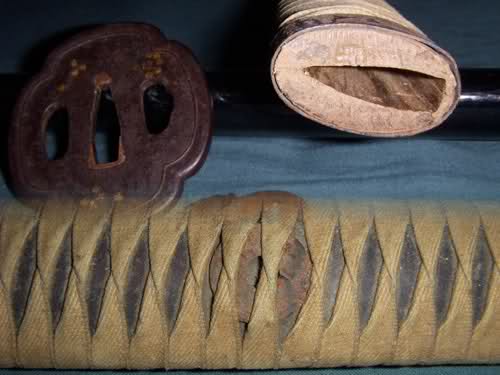
All, I think this image summarises the characteristics of these weapons (I hesitate to use the word sword). The tsuka made from a bit of old saya, mounts made up from sheet iron, the binding done with strips of coarse cloth folded to make a tape and any old bit of something, but usually washers, to act as menuki. Note how the 'fuchi' is just a strip of iron bent around and brazed shut. The one part that always seems to be a genuine sword fitting, as opposed to having been cheaply assembled from scrap, is the tsuba. Whilst typing this it occurred to me that the 'washers' might be old roves from dismantled boats - they generally have the area around the hole distorted as if they have been reclaimed from some other use. Were Japanese boats clinker built? Ian Bottomley

-
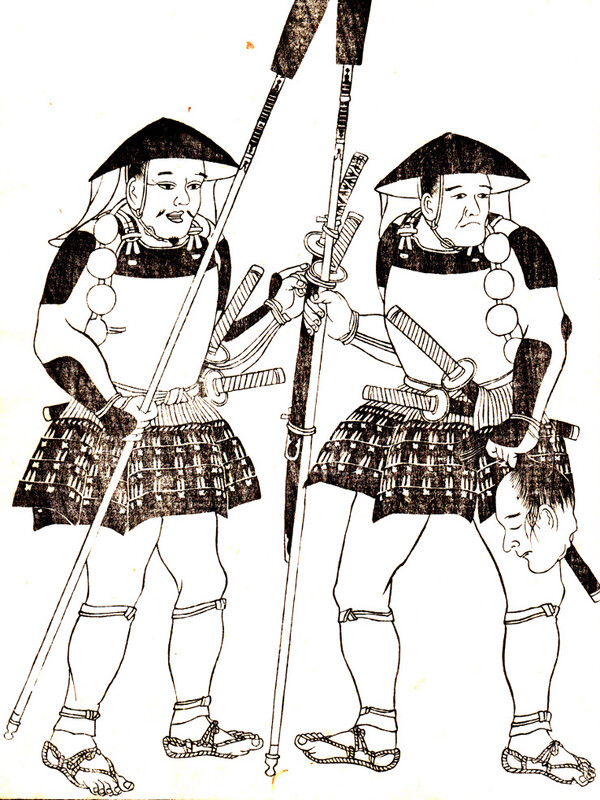
John, It could well be that, but look at the looted sword tied to the guy's spear that is clearly a conventional binding and all of the many illustrations in the books show the same spiral wrapping on the swords of the common soldiers. Has anyone ever seen a photo or drawing of such a koshirae being used in the Boshin war? I haven't. I have seen a similar wrapping described as Shonai Han, but they were for the samurai of the Han, not the common soldiers. As for age, why should they have survived from the Momoyama? If they were stored in castles for use in the event of trouble, they would have been refurbished from time to time. I know there are some koshirae from the Momoyama, but how many of those have been re-wrapped over the last 400 years? Ian Bottomley
-
This is why I maintain these are swords issued to ashigaru. Look carefully at the swords in the image. Ian Bottomey
-
Jeremy, The first of your armours has a dou made in Kaga, as shown by the shaped edges to the plates. Since it is notionally held together by cross-knots it would be called a hishinui dou. Production in Kaga started in the Edo period at first by the Haruta family who were joined in the early 1800's by the Myochin. It looks late Edo. I note it had an etchu zunari kabuto - so-called because it was a style advocated by Hosokawa Sansai who was Lord of Etchu, rather than being made in that province. I'm afraid I can only glimpse other parts. The second armour is a tatami dou with a chochin kabuto, both 'folding armour'. Again Edo period and probably again 18th or 19th century. Ian Bottomley
-
Collecting Japanese swords vs japanese sword collecting
IanB replied to Peter Bleed's topic in Nihonto
Paul, I absolutely agree with you that to understand the technology and identify the features of masterpiece swords demands that you should look at such blades and that such study will ultimately lead to an understanding of these blades. I am certain that nobody, myself included, would dispute that blades such as these are magnificent objects and eminently desirable, but that was not the point I was trying to make. The theme of this thread is about collecting Japanese swords, which I understand to mean far more than blades made by the great masters. I would also add that in my view the topic encompasses so much more than just blades. I have no problem whatsoever with someone who wishes to study blades made by the great and the good, nor indeed someone who studies only factory made blades of the Showa period. However, I still maintain the view that confining study to 'art swords' does little to advance our knowledge about the sword as a whole. Pick up almost any book on swords, other than the trivial, and it will describe in minute detail the features to be seen in a blade made by 'such and such' as well as giving details of his biography and his relationships if known. Studying these writings and identifying the features described will indeed aid in recognising such a blade. Having acquired that ability has certainly increased one's personal knowledge about the blade and its maker, but has it added anything to the knowledge about the Japanese sword? In my view the gaps in our knowledge, which are many and diverse, will not be filled by studying only a very small sub-set of the vast range of swords made and used in Japan, be they art swords or junk. There is a place for looking at everything. Ian Bottomley -
Collecting Japanese swords vs japanese sword collecting
IanB replied to Peter Bleed's topic in Nihonto
All, An interesting thread that raises a serious philosophical question. I have no experience of sword societies in Japan, other than meeting members as individuals, but I have of an armour society and the overall impression was one of stultification. What was evident is perfectly summed up by the old proverb 'The nail that sticks up gets hammered down'. Imagine a collection of some 480 or so armours (at the Watanabe Museum in Tottori). I asked a prominent member rather naively if he had been, only to be told 'No, there is only one good piece there'. The reason for his reply was that Dr. Sasama had been and only photographed one helmet. In reality the place is stuffed with the most interesting items you would be hard pressed to see anywhere else. At a meeting whose theme was nodowa, what to me was the most absorbing item was almost totally ignored because it was Edo period. Does this sort of attitude lead to a greater understanding of the subject? Not in my opinion. When it comes to swords, does gazing at a sword made by a famous smith, whose work has been written about by scholars since times immoral further our understanding of the Japanese sword? Again I would say no. Pick up almost any book on swords or armour and you see the same old items illustrated time and time again. You don't acquire knowledge of European painting by only looking at Rembrant's work, nor of Western literature by reading only Melville. Acquiring the humblest of swords can often lead to discoveries that do further our knowledge. I remember buying a junk hilt for the menuki only to find a lead weight in a cavity in the region of the kashira. Who knew that was done - very few I suspect. If your intent is in furthering knowledge of the Japanese sword or armour, the lacuna are lower in the quality chain. Ian Bottomley -
Giles, I'm afraid I cannot add anything much to what has been said except that the shikoro is a good fit and that the kuwagata dai looks to be very nice quality - shakudo mounts on armour are not that common. Ko-boshi bachi seem to have started in the 16th century, perhaps a bit later than the high sided suji bachi. My old friend Dr. Orikasa states that one was worn by Aoki Kazushige at the battle of Anegawa in 1570, and that one signed 'Joshu ju Yasushige' exists dated to 1572. These dates give us an idea of when they were introduced. Just why they were made and became fairly popular is a matter of contention. The mass of rivets added considerably to the weight, and this one has nothing like as many as some. Last weekend I handled a 62 plate helmet with 33 rivets per column and an extra row down the centre of the front plate. As has been said, yours has very exaggerated rivets and you wonder how they were supported to peen over the rivet inside. The smith must have had a number of rivet-sets to accommodate the different sizes of rivet. I like the fact they were called 'daikon oroshi' or radish graters by the vulgar. We know the Saotome, Haruta and Neo shools made them, as well as individuals such as Nagamichi. I don't think they made yours - it is a bit of an odd-ball. I know there is an image of a helmet somewhere with even longer rivets, but off-hand I cannot find it. Ian Bottomley
-
47 Ronin The Movie
IanB replied to Ichi's topic in Sword Shows, Events, Community News and Legislation Issues
Henk-Jan, Perhaps I should have said - apologise to the ronin on behalf of those who try as they did to do their duty. Ian -
47 Ronin The Movie
IanB replied to Ichi's topic in Sword Shows, Events, Community News and Legislation Issues
If I ever get to Japan again I will make a point of visiting their graves again, burn incense and apologise on behalf of those of us who inhabit a world that shows respect to those who did their duty. Ian Bottomley -
Clive, You have heard by presentation before, so you can sleep through that bit. I note that Karen Watts' talk has been edited out but the remainder should make it a very good day. Ian Bottomley
-
Japanese sword video on pawn star
IanB replied to daishobohi's topic in General Nihonto Related Discussion
We see some of these shows over here in the UK. Most are obviously set-ups where a guy or a small team 'discover' a treasure and make money selling it. Who they are supposed to entertain I know not. I can only think that it is to give the population some faint hope that they too can become rich rather than just function as a 'crop' to be harvested by the politicians and bankers. However if you think that is bad, our own BBC commissioned a whole historic series about the women who influenced events during the dynastic struggles of the Wars of the Roses (16th century). After a couple of episodes they then felt obliged to put out a programme pointing out all the historic inaccuracies in the series! You couldn't make it up. Ian Bottomley -
Howard, I think you have nailed it. Not however Mongolian and certainly not 13th century but Korean and probably 16th century. There must have been a fair number of these helmets brought back after the Korean campaign as war-trophies. The Royal Armouries has one mounted with a Japanese shikoro that is much more Chinese in style, with a concave sided superstructure on top rather than the conical shape of the one you show. There is also a real Korean helmet consisting of an iron frame filled with black lacquered rawhide plates and fitted with fabric covered ear flaps and a neck guard. That winging its way to you has the conical structure in copper and has obviously lost its plume-tube. Not exactly items of great quality, but of great interest and rarity. Ian Bottomley
-
Howard, The helmet with the shikoro is not a momonari kabuto - they have a medial flange that is stepped at the apex, the front part being sometimes concave in profile. The helmet you show is a variant of a toppai kabuto ('pointed'), more properly a shiinari kabuto likened to an acorn. The other, with its flat peak is strange and not any of the classic form that I know of. Ian Bottomley
-
Howard, I don't want to be a party pooper but I'm afraid the signature had been done with a dremel tool fitted with a rotary cutter. It should be done by a chasing tool having a V sectioned head. Struck square this gives a V shaped groove, but struck with one end lifted slightly it produces a V shaped stroke that tapers to a hair-line. If you look at the signature in your helmet you will see that each stroke is U shaped with rounded ends. Sorry. Ian Bottomley
-
Where did you start?
IanB replied to Herman the German's topic in General Nihonto Related Discussion
Herman, The world of Japanese swords, tsuba and armour never really gets that much easier. The more you think you know, the more you find you don't. I started in the days when there was an abundance of swords in the UK, still relatively expensive when I think of the money I earned, but cheap by today's prices. I bought what I liked and what I could afford to buy - some good, many bad. For several years I could find nothing much written in English about my treasures but it didn't bother me too much because I had the swords themselves. When Basil Robinson published his book 'The Arts of the Japanese Sword' I began to study what he had written and gained a little knowledge that I have tried to add to as more and more information becomes available. I now only own about a dozen swords, (because I really collect armour) and almost all have unsigned blades. There is an opinion that they are bad swords because they are unsigned - that may be true but I would beg to differ. I don't know who made my favourites and although I have a good idea about some, it doesn't matter because it is the swords themselves I am in love with. Putting a sword in for shinsa will give me a name but that will only be an opinion expressed by people who know a lot more than me and won't make any difference to the sword itself. Many here always recommend a beginner buy books and study before buying a sword. In my opinion you will never learn anything about swords from books - you need to hold them, look at them in different lights and feel how they handle to learn. I would say buy a sword you know is real, and is one you like, then start studying it. It might not be the best sword in the world but you will learn far more with a sword in your hand than any amount of looking at pictures and reading descriptions in books. Ian Bottomley -
Nick, That brings back memories. When I saw the first image you had posted I thought I was looking at a sword I owned way back in the 1960's. It isn't, but the technique is exactly the same. Mine was mounted as a tachi with pain brass bounts that I suspect had been knocked up from a katana saya for the tourist trade. Like yours it had mainly pieces of mussel shell, showing MOP with a purple colour and a few cone-shaped shells that must have been cut into thin slices before fastening onto the saya and embedded in lacquer. Colourful to say the least. Ian Bottomley
-
Grev, As John will happily confirm I wouldn't know a tsuba from a dustbin lid, but the first tsuba looks to be signed Masatsugu 正次 to me. The second one is industrial strength sosho, but at least I know the kamon is Inaba family. Ian Bottomley
-
I would hazard a guess at the date being Genroku ? Ian Bottomley
-
All, I agree with all the previous commentators that this is an exceptionally fine helmet and like others I would have loved to have seen the complete armour. I'm afraid I disagree with the date however. I read the date as Genroku 16 or 1703, he second kanji of the nengo can only be 禄. There is no other nengo with that second character around that era except Bunroku, which is too early for the Saotome. The shape of the tehen kanamono is surely modelled on the turned-over apex of a European Spanish morion or a cabaset, despite the fact that the front and back plates lack a medial ridge. I suppose by the time the helmet was made, the originals had become something of a folk memory. Ian Bottomley
-
All, There is a 'daisho' in Keighley museum (Cliffe Castle) in the UK that also has what would normally be regarded as two wakizashi blades. Whether it is a coincidence or not I do not know, but the larger blade is signed Tadayoshi (which generation I am now no longer sure about). I remember when I first looked at these swords it occurred to me they may have been chosen by an owner who fought with both swords. Ian Bottomley