Bruce Pennington
-
Posts
14,289 -
Joined
-
Last visited
-
Days Won
170
Content Type
Profiles
Forums
Events
Store
Downloads
Gallery
Everything posted by Bruce Pennington
-

Type 98 Translation/ID (Seki Toku?)
Bruce Pennington replied to CowboyVittles's topic in Military Swords of Japan
@mecox We now have 2 blades with this exact 3-stamp combo Sadatsugu, July 1943 1944 Kanetoshi, July 1944 Both from Gifu, both RJT qual. Like always, I'm looking for a connection between the 2. Do you know of any? According to Thomas, @Kiipu, though, the stamp meant "special approval" (HERE} and could have been used by any factory. So, there might not be a link between the 2. -
Type 98 Translation/ID (Seki Toku?)
Bruce Pennington replied to CowboyVittles's topic in Military Swords of Japan
Yes, 貞継 Takai Sadatsugu 高井 貞次郎 "SADATSUGU (貞次), Shōwa (昭和, 1926-1989), Gifu – “Sadatsugu” (貞次), family name Takai (高井), rikugun-jumei-tōshō, ryōkō no jōi (Akihide), Fifth Seat at the 6th Shinsaku Nihontō Denrankai (新作日本刀展覧会, 1941)" An RJT qualified smith. No chance there's a faint star near the top of the mei side? The only other blade I have of his is a Tan stamped blade from 1942. Also, can you tell if the blade is gendaito or oil tempered? Close-ups of the hamon would be nice. -
On a scale of 0-10, how fake is this sword?
Bruce Pennington replied to George KN's topic in Military Swords of Japan
I was going to say the marks on the liner were random, too, but they do fit the marks on the tsuba. Can't comment on the seppa kanji. And the mark on the nakago looks to be pitting. I know - never say never with gunto - but I've never seen a stamp of any kind on an Emura blade. -
That is not a World War II kabutogane.
-
Cursive kanji Polishers signature?
Bruce Pennington replied to Mike0820's topic in Translation Assistance
@Mike0820 is that tassel all brown? -
nihontoclub.com not reachable any more
Bruce Pennington replied to cisco-san's topic in General Nihonto Related Discussion
Maybe they are getting attacked, what do you call it when they flood with thousands and thousands of hits on a website? -
Beginner here!
Bruce Pennington replied to Crusader7781's topic in General Nihonto Related Discussion
You realize you could just post any first name, doesn’t really have to be yours. No one would know the difference. -
Beginner here!
Bruce Pennington replied to Crusader7781's topic in General Nihonto Related Discussion
Welcome Preferably! You just missed the Introductions forum, found here: Here at NMB, we differ from most online forums and require a minimum of a real first name. We like talking to real people! -
I'm curious about the black marking on the jiri of both sides. My first impression was that it's an anchor, but I don't think so. Anyone recognize them as kanji or kana?


-
Thanks John! Hi Mike! I have 6 other Masatsune blades on file with the Showa stamp and NONE of them show the full nakago, so I don't know if those blades bore the dots or not. Very frustrating! We haven't got a clue as to their use or meaning. They are predominantly on WWII blades, but I have seen a rare few on much older blades. You have the honor of having the first I've seen with such small dots in a diagonal!
-
Been seeing a lot of this style lately. You've got a 50/50 shot at either island sword or fake. The quality of both are pretty much the same. They do tend to have stamps, but no one knows what they are, or if they point us toward one side or the other of the issue. The late Nick Komiya swore he knew a guy on one of the Japanese islands that was making these fakes. It's certainly possible. Best person to say is you, as you have it in hand. Look it over for real signs of wear & tear, or age. Fakers can artificially 'age' a sword, but there are often telltale signs of that. For what it's worth, from the photos, the ito on yours looks pretty new. If so, it could support the "fake" side of the issue.
-
please help with translation on tang and opinion/s
Bruce Pennington replied to Andygw's topic in Translation Assistance
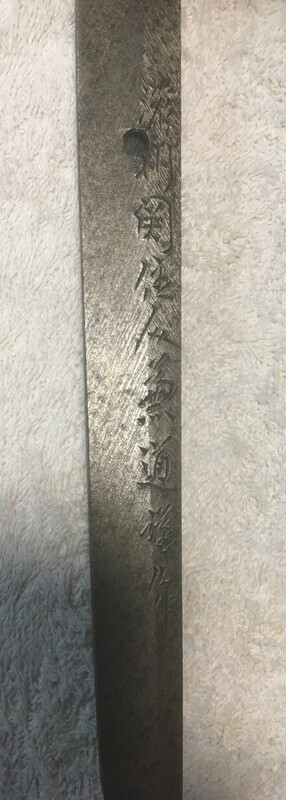
Tropical corrosion and ill treatment can make a blade look quite old. The mei matches the Kanemichi I have on file. For example:
-
Is there a Kaigun Jumei Tosho mark?
Bruce Pennington replied to george trotter's topic in Military Swords of Japan
Again, my apologies George for running off track, but this discussion reminded me of your translation of an Ohmura page: "HONTANRENTO (True forged swords) 1. Swordsmiths were commissioned to forge swords at the named workshop's forge (the nakago was marked with the swordsmith's mei and the workshop's logo/mark). Tokyo Hohei Kosho: Yokoyama Sukekane, Morioka Masayoshi; Tokyo No 1 Army Workshop: Yoshihara Nobushiro, (Akihiro, Kuniiye same man); Osaka Kosho: Gassan Sadakatsu, Sadakazu (nidai), Sadashige, Masakiyo; Kokura Kosho: Hakuryushi Tadataka, Taira Sadashige, Kanenobu; Kyuheikisho (refurbishment workshop): Yoshihara, others. [NO STAR, MEI, SHOP LOGO, BUT GENDAITO] 2. Private swordsmiths, and also Sword companies were commissioned to forge swords (nakago marked with mei and simple Army Star inspection mark). [MEI, STAR, BUT NO DATE] 3. Army specification Gendai forged swords (nakago marked with mei, date and star). Rikugun Jumei Tosho made swords of the style. They were trialled from Sho 15 [1940]. From Sho 17 [1942] it was implemented nationally. For efficiency, a big break was made with the tradition of individualistic handwork and non-uniformity of Nihonto "True Standardisation" was tried for the first time. Every sword was subjected to severe inspection to maintain quality/performance. (I am not sure if I have translated the following correctly) The former drawback of testing each sword (as in old sword making in meito times) by tameshigiri was not used. This was the first time such a situation occurred." [MEI, DATE, STAR] So, these Noriaki blades, along with several others on file without dates, are examples of Item 2 - blades made with Army tamahagne, in a private forge, or sword company workshop. I also am still puzzled by Item 1 saying swords would be "marked with the swordsmith's mei and the workshop's logo/mark". I don't know about "Tokyo Hohei Kosho", but the "Osaka Kosho" is probably the Saka stamp, right? Also, I just noticed the mention of "Tokyo No 1 Army Workshop" and see that we don't have a stamp for that factory. We have the "TO" for Tokyo 1st Army Arsenal Inspector and the "KI" for the 2nd Factory of Tokyo 1st Army Arsenal, but no 1st Factory. There are a few seemingly random blades with unknown marks we have been speculating as "workshop logo/mark", could these be fitting this Item 1 category? It would take extensive time and research to find those blades and try to guess if they blades were gendaito. Hm, sorry for the complicated post, but this all has opened up questions. -
Thoughts on my bargin bin Type 98
Bruce Pennington replied to sleepy_hue's topic in Military Swords of Japan
You still have 2 choices - keep as is, with TLC; or pay $2,000+ for a professional polish. They can bring it back to life if you are willing to pay that price. Except for my Dad's Mantetsu, I've kept mine in their current condition, blades that is. The fittings I find the missing parts to bring it back to proper operational condition where possible. As long as you are using WWII parts, you are not doing anything the original owner wouldn't have done for missing or damaged parts. -
Agreed
-
Thoughts on my bargin bin Type 98
Bruce Pennington replied to sleepy_hue's topic in Military Swords of Japan
Straight, or suguha, hamon. You can clearly see it in the third photograph. -
Thoughts on my bargin bin Type 98
Bruce Pennington replied to sleepy_hue's topic in Military Swords of Japan
October 1944 to be exact. You would have to show some clear close-up shots of the blade and temper line so guys can give you a better idea how the blade was made. There are plenty of traditionally made blades in the “Type 3” fittings, but they are usually higher quality than this. I have one of a rare star stamped blade, in other words traditionally made, in this exact style fitting, but it is unusual to find them that way. -
Type 98 no hamon or stamps?
Bruce Pennington replied to ribendao's topic in Military Swords of Japan
The dark ray skin and no visible temper line is usually an indicator of an island made sword or a fake. But it is impossible to say without more photos. -
Thoughts on my bargin bin Type 98
Bruce Pennington replied to sleepy_hue's topic in Military Swords of Japan
If you want to tighten the fit of the tsuba/seppa set, you can usually find seppa for sale online. I once bought a set of 8 or 9 random ones to tighten the fit on a couple of my swords. They don't cost that much. -
Thoughts on my bargin bin Type 98
Bruce Pennington replied to sleepy_hue's topic in Military Swords of Japan
Logan, You did well at that price. George's link is informative. The full history of this style can be found here: History of the mislabeled Type 3 Sword - by Nick Komiya; and Unveiling the Rinjisieshiki Sword in 1940 - Nick Komiya Kudos for lining your saya. Rust can really scratch up a blade. A couple of guys have ventured into making their own wooden liners. Not technically hard to do, but definitely takes time and effort. @robinalexander has experience at it, if you want to get his lessons learned. I like the tsuka (handle) wrap on yours. Nice workmanship. The skin underneath - same' - is ray skin. They can crack with age, but you needn't worry about harming it in removing the tsuka. Tsuka were made for easy removal since ancient times. Your model, like George said, has two menugi (pins), the screw and a bamboo peg. Tap the peg out with a punch and simply unscrew the screw. The tsuka and handguard (tsuba) with spacers (seppa) will slide right off. The nakago (tang) is likely signed and dated, and will probably have some small stamps I'd like to see for my charts. -
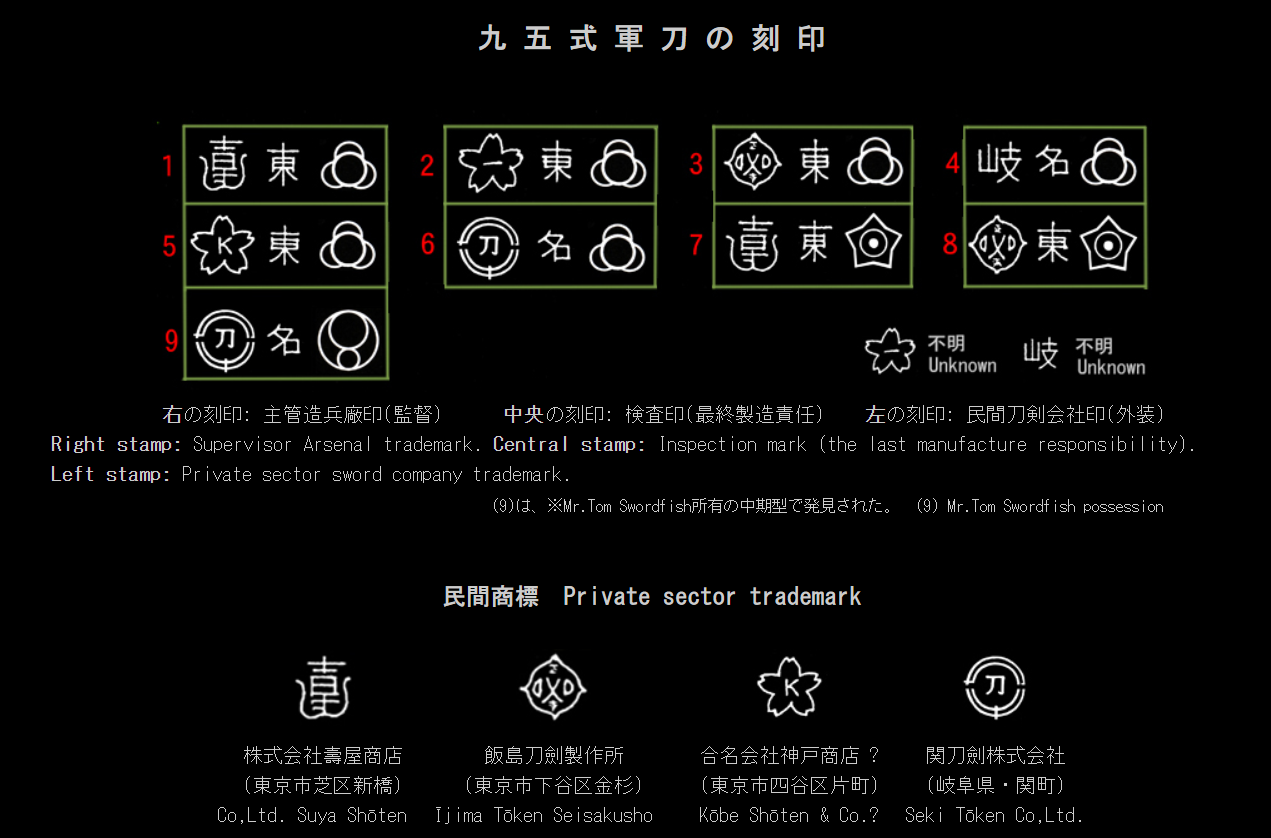
Thanks Justin. My copper gunto has no number on the saya throat either. It's likely they were factory replacements after the original got damaged in one way or another. These Nagoya 95s with steel fittings will sometimes have stamps on the fuchi, but not always. When you see them, they are usually very faint. The stamps would be number 9 on this chart:

-
Trying to get info on an estate sale find (gunto?)
Bruce Pennington replied to mackiejamie's topic in Fake Japanese Swords
I still have the fake I bought early on. Didn't want to sell it and see it get back on the market deceiving another new guy like myself at the time. -
Sam has it. A partially struck stamp can often have me stymied. The large Seki stamp was used by the Seki Cutlery Manufacturers Association from 1940-1944, with the majority of dated blades made in 1942. So, you have an idea of approximately when your blade was made. The association was a civil group asked by the sword industry to inspect showato for quality. In the rush to meet the need of the Army when they switched from Western styles sabers to samurai style swords, there were shops putting out some poor quality blades. Sword makers were alarmed and asked the association to inspect blades to weed out the bad ones.
-
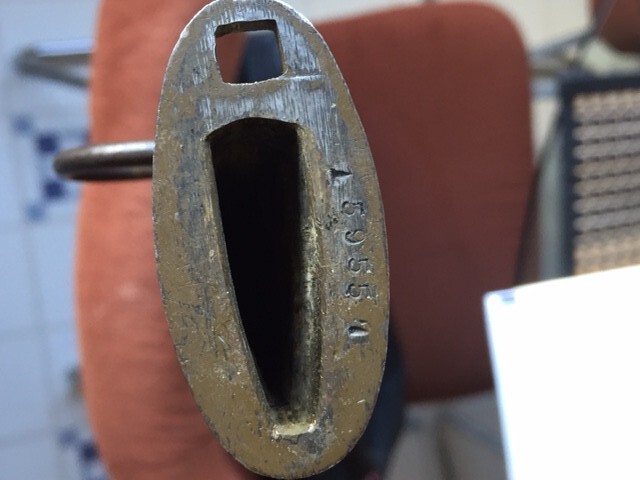
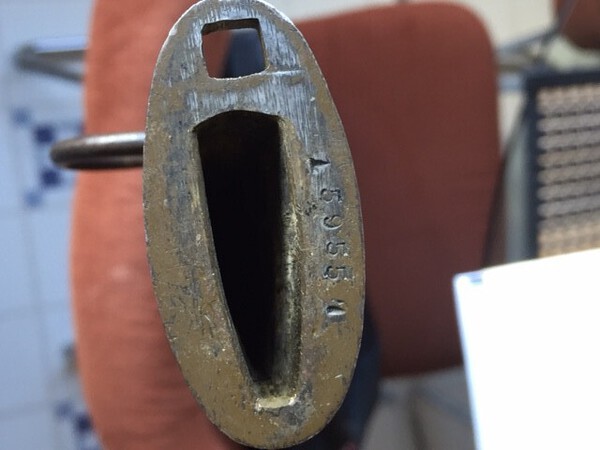
Justin, The serial number of the saya (scabbard) is on the face of the throat, like this:
-
Is there a Kaigun Jumei Tosho mark?
Bruce Pennington replied to george trotter's topic in Military Swords of Japan
Sorry, no. It's from Slough, pg 135. Don't have an actual of his on file. The May '45 Fumitada and Yoshinori are the same ones I have.