Bruce Pennington
-
Posts
14,499 -
Joined
-
Last visited
-
Days Won
175
Content Type
Profiles
Forums
Events
Store
Downloads
Gallery
Everything posted by Bruce Pennington
-
 It seems so random.
 -
I'm guessing the stamp was of a forge, in a similar fashion to Amahide's Tan Rej Jo. He had a hotstamp that has been seen on 4 other smiths' blades that worked at his forge. Maybe @mecox can confirm that Yoshisuke and Yoshichika worked together at a single forge/shop?
-
Really cool to see the matching number painted on the saya liner! Great sword, Adam!
-
Ww2 Japanese sword for sale.
Bruce Pennington replied to Mick taylor's topic in Swords and Edged Weapons
Nice looking gunto, Mick. For guys that love the leather covers, this is a plus, as it's pretty rare to see one that still has the leather retention tab on the tsuka. Good luck with the sale. -
Ok, I only have blades of 3 of the others. Two look to be suguha hamon, but the third is almost identical to yours Suguha Didn't record source, but I think this was from AOI Art This was posted by Mathias_AC at Wehrmacht-awards Here's the one with similar hamon, found on a Komonjo sale:


-
Coming up, but first, that small stamp on your seppa is the Nakano Shoten logo. "Located in Tokyo, this comany was owned by Mr. Nakano. In additon to Tokyo, the company had shops in China. The company provided a full range of koshirae."
-
I've seen a few photos over the years that seem to show a kaigunto with white same'. This photo, posted on this Gunboards Thread, is the most clear one I've seen. What do you guys think? Bright light glaring off shiny black lacquered rayskin? Family blade with navy saya (cannot see the kabutogane); I have seen one like that before.
-
I have 4 other Yoshisuke blades with the stamp and 1 Yoshichika, noted by Thomas above. None are dated. 3 are in kaigunto fittings, the other 2 in Type 98.
-
Seki Inspection Tag On Combat Saya.
Bruce Pennington replied to mauser99's topic in Military Swords of Japan
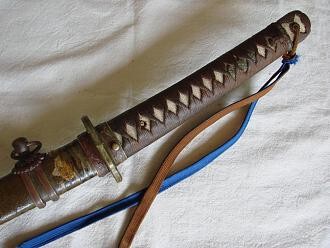
Another 3-pointed label found on a 1941 Kanenori blade, posted by Blue Orchid on this Wehrmacht-awards thread.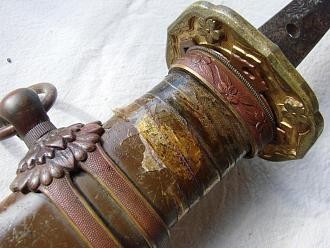
-
Pinned Kabutogane on Type 94
Bruce Pennington replied to PNSSHOGUN's topic in Military Swords of Japan
Here's a sad one for you, John! Mumei blade, sale by Centurion Auctions HERE. -
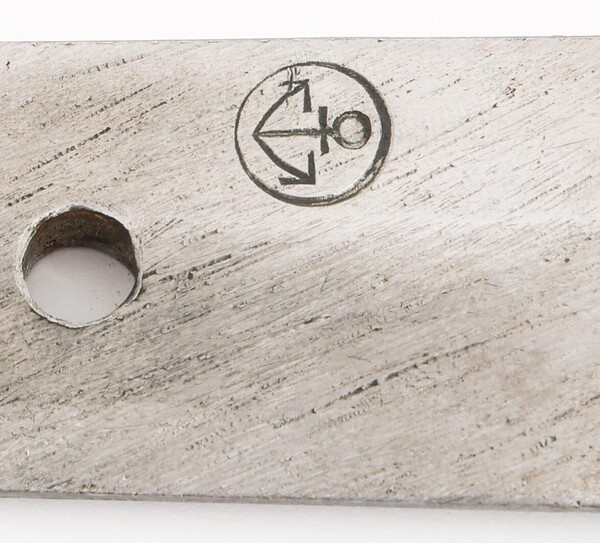
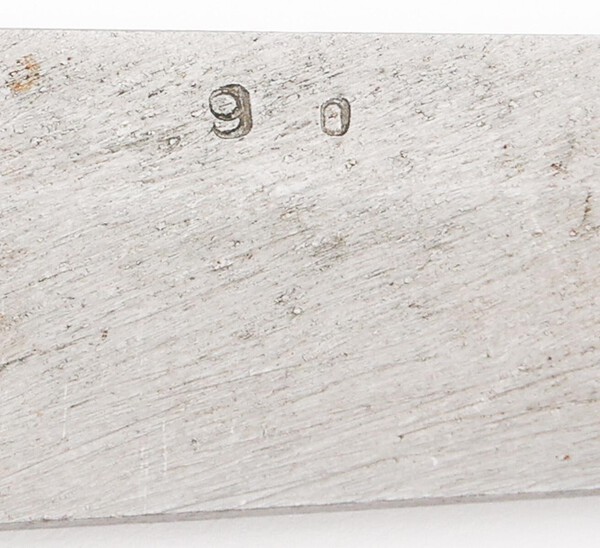
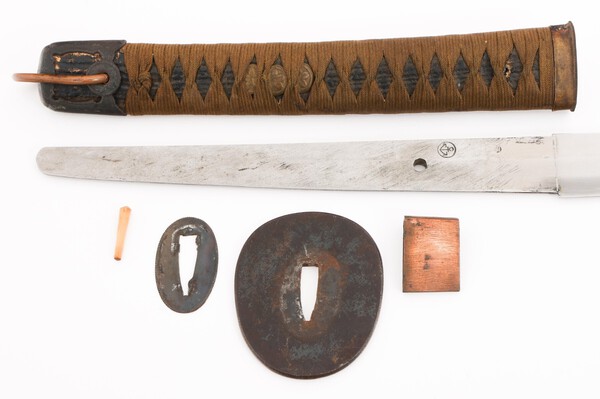
Standard late war kaigunto for sale by Centurion Auction HERE. Stamped with a small "90" and Toyokawa anchor. Note the one-piece fuchi/seppa

-
FYI: Site is very slow this morning - 5:30am to present 6:15am Mountain Time USA
-
Torio Hiromasa with removed stamp
Bruce Pennington replied to RobCarter3's topic in Military Swords of Japan
That's a really nice looking gunto! Assuming the seller has the date correctly, that's the latest date I have for the Yama stamp, and the latest date I have of a Hiromasa blade. I can clearly see the star. And I see no reason to doubt the originality of the habaki. Springs of '45 is quite late in the war. Many parts were being made with lower quality standards by that time. @mecox -
That is a considerable amount of play in the fuchi! Before seeing it, I was going to point out that wood can dry and create some looseness in parts, like the haikan (hanger ring), but that fuchi is way too loose, IMHO, to be original.
-
The seller replied with a "Thanks" and has either removed the sale or changed the name of the sale, as I no longer can find the item under that title.
-
I sent a message to the seller. Hopefully he'll fix his title and description.
-
Received a kyu-gunto; knowledge appreciated!
Bruce Pennington replied to Alighierie's topic in Military Swords of Japan
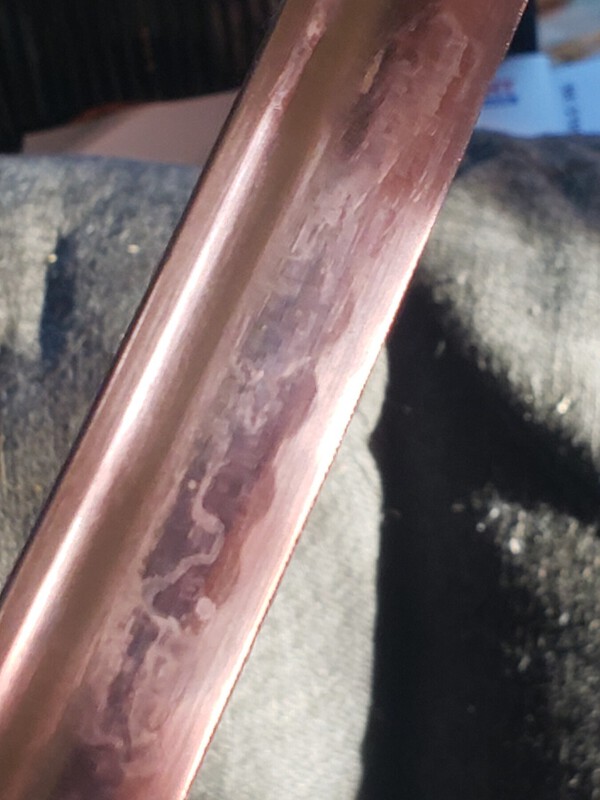
Posting photos The guys have already said it all. The finish on the handle, guard, and blade are all artificially applied during production and cannot be restored if you accidentally remove them by trying to buff, sand, or "clean". All you can do with these dress swords is rub them down with a soft cloth and oil, then wipe clean. The nakago on these come out the pommel end and are hammered round, like a rivet. Don't try to remove.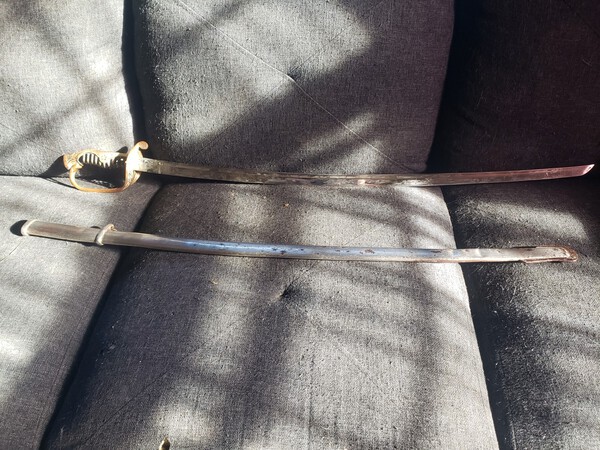

-
I inherited a sword and need help
Bruce Pennington replied to ddily's topic in Military Swords of Japan
Years of steady, my friend! And specializing in that kind of thing. The fittings are a quality upgrade. The pierced tsuba and 8 seppa are always on quality swords. -
I inherited a sword and need help
Bruce Pennington replied to ddily's topic in Military Swords of Japan
The older blade has been fitted for the war in Type 98 Japanese officer fittings. You can read about them here: http://ohmura-study.net/934.html Like John said, a close-up of the nakago (tang) will help the guys with date estimates, and if there is a smith name. The nagasa measurement HB is asking for is here:
-
Unknown Japanese Sword
Bruce Pennington replied to Byrddawg's topic in General Nihonto Related Discussion
Well, you got me there! I assume you're talking about the blade mune, not the nakago, right? It's not something I've ever paid attention to. I checked my files on my own gunto, but none of them show a good view of the blade mune. I'm away from home, or I'd just go look. Maybe someone else can chime in on that. The nakago looks to have been reshaped, maybe to fit a specific tsuka? You can see there are 2 older ana, and then the one closest to the machi has a new hole in the edge of it, likely for the latest tsuka. Just speculating, but there were many farmers in S.E. Asia that used WWII blades and refitted them with home-made handles for their farm work. This could be something like that. Another option is the old - Island-made sword. I've tried to see a hamon, but it's either obscured by decades of environmental effects, or there isn't one. Lack of a hamon would point to island-made (or fakery). -
El, Here are the Gunzoku tsuba we have thus far. As noted in the display, #6 is possibly Gunzoku but we have no documentation to back that up. I'm not a civil tsuba guy, but I believe the shape was used over the years in the civil sword world. So, like #6, it could go either way.

-
WW2 Sword translation confirmation
Bruce Pennington replied to spellsword's topic in Translation Assistance
Are there numbers on the other fittings, when you take them apart? They may match. -
Unknown Japanese Sword
Bruce Pennington replied to Byrddawg's topic in General Nihonto Related Discussion
Jason, Did it come with any fittings? Handle? Scabbard? -
Unknown Japanese Sword
Bruce Pennington replied to Byrddawg's topic in General Nihonto Related Discussion
Adding a couple photos for ease of discussion -
Help with identification of my grandfather's sword
Bruce Pennington replied to hopeforthebest's topic in Nihonto
Well, this is an interesting one! Above the mei and ana, you can see where someone filed off a Showa stamp. It was an inspection/approval stamp of the Seki Cutlery Manufacturers Association, used between 1935 and 1942. Most dated blades with the stamp are from 1940-1941. Sesko lists a Kuniyuki: "KUNIYUKI (国行), Shōwa (昭和, 1926-1989), Ōita – “Kuniyuki” (国行), real name Honjō Tetsuo (本荘鉄男), rikugun-jumei-tōshō" "Ōita" is the city or prefecture he was from: "rikugun-jumei-tōshō" or RJT was an Army program that had tight production specifications, and their blades come with a star stamp, but the program didn't start until 1942. Kuniyuki obviously applied for the program when it was instituted, and passed the test for entry. The showa stamp most likely means the blade was not made in the traditional manner, but in my experience, the blades bearing this stamp are well made, and nice quality.