Bruce Pennington
-
Posts
14,337 -
Joined
-
Last visited
-
Days Won
171
Content Type
Profiles
Forums
Events
Store
Downloads
Gallery
Everything posted by Bruce Pennington
-
If it's a kao, I've never seen one like it. Agree with Barry that it looks more like kanji. @uwe @Nobody
-
 @Kiipu - a head-scratcher!!! {I've edited my original post, as it was way wrong} Katsumasa is one of the few smiths with stamped numbers on the blade, that was not RJT. I have 5 of his blades with stamped numbers and they are all at the top of the nakago, with a NA stamp and number. They flow in sequential order by date, so I don't believe this was done by fittings shops, but rather by an Army system of tracking (reasons unknown). Jan '43 "143 Na" Jan '43 "168 Na" Mar '43 "1025 Na" May '43 "1550 Na" Dec '44 "245 Na" (started over in '44?) Good eye on the "Na" stamp @mecox mal. @kealpe - Keith, are you anywhere near Colorado Springs?
 -
I own mostly WWI showato, and out of curiosity would love to slice something, even a watermelon, with them, but knowing that cutting edges loose steel every time they are used ..... I just can't do it. So, with a nihonto, I'd doubly be reticent.
-
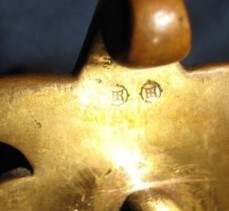
Trystan, These 1886 pattern Cavalry, or Type 8?, swords are a mystery. I have one other with a double stamp, different logo, on file. I suspect they were shops making these swords, but have no data on them. Here's the other one I have:
-
Please help me to identify this sword
Bruce Pennington replied to tawatchai_s's topic in Military Swords of Japan
I have a couple of Yoshiharu on file with stamped numbers at the end of the tang. You didn't show the full tang on the side of the smith's name. Anything down there? -
Please help me to identify this sword
Bruce Pennington replied to tawatchai_s's topic in Military Swords of Japan
Made in "Spring 1944" Can we see the latch release button on the other side? Type 94 or 98 Japanese Officer gunto. Unusual pattern on the fuchi (copper collar on the handle). These run in the range of $900-1,400 USD. Varies with the buyer's market, with the condition of the fittings and blade, and whether the blade, itself, is traditionally made or not. Yours has a nice looking blade with a very straight saguha hamon (straight temper line), but I don't see the smith listed in either Slough or Sesko, so it's probably not traditionally made. Are there any small stamps higher on the tang, might have to remove the tsuba/seppa set (handguard and spacers) to see one. They can be on the back edge of the tang, too. -
Rust Resistant Steel blade stamps Kai Gunto
Bruce Pennington replied to robinalexander's topic in Military Swords of Japan
Ok Trystan. So the logo on the tsuba must be from another shop that made the fittings. I'll file it in "Unknown". -
Help with translation of symbols on WWII Sword tang
Bruce Pennington replied to Eds's topic in Translation Assistance
Ed, no date on the other side? -
Sounds like what happened to Ken's club is exactly what Kirill is looking for!
-
Rust Resistant Steel blade stamps Kai Gunto
Bruce Pennington replied to robinalexander's topic in Military Swords of Japan
Thanks Rob! Records annotated now. -
Late War NCO Type 95 Gunto
Bruce Pennington replied to Misconstrued's topic in Military Swords of Japan
Yes. The Army reg called them "Hiejo Factory of Jinsen Army Arsenal", thanks to Thomas, @Kiipu, page 18 of Stamps of the Japanese Sword. -
Thanks Mario! Another one of those where I logged it into the chart and got distracted, forgetting to save the photos. I want to correct my statement above about the navy blades - I don't have enough signed and dated Navy blades with stamped numbers to determine if they fit the same pattern as the Army stampings. But with the mumei blades, the number very well could be in sequential order. Without dates, it's not possible to know for a fact, but they do appear to be an intentional flow of numbers like the Army system.
-
Rust Resistant Steel blade stamps Kai Gunto
Bruce Pennington replied to robinalexander's topic in Military Swords of Japan
Rob, My research is on the practice of stamping numbers, and covers Army, Navy, Showato, gendaito, and zoheito. It's the stamping that I chase. Here's the other one. Just discovered that it's stamped "384" and I didn't have that numbered blade in the chart! By the looks of it, it's likely a stainless blade too.
-
Rust Resistant Steel blade stamps Kai Gunto
Bruce Pennington replied to robinalexander's topic in Military Swords of Japan
Hi Rob! Thanks for the post! 1. That chart you referenced on pg 27 of the Stamps Doc is specific to the SMR Mantetsu operation. To my knowledge, no one else was using the I Ro Ha sequential system. 2. That little stamp, to me, looks like a gourd, and now, we have a possible shop! I'll do some digging to see if I can found out where the original one came from, but I'm not usually very good at finding stuff like that! 3. I agree, the stamp on the tsuba looks like it could be a shop logo. @IJASWORDS - Neil any chance of finding a page in your book on the 川越製造所 Kawagoe factory? Thanks @BANGBANGSAN for the possible shop name! -
Mario, thanks for the post. Looking at the files, seems I logged that one in last year when I read the book, too. My general feeling is that these numbers are put there by Army Arsenal inspectors. Yet, some, like the navy blades, may not fit that mold. These two examples, with the Suya logo right by the number, could indicate the number was put there by the shop that made the blade. For years, we had all assumed they were stamped in by the fittings shops, and honestly some may have come about that way, but most of them follow a sequential flow over time, specific to each smith, and to me, that speaks of Army behavior, not random shops (of which there were over 1,000 operating during the war). But it's still quite an unknown issue. @Kiipu - Thomas, do you, or anyone else, have photos of that Yoshichika with the Suya 14 on it? I have it logged into my chart, but found out I have no photos on file.
-
Greetings to you, too, Marcus! Welcome to the NMB. Sorry your arrival had to meet bad news. Like Paul said, your sword has literally all the signs we look for in a fake. If you haven't already explored Ohmura's fabulous website, it's a free education on what Japanese gunto really look like with over 65 pages of excellent examples: http://ohmura-study.net/900.html You can also see examples of fakes at NMB's page HERE.
-
Another thought is that the logo on the Dirk is specific to navy items that Suya made, while the other logo is specific to army items. We have seen that in some other stamps.
-
I agree with you Jean. Unless it was, like John proposed as a possibility, that it was a broken or post-war cut blade used to make this after-market item. Nothing else is right for a Japanese rig. A view of the machi could prove useful, for sure.
-
That is the same stamp in Nick's example. Looks to me like a stylized "壽". Which makes me wonder, now, where the logo found on Type 95's came from. It seems to me that the one on 95's is a more full renditon of that kanji and the ones on early dirks are maybe simplified?


-
It does appear to have been hardened. Agree with John on this. Seeing the nakago might give us important clues.
-
Help identify writing and info on sword
Bruce Pennington replied to jamesbranagan's topic in Military Swords of Japan
You could be right Mario. Maybe someone who knows more about civil fittings, like @Dave R or @PNSSHOGUN, can say if this one is a civil saya. -
Sword Collecting in China?
Bruce Pennington replied to Peter Bleed's topic in General Nihonto Related Discussion
It's the second forum in the Izakaya page: https://www.militaria.co.za/nmb/forum/49-the-izakaya/ -
Help identify writing and info on sword
Bruce Pennington replied to jamesbranagan's topic in Military Swords of Japan
"Machine made" is shorthand for "non-traditionally made" - ALL WWII blades were made by men, using various tools. The most mechanized were the NCO Type 95s. I am not the right person to answer your question, so hopefully someone with that skill will answer. I have never seen a non-traditional blade with such a pattern, however this blade could have been made with all the same procedures as traditional blades, but if it was simply quenched in oil, rather than water, it would not receive the "traditional" title. -
Help with a Mei, Please
Bruce Pennington replied to Bruce Pennington's topic in Translation Assistance
Bingo! Thanks Jussi!!! I'll pass this along. Appreciate it, guys! -
Help identify writing and info on sword
Bruce Pennington replied to jamesbranagan's topic in Military Swords of Japan
Hi James, welcome! You've got a Type 98 Japanese officer gunto (sword) there. The saya (scabbard) would have originally been leather covered. These often get torn up and/or lost over the years. The writing is "47" and you might find the same number stamped on the tsuba/seppa set (handguard and spacers). Since each blade is always slightly different in size and thickness, these parts are custom fit to each blade. The numbers were put there to keep the various parts together during processing. I'm curious about the perpendicular marks in the hamon (temper line). Are the present the full length of the line, or just in this location?