


Bruce Pennington
-
Posts
14,324 -
Joined
-
Last visited
-
Days Won
171
Content Type
Profiles
Forums
Events
Store
Downloads
Gallery
Everything posted by Bruce Pennington
-
 Keith, how about a good photo of that habaki for the habaki thread?!
 -
Thomas, quite unique! Is that silver plating on the non-gold half? If so, wonder how the craftsman made the patterns.
-
Photo Of Confiscated Swords
Bruce Pennington replied to Misconstrued's topic in General Nihonto Related Discussion
Kaigunto.- 1 reply
-
- 1
-

-
Interesting Photo
Bruce Pennington replied to Misconstrued's topic in General Nihonto Related Discussion
My feeling is with Jussi, as the swords on the ground and normal sized. If the tall item standing on his left is the saya to the sword in hand, it is much longer/taller than the other one next to it. Of course, it could be both - short guy, longer than normal sword. -
What happened to confiscated swords?
Bruce Pennington replied to Misconstrued's topic in General Nihonto Related Discussion
There is a long line of post WWII documents posted by Stephen Thorpe - WW2 US Govt Archived Documents - that discusses the progression of Occupation Forces on sword confiscation, and the cessation of it. Discussions about National Treasure blades taken by soldiers and local police and the efforts to get them back. Very worth reading. -
What happened to confiscated swords?
Bruce Pennington replied to Misconstrued's topic in General Nihonto Related Discussion
As to the 'why', I have often asked the same question about the destruction of U.S. military planes after the war. The answer I got was that materials, like steel, were in short supply. Citizens, during the war, were constantly being encouraged to donate metal items, pots and pans etc, to build weapons. When the war was over, the shortage still existed. Vast numbers of aircraft were cut up and melted down for the steel, copper, etc. I imagine the same was true for post war Japan. Additionally, in 1946, an order came out prohibiting the troops from bringing home any more war trophies. And in Japan, a law was passed prohibiting war weapons. -
What happened to confiscated swords?
Bruce Pennington replied to Misconstrued's topic in General Nihonto Related Discussion
The Dawson and Fuller books, as well as other sword history books, say that approximately 500,000 swords were confiscated. About half were destroyed, either dumped in the ocean or cut up and melted. The swords in the photo of this post - Interesting Photo - were being cut up and melted. Many of the other half were granted to ranking officers and their staff (there's a photo in one of them, of a secretary receiving a sword). Recovery of dumped swords would be fruitless. The waters where they dumped weren't that deep, therefore the rust would be total. -
Rust Resistant Steel blade stamps Kai Gunto
Bruce Pennington replied to robinalexander's topic in Military Swords of Japan
Sure. Part of my frustration in tracking these things, is guys often don't post a photo of the entire nakago when asking about a mei translation. Sometimes simply discussing a stamp will generate 1 or 2 more from guys reading posts, though. -
I must back-track on my earlier comment - this very well could be a kao/kakihan. I have been hyper-focusing on cut-test kao that all fit a similar pattern, that I forgot that the smith kao can be all over the place in style. And many of them incorporate a blend of kanji, often from their names, in the stylized logo. I'm going to save this one as a Naokatsu kao. When I add it to the the Stamps Doc, I'll call it a 'possible kao for...." @Ron STL - have you got a date, or estimate, on this blade?
-
Whoa, there Nelly! Thomas, can you give me the smith name of this. I get the date - August 1832 - but no clue on the smith. The 5 'dots' or 'circles' are definitely going in the files!
-
Need Info on Dad's Sword
Bruce Pennington replied to WillieGilligan's topic in Military Swords of Japan
The first and last thing I do when I examine one of my swords, is to smell it! I LOVE that smell!!! -
Rust Resistant Steel blade stamps Kai Gunto
Bruce Pennington replied to robinalexander's topic in Military Swords of Japan
Certainly a possibility. Never saw that arsenal mark before. I have 2 concerns, though. 1. I have never seen an arsenal inspector mark at the end of a nakago. But I have seen religious symbology and other markings there. On both of these, there is a small 'stem' at the top like a gourd: 2. Has anyone every heard of the Hiroshima Arsenal processing swords?
-
I could find very little about that hand guard style in either Dawson or Fuller. Did they make this style hand guard into the Type 19 years?
-
He was a prolifice smith and/or quite popular, as I have 6 of his blades Showa, 6 Large Seki, 3 NA, and 1 Gifu, and several non-dated. The Showa and Seki were all un-dated, while the Na and Gifu were '43-'44 blades. Can't say about gendaito blades, as I don't track them if they are un-stamped. Maybe someone has an idea.
-
Please help me to identify this sword
Bruce Pennington replied to tawatchai_s's topic in Military Swords of Japan
DOHH! (I thought we had a emoji for that!) Although.....technically speaking, the blade could have been refitted with 94 fittings. But, truthfully, when I typed that I was hyper-focused on the unusual fuchi and wasn't thinking about the date. -
If it's a kao, I've never seen one like it. Agree with Barry that it looks more like kanji. @uwe @Nobody
-
@Kiipu - a head-scratcher!!! {I've edited my original post, as it was way wrong} Katsumasa is one of the few smiths with stamped numbers on the blade, that was not RJT. I have 5 of his blades with stamped numbers and they are all at the top of the nakago, with a NA stamp and number. They flow in sequential order by date, so I don't believe this was done by fittings shops, but rather by an Army system of tracking (reasons unknown). Jan '43 "143 Na" Jan '43 "168 Na" Mar '43 "1025 Na" May '43 "1550 Na" Dec '44 "245 Na" (started over in '44?) Good eye on the "Na" stamp @mecox mal. @kealpe - Keith, are you anywhere near Colorado Springs?
-
I own mostly WWI showato, and out of curiosity would love to slice something, even a watermelon, with them, but knowing that cutting edges loose steel every time they are used ..... I just can't do it. So, with a nihonto, I'd doubly be reticent.
-
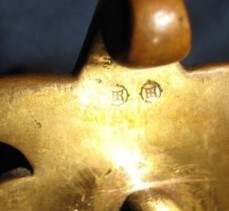
Trystan, These 1886 pattern Cavalry, or Type 8?, swords are a mystery. I have one other with a double stamp, different logo, on file. I suspect they were shops making these swords, but have no data on them. Here's the other one I have:
-
Please help me to identify this sword
Bruce Pennington replied to tawatchai_s's topic in Military Swords of Japan
I have a couple of Yoshiharu on file with stamped numbers at the end of the tang. You didn't show the full tang on the side of the smith's name. Anything down there? -
Please help me to identify this sword
Bruce Pennington replied to tawatchai_s's topic in Military Swords of Japan
Made in "Spring 1944" Can we see the latch release button on the other side? Type 94 or 98 Japanese Officer gunto. Unusual pattern on the fuchi (copper collar on the handle). These run in the range of $900-1,400 USD. Varies with the buyer's market, with the condition of the fittings and blade, and whether the blade, itself, is traditionally made or not. Yours has a nice looking blade with a very straight saguha hamon (straight temper line), but I don't see the smith listed in either Slough or Sesko, so it's probably not traditionally made. Are there any small stamps higher on the tang, might have to remove the tsuba/seppa set (handguard and spacers) to see one. They can be on the back edge of the tang, too. -
Rust Resistant Steel blade stamps Kai Gunto
Bruce Pennington replied to robinalexander's topic in Military Swords of Japan
Ok Trystan. So the logo on the tsuba must be from another shop that made the fittings. I'll file it in "Unknown". -
Help with translation of symbols on WWII Sword tang
Bruce Pennington replied to Eds's topic in Translation Assistance
Ed, no date on the other side? -
Sounds like what happened to Ken's club is exactly what Kirill is looking for!
-
Rust Resistant Steel blade stamps Kai Gunto
Bruce Pennington replied to robinalexander's topic in Military Swords of Japan
Thanks Rob! Records annotated now.


