Bruce Pennington
-
Posts
14,377 -
Joined
-
Last visited
-
Days Won
171
Content Type
Profiles
Forums
Events
Store
Downloads
Gallery
Everything posted by Bruce Pennington
-

Arsenal Mark on RJT sword Fittings
Bruce Pennington replied to george trotter's topic in Military Swords of Japan
The difference could be due to a nakirishimei. Slough has many examples of variations due to this with other smiths. I have never seen a gimei with authentic looking "Na" stamps like this. -
The Mysterious "w" Stamp!
Bruce Pennington replied to Bruce Pennington's topic in Military Swords of Japan
Yes, a typo. I've corrected it in the Stamps Doc, thanks! Thomas, Took me a while, didn't have them documented. I think I switched the 'large Seki' on the 2 smiths. It was a Kanenori on this Wehrmacht-Awards thread. I referenced it on this Mysterious W Stamp thread. that has a very corroded large Seki, and what I still believe to be a very corroded 'W'. The debate, of course, is whether corrosion simply appears to be a Seki and W, or if an original Seki and W got badly corroded. I could see that either way, but, to me, the evidence looks like the stamps were originally there. On Kaneoto, I'm striking out. I've got Kaneoto with star, and Kaneoto with large Seki, but cannot find my reference to one with a W. But I did find a Yoshiharu with W & TO!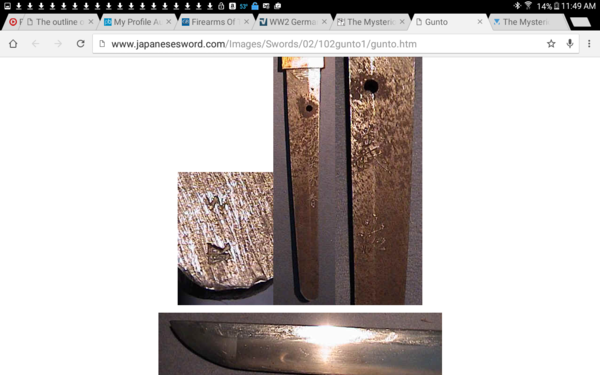
-
The Mysterious "w" Stamp!
Bruce Pennington replied to Bruce Pennington's topic in Military Swords of Japan
An update on the previous post I'm starting be think there was no "Yoshitani". The only sources come from this text post Undocumented Showa Era Swordsmiths on the Japaneseswordindex.com and a page from Japaneseswords.com - Katana by Yoshitani. I've run this by @mecox and he agrees the mei on the blade posted by Japanesesword.com is "Yoshiharu." It is possible the Yoshitani listed on Japaneseswordindex came from a mis-translated blade as well. We have all encountered a WWII smith not listed in any reference books, so I hesitate to say with certainty that there was no Yoshitani, but after seeing a blade mis-labeled with that name, and considering that even the one listed on Japaneseswordindex shows his name with a "?" indicating that they have no kanji for the "tani" portion that matches, I'm going to drop the name from the list of known smiths who's blades carry the stamp. If anyone knows of a Yoshitani blade, please post, but until then, I'll amend the Stamps doc accordingly. -
Arsenal Mark on RJT sword Fittings
Bruce Pennington replied to george trotter's topic in Military Swords of Japan
Looks like something was removed, but it's on the date side. I did some random sampling and it seems the star is normally on the mei side. Peculiar. -
Good to know. Unbelievable what people will copy and fake. I must admit though, that I'm clueless to all the artisans, and just enjoy the art.
-
Barry, Are you thinking this is a gimei habaki?
-
Attention Mantetsu Owners: A Survey
Bruce Pennington replied to Bruce Pennington's topic in Military Swords of Japan
We'd need to see a photo, Zac. -
Type 98 late production Translation Help
Bruce Pennington replied to Familyswords's topic in Translation Assistance
Thanks Jussi! After your post, I found him in Markus' book: "KANEHIDE (兼英), Shōwa (昭和, 1926-1989), Gifu – “Kanehide” (兼英), real name Kanematsu Akira (兼松晃), born Novemver 24th 1915, he worked as a guntō smith" Michael, nice job on the re-wrap! Your sword is one of the contingency models spun off the Type 98 design orders. Designed in 1938, hit the streets in 1940, but didn't get really popular until 1943-45. You can read all about them here: Unveiling the Rinjiseishiki Sword 1940 and Myth of the "Type 3" nomenclature -
Please help me to identify this sword
Bruce Pennington replied to tawatchai_s's topic in Military Swords of Japan
@tawatchai_s - Your photo doesn't show the full, bare nakago. Could I get a full one of both sides? Any stamped numbers at the end? -
Identification Type 98 Army
Bruce Pennington replied to chgruener's topic in Military Swords of Japan
Could we get some clear, closeups of the various fittings? -
Attention Mantetsu Owners: A Survey
Bruce Pennington replied to Bruce Pennington's topic in Military Swords of Japan
Welcome Zac! Excellent presentation, thank you! Your serila number - MO/モ 409 is the second series out of 5 for year 1944. If the series were spread evenly over the year, and we don't know that they were, this would put your date in July through mid-September of '44. I only have 4 '44s in the MO series, now: 104 Nan 228 Nan 409 Nan 799 Ren Concerning the "W/M" stamp, yours is the latest so far, all 4 of the Nan-stamped '44s have the mark. All the previous ones are in 1942/43. From the photo, it looks like the same' is celluloid? Mine is too, and it seems it was used fairly often on Mantetsu fittings. On a "stamped numbers" note, yours is the first 1944 Mantetsu with the stamped numbers on the face of the nakago with matching numbers on fittings. I believe these to be done by the fittings shop. -
Dave, My first feeling is island made.
-
Hi William, I'm another Colorado collector! Don't know if you're interested in WWII gunto, but a great place to start getting familiar with the look of real Japanese workmanship is Ohmura's fabulous site: Military Swords of Imperial Japan (gunto) and it's completely free!
-
I agree. I love the larger sakura and the dimpling work. Plus the tsuba is quite thin, giving it an elegant appearance. Evan, thanks for the edge-view of the sayajiri! Haven't ever seen that aspect before, and surprised at the thickness of the drag. I agree with you that it looks 'carried'. The sweaty palm oils in the ito, to me, show it was held quite a bit in someplace hot. My dad's Mantetsu tsuka had the same look.
-
WW2 Japanese army older sword
Bruce Pennington replied to Swords's topic in General Nihonto Related Discussion
Steve, I've enjoyed the learning process from all your threads. Not wasted, if you ask me. And many days, there is not much going on anyway. -
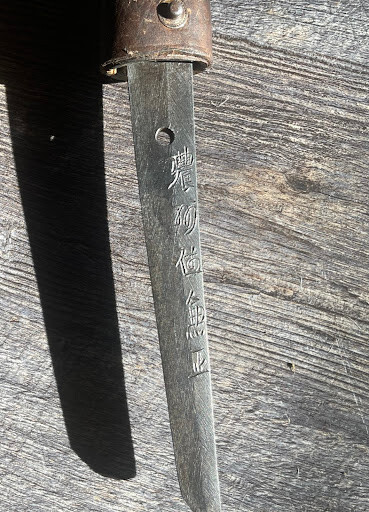
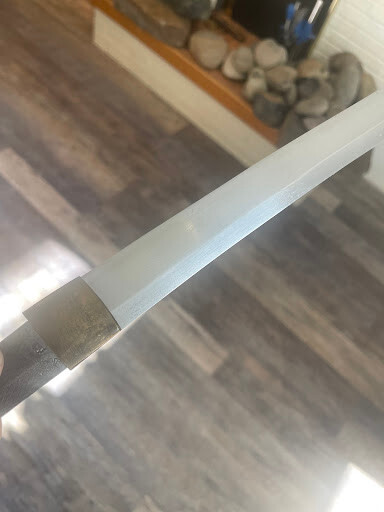
@chgruener Christopher. I'm posting your photos for future reference. Welcome to NMB! Can you post a clear picture of what looks to be 2 stamps at the top of the nakago (tang)? You can read a ton of stuff for free at Ohmura's website - Military Swords of Imperial Japan (Gunto)





-
That's a great one, Peter! The skill just amazes me. I can't even draw, with a pencil, anything like this and he's carved it into metal.
-
Hello Evan! Your fittings were made by the Wakasei Co. of Tokyo. The four stamps are (thanks @Kiipu and @BANGBANGSAN!): 若瀬 = Wakase. The drag, while not 'rare' is a bit unique, and was aparantly made by the Wakasei Co. too. On one side it says roughtly "New 'idea', utility use" + the Wakasei logo, and the other is a patent number 213917 (all from Richard Fuller's book). You can see more like this here: Gunto Tsuba
-
Sword authenticity, can somebody please help?
Bruce Pennington replied to BrunofromBrazil's topic in Military Swords of Japan
Yes, to Damascus steel alone says it distinctively. -
Reminded me of this one posted by @C Lewis: I think I have another one with the SMR logo on it. It’s on another computer and I will post when I get to it.
-
Markus Sesko lists these two "Osafune Sukesada": SUKESADA (助定), Bunmei (文明, 1469-1487), Bizen – “Bishū Osafune Sukesada” (備州長船助定) SUKESADA (助定), Daiei (大永, 1521-1528), Bizen – “Bizen no Kuni Osafune-jū Sukesada” (備前国長船住助定), “Bishū Osafune Sukesada” (備州長船助定), student of Hikobei no Jō Sukesada (彦兵衛尉祐定), mostly a chū-suguha-hitsure
-
Sword authenticity, can somebody please help?
Bruce Pennington replied to BrunofromBrazil's topic in Military Swords of Japan
Hard to say, Bruno. I personally would put this in the $900-1,200 USD range. Some dealers are asking over $2,000! It's in great condition, so that pushes the pricing toward the higher end of the market. -
Sword authenticity, can somebody please help?
Bruce Pennington replied to BrunofromBrazil's topic in Military Swords of Japan
I'm going to go out on a limb and say "Yoshinao" on the smith name, but I'm 75% wrong on these! Agree with all the above evals. -
Arsenal Mark on RJT sword Fittings
Bruce Pennington replied to george trotter's topic in Military Swords of Japan
Thanks, but yes. I have it filed from his original post. -
Pinned Kabutogane on Type 94
Bruce Pennington replied to PNSSHOGUN's topic in Military Swords of Japan
Reminds me of this one posted by @Lareon.