zanilu
-
Posts
559 -
Joined
-
Last visited
-
Days Won
5
Content Type
Profiles
Forums
Events
Store
Downloads
Gallery
Everything posted by zanilu
-
Grande Mauro!
-
Me too Curran! I am really envious of @MauroPdatabase! Regards Luca
-
Curran your point is clear! Il tuo Italiano è migliore del mio Inglese! Your poit is clear. Thank you! Regards Luca
-
Dear Curran. Maybe not being English my mother tongue make me read meanings that are not there... In your sentence I read that NBTHK would paper it as Kyo-kanagushi but you somewhat imply that another organization or authority in the field would not give the same attribution. Regards Luca
-
That was exactly my point Simon. The unknown author you cited seem versed in the subject but without a solid bibliography to support it you can not rely on it. Regards Luca
-
My impression is that we are putting too much stock in the information we get from the web. We see a page based on sources from other pages etc... and we build new theories out of the blue. Where are the sources from scientific literature? There is any evidence Even the account cited from reddit by Simon, even though it sounds most reasonable and well researched is not coming from a scientific publication. We ahve to be very careful... Luaca
-
You are welcome Steve. The more the better. Your example looks to share a lot with mine. Let's see if more information can be gathered! Luca
-
Thank you Mauro for the hint. As said not my piece of cake (non il mio pezzo forte!). Luca
-
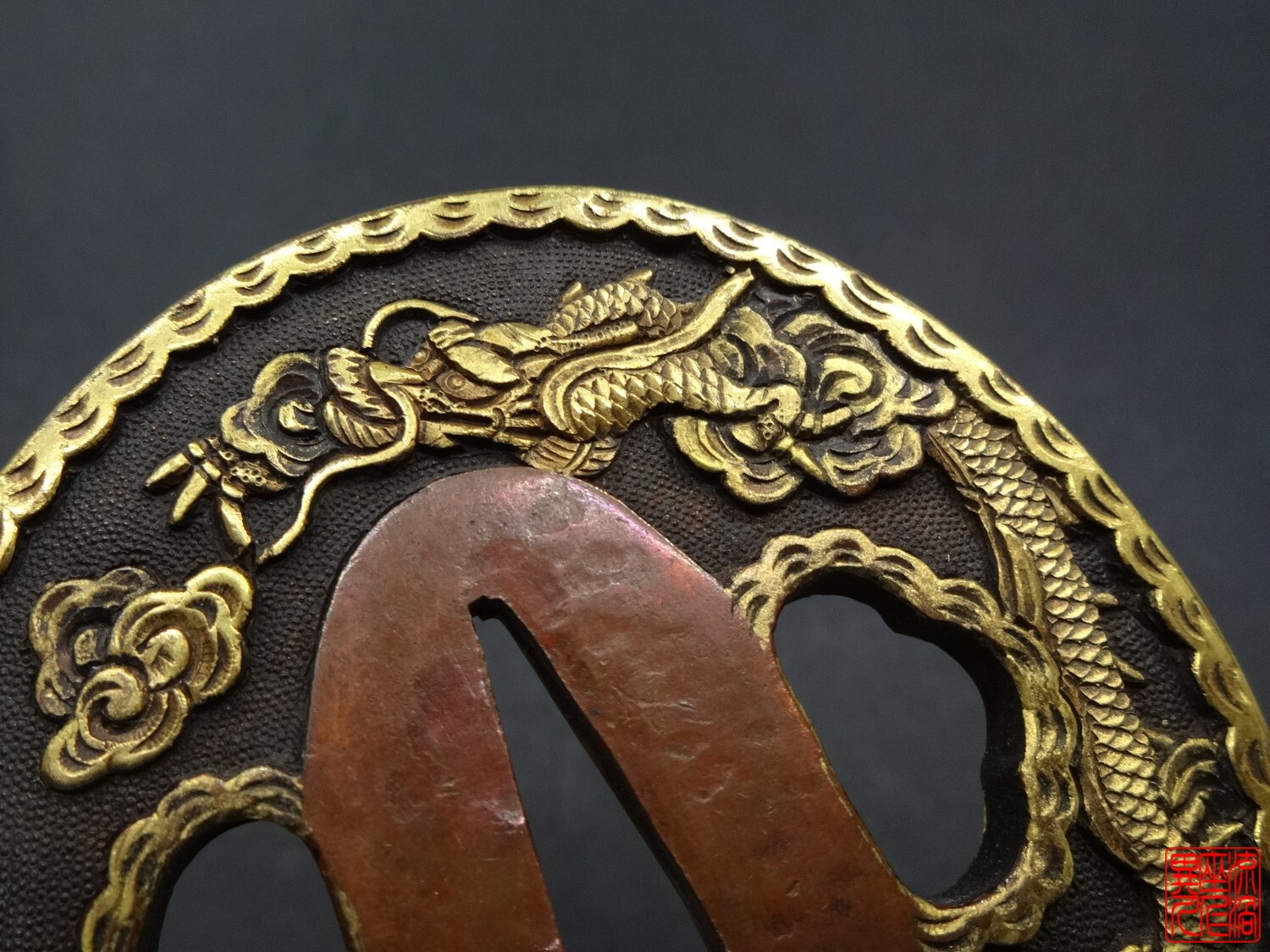
Dear All Here is a tsuba that I acquired more that 10 years ago when I was starting my collection. It did not have much of my attention until last friday when I was duing the weekly rotation of the pieces on show on my bookshelves. It does not look that bad when examined up close, not a master piece but an honest one at least. Since my interest since then has drifted toward iron tsuba with brass inlay I am out of my comfort zone giving it an attribution. It lokks to be made of suaka not yamagane thus the Ko-Mino attribution of the original seller doesn't look on spot. The nanako is very small sized and reasonably regular. The kin-iroe is well executed without smudges. The dimensions are, 69 mm x 66 mm with a thickness of 3 mm at the mimi. My hypothesis is it could me Mino if not Ko-mino or one of those later Edo pieces of undefinable origin. As I was saying I am out of my comfort zone so any help is greatly appreciated. Regards Luca


-
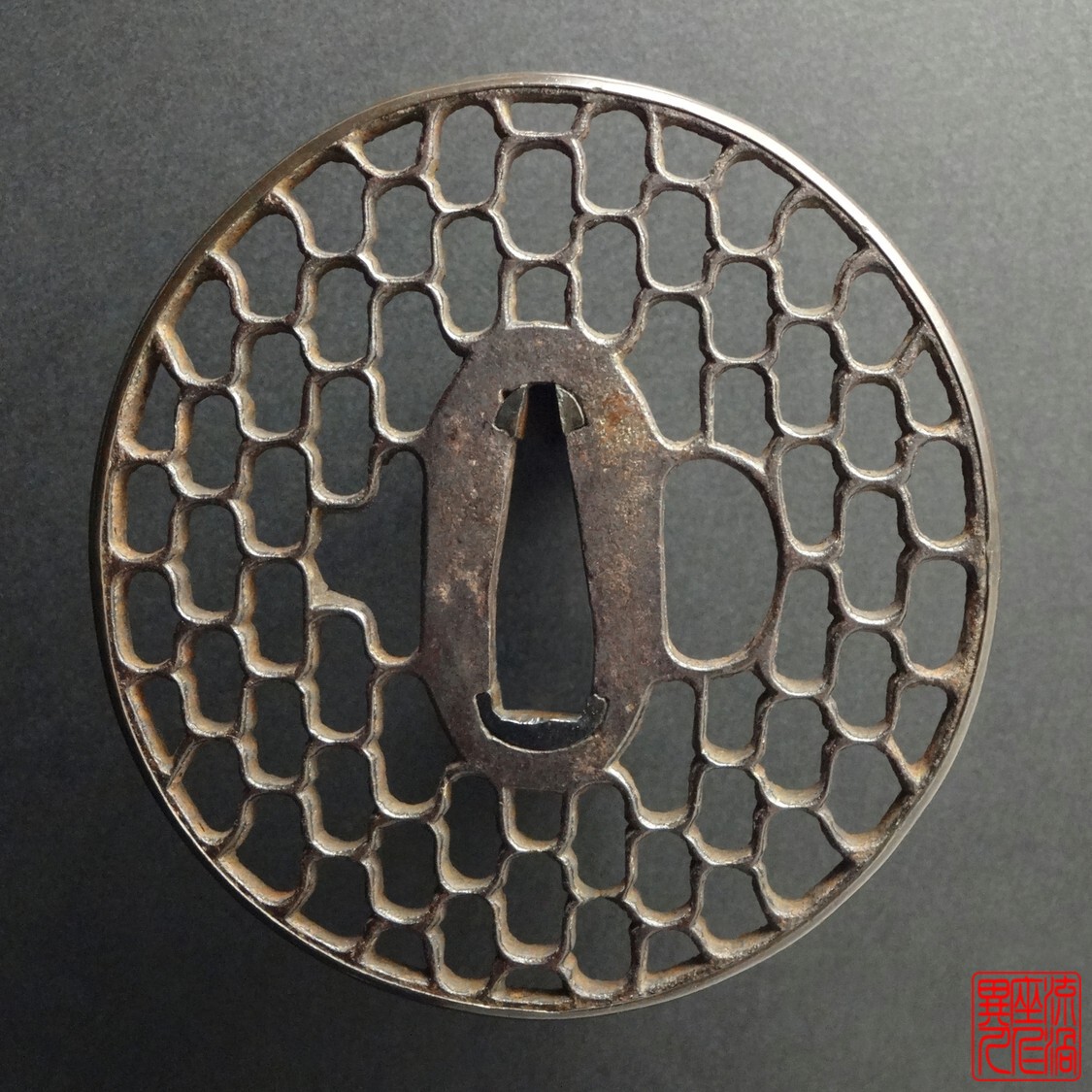
Thank you Dale. The net opening are more elongated compared to the previous example. If I am forced to find a difference I would say that the opening are more rectangular. Regards Luca
-
Thak you all guys! A lot to ponder! The small web of the net and the small rim make me think of Kyoto sukashi, so the suggestion of kyo shohami sounds reasonable... As Grev pointed out the net elements in my tsuba are more rectangular and uniform in shape than those of the other examples. interesting point. If other information is available please feel free to add... Regards
-
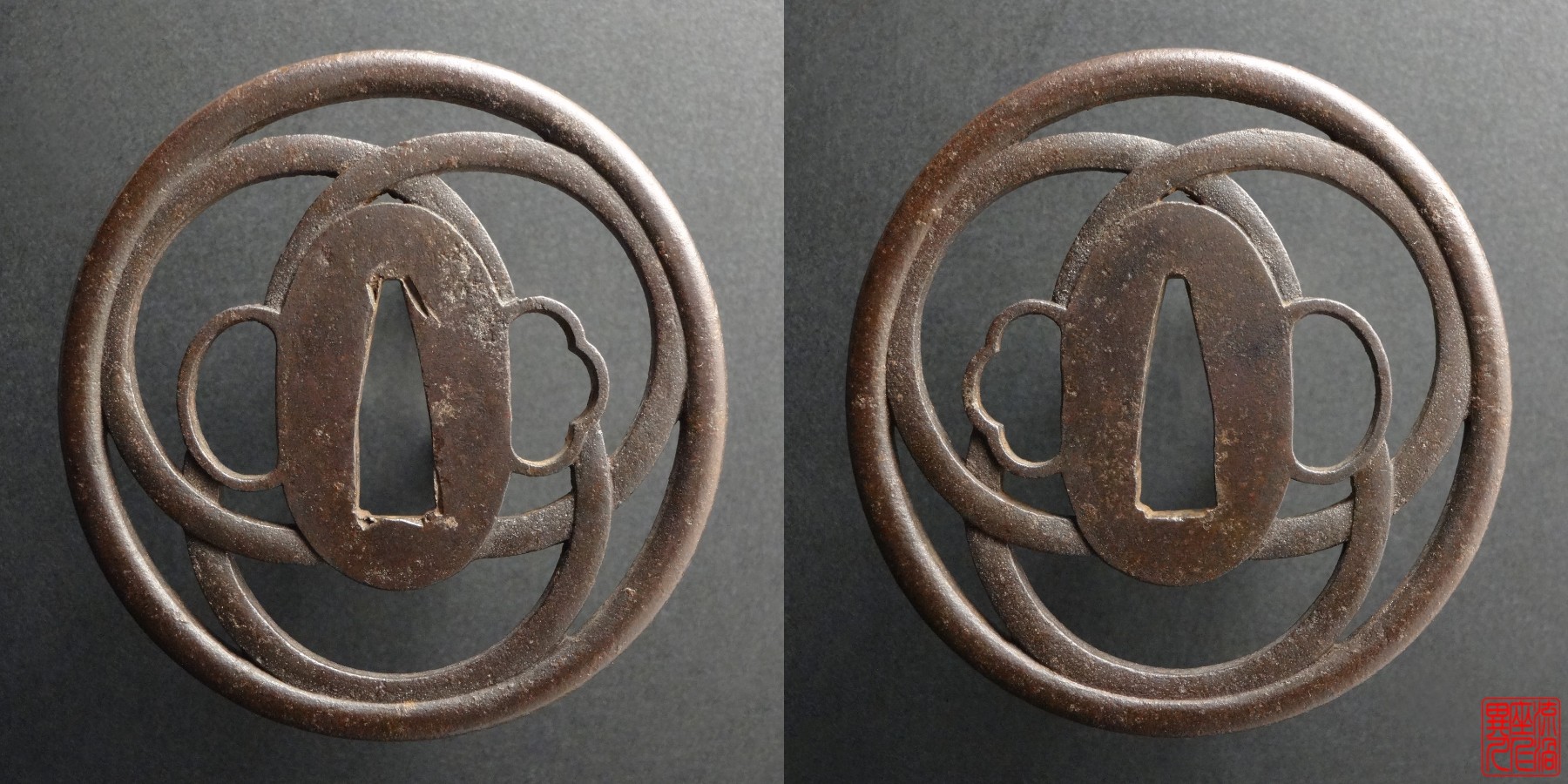
Dear All I have recently bought this tsuba from Yahoo Japan. Dimentions 83.5 mm x 80.4 mm, thickness 5.3 mm. It was more from an impulse rather than a thought out acquisition, but I like the design and it is a nice addition to my collection to broaden its scope. I was wondering whether it is possible to narrow down the attribution to one of the many Shoami branches and thus to give a better estimation of the period of production. Shoami is not my main line of study so I would appreciate id any of you can share kantei points to help in a better attribution. Thank you in advance Best Regards Luca


-
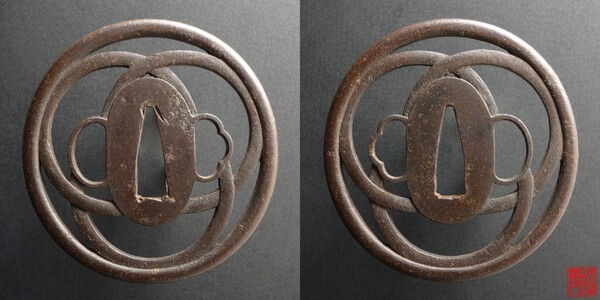
Hi Damon This is from my collection: It is papered by NTHK and is described, unsurprisingly, as "Mitsuwa Sukashi zu (openwork of three rings)". Regards Luca
-
I do agree with the previous comments. Probably a fake in very potrebbe conditions. Better pass it on... Regards Luca
-
Thank you to you @Brianand to all other contributors!
-
Sometimes having neglected pieces restore by professionals is a worth endeavor in my experience. It depends greatly by the piece quality. I have always approached restoration from an artistic point of view rather than monetary. Regards Luca
-
Thank you John Regards Luca
-
Thank you Grev!
-
Grev. I have reported the better images I can find of both tsuba and mei. Unfortunately most of the literature I have access to has B/W pictures and I did the scan myself from the books. As you surely know scan from books has its limitations in quality due to the printing process. I scanned all the images at 1200 dpi (going higher would not have improved the image quality). Using larger images in the pdf would have not improved their quality anyway. Also I had to compress (reduce image quality) to produce a manageable side pdf for upload. The original file was 94 MB compared to the squeezed one that is 1.7. The quality of the images I have downloaded from internet is varying in quality but is usually below that of the scans. Regards Luca
-
Hello Following my compilation of information about Kaga Yoshiro of few month ago I was able to complete the subject by doing a similar work for Bizen Yoshiro. Though smaller in scope I hope it can be useful to all of you. bizen_yoshiro.pdf All comments and correction are of course welcome Best Regards Luca
-
Grazie Pietro. I think that your hypothesis also make sense. And as, rightly said by Jean, we will probably never know. By chance do you have also the measurements of the tsuba you posted? Regards Luca
-
Jean you are right! I stand corrected about the lack of pre made plates. Sometimes my engineering background make me assume something wrong. <<Concerning your nice DAISHO, it may have been made by the same hand (or workshop), but perharps with some time between them>> I start to see it the same way, the more I think of it the more it looks reasonable. Thank you. Regards Luca
-
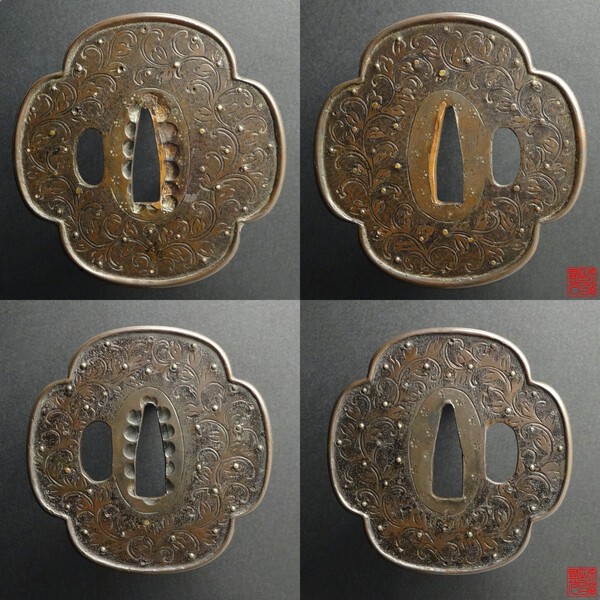
Hello to all NMB members I have recently acquired the following daisho tsuba papered by NBTHK as Ko-Kinko. Far from me to question NBTHK from the depth of my ignorance on the subject but... It is not exactly rare but also not common to find a tsuba daisho of yamagane papered as Ko-Kinko. As a general rule a yamagane tsuba with an old fashioned design of arabesque or waves, combined with an old looking texture can be regarded as Ko-Kinko, confirmed by NBTHK attribution. As a consequence of the the Ko-Kino attribution a time frame ranging from Muromachi to Momoyama can be considered. However the fashion of wearing two swords in matching pair started only at the beginning of the Edo period. As I see it we have at this point four possible options: A real, ahead of time, Ko-Kinko daisho from the Muromachi/Momoyama period. An Edo period daisho made on purpose with an old-fashioned style. Only one of the two tsuba is from Muromachi/Momoyama period and the other one was later made (Edo period) to match the old one to form a daisho. Two tsuba made independently but so alike that they could later matched in a daisho. An additional possibility I could not imagine! If we compare the two tsuba we cas see that, both tsuba are obtained from a solid plate of yamagane with a dote mimi (or better uchikaeshi mimi?). Dai mimi Sho mimi The thicknesses are different, the dai is 4.0 mm at seppa dai and 5.4 at mimi while the sho is 3.5 mm at seppa dai and 4.0 mm at mimi. This could point to the possibility that the two were not obtained from the same plate. Possibility also supported by the fact that the sho seems to have developed a slightly darker patina compared to the dai. There is also a difference in the size of the inland dew drops between dai and sho. On the dai the average size is about 1.6 mm with the most frequent value being 1.5 mm (44% of the total), while on the sho the mean is about 1.8 mm with a most frequent value of 1.8 mm (30% of the total). In the evaluation of the mean values the deformed dew drops were not considered. On both tsuba the dew drops on the ura side are consistently larger that on the ura. There is also difference in the surface finish of the two tsuba, described on the NBTHK paper as ishime-ji. On the dai the surface is finished with parallel lines engraved at approximately 45 deg from the vertical, that look like engraved in kosokibori lines. On the sho, instead, the surface is finished with a more random pattern. The two tsuba have a lot of points in common but not as mush as one would expect from a daisho. If I would have stumbled in them separately I would have assumed them at least from the same workshop if not from the same artist. Any comments on the NBTHK attribution and on how to determine the age of kinko tsuba is more than welcome! Best Regards Luca


-
Having made some casting in my time, part of school training, I do at list know how devilish is iron in casting thin walls and small details. I could have not expressed my feeling about cast iron tsuba better than Ford. Regards Luca
-
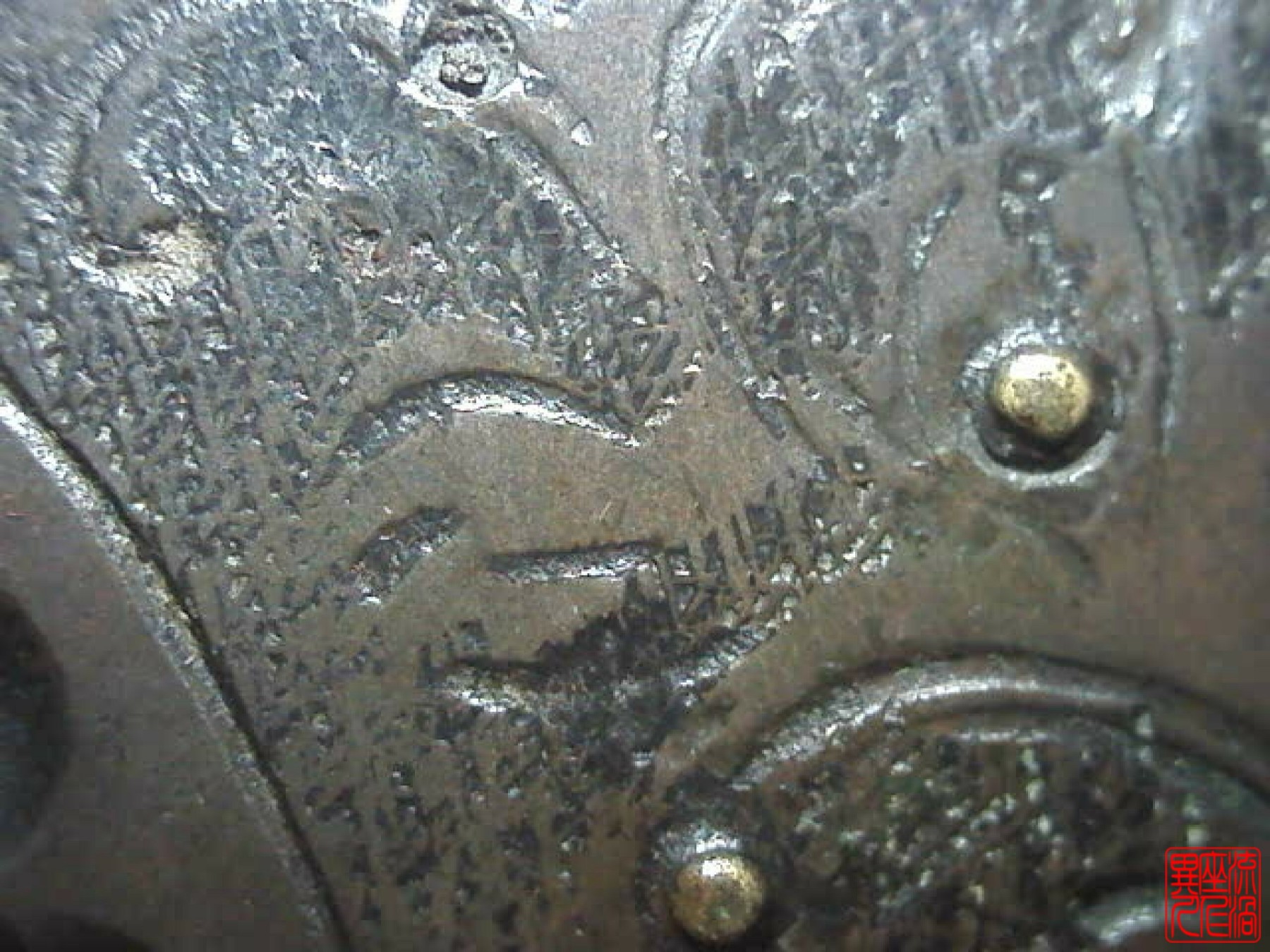
I agree with Mauro, looks like forgin layers that maybe due to corrosion show some signs of delamination. My two cents... Luca