zanilu
-
Posts
535 -
Joined
-
Last visited
-
Days Won
5
Content Type
Profiles
Forums
Events
Store
Downloads
Gallery
Everything posted by zanilu
-
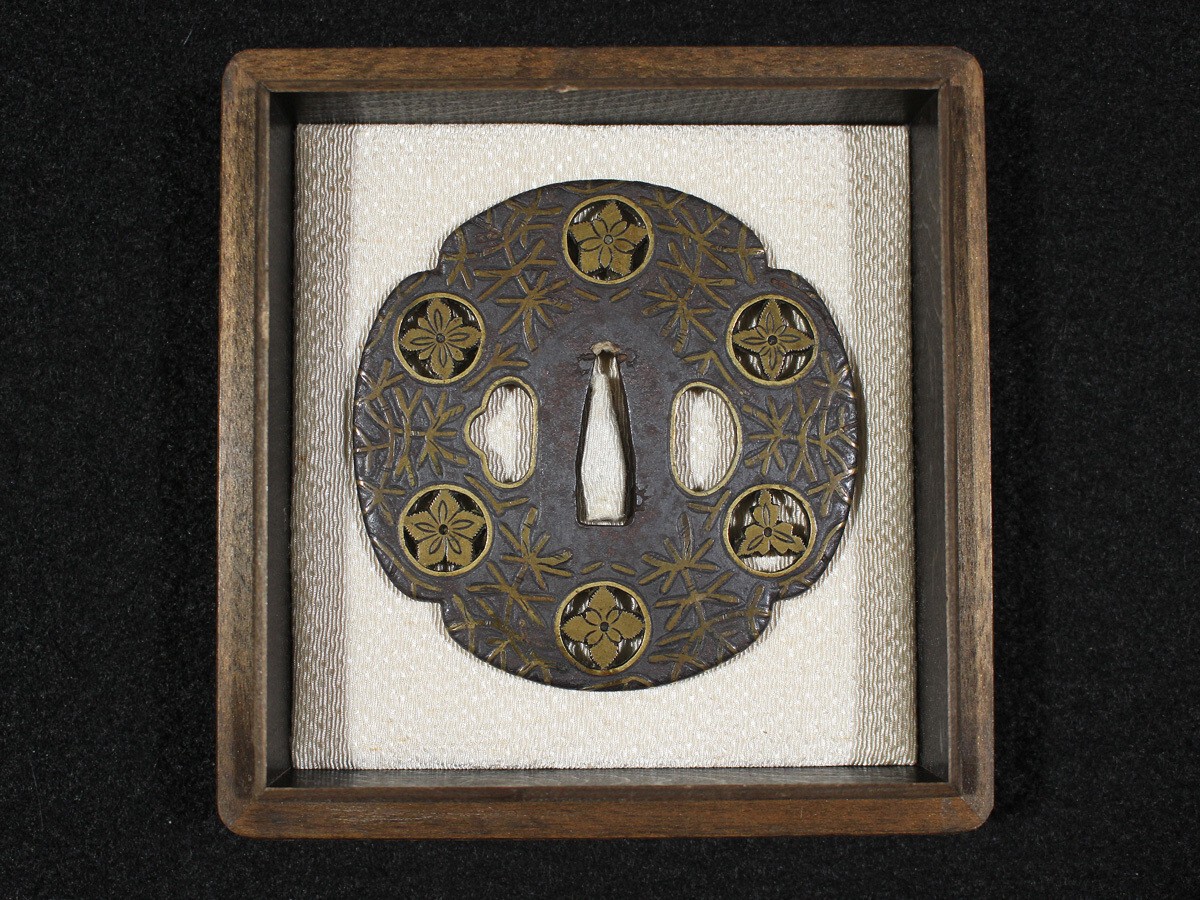
If you look at the very first picture posted, it seems to me that the depression between the lobes goes well with your thumb and index fingers to hold the tsuba when the sword is in the saya. Just an observation from the Iaido practitioner point of view. Luca
-
I have received an email from Ford patreon channel. The message was from Isabella, unfortunately I do not think it wad a fake, I wish it was... Luca
-
I do not know if I am entitled to do this post but from Patreon I learned of the passing away of Ford Hallam! (https://www.patreon....315&utm_medium=email) I am sad about is departure! He was a great artist and artisan and will be greatly missed!
- 45 replies
-
- 18
-

-

-

-
I always use "Metal Craft" to avoid any misunderstanding and deflect overzealous custom reaction... Regards Luca
-
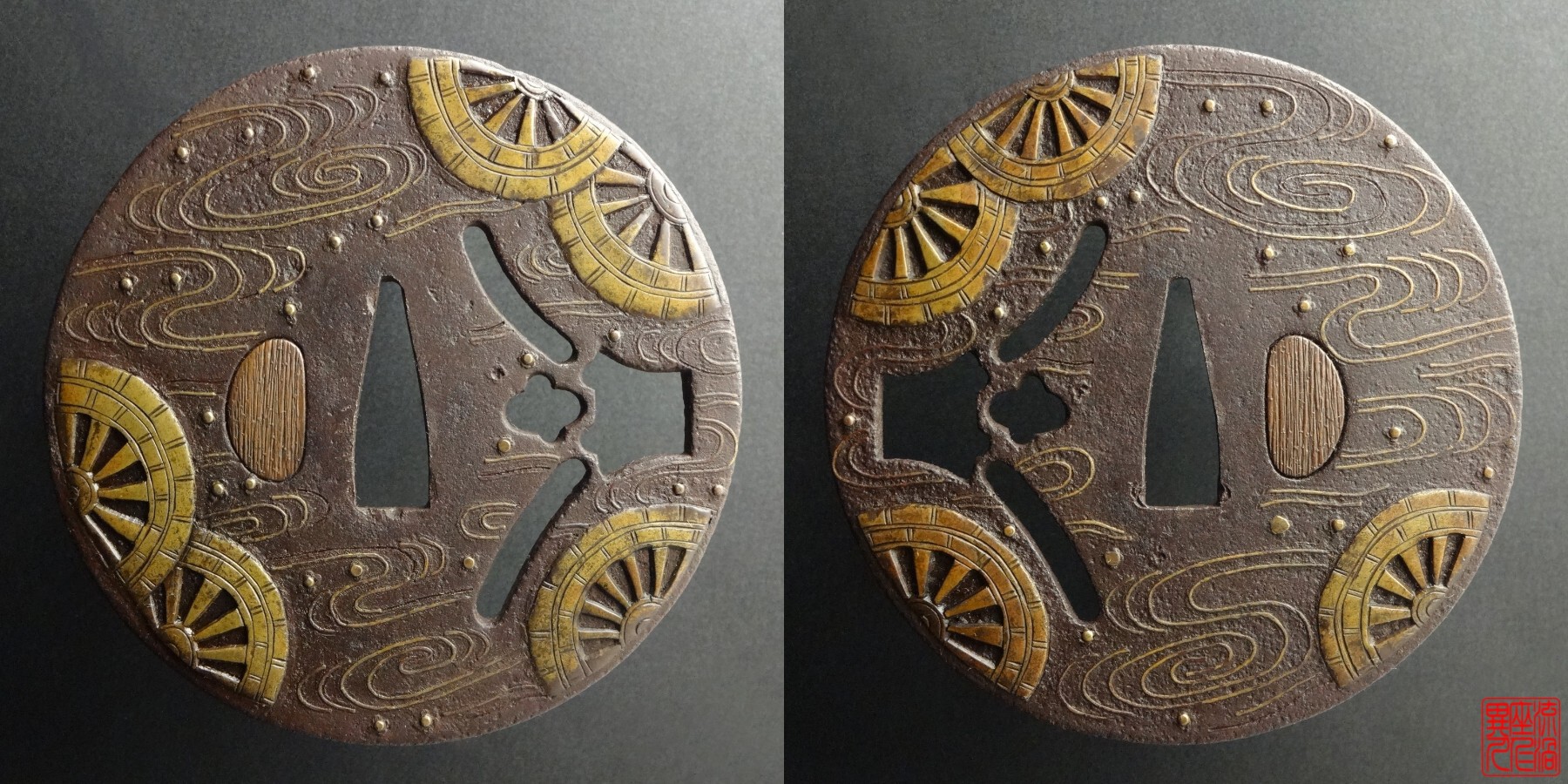
Yes Jake. It is. The inlay is suemon zogan it brassi is not level with the iron surface but it is protruding from the surface. Regards Luca
-
My NBTHK papered Ono tsuba. Dimensions 71.3 mm x 71.0 mm, thickness at seppa-dai 4.5 mm, at mimi 7.5 mm. Regards Luca

-
50+
-
Thank you David. This cover the omote side, on the hura there are squirrels and what looks like some kind of water melon on trellis. Regards Luca
-
Hello everyone, I would like to share one of my latest acquisitions with you. Dimensions: 78.6 mm x 80.3 mm, thickness 3.1 mm at the mimi and 3.2 mm at the seppa-dai. Initially, when I saw it on Yahoo Japan, my first hypothesis was that it was a Heianjo Zogan tsuba with suemon-zogan brass inlay. However, upon receiving it, I noticed a silver-like coating covering parts of the brass inlay. It appears that this silvery layer originally covered the entire inlay but has been abraded over time, now remaining only in the lower, more protected regions. Interestingly, some silver can also be found on the copper seki-gane, which on one side also shows traces of black lacquer. It seems that silver was a later addition, possibly applied via mercury gilding, which has worn off from the higher points over time. I would highly appreciate your opinions on this. It can be still attributed to Heainjo Zogan in spite of the silver addition or its presence points for a different attribution? How will you describe the decoration that looks like squirrel with gapes and melons in trellis? Which is the correct way to describe it in Japanese? Best regards, Luca


-
Yes You are right Piers. The second one say Heianjo zogan my mistake! For that one my assumption is that this is due to the lack of the mon that have probalby fallen off. But this only adds to my confusion! Comparing the first one with the others I see no particular differences that can justify the attribution! I have added only a few of those I found! Regards Luca
-
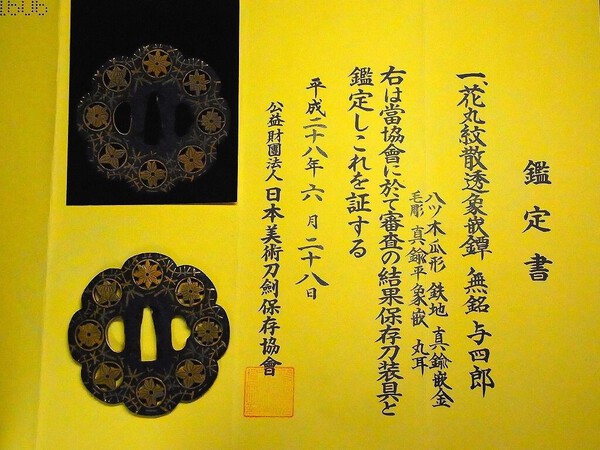
That's exactly my point Dale. We have a lot of attribution from NBTHK of these kind of pieces, all mumei, to Yoshiro and then this one attributed to Heianjo! Attached are the papers for a few of them from my database. The question is why this piece have a different attribution? Regards Luca


-
Dear All I have seen this tsuba for sale on Yahoo Japan. To me it looks clearly as a Kaga Yoshiro piece but it comes with an NBTHK paper to Heianjo Zogan! What am I missing? Do you see any particular reason for the attribution? Regards Luca


-
The largest in my collection: Edo period Katsushi 105.0 mm x 100.0 mm , thickness at seppa dai 2.5 mm, at mimi 3.3 mm. Edo period (Early?) Heianjo Zogan 102.5 mm x 102.3 mm, thickness at seppa dai 4.2 mm, at mimi 4.0 mm. Regards Luca


-
Thank you!
-
Thank you Steve! So it should read koberi kin? Gold border? Regards Luca
-
Dear All I am translating the NBTHK paper of a Nagamine Fuchi/Kashira of recent acquisition. But this bit is puzzling me: It looks like 小縁金 that should sound like ko fuchigane or somehthing like small gold collar. Which is the exact translation and meaning? It is referring to the small gold border on the rim of the fuchi: Thank you in advance for the help Regards Luca


-
Luca, stai parlando male di Garibaldi! (it's an Italian idiomatic expression to say that some opinions cannot be challenged even if overtly misleading) I know Mauro. But this case "Chiede vendetta" (calls for vengeance)! Regards Luca
-
David I agree that it should not be an achademic paper but the criteria used should be given at least... Regards Luca
-
I am lost! I have collected many Yoshiro pieces example here: I have always found frustrating the fact that NBTHK does not provide justification, reasons and references the leader to an attribution. To me the shinsa process is rather opaque! Regards Luca
-
It looks like the essence of Kaga Yoshiro. A manual piece! But what do I know... Regards Luca
-
Dale I suspect that i other side is made by the copper plate you mention in your original post and that the wire mesh is sandwiched between the original tsuba and the copper plate. In the past I have seen passing tsuba with a copper plate added to one side. At the moment I can not find any though. Regards Luca
-
That it is strange is a fact! Shingen? Regards Luca
-
Superbe Steve! I am very grateful! Thank you Best regards Luca
-
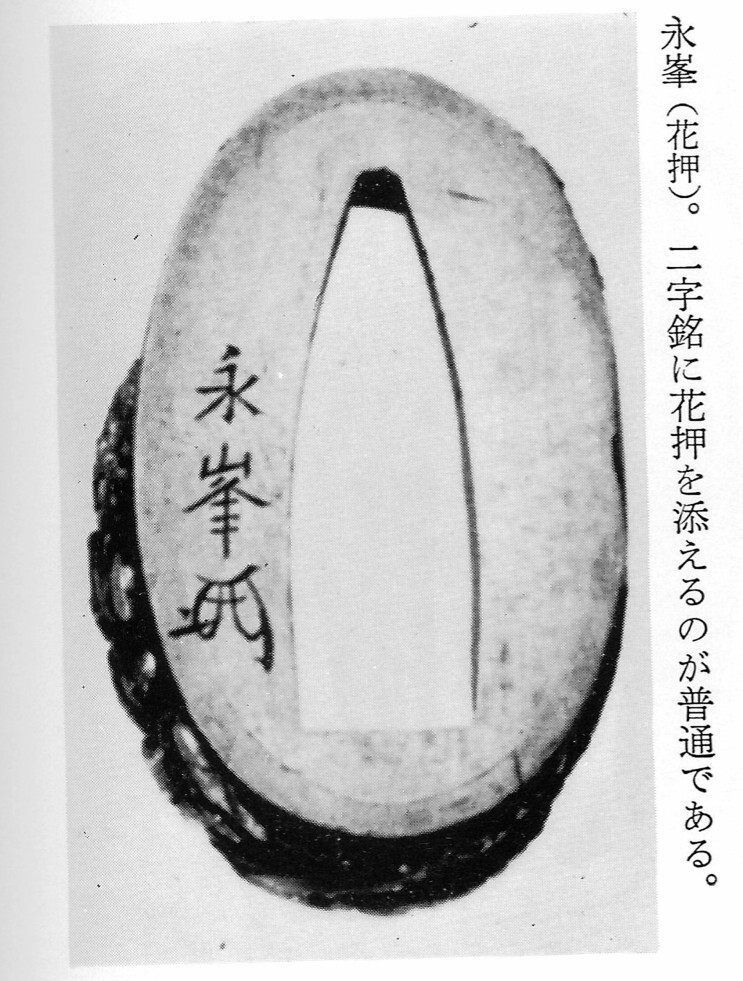
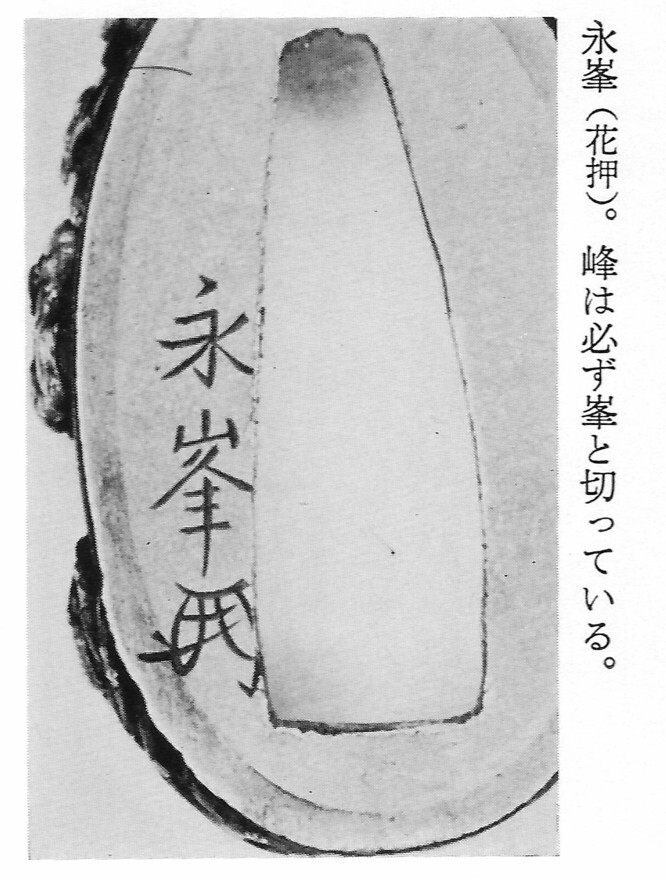
Hello everybody I am compiling a review of all the information about Ayanokoji Nagamine that I have gathered so far as I have done in the past for other topics. At the moment I am in need of some help managing the translations of some entry from Wakayama Toso Kodogu Meiji Taikei, since I can not go beyond google translator. Following are the scan from the book and what I got so far: [02] 花洛住 氷筆 (花押) 最近になり 外国資料に [花洛住渡辺即三良行 年六十ー歳 永峯 (花押)] と切つた小 策があるとを確認レた Karaku-ju Nagamine (ka\=o) Saikin ni nari Gaikoku shiryō ni hana raku jū Watanabe soku san Yoshiyuki Toshi roku jū ̄ toshi Nagamine (kaō) to setsu Tsuta-shō Saku ga aru to o kakunin reta Karaku-ju Nagamine (ka\=o) Recently become For foreign materials Hanatsubaki Sayayuki Watanabe 60 years old Nagamine (ka\=o) And small I confirmed that there was a solution Here I think is reported the information about a mei in which the age of 60 for Nagamine is citen. Also cited in Haynes "The Index of Japanese Sword Fittings and Associated Artists" but I have never seen any picture of it. If by chance any of you have it and can share it I will be grateful. [03] 花洛住 氷筆 (花押) 花の字をと異体に切つ たリ この緑銘のように華をくずしたようにみえろ字体に切る Karaku-ju Nagamine (ka\=o) Hana no ji o to itai ni setsutsuta Ri kono midori mei no yō ni hana o kuzushita yō ni mi ero jitai ni kiru Karaku-ju Nagamine (ka\=o) Cut the character of the flower into a different shape. Is it saying something about how a character is cut? [04] 氷筆 (花押) 峰は必ずと切つていろ Nagamine (ka\=o) Mine wa kanarazu to setsu tsute iro Nagamine (ka\=o) Always cut the peak Also here is it saying something about how a character is cut? [05] 氷筆 (花押) この工人の花押を比較すると小異があ リ さらに別形もみられるので 同名二人説や複数説 もある この縁銘内字は他のものとくらべ変わつ ている Nagamine (ka\=o) kono kō hito no kaō o hikaku suruto shōi ga a Ri sarani betsu katachi mo mi rarerunode dōmei futari-setsu ya fukusū-setsu mo aru kono en mei-nai ji wa hoka no mono to kurabe hen watsute iru Nagamine (ka\=o) When comparing this engineer's Hanashoshi, there are minor differences. There are also other forms, so there are two-person theories and multiple theories This inscription is different from the others [06] 氷筆 (花押) 二字銘に花押を添えろのが普通であろ Nagamine (ka\=o) Ni Jimei kaō o soero no ga futsūdearo It's normal to add kao to the two-letter name I know it is a lot to translate anyway I thank you in advance for any help you can offer. Best Regards Luca


-
Thank you Piers for the update!