zanilu
-
Posts
542 -
Joined
-
Last visited
-
Days Won
5
Content Type
Profiles
Forums
Events
Store
Downloads
Gallery
Everything posted by zanilu
-
Bump!
-
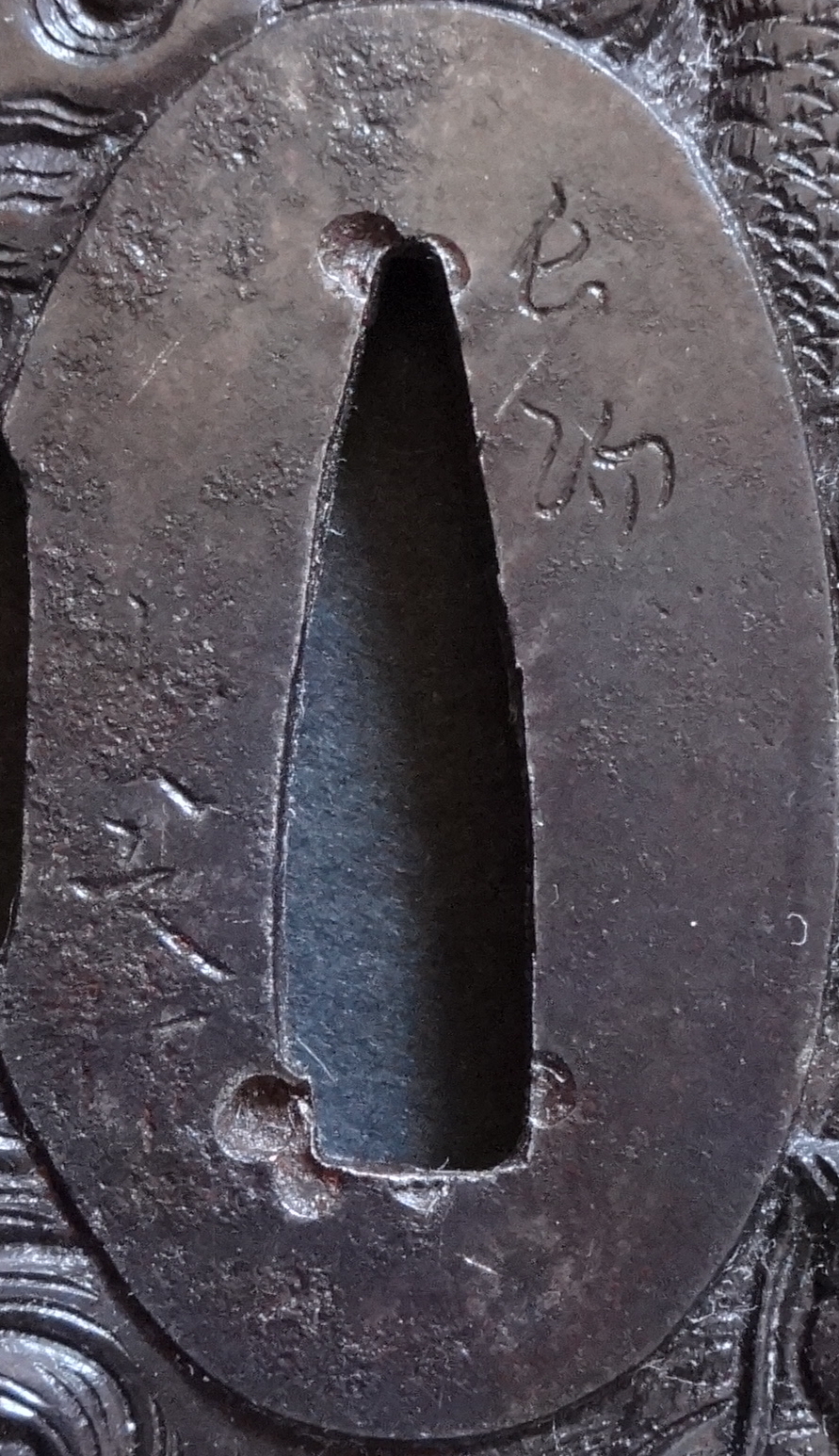
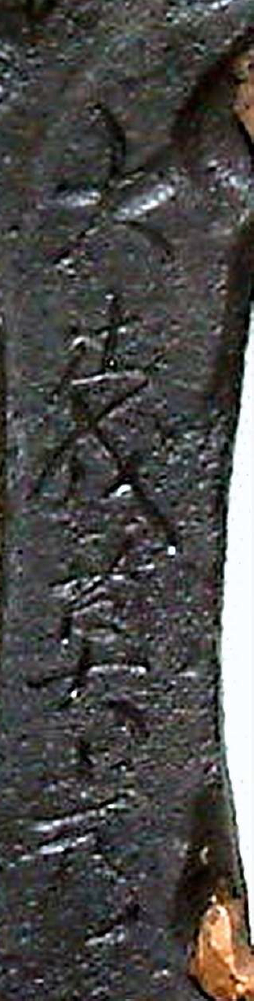
Dear All. I had this small tsuba in my collection since the beginning back in 2010. The tsuba look Choshu to me but I could be blatantly wrong of course. The dimensions are 73 mm x 70 mm x 4 mm. Weight is 127 gr. In the past months I spent some time with bones and antler horn fragments in order to remove rust. In the region of the seppa dai some corrosion products are still present and regardless of how hard I have tried I could not remove more. See the before and after pictures. Unfortunately the corrosion ruined the mei that is now partially unreadable. The mei on the left side of the nakago ana is composed ot three kanji, the last one seems to be "saku". On the opposite side of the nakago ana there are also two "cursive" characters. My ability to read kanji, that is limited to counting strokes, is not sufficient to guess the mei of this tsuba. Is any one of you, my knowlageble friends, able to guess the two partially unreadable charactes and decipher the cursive one? Any help from your side is welcome! Regards Luca


-
John I will take closer look at look at the faces. Bian The text is taken from a pdf file already generated with LaTeX. As soon as the text is finalized I will be back to you with the PDF. Luca
-
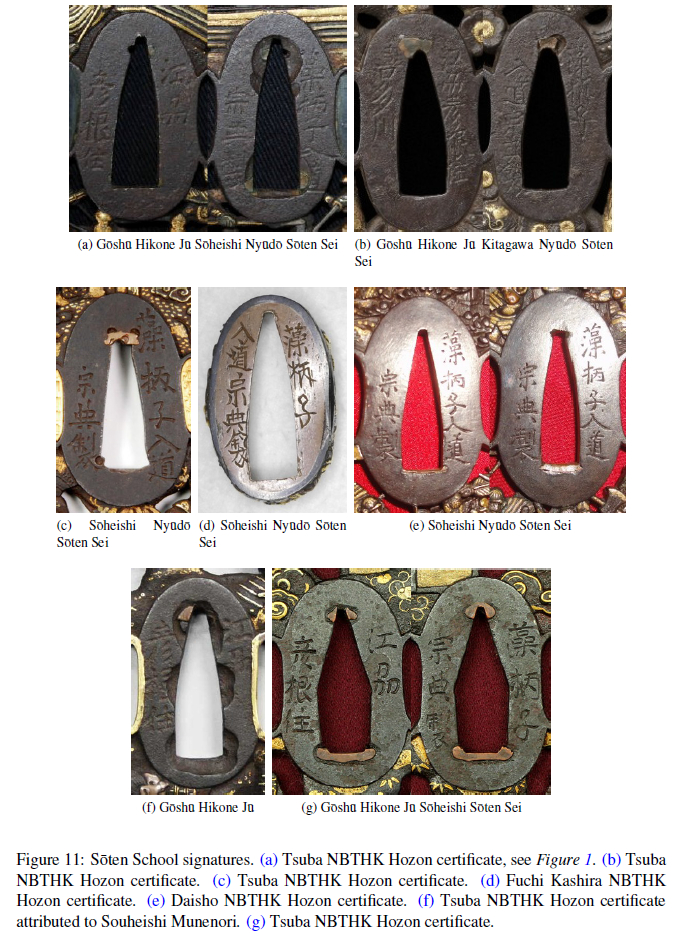
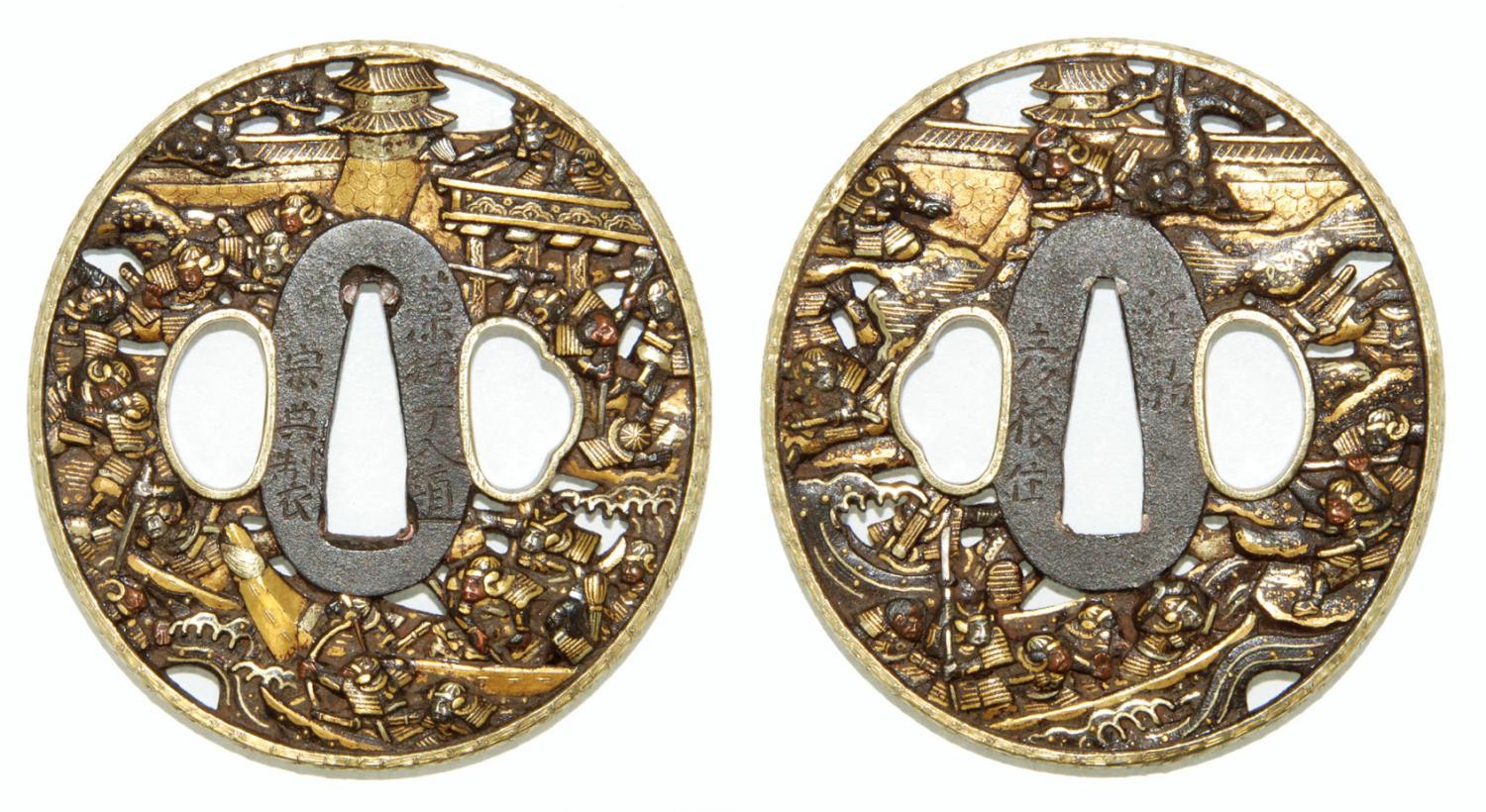
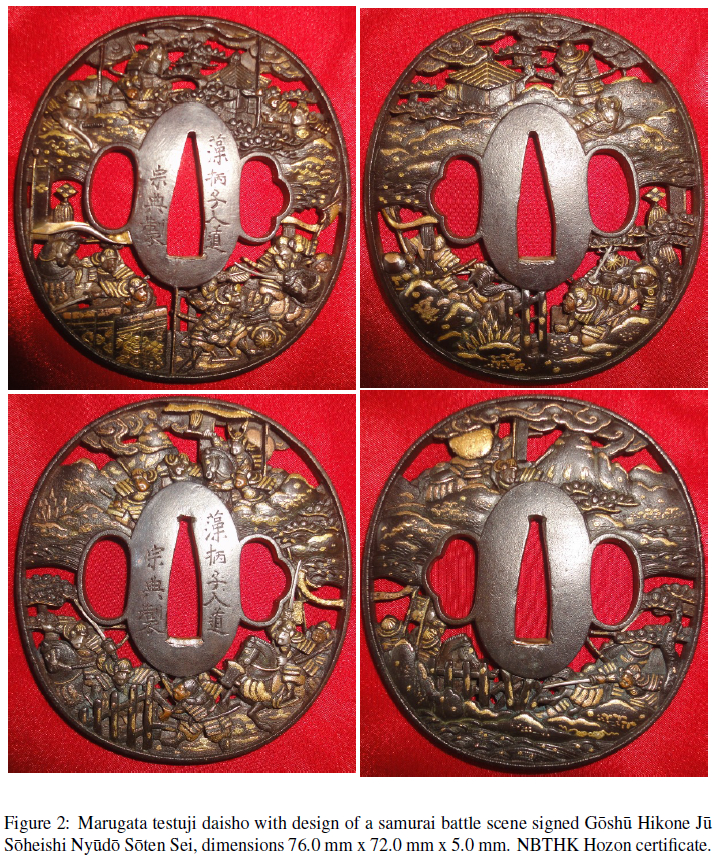
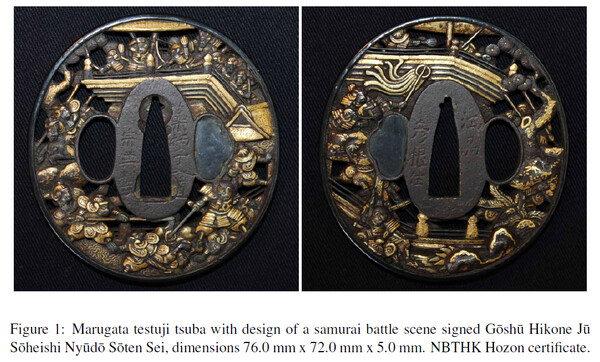
Hi to everybody Several months ago I bought a Soten tsuba signed Goshu Hikone Ju Soheishi Nyudo Soten Sei (see attached pictures FT-0052-*.jpg). The tsuba is papered by NTHK as genuine Soten tsuba. A few information about the tsuba are: height 75 mm, width 70 mm, thickness at mimi 5 mm. Nademaru gata, kaku mimi with gold fukurin, ryohitsu plugged with gold. The translation of the NTHK paper should be something of this kind (the translation was provided by a Japanese speaking guys on INTK website - http://www.intk-token.it/forum/index.php?showtopic=8630&hl=): Kanteisho Tsuba Soheishi Soten Original piece 20th of January of the 25th year of Heisei Era (2013) Nihon Token Hozon Kai (NTHK), a non profit organisation. Miyano Teiji, director. Mei: Goshu Hikone Ju Soheishi Nyudo Soten Sei Made by Soheishi Nyudo Soten, living in Hikone, Omi province. Construction: Nagamarugata, Tetsuji. Design: Gassen no zu (battle scene). Uchiborisukashi no kingin iroe (perforated decoration painted in gold and silver). Dimensions: 7.5 cm height, 6.9 cm width. Additional information: Late Edo era. In order to further my meager knowledge about tsuba I decided to study this tsuba comparing it to similar tsuba and to other papered Soten tsuba. The text reported hereafter is basically personal notes as well as the figures. In some cases part of the text is taken from books I have of from internet, if the authors feels them as infringement of their rights, please let me know and I will remove them from the post. If you have any comment or additional information I would gladly accept it. The comparison between FT-0052 and other Soten work is quite complicated by the sheer number of gimei and imitations. In fact, again according to Haynes[3]: The first Soten had many students who helped him produce Soten style tsuba. In fact, during his lifetime, the demand for this style of tsuba became so great that he and his school could not keep up with orders. In Kyoto the Hirahiya school and, in Aizu, the Sohami school made Soten style tsuba to help fill the orders for the many requests received from all parts of the country. Among the large number of tsuba signed Goshu Hikone Ju Soheishi Nyudo Soten Sei I was able to find only a few that are comparable, of similar design and with high quality pictures that allow a comparison of details. Of the few tsuba reported in Figures 1 to 6 only the tsuba of Figure 1 and the daisho of Figure 2 are papered. Comparing FT-0052 with the previously reported tsuba for the the workmanship, the way in which the samurai figures are realized and the level of detail, the closest match is with the tsuba of Figure 6. This is readily apparent by the details comparison reported in Figure 8. The way in which the faces, the hands and even the hair of the samurai are rendered is practically the same. The armor outline, and ligatures rendering is identical between the two. This is also true for the way in which the weapons are represented with small round tsuba and decorations on the saya. The castle wall, made of hexagonal blocks, and the tiles at its top are rendered in the same way. As for the mei Haynes notes that: ... the kanji for “shi” ; in Soheishi is rendered in such a way as to replace its initial horizontal stroke by a lozenge-shaped component; this is a feature said to be common to most, but not all, genuine Soten work. On pages 62-63 and 64-65 of his Catalogue of the Dr. W. Fahrenhorst Collection, Inami Tomihike illustrates two tsuba that are attributed to Soten. The first of these is very similar, both in its design and its description, to the one being studied, while the second is almost identical. On both of these tsuba the character for “shi”; in Soheishi is written in the conventional manner of the three-stroke kanji, with a horizontal first stroke. The mei of the tsuba cited by Haynes[2] is reported in Figure 10f. The comparison between FT-0052 mei with Soten signature is quite complicated by two aspects; first the FT-0052 mei is partially unreadable due to wear and by the punch marks at the base of the nakago and second by the sheer number of gimei and imitations, as said before. For the above reasons mei comparison was limited to tsuba with certification (NBTHK, NTHK) or reported as legit Soten tsuba by well known and respected experts in publications or elsewhere. The mei collected so far are reported in Figures 9 to 12. An exception, due to the similarity in workmanship, is the mei reported in Figure 12c from the tsuba of Figure 6. As expected the mei analysis does not give any clear indication. The best, but still partial, matches are for three mei as reported in Figures 13 to 15. In all the three figures, FT-0052 mei is sketched in central position with highlighted in green, blue and black the strokes with decreasing degree of similarity with those of the mei under analysis. The green strokes show a higher degree of similarity while blue ones a lower likeness. The parts left black do not match at all. The mei of Figure 13 shows a good match only for a few strokes. The degree of similarity is stronger for the mei of Figures 14 and 15. The best match is, surprisingly (or not), for the last one, i.e. the mei from the tsuba of Figure 6, that is also showing the stronger similarity in terms of workmanship and design. All considered my attempt to find an attribution more precise that a generic “Soten school” was doomed to fail from the beginning given the degree of uncertainity sorrounding this school. The additional information provided by NTHK. i.e. late Edo period, is not compatible with either the 1st and 2nd generation Soten masters (According to Sesko[10] the first master year of birth is around Enpo (1769) while the 2nd generation is traditionally dated after the Kanen era, i.e. around Horeki (1751-1764) and Meiwa (1764-1772).) After discarding the fist two masters we get lost in the sea of Hikone Bori tsuba signed Goshu Hikone Ju Soheishi Nyudo Soten Sei. The level of workmanship shown by tsuba FT-0052 set it well above the average Hikone Bori. Maybe we are looking a high quality Kyoto Hirahiya or Aizu Sohami “Soten”. That were excluded from the analysis in virtue of the attribution given by NTHK. The similarities between FT-0052 and the tsuba of Figure 6 in both workmanship and mei is interesting. Maybe the two tsuba are from the same artisan or from the same group of artisans, like two sisters or cousins meeting at last.




-
Brian, Ford If you look at the sho tsuba of the "daiso" of my original post you will see tha the beads just above the top (edge side) of the nakago ana are made of copper not brass like all the other inlays. Is this whst you mean with "mixed inlay"? Luca
-
Thank for the info Barry. I will check it out... Luca
-
Hi Ron. Are the JSS/US newsletter articles available on the net? Regards Luca
-
Ford I was afraid of your answer. X-Ray diffraction of SEM/TEM are too expensive to be considered for a personal research... Luca
-
Hi Stephen. Nice pieces especially the second one! Ford. I have a some knowledge about metal analysis from my work, but I can not thing to any technique that will not damage even in very tiny regions the metal or the patina. Do you know of any method that is at the same time cheap and harmless for the piece under examination to determine the composition of the brass. Regards Luca
-
Thaks for the info Christan. I will vheck it out. Luca
-
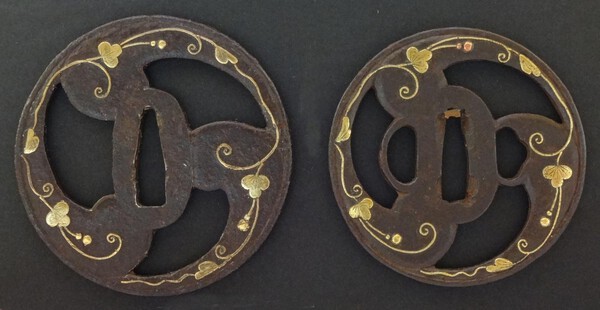
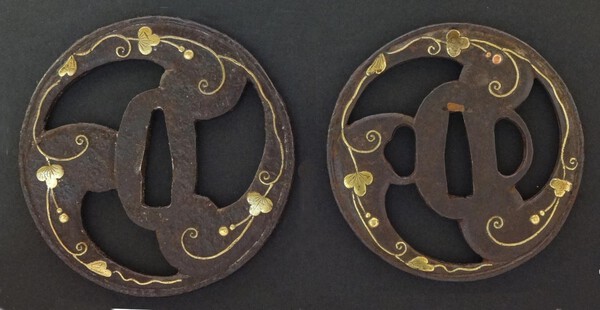
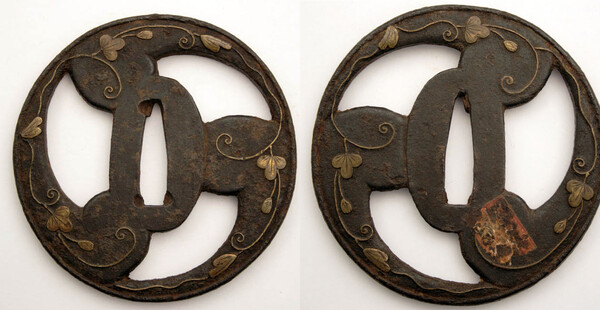
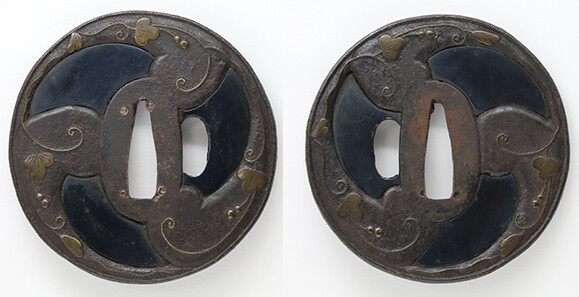
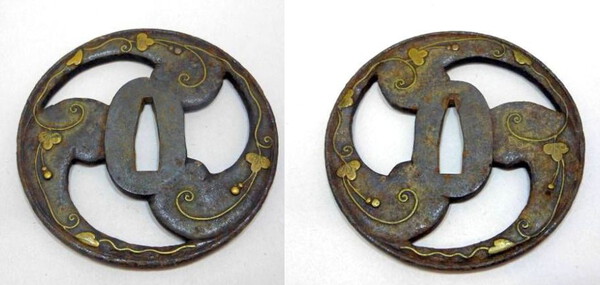
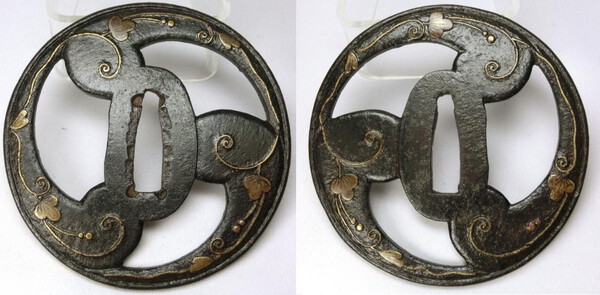
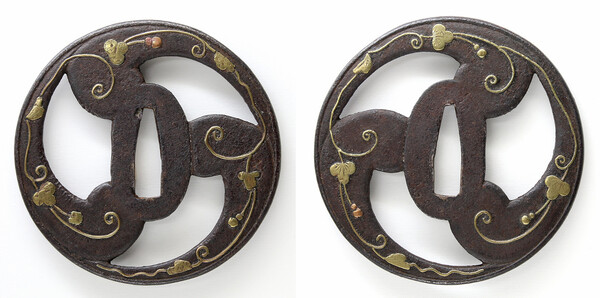
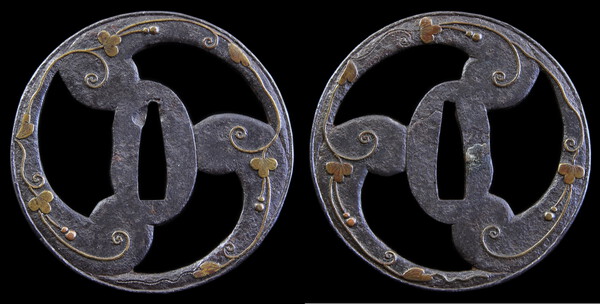
Hello to Everybody on NMB I have sort of fascination for Heianjo zogan tsuba. So I bought some over the years. Among those in my collection I have three that are extremely similar, practically identical in design differing just for their size. All tree tsuba are mitsudomoe testuji with bass inlay in the form of wines and leafs. The smallest of the tree has kozuga and kogai itsu-ana. The largest smallest I consider as part of a sort of daisho. I have found on the net several tsuba (fig-01 to fig-05) similar for design and dimensions to my trio as reported in the attached table. According to Haynes website: A form of brass inlay, see Figure 4.20. This method was used even in the old periods, but from the latter part of the Muromachi Jidai to the Momoyama Jidai, it was called HEIANJO ZOGAN and HIRA ZOGAN of SHINCHU (brass) was quite popular. There are a fair number of extant works by YAMASHIRO NO KUNI JU NAGAYOSHI, HEIANJO JU MASASHIGE, IZUMI NO KAMI KOIKE YOSHIRO, and the like. All my tsuba and the those found on the web look to be of the late Edo period to me, not as old as Muromachi. The workmanship and the designs of these tsuba look the same. Is it so also for a better trained eye? I mean there are subtle differences in the design and realization that I cannot see? I have rarely seen signed Heianjo tsuba (I could be wrong of course) and I have not find any specific information regarding schools or artisans (I could be wrong on this too!). In Heianjo tsuba there seems to be a sort of serial production of certain designs (this one and others). Is this due to the popularity of these designs reproduced by different group of artisans or can they be traced back to some workshop/groups or geograpic areas? I was wondering whether there are specific information about this style or school and whether it is possible to divide them by design or specific peculiarities. Also if anyone of you as information about this mitsudomoe design that he/she can share I would be grateful. Regards Luca Size Table --------------------------------------- tsuba-01 83.7 mm x 82.7 mm x 4.9 mm daisho (dai) 87.0 mm x 86.0 mm x 4.0 mm daisho (sho) 78.0 mm x 77.4 mm x 3.6 mm --------------------------------------- fig-01 83.0 mm x 83.0 mm x 6.0 mm fig-02 82.0 mm x 82.0 mm x 5.0 mm fig-03 85.0 mm x 85.0 mm x 4.5 mm fig-04 87.5 mm x 87.5 mm x 5.0 mm fig-05 84.2 mm x 83.6 mm x 4.5 mm ---------------------------------------
-
Books arrived in perfect conditions. Thanks Andi Regards Luca
-
Thanks everybody for the feedback... Luca
-
Hi to all May I ask you your opinion on this tsuba? http://www.aoijapan.com/tsuba-yoshiyasukao It is not exactly my kind of tsuba since I prefer more essential and simple one but I was wondering if it can be considered a good piece of good/average or above average execution and on which points this deduction is based... Thanks to all Luca
-
christianmalterre may I ask you the title and author of the book from which you took those pages scan. Thank you in advance. Luca
-
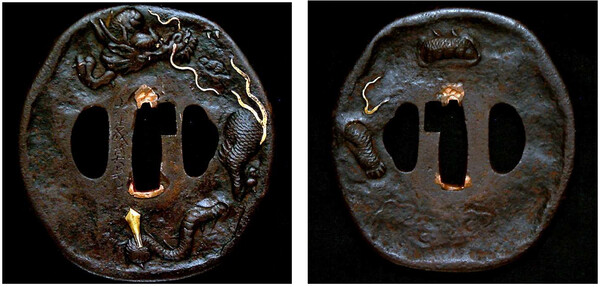
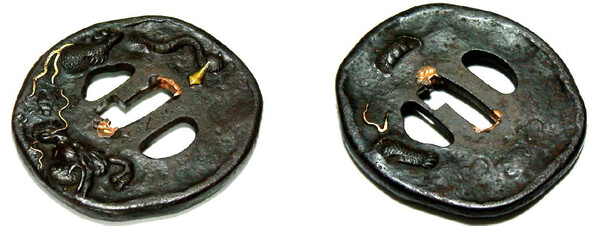
Dear All Sometimes I am a compulsive buyer so now and then I end up buying something I do not really like. This is the reason why I ended up with this tsuba (see attached pictures). The tsuba dimension are: 83 mm x 78 mm, 3 mm thickness at seppadai. The tsuba is signed Omori truide. From a quick image search on google I got the impression that the author of this piece is not THE Omori Teruide of most of the tsuba I have found. The overall quality of the my tsuba seems far inferior to me that I hear it screaming gimei. Also I didn't found any match in the mei comparing it with geniune Teruide work. Whiteout considering that ugly cutoff on the nakago ana side. Of course and comment from you guys is welcome. Regards Luca
-
"years"
-
Hello Everybody Grey I have left the tsuba soak in wd40 for more than one week without seeing any appreciable effect on the rust unfortunately. I will leave tomorrow so I have already applied some wax that I will remove when I get back, probably using isopropilic alcohol. The I will resume with bone (someone knows where to find fossilized ivory?) and the fiber glass pen I have just ordered. The boil+freezing will be last ditch option. Luca
-
Hi Geraint Your point is perfectly clear, the example you linked it astonishing, especially the ura side. I do not remember the cracks seeing it in Aoi offices, but it is possible... Thank you for the clarification. Luca
-
Hi all. Thanks for the tips (except for the sand blasting of Stephen ). Since I have to go abroad for a business trip I will put the project on hold for the some time. To avoid problems I was thinking to put some Renaissance wax on the tsuba to protect it temporarily until I resume the project. To remove the wax I was thinking to first boil it and then brush it with a tooth brush and some isoproplyl alcool. Then I will try with the fiberglass pen suggest by Grey. Any suggestion?
-
Hi Grey Thank you for the suggestion. I will try it. I have been working on the rust for some time now, first soaking the tsuba in wd40 as suggested by Elliot Long and then scraped it with cattle bone splinters. The rust is pretty hard, after more than 6 hours of total scraping time I have obtained few results so far. How frustrating... Regards Luca
-
Brian, James Thanks for the your indications. James, I am working on the red rust with a lot of patience and ox bone... Regards Luca
-
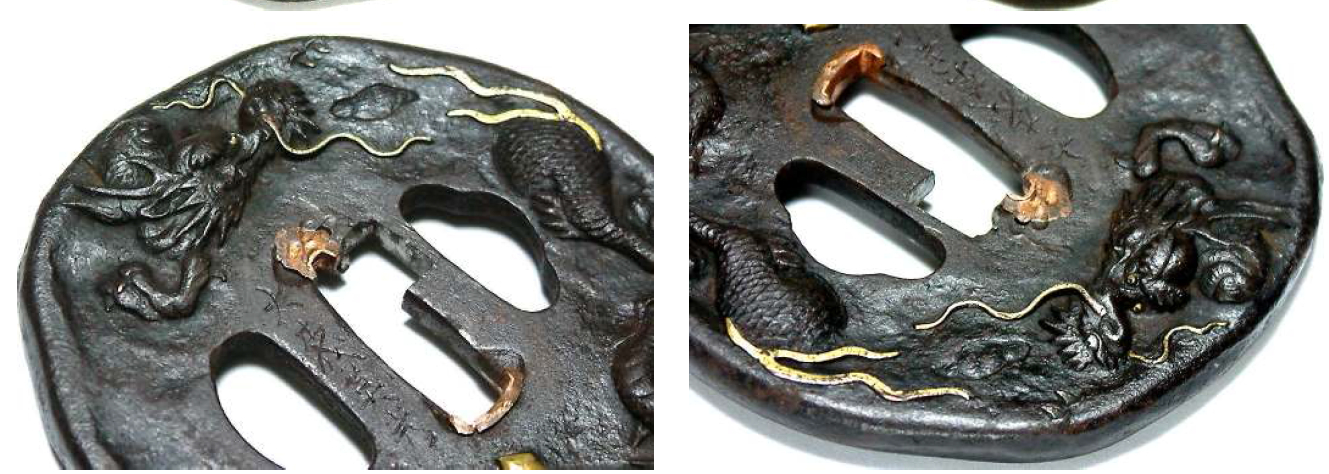
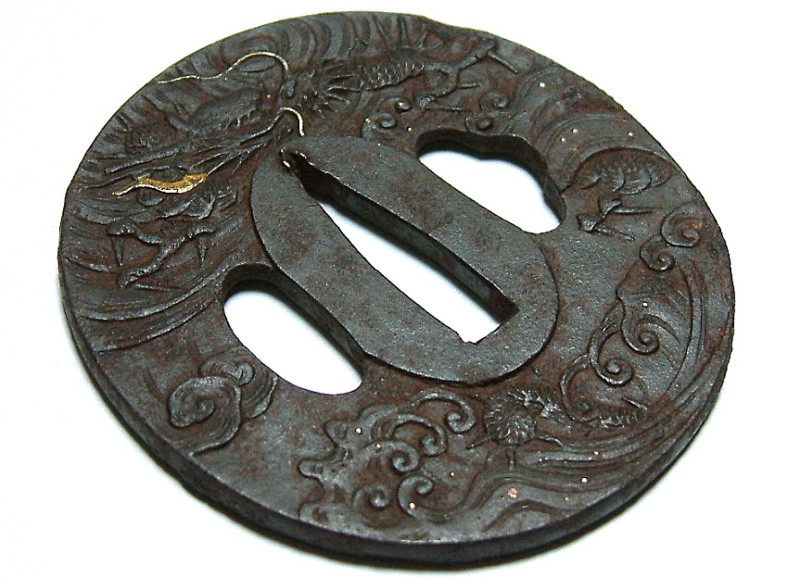
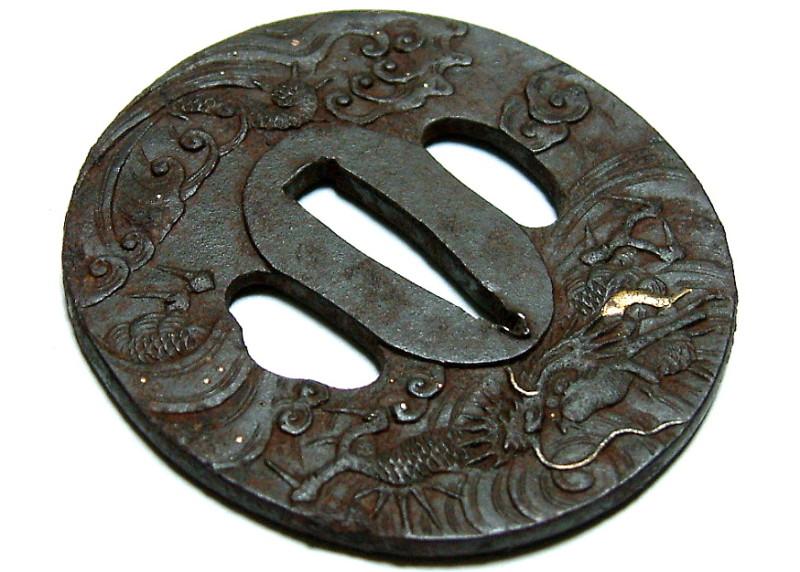
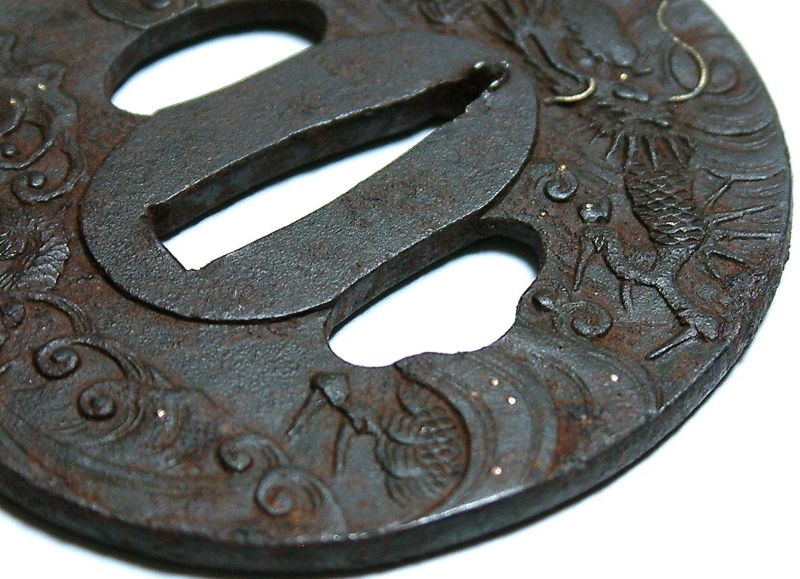
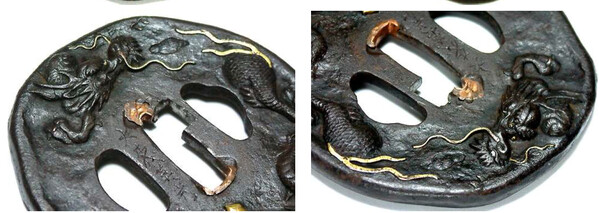
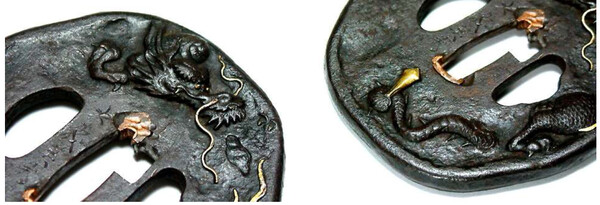
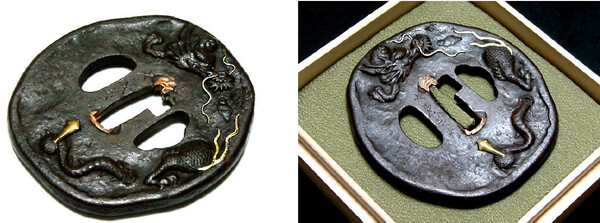
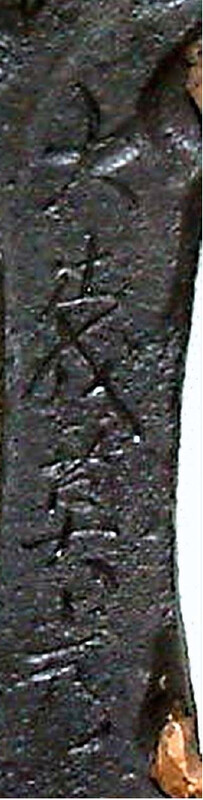
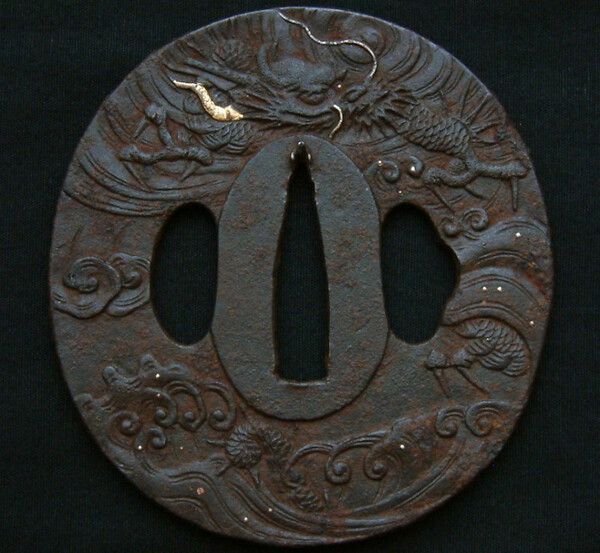
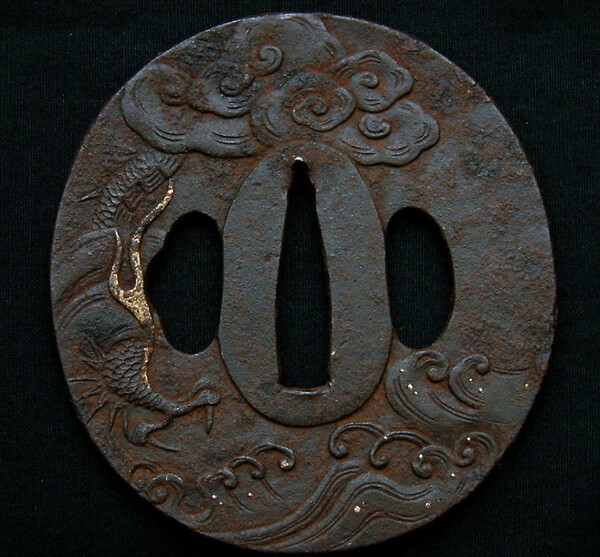
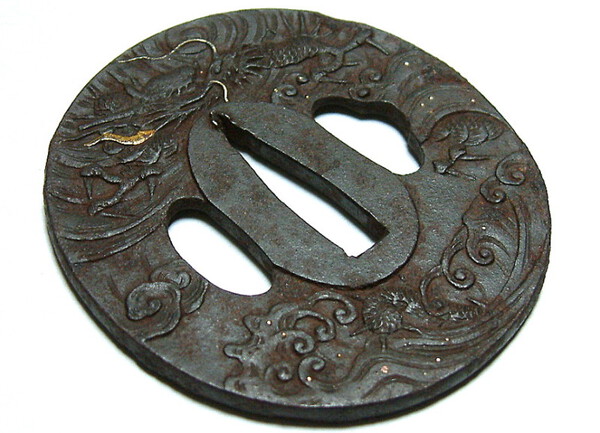
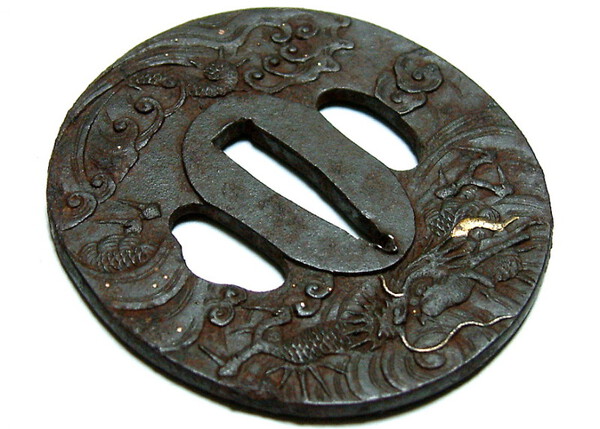
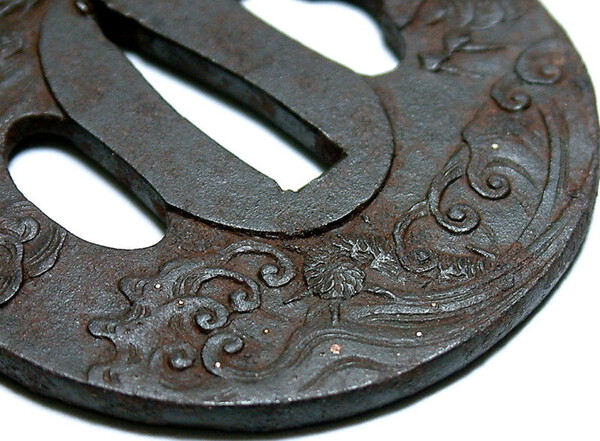
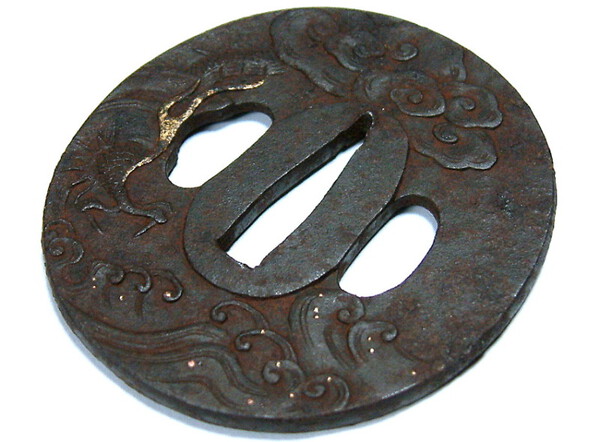
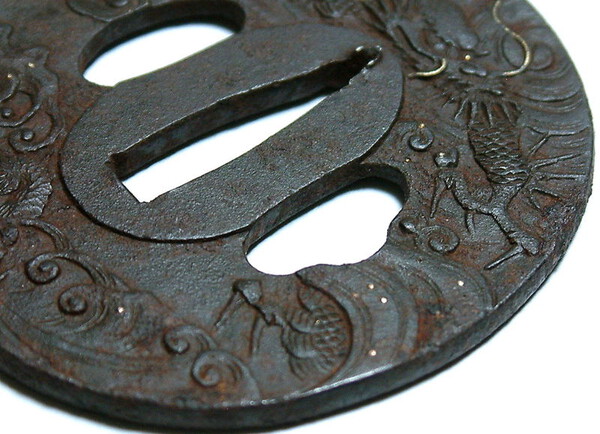
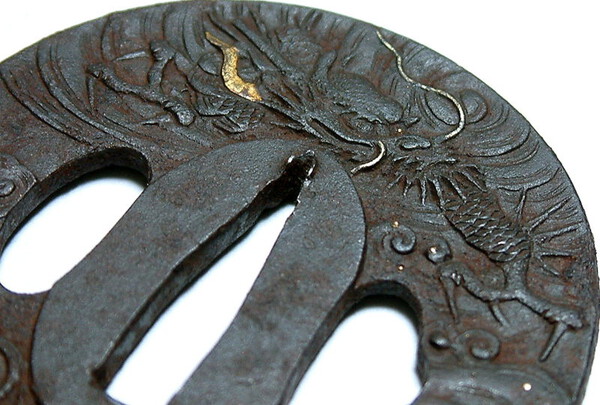
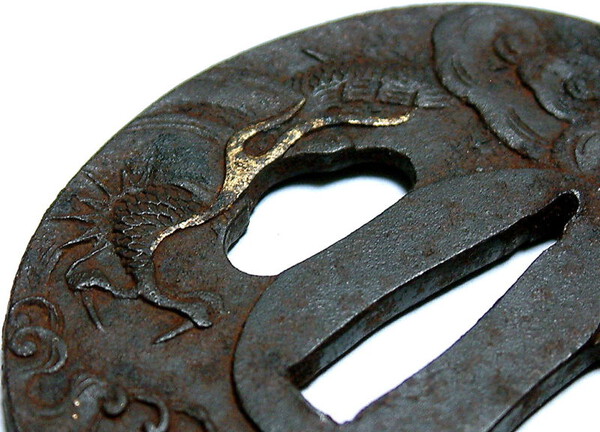
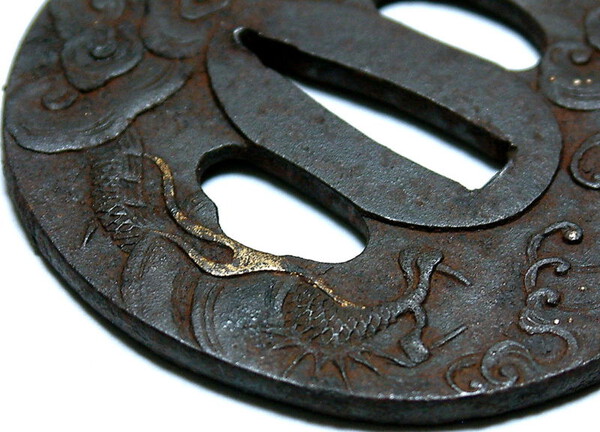
Dear All First of all I am a complete beginner in study tosogu so all your comments are welcome. I have bought a few years ago a tsuba with a dragon in clouds as waves depicted on it (see attached pictures). The tsuna is mumei with dimensions of 72 mm x 67 mm, 3 mm thick at the mimi. The material is iron. I have recently found a similar tsuba discussed in: http://www.militaria.co.za/nmb/topic/10748-1st-tsuba-purchase-info-on-tomokiyo-kao/ The design is quite similar both in subject ad realization. My tsuba is in definitely whores conditions with some traces of corrosion, or at least so it seems to me. Or they could be traces of casting. Casting could explain also the fact that the clouds, dragon and waves seems to be no as well defined as in the similar tsuba I was referring above. What is your opinion? Could this tsuba be considered just a low quality cast copy or it could be considered a legit Choshu tsuba even though of lower quality compared to the above? I have tried to remove as much rust as possible using cattle bone shims and rubbing it with rough cotton cloths following the advises I have found on this forum. The red rust seems to be quite stable and not active so far. Thank you in advance for all your suggestions Luca
-
Hi Geraint Thanks for you answer. Obviously the tsuba you pointed out are of finer quality compared to the one I posted, those are among the tsuba I have seen (in picture) that lead me to guess Nara. As for the wear you mention I have that chance to look at the tsuba in Aoi Art offices in Tokyo back in May of this year and the surface of the whole tsuba looked uniform and shiny without any blemish (migaki ji i guess is the right term). Your remark is too cryptic for me, sorry. Can you be more explicit. Do you mean that the quality of the work is poor and I have to look at it in closer or the opposite? As I said I am a beginner and quite dumb I was able to get more information about the size: 69.5 mm x 64.5 mm x 4.0 mm thickness. Regards Luca