SteveM
-
Posts
4,407 -
Joined
-
Last visited
-
Days Won
99
Content Type
Profiles
Forums
Events
Store
Downloads
Gallery
Everything posted by SteveM
-
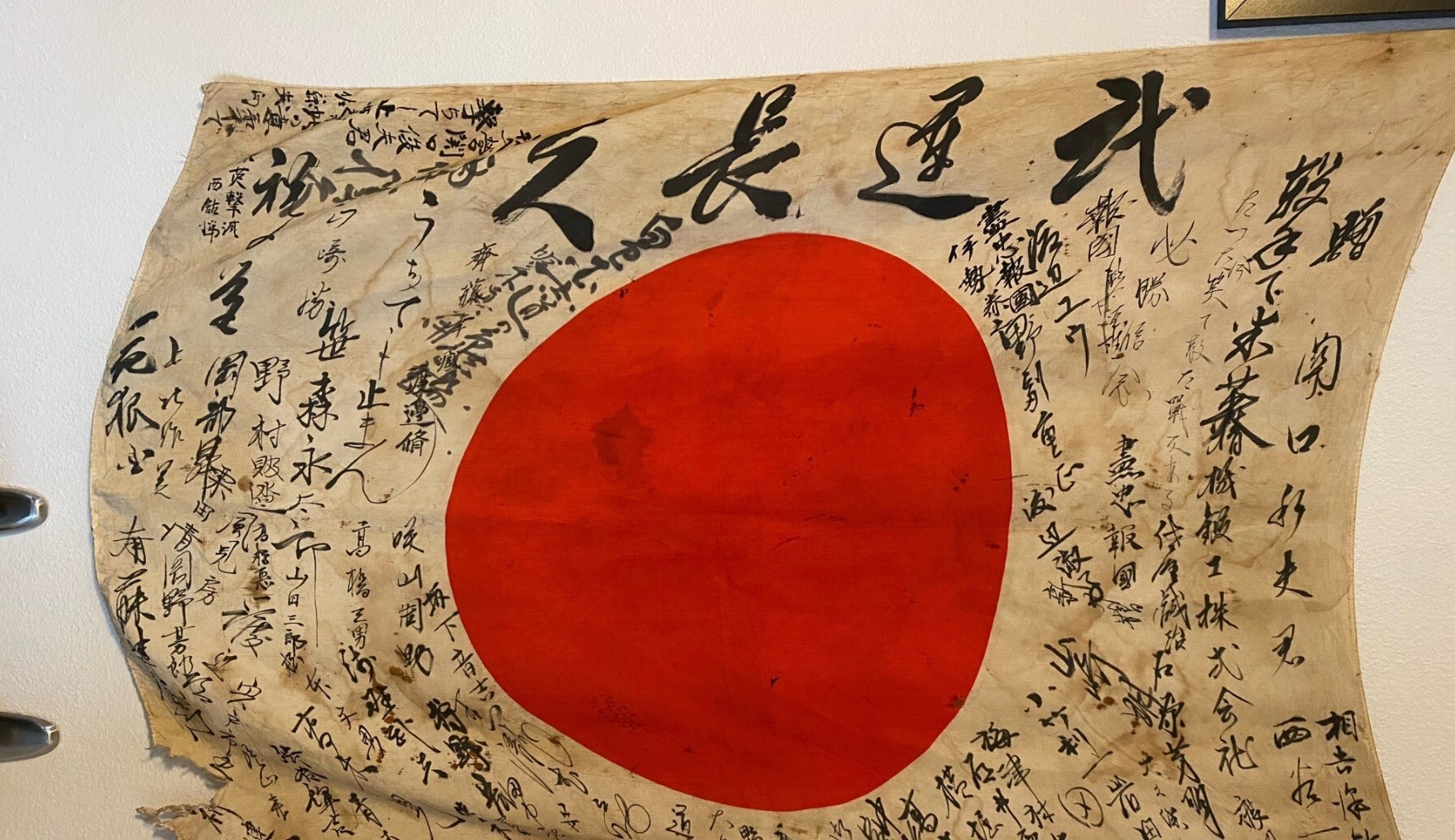
This is the correct orientation The big letters across the top read 武運長久 (būun chōkyū), which is basically "good luck in battle". The letters that go vertical down the right side are the recipient's name 贈 関口利夫君 Sekiguchi Toshio (not sure about Toshio). Sekiguchi is the family name. The rest are names and patriotic slogans. The flag was presented to Mr. Sekiguchi by his workmates at the company for which he worked. I can't quite read the name of the company. Some steel company, it looks like.
- 1 reply
-
- 2
-

-
The British Museum has done most of the hard work Title of the print is "Genpei Eiyu Kurabe" (written down the far left side of the print). It means "Comparison of the Heroes of the Genpei War". It's a series of prints feature legendary heroes. Next to that is "Kajiwara Genta Kagesue", which is the name of the hero in this picture - the one on the left. The other bits are explained on the page below https://www.britishm...t/A_1906-1220-0-1352
-
重寿 Shigetoshi The same smith as in the thread below
-
The artist's name is Kyokusui (旭翠).
-
Help identifying Japanese WW2 Banner
SteveM replied to AlphaRaider's topic in Translation Assistance
It is a banner that is written in commemoration of sending someone off to war. In this case, Takeshi SANO was being sent off to war, and his friends/colleagues created these two banners (and maybe others) for him. Its called a shussei nobori (出征幟). The reason we can't nail down the pronunciation of the name, is because that one kanji (健) has multiple possible pronunciations. It's kind of like the name Stephen, where it can be pronounced either Steven or Stefan, and the only way to know is if you ask the person himself (or his mother, father, etc.). You can't tell just by the spelling. My gut feeling is that "Ken" is not a popular pronunciation for this kanji during the early 1900s, so Takeshi or Takeru feels like more plausible pronunciations, but there is no way to know for sure. Even more exotic and rarer pronunciations are also possible, but those three are the most likely, and of those three my guess is that Takeshi is probably the most common. -
Thinking of going to this. Had a good time at the SF show and met a number of people I've only seen on the forum. I was also to pick up a few good books for good prices.
-
Help identifying Japanese WW2 Banner
SteveM replied to AlphaRaider's topic in Translation Assistance
Congratulations Sanō Takeshi-kun Edit: given name could also be Ken, or Takeru, or a few other readings. 7th Infantry Regiment The smaller writing on the bottom of the left and right banners are the names of the people who (presumably) presented the banners. Okegawa Tarō (right) Sakai -rō (left) the middle bit is missing -
Type 98 Noshu ju Tanba Kanenobu. Father or son?
SteveM replied to MacTheWhopper's topic in Translation Assistance
The translation you got was correct: Nōshū-jū Kanenobu-saku. Shōwa 18 nen (1943) I don't have any information about a father/son Kanenobu. I think this is Niwa Kanenobu (real name of Niwa Shūji). On some English sites there is a typo in the Japanese spelling of Kanenobu's name. Some incorrectly list it as 兼信 instead of 兼延. -
This site here also says Tōseizan (p.84). It suggests the date would be early20th century (Taishō-Shōwa). https://online.flipb...vrwj/index.html#p=84
-
Signature is 東正山造 (Tōshōzan-zō). Made at/by Tōshōzan. There are several possible readings, so the pronunciation might be slightly different (might be Tōseizan, for example). I just took a quick look on the internet and I can see Western collectors using both names. Ref: these guys say "tentatively" Tōseizan. I have my doubts. https://www.bluecher...-information#t_marks
-
Understanding the four kanji following zodiac date.
SteveM replied to Ron STL's topic in Translation Assistance
The three kanji (after 寅 - tora) are 旧節旬, which I'm sure is an allusion to a date on the old lunar calendar, but I don't know what date it would refer to. 節句 (Sekku) would be one a few specific dates on the calendar, for example Tango no Sekku would be May 5th), but this writing says 節旬 (slight variation in the kanji). This word doesn't show up in any search. My guess is that it is a spelling error by the person who wrote it, and it should be 節句. But that assumption still doesn't tell me which date it is.
-
To me it looks more like Yoshihiro (吉廣) of which there are seven metalsmiths using that name. There is a late Edo metalsmith with the name Yoshihide (吉英), but the second kanji on this mei doesn't look like 英 to me. And in late Edo, I don't think you'll find too many swordsmiths forging tsuba. It was mostly the domain of metalworkers, by this time, with maybe a few notable exceptions.
-
志号足立マ ? The last three might be a name. Adachi something (Masashi, Masatoshi, Masayoshi, etc.). Not sure what the first two might signify, other than a part number, or assembler's number.
-
Yes, the signature in Jay's post and the signature on the tsuba in the Worthpoint auction are both 正美 . Different guy from the 正義 who made the tsuba in Robert's thread. But both are pronounced the same.
-
Wakayama lists 4 smiths using 正美 (Masayoshi), but none of them are linked with the Mito school. That calalogue entry from Worthpoint might be mistaken.
-
Tea Caddy Signed Shomi Eisuke from Kyoto, Meji Period
SteveM replied to Bob61's topic in Other Japanese Arts
The two items I linked to have signatures like yours. This is the signature from the bronze box. Its identical to yours. (紹美製) Jomi-sei (made by Jomi) This is the signature from the bottom of the vase, and is a bit dark. It says Jomi (紹美) without the "sei" kanji on the left side. in a slightly different style, but still recognizable as Jomi. Here is another example like the first (and like yours). Jomi-sei. It is from the lidded jar at this site: https://www.kyoto-yakata.net/sale/57781/ Here's one from a vase at Sotheby's. Same as yours. https://www.sothebys...39-1899-meiji-period There are a lot on the web. These are kind of the easy pickings when I searched using google images.


-
Very unique way of writing 伊 (the first character of "Iga no kami"). I can't find any other examples where its written like this. That makes me suspicious. Mind you, I just took a quick look around in Fujishiro and on the internet. I haven't looked too deep. But also bear in mind that typically it is the sword that validates the mei. In other words, if the sword looks exactly like an "Iga-no-kami Kinmichi" sword, then the authenticators will deem the mei to be valid (assuming it, too, is within a reasonable variance to other authenticated mei). This is why collectors like to see the sword itself, rather than just a close-up of the mei.
-
主水正正清 Mondo-no-shō Masakiyo (this is the swordsmith's title and name) 享保六年八月日 Kyōhō 6 (1721) August
-
Tea Caddy Signed Shomi Eisuke from Kyoto, Meji Period
SteveM replied to Bob61's topic in Other Japanese Arts
I'm afraid I'll be no use to you on this question. From the sound of it, his name was used as a sort of "brand name" for the works produced in those 81 workshops. So your tea box may not be an actual item produced by the hand of Jomi Eisuke. Actually this kind of thing is common in the sword world as well. Tsuba signed with Sōten, or Seiryūken might be considered "genre" works - items of a certain style produced by workshops under the direction of the workshop founders or their descendants. Nevertheless, the works seem to be well-regarded. For reference https://www.freemans...an-arts-1673/lot/186 https://www.bonhams....2-late-19th-century/ -
Tea Caddy Signed Shomi Eisuke from Kyoto, Meji Period
SteveM replied to Bob61's topic in Other Japanese Arts
You might have better luck searching under the name "Jomi Eisuke" (or Jōmi Eisuke, although I don't think the macron over the "o" makes much of a difference when searching). Your item is signed Jōmi-sei (紹美製), "made by Jōmi". https://cefiro.main....Japanese_Makers.html -
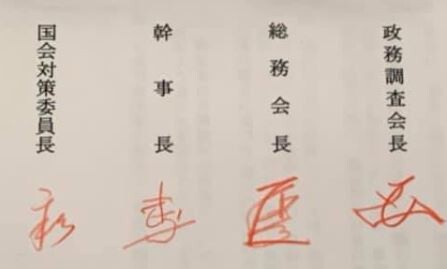
Also politicians. They are still used today. Current Prime Minister's is on the far right. Some more info https://en.wikipedia.org/wiki/Huaya
-
Wrestled with this a while but couldn't complete it 江戸 美(全)的姿? 馬 5 Edo beauties. I don't know what the event is. Just sitting around a table eating? Or is it a new year's meal of some kind. Or some other celebration? The character alone at the bottom is 馬, which may or may not be shortened version of the artist's name, and that artist might be Teisai Hokuba (蹄斎北馬) and he is just signing with the final character of his name.
-
Top: 松山 Matsuyama Middle: as Jean says, 正光 Masamitsu Bottom: 玉昇 Gyokushō
-
Another. Again, it goes without saying that they could all be mistaken.

-
Here are two sources saying Yoshitada was Kunisada 3rd. Of course, both of these sources could be mistaken. https://www.touken-w...ctory/inoue-shinkai/ https://meitou.info/index.php/井上真改