SteveM
-
Posts
4,356 -
Joined
-
Last visited
-
Days Won
97
Content Type
Profiles
Forums
Events
Store
Downloads
Gallery
Everything posted by SteveM
-
What Is Happening To Nihonto Message Board?
SteveM replied to Peter Bleed's topic in General Nihonto Related Discussion
I've just returned to the board after a 6-year absence. I haven't lost interest, but my interest has been pushed to the background by other things in life, as happens. My swords languished in my closet for the past few years. I just took them out recently to make sure they were still in good shape, and really struggled to get them out of the shirasaya so I could clean and re-oil them. I originally joined when the board was run by Rich (going back maybe 10 years) and it is nice to see the very high standard that Brian has maintained all these years. (Just found the videos by Ford Hallam... breathtaking). I think its good to welcome a lot of new enthusiasts to the world of Nihonto. It tends to be a very small, exclusive club, with a very high barrier to entry. Everything conspires against the newbie: the language, the price, the availability, the vast amount of crappy items or forgeries out there... so difficult for beginning students/enthusiasts to get reliable information. So, I say welcome newbies even they come with questions that can be answered by wikipedia-sensei. Very pleased to see the board in great shape and has so many high-level contributors. -
朧銀 Yes, "rogin" or "oborogin" as John above says. Both are correct, apparently, but in my experience I have only heard "rogin". It shows up in the Japanese wikipedia entry under the shibuichi entry. Shibuichi is an alloy of (typically) 1 part silver to 3 parts copper. The linked chart indicates also 1% gold. I think rogin may have more silver than is typically found in shibuichi, but I am out of my depth here. http://www.geocities.jp/atelier_hogaraka/shibuithi.html https://ja.wikipedia.org/wiki/%E5%9B%9B%E5%88%86%E4%B8%80_%28%E5%90%88%E9%87%91%29 Note there is an English entry for shibuichi as well, but it makes no mention of "rogin". And, I'm also wondering if the kashira in the picture used in the English entry wouldn't be greatly improved if that kashira were restored to its original lustre, as shown in another thread by Ford Hallam.
-
Did a search for Tashiro Minamoto, and it seems that Kanemoto (兼元) or even Ichi-Kanemoto (一兼元) is another possibility. 田代源一兼元 http://entry.winners-auction.jp/productDetail/42441 ↑ Not a great shot, but if you are web-surfing with a monitor it should be OK.
-
Sorry, it was pedantic of me, but I thought it might be useful to make the distinction. Like in another concurrent thread I was completely thrown by what I thought was the kanji 倅 (segare), but it turns out the kanji was actually 焠 (niragu). Slight change in the radical makes all the difference in the word/phrase. And both are obscure enough to be out of daily use, yet it crops up here in the sword world. Anyway, a slight diversion, but hopefully useful or interesting to people who are studying kanji.
-
Yes, I think you are right. 焠 (this makes two new kanji I have learned from this thread) My gut feeling is that this is still a problematic mei. The name, the highly unusual kanji... The curious use of 勝永 on one side, and 臣 on the other. It seems a bit much... but I have been surprised before.
-
A slight correction. 末関 = Sue-Seki. 未 would be Mi (a different kanji meaning almost or incomplete). Confusingly similar, but the top horizontal stroke on sue (末) is longer than the stroke underneath.
-
Hello Daniel, You already have the name of the smith: Fujiwara Yukitoshi (藤原行俊). The kanji 行 could also plausibly be read as Iku (as indicated in your original post), but I favor Yuki as a more likely reading. So, to avoid doubt Fujiwara Yukitoshi, or Fujiwara Ikutoshi Both are possible. The former is more probable, in my estimation. Regardless of the reading, since the smith doesn't appear in any of the obvious reference sites or materials, one has to assume it is a rather obscure smith, and not as famous as the sites linked above are asserting.
-
Yamato - Den Monju - Please Help With Translation
SteveM replied to Moley's topic in Translation Assistance
Or woman -
Yamato - Den Monju - Please Help With Translation
SteveM replied to Moley's topic in Translation Assistance
Hello Moley/Gwen, I think normally the site here likes to think of itself as a learning site, and not necessarily a free translation service. So the ladies and gents here prefer you to pick up what you can from the other resources available. Most of the official certificate is boilerplate, and the only things unique to your wakizashi would be the items #2 and #3 as shown in the nihontocraft site linked to earlier (as Jean said above). What we do do quite often is try to decipher, decode, and otherwise translate signatures on blades. These can be very tricky, even for experts. Other short bits of Japanese would also be fair to pitch to the crowd here. This is my 2 cents. I used to frequent the board regularly many, many years ago, and am just coming back after getting my interest re-kindled, so I may not be the best person to pontificate on the what is acceptable. Steve -
Yamato - Den Monju - Please Help With Translation
SteveM replied to Moley's topic in Translation Assistance
Also, Your wife is right - the alignment of #2 is correct. And... you say this is a tanto, but the paper indicates it is a wakizashi. . -
Looks like an unusual collection of kanji 臣忠夫倅之 Jin Tadao Segare Kore (with a very stylized "Tada") Which one might translate as "made by the son of Jin Tadao", but that would be a very loose translation because A) there is no "made" in that mei, and -B: "Jin" is not a typical Japanese last name C) Segare, meaning son, is not a kanji I have ever seen on a mei. A bit strange. These together with the highly stylized Tada make me think the signature is a bit suspicious. You have the other side right. 勝永 Katsunaga
-
I see the same design, different mei here http://www.geishasblade.com/shop/accessories/nagamushi-snake-brass-tsuba/
-
Did you grandfather just buy this from Yahoo Auction in Japan yesterday? Cause the same sword is showing up there. Edit: Seems like a very obscure smith. The reading might well be Yukitoshi, but that still doesn't turn up much.
-
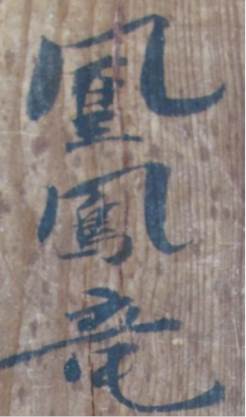
Funny, I just noticed that the person who wrote 鳳凰 got the kanji reversed. On the box its written mistakenly as 凰鳳 (ō coming before hō). Could be an honest mistake, as the kanji are indeed similar, but.... the great Kanzan Sato making an error like this on hakogaki?? Seems unlikely.
-
Hō-ō Ryū 鳳凰竜

-
Kanzan 寒山

-
Found two other examples of this motif 「乃字猿」 http://www.tokka.biz/fittings/TS533.html http://okazakipark.com/museum/db/kikaku/E/e041%20token.htm Still searching for an explanation... Edit: Found a third one http://aucview.aucfan.com/yahoo/b166820306/ 2nd Edit: Found a fourth one http://blogs.yahoo.co.jp/jcbmy121/14051071.html This fourth one hints at the tsuba being from the Yasaka school. Yasaka is the name of a temple in Kyoto that is associated with the three wise monkeys mentioned above (hear no evil, speak no evil, see no evil). The Japanese name of the temple 八坂庚申堂 (Yasaka Kōshindō) has the zodiac character for "monkey" in it (申). May be getting close to something. Grev I think the accompanying kanji for 乃 would be 禾 (ine) instead of 末, but my guess is that this line of inquiry is a dead end. I don't think the monkey is Hideyoshi. Will keep looking.
-
No. It is possible that over time he changed his signature to include the Fujiwara name, which is a name that is associated with nobility. Unfortunately you also have to consider the possibility that this is a forgery, and the forger left off the Fujiwara kanji, for whatever reason. It something I can't determine from the pictures, but as I've hinted a couple of times above, I have some suspicions. Sending it for shinsa would be one way to help determine its authenticity. Good luck!
-
I think definitely this is supposed to be Kunitake. The mekugi-ana (peg hole) is placed such that one might suppose uji (氏) is a possible candidate for the last kanji, but from the other parts of the name it seems obvious that its supposed to be Kunitake. As to whether it is authentic or not, I leave to the experts. It slightly resembles the engraving on the lance/halberd (槍) posted above. But the kanji for Kuni and Shiro in your sword are quite strange, and strangely-rendered kanji are usually a hallmark of fake signatures. Engraving the kanji into the nakago is a very deliberate process. It's not like signing your name, where occasionally you slip or put too much strength into one part or the other. Engraving the kanji is a somewhat time-consuming process where each stroke requires some deliberation. It's almost impossible to have an "oops" moment where you would slip and screw up a kanji in an engraving. Sword-related terminology is a unique thing, and requires some study. Japanese people unfamiliar with swords would not know what to make of any sword jargon. Terms that we casually throw around: nie, nioi, shinogi, nakago, boshi, jihada, hataraki, etc... either have no meaning in everyday Japanese, or have meanings other than what they mean in the sword world. It is a specialized vocabulary. Likewise, signatures from even a hundred years past, like yours 「平安城住國武作」 means nothing to modern Japanese, and I'm not surprised that a Japanese person who is not a sword enthusiast would think it is Chinese. Edit: Actually Uji (氏) can't be a candidate because the long vertical stroke of the final kanji on your sword is piercing the top horizontal line. This isn't the way to write Uji, so we can rule this out as a candidate.
-
Translation Assistance - Child's Katana (I Think)
SteveM replied to TroyCHunt's topic in Translation Assistance
Probably not a child's katana per se - that is to say, not one that you would give to the kid so he can run around the house with it, terrorizing the cat. But it might be something made for a wealthy family for "Boy's Day" (端午の節句). There is a similar katana that shows up every year at one of the dealer's stands at the Daitoken Ichi here in Japan. A very small katana (actually wakizashi size, but it is meant to be a miniature katana) in a kairagi scabbard. I've looked at it a couple of times, and I think the dealer explained to me that it was a festival sword as above. Always tempted because the scabbard is lovely, and it is reasonably cheap, but since I've seen it there year after year, I can only conclude that its not a popular item. As Ask says above the other side says Nihon Kaji Sōshyō 日本鍛冶宗匠 -
A Family Friend Brought This Back From Wwii (Us Marine)
SteveM replied to jesse's topic in Translation Assistance
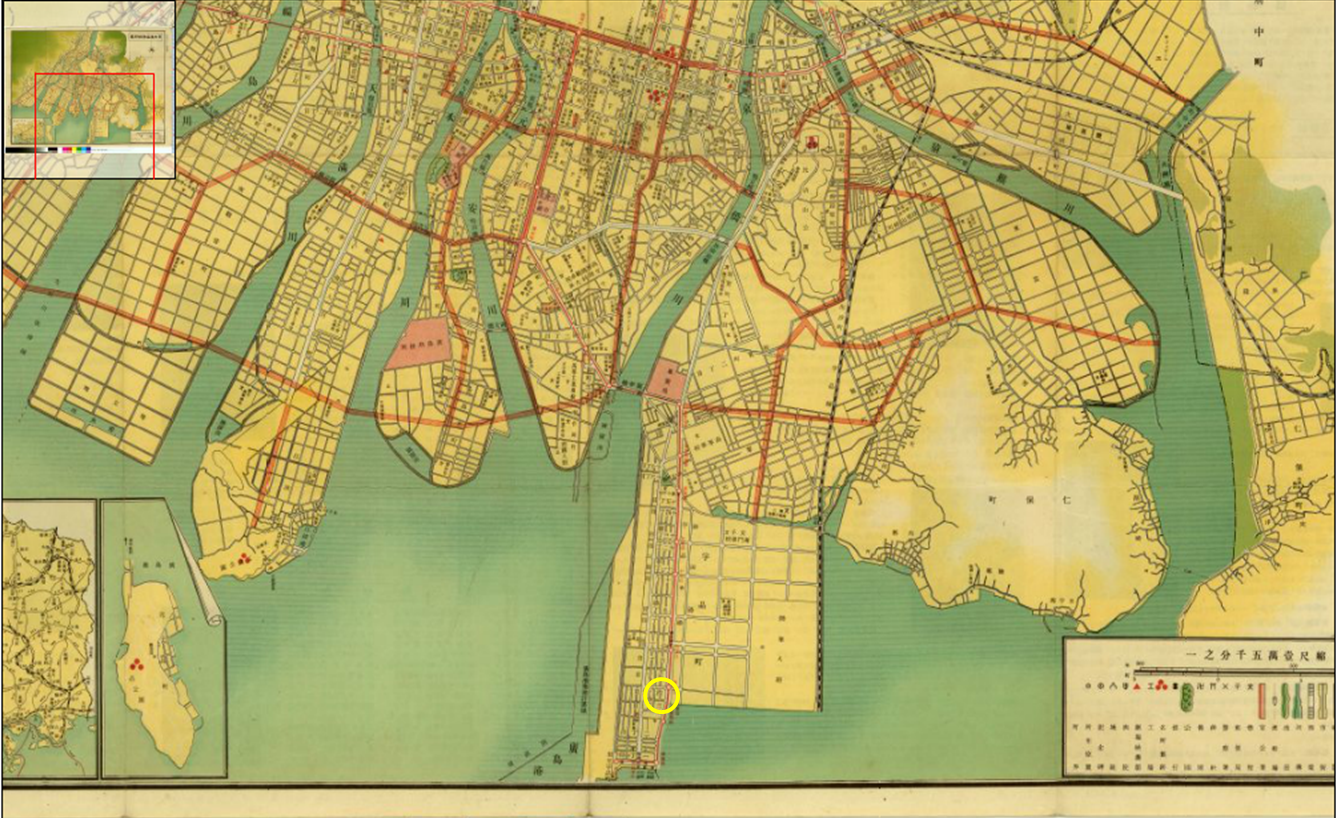
Looking through some old maps and found where Ujina-cho, Kanda-dori 4-chome would have been. Thought Jesse might be interested. Alas, the address system has changed, and that old address is no longer valid. Today it would be close to where Motoujinaguchi Station is. The map is from 1940. I've put a yellow circle where Kanda-dori 4-chome would be.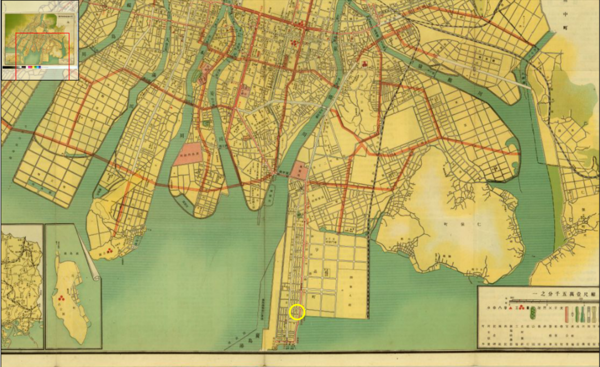
-
Hello Thirdtuck, Your sword may be much more recent than the 1600s. It is possible that it was made in the 1800s, and someone added the Kunitake signature to give it the appearance of being much older. It is extremely common in the sword world (then as well as now). I'm a bit of a purist with regard to swords, so I would be very careful of using any solvents because if you don't know what you are doing you could end up doing harm to the blade. Even if the signature is fake, the sword might still have some merit, so best to take care of it until someone can tell you for sure what you have. The uchiko is a good idea - look on Amazon if you don't know what this is. And, as above, get a book on swords. John Yumoto's book used to be the default beginner's book. Maybe there is a better one now. Wakizashi or Katana depends on how long it is. Traditionally a katana is anything over 2 shaku (about 23.8 inches). Anything under that would be a wakazashi. There is some elasticity in this definition, but that is the general rule.
-
I'm a bit suspicious of it because; 1. The unusual rendering of shiro (城). 2. The unusual rendering of kuni (國). This looks like no kuni I've ever seen before. Don't know if it's acceptable to link to the following commercial sites or not, but The respected smith of the 17th century looks like the following http://kako.nipponto.co.jp/swords2/KT213238.htm (Typically with Fujiwara added to the name) Here you can see a "Heian-jo ju Kunitake" (w/o Fujiwara) that is supposedly authenticated. Looks quite different to the signature in the sword above, and quite different from the OP's sword. http://lll.pro.tok2.com/sword/sdata97/ja606b.htm
-
hidden papers can anyone translate some of it?
SteveM replied to shan's topic in Translation Assistance
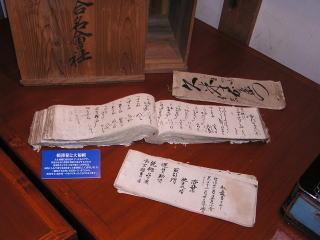
Hello Shan, I'll take a stab at this... I can't really read much (any) of the writing, but it almost looks like some sort of shop ledger; the way there are certain lines that end at a specific point on the paper, terminating in the same repetitive kanji. You sometimes see things like this in antique shops here in Japan (I guess people use them as interior decoration). The only thing is that usually these old ledgers and inventory lists have the thickness of, say, a telephone book, and are long and thin - like the ones in this photo... so I could be wrong on this. SteveM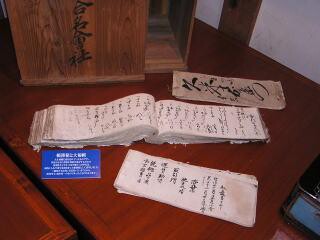
-
If you are researching so you can try to return the sword to the UEDA family, you could start with the Kochi City Hall (maybe the board of education), or the Kochi Police Dept. (public safety section - the guys that handle sword registrations). Maybe they would be interested to try to track down this person's family. I was just reading about the kinds of gunto that are allowed so there is a chance that you couldn't repatriate it, I guess. If you are just looking for info on UEDA-san, I don't know where you would start, but its kind of tricky because its not such ancient history. His relatives are no doubt still around, and if you get in contact with them, but aren't considering returning the sword... its kind of awkward. And of course, its not entirely implausible that UEDA-san himself is still alive.