Peter Bleed
-
Posts
1,866 -
Joined
-
Last visited
-
Days Won
8
Content Type
Profiles
Forums
Events
Store
Downloads
Gallery
Everything posted by Peter Bleed
-
Sad News -- Paul Davidson
Peter Bleed replied to Kanenaga's topic in General Nihonto Related Discussion
Paul's passing is a tragedy. I will miss him personally as dependable friend and wise advisor. We worked together on a couple of adventures that I recall with fondness. He had a wonderful manner and a common touch but Paul was also a deep and real expert. His collection is amazing and his library without par. A sword visit to Paul involved systematic presentation of pieces arranged and curated to address the topic at hand. Paul responsibly supported sword collecting in ways that will be hard to replace. He was advisor to the JSSUS and was also, of course, President of the NBTHK-AB. He was also the rarest kind of serious collectors. He built an amazing collection of high quality blades, fittings, and armor. And he did so at the highest level. Everything in Paul's collection was just right, fully documented, and appropriately preserved. His contributions to sword appreciation absolutely need documentation. He was also hale and dynamic and the exact image of someone who would last forever. We all assumed that Paul would be there when we would need him. I truly can't understand what American Japanese sword collecting will be like without him. Peter -
interesting little rig - good koto Mino, when guys needed them
-
The satisfaction of owning a sword you like and know is "good" is undeniable. BUT for many of us poor vulgarians there is also a great deal of satisfaction to be realized in "finding" a sword, "cleaning it up", "researching" it, discussing it with a crew, investing a lot of dough in it, and waiting for the system to poop out a result. That can be the hobby. Peter
-
matsuda Kanetaka 1935 Hmmmm? Peter
-
Truly a virtuous piece and Geraint's assessment was wonderful. Peter
-
Is this "decorated" nakago a known thing by this maker?
Peter Bleed replied to waljamada's topic in Military Swords of Japan
yeah, and dated 1943 -
Looks pretty new to me. Kanetoshi - mebbe- as a signature, but overall I see this a a mass produced exercise sword Peter
-
I hopped on this thread - hoping and expecting to see an Ainu blade. This piece is rather rustic, but hihgly refined. I see this as a very nice Japanese blade. It is terrific, but not Ainu. Peter
-
How do you showcase your nihonto?
Peter Bleed replied to Oshy's topic in General Nihonto Related Discussion
My collection is a result of search and discovery so I really enjoy "finding" my swords when I get them out. As I result I keep very little of my Japanese stuff out and visible. I remember with pride when I visitor to our home, after looking around said, "I thought you collected Japanese swords." Now if I could only figure out how to store rapiers! Peter
-
Dear Friends, Please allow me to present an image I recently acquired. I am interested in early photos of even earlier swords. And in that pursuit I "found" the attached image. It doesn't fit what I was interested in, but I was bored and the whole Covina thing has us al running in strange directions, so I followed it there in the world's fleamarket, and.... I find this an interesting image.The photo has no marking beyond the name of the photographer K. Yamanaka from Nakatsu. I think that is a place in northern Kyushu. It is also undated, but I read it as either very late Meiji times or maybe even Taisho - that is a pure guess. Let's start with the sword the gentleman is holding. It does not to my eye look exactly like any of the gunto types I have seen. I don't think it is a Type 32 sword. It looks closer to what Jim Dawson calls a Type 8 Riding Sword altho the shape of the backstrap seems like less than a perfect match for anything he shows. And I would like to have a different perspective on the tsuka. Notice, too, that it seems to be equipped with a leather barrel sword knot. Moving to the fellow who is shown with the sword, it is fair to start by saying that he is holding NOT wearing the sword. He is in Japanese clothing so there is nothing like a sword belt. He is wearing a mon-zukuri haori and a couple of other layers. He has what looks like a billed cloth cap that might have a small central pip of some manner, but it doesn't look like any of the military caps I have bumped into. He is also wearing tabi so I assume he showed up at the photographer's shop wearing geta. All this to say that I don't think his fellow is dressed at all in a military or other official outfit - - right?? Now, let's look at how he is standing.First, he is holding this apparent gunto with edge up, as if it were a katana. And he is also holding a carpet bag. Together with hat and the rest of his outfit, this suggests that he was getting ready to travel. The fellow also seems to my - aging - eyes to be too old to be an active soldier. Could he be a "old soldier" who is getting ready for reassignment? Peter

-
cuir bouilli in Japan
Peter Bleed replied to Peter Bleed's topic in General Nihonto Related Discussion
There are times when I approach the NMB like Amatarasu doing a dirty dance in front of a cave in hopes of getting the important spirits to come out (If I have misremembered this story forgive me. You should hear my recollection of Genesis). My point is that NMB is a wonderful resource when a naive can pose a question that draws out real experts. I think I shook my bootie pretty well today. I drew out Ian! Thank you, Ian, and let me say that the Fur Trade Museum also mentioned the "Leather in Warfare" volume. Peter -
cuir bouilli in Japan
Peter Bleed replied to Peter Bleed's topic in General Nihonto Related Discussion
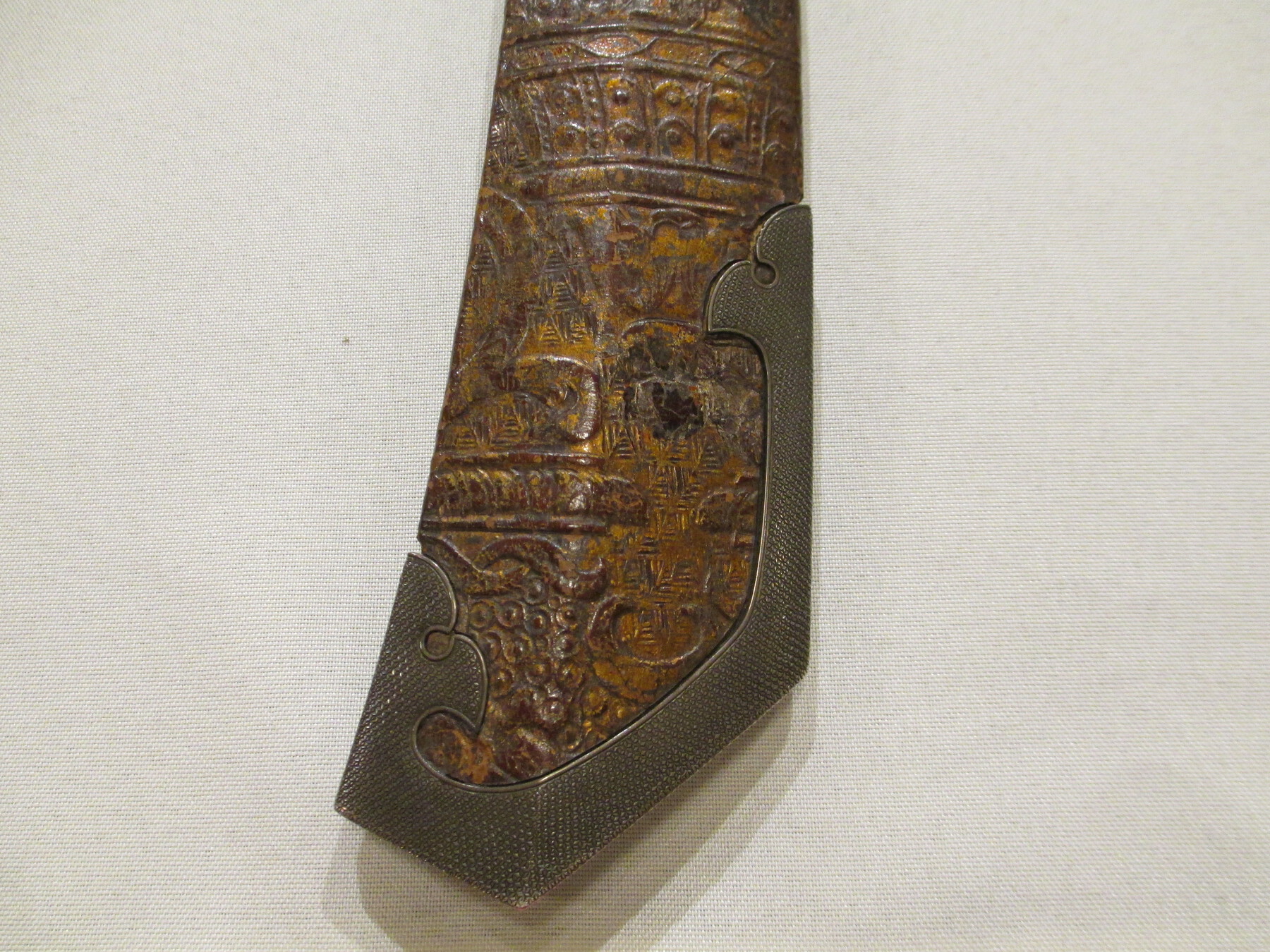
Thank you all for these interesting replies. In the popular understanding leather working was the specialty of so-called Burakumin or Eta folks. I had seen one of these pictures but not the one with the fellow painting the drum. They are very neat, Thank you David. In popular presentations these folks are often classed as "untouchables" and the folks in these images might seem a little unkempt but it also seems fair to view these folks as careful handlers of a field they monopolized. A friend of mine - now departed- studied the archaeology of Meiji period Eta sites because they got way (!) into bone working and made bone tooth brush handles for the world - but I digress. I will attached an image I have been permitted to attach to this discussion. This is a snippet, but it really looks to me like it was not made in Japan Peter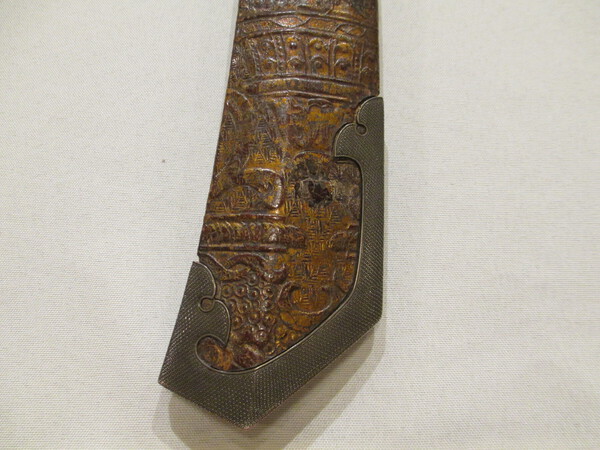
-
I have been asked to assess what looks to me like a rather clean Type 95 Non-com's sword - round iron tsuba with top lock. Base on pictures it retains most of the paint on the tsuka and seems 'clean." It has been a long time since I had any contact with this market. I'd appreciate guidance. Peter
-
cuir bouilli in Japan Out of interest in Nanban fittings etc, I recently discovered an article that describes the Dutch trade of deer hides from Taiwan into Japan during the Edo period. And that made me recall a wonderful wakizashi a friend owns that is fitted with “Nanban leather.” I asked for help from the (wonderful) Fur Trade Museum and they identified this stuff as “cuir bouilli” which is boiled leather – altho it doesn’t actually involve “boiling” (Be that as it may, I bet that a red wine is still appropriate accompaniment.) So please allow me to ask this august body if we are aware of other Japanese cuir bouilli. Or should we assume that Japanese workers used leather that was “boiled” or otherwise prepared before it arrived in Japan. Leatherwork was hardly a common craft in Edo Japan, but there certainly was interest in exotic materials. Peter
-
Sean, Thank you for following up. And I agree with Piers that it sure looks like the nipple is missing. I suppose that it could be this gun was set up for some manner of "pill" or some other alternative to a percussion cap. In fact, this gun look like it is pretty highly machined and "designed" so it might be a specialty. Now, selling such things follows the old cowboy axiom, "Going out on the buffalo range, depends upon the pay.." You could put a price out there and see if you get any takers. A couple of these did sell - rather slowly IMHO- here in NMB in the past year. Check the files to see how they went. Peter
-
I would never read this signature. The NMB is a great resource. Peter
-
it says made in china
-
Sean, Thank you for showing us an interesting shooting iron. I am interested in how technology changes and that is what attracts me to these late modifications to Japanese matchlock guns. My opinion is that you gun is much older that the modifications that it shows. As a guess I'd say the gun was made at about 1700 or so, but that the ignition system - and other changes date from something like 1860. This was a moment in world history when firearms were evolving rapidly and when Japan was under great external threat. They were very interested in percussion cap technology. It was one of the "secrets" that Admiral Perry was specifically asked about. And not incidentally by late 1865, the world was awash is surplus cap lock arms. It was in that window that lots of Japanese gunsmiths explored caplock systems. Most collectors avoid these modified matchlocks for two reasons" 1) they aren't 'original' , and 2) there are challenges to getting them into Japan. That means their 'value' is not what Japanese collectors will pay. Bottom line, these guns interestingly reflect a moment in Japanese and world history. Peter
-
Can't judge his smithing, but his penmanship was - ahhh - dodgy Peter
-
INDEED! The o-tanto by Yasushige is a perfectly worthy Japanese swords, BUT that Southeast Asian sword is very interesting. Please forgive me if my lust is showing! Peter
-
Bushu ju Yasushige saku Looks like a nice old sword. I'm off to the books Peter
-
Dear Colleagues, I recently discovered an interesting article on the Dutch deerskin trade out of Taiwan and into Japan in early Edo times. This link will hopefully point anyone interested in the right direction. https://www.academia.edu/35305851/Emergence_of_Deerskin_Exports_from_Taiwan_under_VOC_1624-1642_?email_work_card=view-paper There is nothing in the article that is directly replated to swords, but we are all aware that so-called Dutch skin or "namban-kawa" was feature of Namban style. The odd pieces of that leather that I have seen are all pretty thick. In the conversations I have had about this stuff it was always assumed to be "European" and beef hide. I THINK(!) it should be possible to tell the difference between deed and cow, so I am wondering if there are any inspectable pieces of "Namban-kawa koshirae". Anybody got any of this stuff? Peter
-
- 1
-

-
Question: Who's it for? Answer: The guy who wants to look like he is the richest one at the whore house.
-
Well, gee, Rodney, welcome to the world of free kantei. I have to say that I do NOT agree with Michael - at least not completely. My guess (!) is that this may be a "Japanese" blade albeit not a "samurai sword." The proportions are all screwed up, but the geometry is pretty good. The tang ( oh pardon me, tsk, tsk) the "nakago" is strangely long and it has got a filled hole, but it looks to me like typical Seki treatment. And it sure doesn't "look" Chinese at least it doesn't look like recent Chinese fakery. I could believe that this is some manner of an early Showa-to or conceivably something made in China during the pre-War 20th century. I also would concur that you had best stick with the NMB! Peter
-
Wonderful rig! I would love to know the history - where was such a wonderful weapon sitting - ignored and unhandled - long enough to end up in this condition. Please tell us what you can about its history. Peter