ROKUJURO
-
Posts
6,689 -
Joined
-
Last visited
-
Days Won
29
Content Type
Profiles
Forums
Events
Store
Downloads
Gallery
Everything posted by ROKUJURO
-
I agree with you as far as the surface is concerned. Indeed, steel can have a grain on the molecular level, but metals do not have pores or interstitial spaces. If it were so, oxygen could penetrate deeply into metals and corrode them internally. But as you know, archeological finds of steel often are heavily corroded superficially (we had some nice examples lately here in the forums), but if cut open, the metal core is completely intact unless there are cavities caused by the working process or accident (cracking). This can happen by repeated folding and incomplete fire welding, but also by insufficiently refined basic steel which may contain remains of slag or scale (seen as FUKURE or WARE in a blade). What we see as HADA are tiny welding seams between layers of the steel, and they indeed represent an increased surface for oxygen attack which is why we regularly inspect and clean the blades. But if the smith made no mistakes, these small surface irregularities (if compared to a glossy polished surface like MIGAKI-JI) do not go deeply into the metal.
-
Ron, could you please explain what you mean by 'porous'? If you had raw TAMAHAGANE in mind I would not have asked, but ALL metal? Do you refer to the surface which could be ground, filed, hammered, or polished and be more or less easily attacked by corrosion?
-
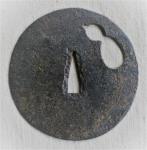
Interesting little TSUBA! I don't think that the rim displays I no ME decoration. To my old glass-eye it looks like flower petals, but the picture came only half the size so maybe I'm off.
-
I read that MEI as NAGASHIGE. It is also on the tag.
-
Dan, before you spend your money on TSUBA that are probably not useful for the purpose, why not ask the TOSOGU expert members to provide some high resolution photos of fire welded steel TSUBA which you could easily magnify. This may do the job as well or better (I hope).
-
Thank you, David, this was indeed helpful. And don't worry: I am not going to produce 'old' TSUBA in large numbers! But there is so much to learn and as I have some experience with steel I find an approach from this side useful and informative. Still, I have the feeling that in many TSUBA different techniques have been used in one place, and I think that besides the mechanical work chemical treatments - you may call them patination, etching, artificial aging, bronzing or browning - were playing a major role in the surface treatment. As an example, TSUBA from KANAYAMA or YAGYU are so different in their feelings and looks of the steel itself that I find it difficult to believe that they fell from the anvil ready with their respective surfaces. TEKKOTSU is, as mentioned above, something that will not protrude from the TSUBA surface by itself. So there are still some questions left open for this life and the next....
-
Pas mal. There are no details shown in your photos so it's difficult to give a well-based opinion. Obviously it is SURIAGE (shortened) which could have had different reasons.
-
Pete, thank you for your explanation and the pictures! However, I am still not quite sure how the surfaces in many TSUBA were really treated. If we have a look at a TEMBO TSUBA there is probably little doubt about how the dimples and stamps were executed, but the beautiful KANEIE TSUBA displays nothing like hammer marks although the surface may have been worked on with TAGANE and a hammer. Why then should we call that TSUCHI-ME JI? Could it be that many TSUBA experts can make statements as to the provenience, age, and style of a TSUBA, but do not know enough about the manufacturing process? This may sound like a provocation but as I wrote above, many descriptions seem to lack a deeper understanding of the metal itself. As an example I would like to mention the definition of TEKKOTSU which is often repeated but likely wrong as being 'hard steel bones'. Also, I get the impression that many descriptions are just copied from what was written some time ago, especially in western languages, as there were only limited sources for Non-Japanese. However, I was not going to criticize these authors but I am really interested in the techniques behind the descriptions and would like to read other's opinions as well.
-
Gentlemen, in descriptions of TSUBA I have often read about the different techniques to produce certain surface textures. While I can understand most of the expressions and can relate them to the use of the respective tools, I am unsure what is understood when TSUCHIME-JI is mentioned. When I work with a hammer I can produce a very smooth surface almost without any trace of the tool. When it is intended and the hammer face is small and closer to ball-shape I can produce shallow indentations which are easily visible as such. I would call that TSUCHI-ME JI. David, please allow me to cite your comment in the description of your latest purchase, the KACHUSHI TSUBA, just as an example: '.....The plate is well forged with a fine TSUCHI-ME-JI surface.....'. While I cannot be sure to see every detail from a photo, my observation is that of a surface with remains of black lacquer the texture of which I would like to call ISHI-ME JI as I cannot see hammer marks. There are many ways to texture different metal surfaces, and stippling with a fine hammer might result in very fine indentations just like ISHI-ME JI I have seen on soft metal TSUBA, and that might still be called a hammer technique. My question is what can be called TSUCHI-ME JI and can you draw a precise line between techniques performed by hammerwork and others made with punches or similar tools, MIGAKI BO, YAKIITE or chemical treatment? Are there perhaps several techniques found in a single TSUBA surface?
-
Ben, no, I cited the thickness.
-
Matt, if you had a 99.9% pure iron blade then it would be worth something because this material is quite expensive (see: http://www.aksteel.eu/de/1-produkte/0-reineisen/). On the other hand you could bend it with two fingers (or three...). So I am quite sure that the jeweler's spectrometer can perhaps tell tomorrow's weather but is not as precise as you would like it to be. If it had measured 99,4% or less, then I would have believed the remaining percentage to be carbon and this would have left some hope for a good tool steel. Stainless steel is another story: to make a corrosion resistant steel you want to have about 17% of chromium in the alloy. If your sword proves to be stainless as it looks to be, then the spectrometer is perhaps only working for gold alloys.
-
BENSUKE, welcome to the NMB forums! I hope you will enjoy the NMB and learn a lot as I do! Your feeling is quite correct: If properly placed, the TSUKA will not be supported on the KATANA KAKE, otherwise the cutting edge might damage the SAYA. By the way, your blade seems unusually thin with 0,55 mm...... Please sign your posts, it is a rule here.
-
Jean, wonderful items and great work from Ford! I have been looking quite some time at this TSUBA, I like it very much, but I was not sure about the condition as it looked as if there was a repair weld on the right side on the MIMI. Perhaps it was only corrosion?
-
Hoanh, as far as I know these TSUBA are cast from bronze with a lost wax model. The modelling is probably a meticulous work, and the positioning of the tiny dots must be quite difficult, I think.
-
Adam, thank you! That's what I wanted to express!
-
Keith, if there is an expert to answer this competently, it is Ford Hallam!
-
It is possible that my old eyes do not work correctly, but while the NAKAGO seems to have some age (or was made to look so) the HAMON on the pictures does not look convincing to me. I cannot see any activity and my first impression was that of an etched HAMON, not even artificially polished. Looking closely at it or under magnification, is there NIE or NIOI to be seen?
-
Gentlemen, the upper two pictures of SHINAE on the KSKY website do not show a 'weak' or 'poor' steel. These kind of cracks are typical for a local overheating in the forging process or, as Chris points out correctly, in the hardening. I have seen this a number of times, and it always looks exactly the same. In fact, these cracks across the structure of the steel represent a weak spot in the blade and might cause failure in use/battle.
-
Could it be an old TABAKO-IRE without it's KISERIZUTSU? Maybe a hint that someone gave up smoking? (Unlikely with Japanese, I know!)
-
Peter, If I had to clean it I would use a steel wire brush (on an angle-grinder which works like hell, or on an electric drill, or the good old manual brush). If it were very easy to remove the rust, a brass wire brush would be good enough. Once the rust is removed, you could use an oil spray like WD 40 (not so good on the wall-paper) or you spray the whole item with clear semi-matt lacquer. Wish you good success! P.S. This is not the way I treat my TSUBA!!
-
It surely looks like one. There are different types as far as I know. The one in the picture seems to have a relatively short and quite heavy chain, so it might have been made for decoration only. A KUSARI-GAMA in action can be seen in the fight between MIYAMOTO MUSASHI and SHISHIDO BAIKEN (http://www.youtube.com/watch?v=uKqU8wxUAsU).
-
Looks like a well preserved WWII blade, oil-hardened, signed KAZUNORI. Nothing really special. Seems the vendor just dreams of a lot of money.....
-
Leather first changes the colour when it dries out, it usually becomes brighter. Applying a quality leather care (as recommended, saddle grease is best) of course brings back the original colour. A good leather grease contains natural ingredients like bees wax but no mineral oil or vaseline. Linseed or TUNG oil will harden the leather which is what you want if the material has become too soft and flexible.
-
As many authors seem not to know the correct spelling, here is another link: http://en.wikipedia.org/wiki/Hait%C5%8Drei_Edict
-
SUISHINSHI MASAHIDE info: http://www.nihontocraft.com/Suishinshi_Masahide.html