ROKUJURO
-
Posts
6,472 -
Joined
-
Last visited
-
Days Won
24
Content Type
Profiles
Forums
Events
Store
Downloads
Gallery
Everything posted by ROKUJURO
-
As far as I know KO-KATCHUSHI TSUBA are mostly quite thin and can be large. The DOTE MIMI might be a hint for a KATCHUSHI design, but in this case the plate seems relatively recent and not as old as KAMAKURA JIDAI where the beginning of KO-KATCHUSHI TSUBA manufacture is located.
-
Looks like a Japanese blade in a south east Asian KOSHIRAE (Myanmar, Thailand or so)
-
Actually, the use of meteoric iron in the manufacture of blades is not very rare. It has been used by the Malayan EMPU, the smiths of the famous kriss, for a long time, and some bladesmiths still use it today in very special knife-blades. Generally, meteoric iron is low in carbon but rich in nickel content, which allows a combination with another steel with high carbon, high manganese content to receive a Damascus steel with good contrast. So it is very likely that a KATANA blade with satisfying technical properties will contain only a small portion of meteoric iron, merely for a publicity effect.
-
Hoan, could this be http://en.wiktionary.org/wiki/%E8%A5%BF? Looks similar!
-
Grev, perhaps it is KATO TERUAKI of the ISHIGURO school (AIZU SHOAMI)?
-
Louis, I have seen a few like this. To me it looks as if heavy corrosion had been removed in an amateurish way to stop the rust. The results are not beautiful.....
-
Red Rust On Nakago - How To Treat (Covering Mei)
ROKUJURO replied to CurtisR's topic in General Nihonto Related Discussion
Curtis, this does not look really bad to my eyes! I would not even call this 'covered with red rust', although there is some of it. The NAKAGO is intact, and a soft brush might already do the job. I even used a brass brush without doing any harm, although I had to wipe off some brass 'colouring' from the NAKAGO with oil and a rag. Of course you might proceed more sensitively with a KAMAKURA period blade.... -
Hearthammer, please sign your posts with at least your first name to be politely addressed. Wherever the blade was found or what story you were told, it is very probably not Japanese as far as a photo allows a comment. MUNEMACHI/ HAMACHI are not in the traditional positions, the NAKAGO is so crudely made that it does not at all seem Japanese, as was said before. A comparison with original Japanese blades would show you what a blade should look like. If better photos should provide evidence for YAKIBA/HAMON or HADA, then another judgement (falsely shortened blade?) might arise. By the way, the TSUKA ITO (handle binding) is not Japanese.
-
Axel, I would really like to have Ford's comment on this TSUBA. To me it looks like a new CNC copy of an otherwise nice design. I may be completetly wrong, but the lines of the SUKASHI are not as smoothly cut and filed as I would expect from a traditionally made TSUBA. To my eye, it looks as if some drilled holes have been used to form waves, but maybe it is my lack of experience to judge this way.
-
Steven, to my old eyes the animal looks more like an ox instead of a boar. Have a close look!
-
Correct, but that applies also to your post!
-
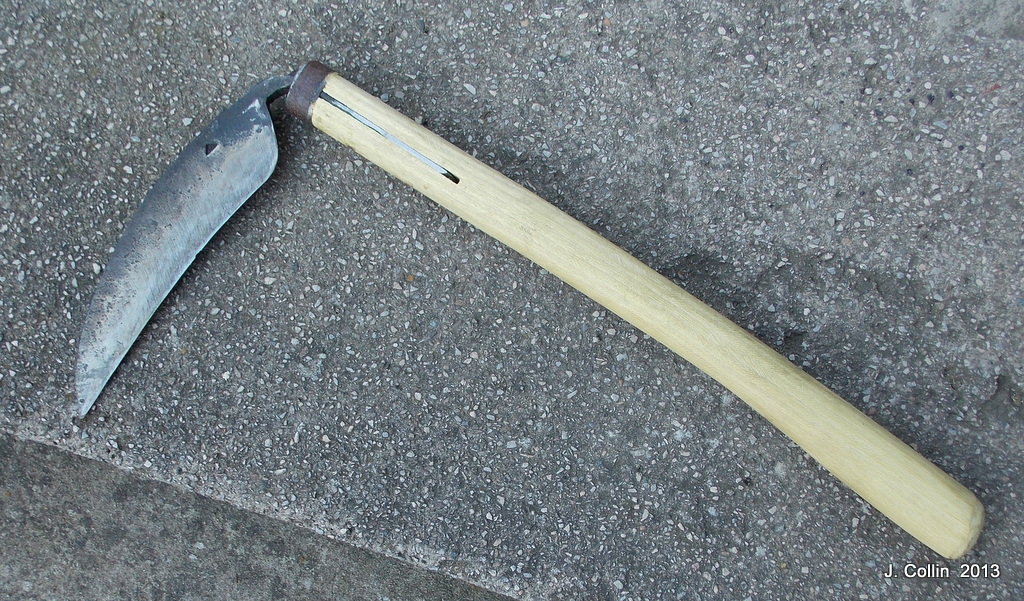
Kama, Jingama, Kusari-gama, Kama-yari etc.
ROKUJURO replied to Bugyotsuji's topic in General Nihonto Related Discussion
I can only offer a picture of a standard KAMA which I made a while ago and which I use in the garden. It serves very well the purpose.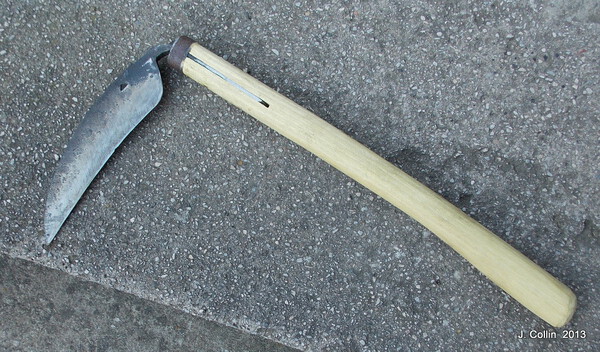
-
Grev, I cannot add any idea to the design of this TSUBA, but the TAGANE around the NAKAGO-ANA show a strange form. The metal seems to have broken and did not react as usual. Are you sure it is not cast?
-
Jason, if you turn the photo 90° to the right you may probably see a NATA, a Japanese hatchet. It is frequently seen, I even have a TSUBA with a NATA for sale.
-
It is probably FURUZAWA.
-
Gentlemen, I have read that in Japan the water temperature was believed to be the same in February and August, so many blades were dated in these months. May sound a little unprecise to Westerners, but would explain an attitude.
-
I received my book just today! It was worth waiting for it! Thank you, Markus!
-
Guido, Ian was faster than me and gave a basic description. Not too much is known about how exactly the Chinese proceeded, but today we know what is necessary to decarburize cast iron to produce the desired material. It is not necessary to copy the text here, it can be read under http://en.wikipedia.org/wiki/Malleable_iron.
-
You are missing what Ian refers to: Decarburization is done with cast iron which has a very high carbon content (up to 4 -5 %). If the process is controlled, the result will be malleable cast iron which has a number of useful applications. Decarburization of a tool steel (having roughly about 0.5 to 1.3 % carbon) will indeed result in a lower quality with loss of strength and possible hardness. The whole discussion is useless without practical experience and profound knowledge of metallurgy. Exchange of opinions will not lead to better knowledge.
-
Craig, the TSUBA could be the best part of the package, but we would need good enlarged photos for a comment. The TSUKA is about the size of the short NAKAGO which has obviously been messed with as already stated. The TSUKA ITO has not been wrapped in the correct way which is food for the thought that the whole set has been put together. The blade might have suffered from a broken KISSAKI and a subsequent amateurish try to fix the damage. Just my thoughts, not an evaluation.
-
As usual, it depends on what you see in it and what you can do with it. The seller states:...Having value for research and study purposes..... I would use it that way or as raw material to forge knife blades from it. A repair is out of any possibility, but I have seen blades with a nice NAKAGO welded to them. It was usually well made but in most cases still detectable.
-
The delivery of that blade will be a shock for the new owner because FedEx is dedicated fright service... (from the seller's description)
-
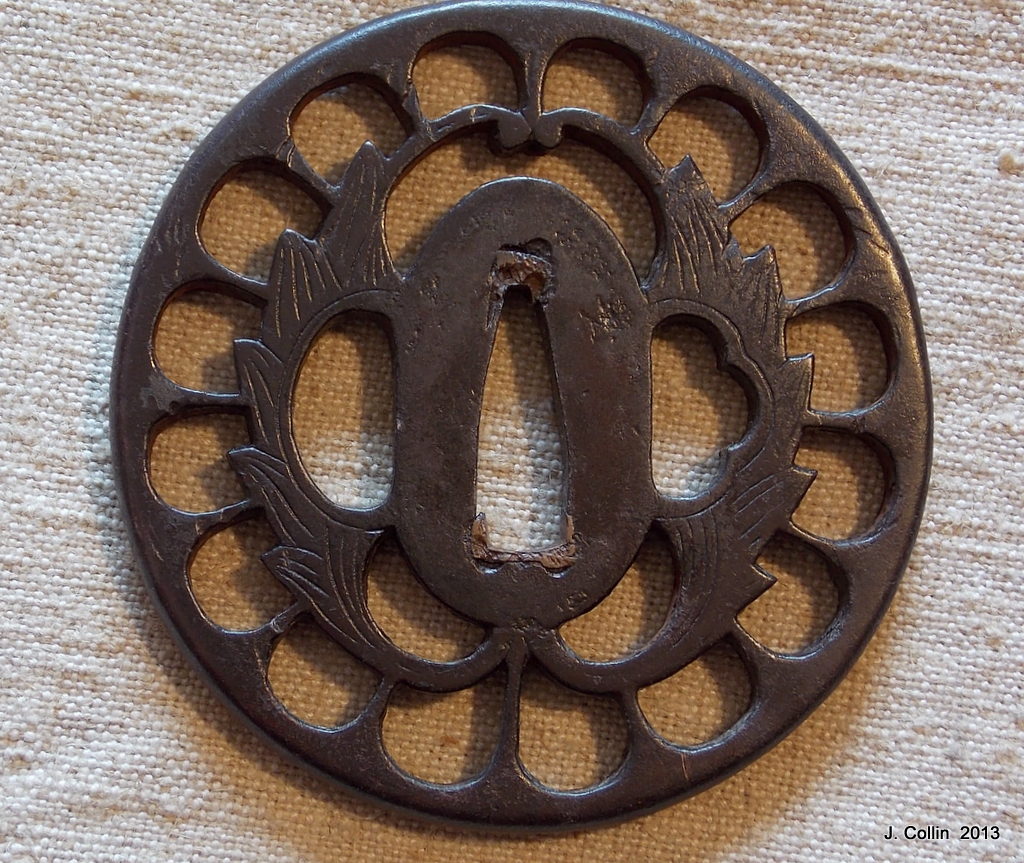
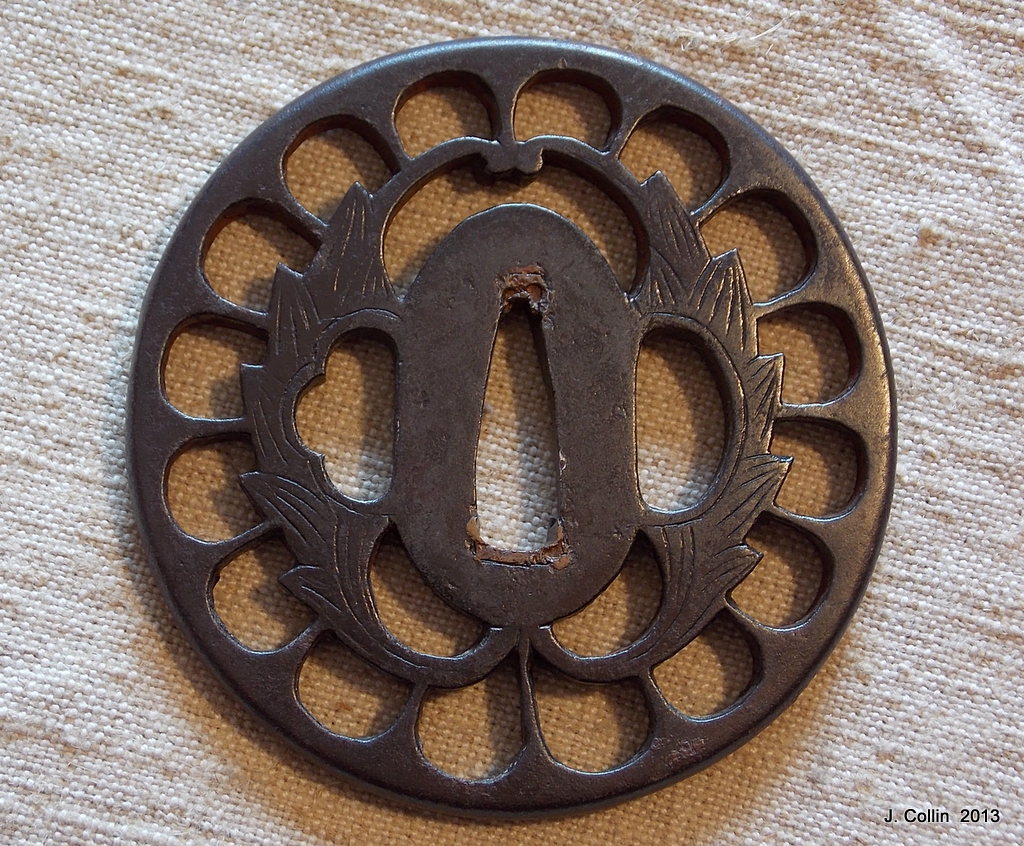
This is my favourite piece.
ROKUJURO replied to Nickupero's topic in General Nihonto Related Discussion
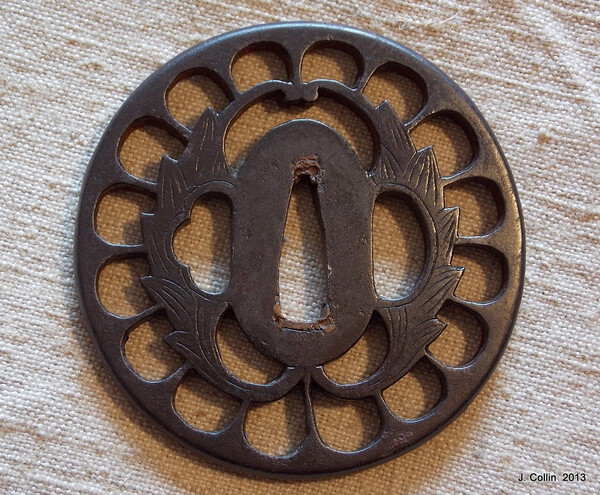
Gentlemen, this TSUBA is perhaps not a splendid one, but I like it: It measures 75,4 by 75 mm and is 5 mm thick. The colour is an even dark chocolate brown, the design is KIKU to MYOGA. I was told that it might belong to a HIGO sideline school, dating in the early EDO period. Any comment is welcome.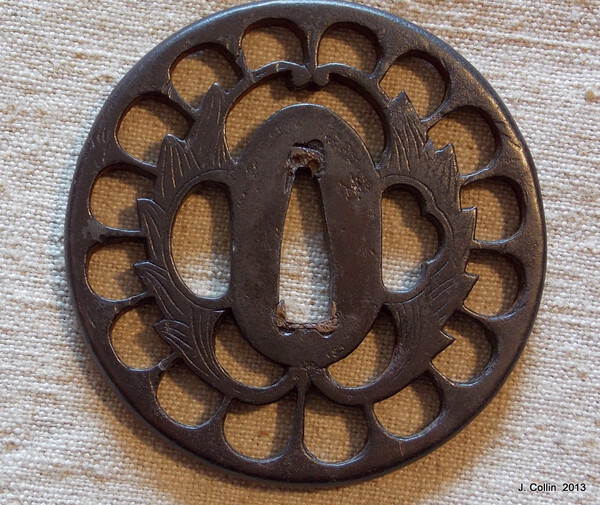
-
Chris' message can only be underlined. I think the key to many visual effects on a blade does not lie in the aesthetic approach and guesses about their origin but in a deep understanding of the qualities and reactions of steel. In the manufacture of a sword blade, a very large number of facts and fundamentals have to be looked at and experienced, and if you are not deeply familiar with every aspect of the forge, you might miss important points. Looking at a blade without this knowledge is close to Platon's allegory of the cave: You can discuss endlessly without really getting to a result that is supported by reproducible evidence. If I may just grab the term UTSURI from the discussion: We know where we can see it, we also know that it cannot be seen in a bad polish, and we have assumptions of how it might have been produced, but in the end we do not know for sure. It may have been influenced by a special material source, but if we look at the perfection of a really well made blade, we know that the KAWAGANE was sometimes very thin over a complex SHINGANE core, and so we have also to take carbon diffusion into account. I don't say that this is the solution, I only want to mention that lots of facts may be hidden under the surface and need more research before we can make statements. This may be a bad example as I don't know if nowadays' swordsmiths can produce UTSURI and know the facts, but I wanted to stress that we need competence for a judgement. A famous Chinese painter once said to his pupil: You will only be able to paint bamboo after you have become a bamboo.
-
Grev, very good and useful work! Thanks for your effort! Thanks also to MORITA-SAN and Brian for the adaptations.