Grey Doffin
-
Posts
4,226 -
Joined
-
Last visited
-
Days Won
31
Content Type
Profiles
Forums
Events
Store
Downloads
Gallery
Everything posted by Grey Doffin
-
 I think if a blade in this condition were given to a properly trained polisher, along with the normal polishing job, some of the rust on the nakago would disappear. Then it might be possible to read the mei. However, this is something that shouldn't be attempted by anyone without proper training. Grey
 -
goinlower's items of interest
Grey Doffin replied to John A Stuart's topic in Auctions and Online Sales or Sellers
Hi Goinlower (what's your name?) To do a good job of appraising such a large collection you need more and better help than you can get by posting pictures of NMB. You need someone who can examine the pieces in hand and give you an informed opinion as to value and best way to sell (if the items will be for sale). To find someone who is both qualified and honest won't be easy, and you will have to pay for the service, but it is the only way you'll ever know what you have and what it's worth. Grey -
Here is an auction out of Japan ending soon http://cgi.ebay.com/ws/eBayISAPI.dll?ViewItem&item=320474616458&ssPageName=STRK:MEWAX:IT The seller admits the tsuba is cast and claims it dates to the 1860's (looks more like 2009 to me). I doubt someone making a cast copy pre-Meiji would have cast the seki-gane; they'd have been removed 1st. Amazing the price this is going for. Grey
-
It would be even more interesting if I read and understood Japanese. Grey
-
Thanks for the help guys. Grey
-
It could have been made in China (most likely), Pakistan, Thailand, maybe Spain, maybe some place else, but not in Japan. Grey
-
Just the habaki, George. Grey
-
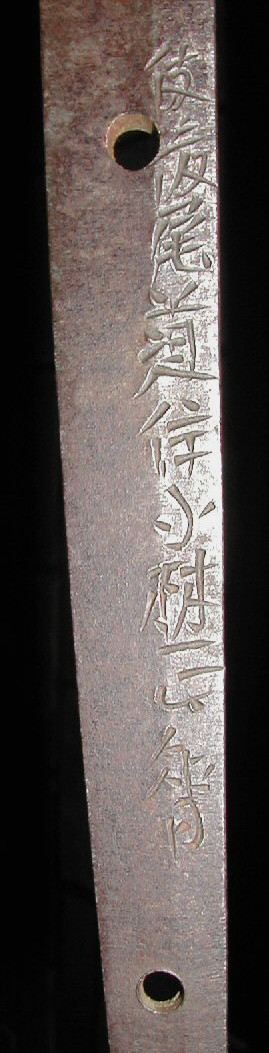
Hi guys, This line of Kanji: 青山幸勧佩刀 I read as "Aoyama Koukan haitou" or in English, Aoyama Koukan wore this sword. Am I correct, and whether Koukan or another name, do any of you know who this refers to? The applicable date would be around 1860. Thanks, Grey
-
I think it says, "Made yesterday in China." Grey
-
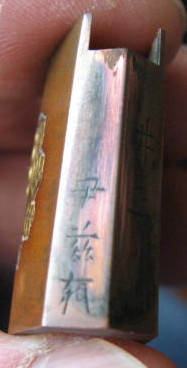
Hi again, Thanks for the help so far; there's more. There is a signature on the mune of the habaki. The right side says "Inouye"; can't read the other. Also, the other side is inlaid with what looks like a variant of a Kiku-mon. If one of you could read the left I'd be most grateful, and any thoughts on the mon would help. Thanks again, Grey


-
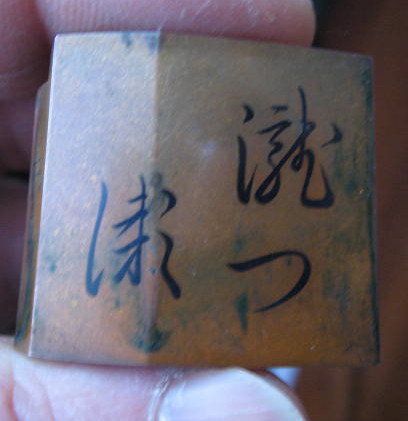
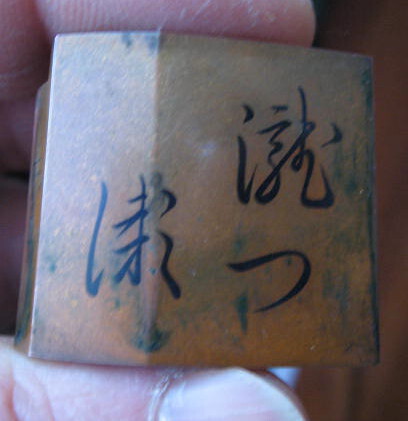
Hi guys, Can any of you make sense of this grass script on my habaki? Thanks, Grey
-
I think it reads, "Sa", as in O-Sa (Great Sa), a very important swordsmith. Gimei (forged signature) is always a possibility with such an important mei. Grey
-
Translation Help + Skip Method of Translation
Grey Doffin replied to mattr's topic in Translation Assistance
Hi Matt, Ditto on skip method; never heard of it. I have 2 dictionaries that I use all the time: Japanese Names and How to Read Them by Koop & Inada, and The New Nelson Japanese English Character Dictionary by Haig. Both rely on radical recognition and stroke count. I think my set of Kanji Flashcards makes great good sense also. The Kanji have been selected to be relevant to sword signatures; worked well for me. Grey -
any assistance would be appreciated
Grey Doffin replied to YukouYukimura's topic in Translation Assistance
I agree. Grey -
NCO shin gunto question - tsuka wood
Grey Doffin replied to grapppa's topic in Military Swords of Japan
This started as one piece of wood that was cut down the middle. The recesses for the nakago were cut and the 2 pieces were glued back together. To carve the nakago recess in a single block of wood would be nearly impossible. Grey -
I think the kissaki might be partially hidden behind the foam of the gun case. Grey
-
Trying to view the mei on my authentic sword? Help?
Grey Doffin replied to acasubtime's topic in Nihonto
Jesse, Many swords are signed Bishu Osafune Sukesada; gobs of them were turned out in late Koto, 16th century mostly. There were a number of good smiths who signed Sukesada, usually with something else (a personal name, for example) to distinguish them from the rest. Most all blades with just Sukesada are school work, made in quantity at a time of great warfare (thus great need for weapons) in Japan's history. The marks on the tsuba aren't important. It is a cast brass tsuba from WWII, very standard, and the marks are some sort of indexing system. The dried blood looks a lot like cosmoline or plain old corrosion. It is very unlikely that anyone planning to keep a sword would allow blood to stay unwiped on the blade. Grey -
Trying to view the mei on my authentic sword? Help?
Grey Doffin replied to acasubtime's topic in Nihonto
Raking light is light at a shallow angle to the nakago, shining across the Kanji and possibly making them more visible. Try different lighting schemes. Grey -
Trying to view the mei on my authentic sword? Help?
Grey Doffin replied to acasubtime's topic in Nihonto
Talc or chalk dust might help the Kanji show better but hold off on any other cleaning attempts. The patina of the nakago is important and shouldn't be messed with except by someone who knows what he's up to (properly trained polisher, for example). Take some pictures, with and without the talc, with a raking light, and post the best here. Good chance someone will be able to help. Grey -
I guess that makes more sense than anything I can come up with. Looks like a Shin-shinto nakago so the smith fits. Thank you again. Grey
-
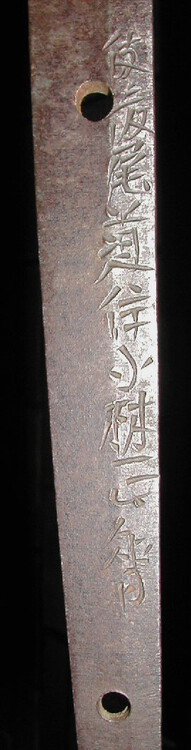
Hi guys, I've been contacted by someone out there asking for a translation of the mei below. I don't know this person and I also don't know if the sword will be for sale. I offered help and I'm stumped. I can make out Ju and Masa but not much else. Thanks in advance. Grey
-
Why would a modern tsuba be any less valid than a modern Nihonto? Are neither of them valid? Grey
-
ebay sword, placing of hi
Grey Doffin replied to Tokaido's topic in Auctions and Online Sales or Sellers
Also, I have seen Chinese made Japanese swords (fakes) on ebay with similar early ending hi. Grey -
ebay sword, placing of hi
Grey Doffin replied to Tokaido's topic in Auctions and Online Sales or Sellers
Andreas, Looks fishy to me; that isn't how hi are supposed to end. Terrible polish also. Wonder what the nakago looks like. Not sure this is real Nihonto. Grey -
Hi Simon, If you already own the kodogu and blade this might make sense financially. If, however, you plan to buy the parts and pay to have them assembled, you would do much better to look for a sword with koshirae that you like. It will cost much less than what you plan. Grey